
Business interruption (BI) insurance for anaerobic digestion (AD) plants protects against lost revenue and fixed costs resulting from operational downtime caused by incidents like fire, machinery breakdown, or grid failure. It is crucial for covering revenue gaps during repairs, with indemnity periods typically structured around income loss.
Protecting your consistent revenue stream is the primary goal of any successful bioenergy production facility.
Today, UK AD businesses operate over 750 anaerobic digestion facilities. This impressive footprint makes the nation the third-largest biogas producer globally. 2
These statistics highlight your critical role in sustainable waste management. They also reveal the massive financial stakes of operational downtime.
A single mechanical and electrical breakdown drains your cash reserves instantly.
Business interruption insurance acts as a safety net against these severe losses. This insurance coverage replaces your lost revenue and pays your essential fixed costs when your plant sits idle. 1
We will show you exactly how to structure this protection. This guide breaks down the critical calculations, giving you the confidence to secure uninterrupted financial security.
Key Takeaways
- Business interruption insurance protects your facility by covering lost revenue and fixed costs during operational shutdowns.
- You must choose between two primary calculation bases. The Gross Revenue Basis covers total revenue lost without deducting saved costs, while the Gross Profit Basis subtracts variable expenses to determine your actual profit loss.
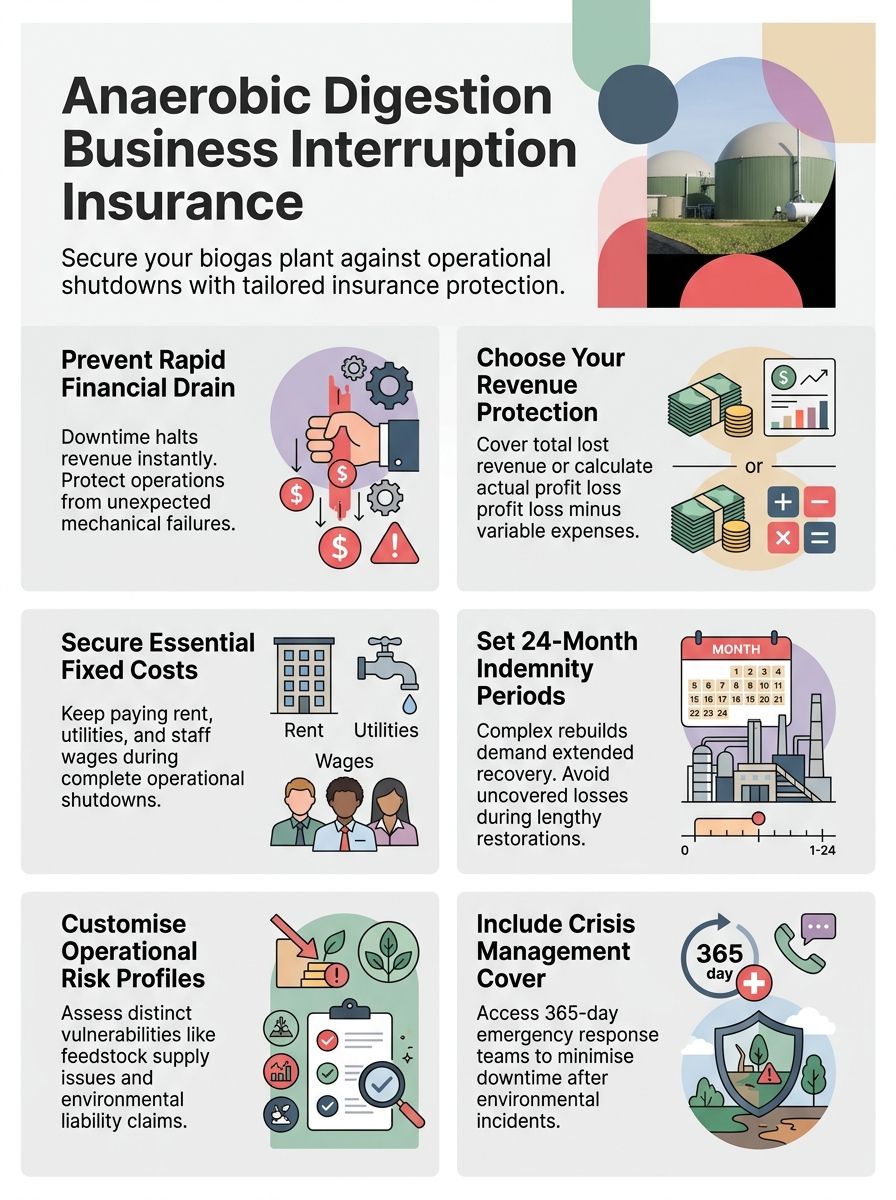
- Fixed costs covered by this insurance include rental payments, utility expenses, employee salaries, and internal recharges. A standard plant with £50,000 in monthly fixed costs commonly receives £1,200,000 in total coverage across a 24-month indemnity period.
- Industry experts recommend a minimum indemnity period of 24 months. Equipment restoration, Health and Safety Executive investigations, and feedstock supply chain coordination require substantially longer recovery times than most operators expect.
- Customised policies address precise environmental risks and mechanical vulnerabilities. Specialists offer comprehensive packages that cover material damage, crisis management costs, and environmental liability to protect your waste-to-energy revenue.

Key Coverage Areas for Business Interruption Insurance in Anaerobic Digestion Plants
Business interruption insurance provides the exact financial replacement your anaerobic digestion plant needs during an unexpected closure.
When a crucial component fails, your income from energy generation stops immediately. This policy steps in to replace that missing revenue and keep your operations solvent.
How does business interruption insurance cover loss of revenue during downtime?
Anaerobic digestion plants receive financial compensation that matches their standard income streams when operations halt. Your insurer calculates this payment based on your chosen coverage model.
In 2026, the stakes for maintaining continuous operation are higher than ever. In March 2025, new recycling regulations in England mandated separate food waste collections for most commercial businesses. This legislation creates a massive, continuous feedstock supply for food waste processing facilities, but should plant downtime occur, the effect of the loss of income becomes ever greater.
If your digester fails, you cannot halt these incoming daily deliveries. You lose your immediate energy generation revenue, and many will face severe supply chain penalties.
Choice of the Basis of Business Interruption Insurance in Anaerobic Digestion Plants
You must choose between two primary calculation models: the Gross Revenue Basis and the Gross Profit Basis.
| Coverage Basis | How It Works | Example Calculation (24 Months) |
|---|---|---|
| Gross Revenue Basis | Covers total revenue without deducting any saved variable costs. | £200,000 monthly gross revenue equals a £4,800,000 total payout. |
| Gross Profit Basis | Subtracts variable expenses from gross revenue to find actual profit. | £80,000 monthly gross profit equals a £1,920,000 total payout. |
The Gross Revenue approach ensures you receive full compensation for lost income. You secure this payment regardless of any operational expenses you avoid during the downtime.
The Gross Profit method requires highly precise accounting. Underestimating your indemnity period leaves your plant exposed to massive uncovered losses.
Insurance specialists advise working with technical providers who assess AD plant income and costs. They ensure your calculation excludes central overheads and accurately reflects your daily operational structure.
What fixed costs and essential expenses are covered by this insurance?
Business interruption insurance in anaerobic digestion facilities pays the mandatory operational bills, including rent, employee wages, and utility costs, even when production ceases completely. 1
These fixed expenses form the absolute backbone of your financial survival during an extended outage.
| Fixed Cost Category | Business interruption insurance Coverage Details | Key Point for Biogas Operations |
|---|---|---|
| Rental and Facility Costs | Rent payments for plant premises and leased equipment remain covered throughout interruption periods | Your site continues to incur these expenses regardless of whether digesters are processing feedstock |
| Utility Expenses | Electricity, water, and gas consumption necessary for maintaining plant infrastructure | Essential services must keep running to preserve equipment integrity and operational readiness |
| Employee Salaries and Wages | Staff compensation continues under Fixed Cost Basis coverage during operational shutdowns | Skilled technicians remain on payroll to ensure swift restart capabilities when production resumes |
| Annual Purchases Net of Discounts | Calculated for many plants at circa. £400,000 annually, covering material procurement obligations excluding rebates | Supply chain commitments may persist even when your digesters cease processing organic matter |
| Bad Debt Provisions | An amount is allocated annually for potential customer payment defaults | Your plant maintains financial reserves for credit losses during operational disruptions |
| Internal Recharges | An amount is allocated yearly for inter-departmental cost allocations and service transfers | Administrative support functions continue billing operational units throughout interruptions |
| Monthly Fixed Cost Total | An amount is allocated per month that represents your combined essential expenses requiring continuous payment | This figure excludes variable costs and reflects only unavoidable operational commitments |
| 24-Month Indemnity Period Protection | Total coverage is provided across two years of potential interruption. Say (£50,000 x 24 months) | Extended protection ensures your plant survives prolonged outages without cash flow collapse |
| What Gets Excluded | Lost revenue and profit margins remain uncovered under Fixed Cost Basis arrangements | This insurance protects survival costs only, not income generation during downtime |
| Cost Classification Requirements | Fixed expenses must exclude central overheads to ensure accurate insurance payout calculations | Proper categorisation of costs directly impacts claim settlement amounts and timing |
A Fixed Cost Basis policy ensures that essential expenditures continue flowing out of your accounts.
Monthly obligations are paid. These can include rent, utilities, and staff compensation that your business simply cannot postpone. Over a 24-month indemnity period, this protection usually extends to over £1,000,000 in cumulative coverage for an average-sized AD plant.
Purchases net of discounts contribute a large sum annually to this fixed cost calculation. Internal recharges add another substantial sum annually to the total potential payout figure.
Insurance specialists report that the most frequent error during underwriting is failing to separate central administrative overheads from direct plant fixed costs. This mistake drastically distorts your EBITDA calculations and reduces final claim payouts.
Correctly classifying costs as fixed becomes vital for accurate claim payouts. This specific coverage mechanism focuses entirely on operational survival rather than profit recovery.
Why is choosing the correct indemnity period important?
Selecting the correct indemnity period guarantees your facility has enough financial runway to fully rebuild and regain maximum production capacity. 1
Renewable energy brokers strongly recommend a minimum indemnity period of 24 months for UK biogas facilities. This extended timeframe reflects the true reality of modern industrial restoration.
Replacing a damaged combined heat and power plant engine often takes up to 12 months due to global supply chain delays.
Allowances for a severe incident
You must also account for mandatory regulatory interventions following a severe incident.
- Regulatory Clearances: Mandatory investigations by the Health and Safety Executive halt your immediate rebuilding efforts.
- Component Lead Times: Sourcing specialised biogas extraction systems takes many months.
- Supply Contracts: Re-establishing a reliable feedstock supply chain requires extensive renegotiation.
- Biological Restart: Seeding a new anaerobic digester to achieve optimal methane production is a slow, methodical process.
Overestimating the indemnity period inflates your AD business interruption insurance premiums unnecessarily. However, accurate alignment ensures your anaerobic digestion operation survives major interruptions without bankruptcy.
Consulting with underwriters at firms like Konsileo helps secure a precise timeframe. These experts match your coverage duration to your specific plant size and mechanical complexity.

How can insurance policies be customised to risks in anaerobic digestion operations?
Personalising your coverage requires a comprehensive risk assessment that identifies your exact mechanical and chemical vulnerabilities. 1
Specialists examine everything from your methane extraction processes to your biological holding tanks/slurry or digestate stores. Pre-quote surveys highlight hidden hazards before your coverage officially activates.
Environmental Impairment Liability
Environmental Impairment Liability stands as a crucial addition to any standard policy. This specific clause protects you against third-party claims regarding biodiversity damage or severe odour complaints from nearby residents.
Standard commercial property insurance will not cover the massive regulatory fines associated with a biological digestate spill. You must secure dedicated environmental liability protection.
Your policy requires specific endorsements for the renewable and alternative energy sector. This includes vital protection against cyber-attacks targeting your automated control systems. 2
Mechanical breakdown and crisis management cover
Securing dedicated coverage for mechanical breakdown prevents a single jammed rotor from destroying your profitability. Operators with broader agricultural ties often utilise farm combined insurance or rural business motor insurance to cover their entire estate.
Firms like Konsileo, Pen Underwriting or The Lycetts Group offer continuous crisis management coverage. These packages provide emergency environmental response teams to handle severe leaks immediately.
Proper classification ensures your fixed costs receive accurate coverage limits based on real data. This proactive risk management approach keeps your biogas and solar insurance fully optimised.

Conclusion
Securing the exact insurance coverage that your anaerobic digestion plant needs requires precise planning and accurate operational data.
Business interruption insurance acts as your ultimate financial safety net. It covers your lost revenue and fixed costs when machinery fails unexpectedly.
Adopting a 24-month indemnity period provides the necessary time for extensive repairs and strict Environment Agency approvals.
Collaborating with renewable energy experts ensures your biogas operation survives major disasters. Finalise your policy today, and you protect your facility's future profitability.

FAQs
1. What is business interruption insurance for anaerobic digestion plants?
Business interruption insurance replaces lost income and covers fixed costs if operations stop due to material damage or insured risks. Because of complex repair timelines for specialised equipment, experts at Konsileo recommend a minimum 24-month indemnity period on a gross profit basis to properly mitigate insurance risks. This specific insurance coverage ensures continuous cash flow for anaerobic digestion and biogas plants during extended downtime.
2. Which types of renewable energy facilities can benefit from this insurance?
Facilities such as renewable energy producers, photovoltaic solar farms, biomass generators, wind turbines, hydroelectric plants, energy from waste plants, and combined heat & power plants can all benefit from comprehensive biomass insurance, biogas insurance, and biofuels insurance policies offered by providers like Konsileo, Pen Underwriting and Marsh McLennan.
3. What specific risks does this insurance address for rural biogas businesses?
These rural biogas insurance policies tackle physical threats requiring hailstorm insurance, alongside complex liabilities including employers' liability, public and product liability, and health & safety breaches. They also cover financial vulnerabilities through emerging risks insurance, providing crisis management costs and protection against delays in project start-up. Coverage frequently bundles farm combined insurance, farm motor insurance, rural business motor insurance, motor breakdown insurance, and motor legal expenses insurance to shield agricultural or estate vehicle fleets.
4. How do insurers determine the right level of coverage for an anaerobic digestion facility?
Insurers assess operational specifics like plant size, integration with renewable & alternative energy sources like solar panels or a biomass boiler, and compliance with British government regulations regarding net zero emissions. As Carl Gurney highlighted at the World Biogas Expo 2022, underwriters also closely evaluate a facility's safety protocols and whether it produces bioethanol or biodiesel. This evaluation helps determine accurate pricing for specialised facilities, including rural anaerobic digestion production facilities, photovoltaic solar facilities and other distinct renewables projects.
5. Are there additional protections available beyond standard business interruption cover?
Yes, operators can add livestock insurance for animals linked to waste management cycles and bloodstock insurance to protect equine assets involved in circular fuel systems. Brokers like David McDonald at the award-winning Konsileo Group design client cover plans with an SME package that may combine these property covers with comprehensive life assurance and other protection policies.
6. Why should companies consult AD insurance specialists when arranging anaerobic digestion insurance?
The UK is the third largest producer of biogas globally, according to IEA Bioenergy, meaning UK-based companies manage over 750 plants, each requiring highly specialised anaerobic digestion insurance to manage unique operational hazards. Consulting experts like David McDonald, Joe McGorman, Adam Shefras, or Sarah Breslin ensures your policy complies with strict UK Financial Conduct Authority (FCA) regulations while providing comprehensive risk analysis. This precise guidance aligns sustainable waste management operations with real-world needs, ensuring continuous production and environmental safety.
If, after reading this article, you want to read more about anaerobic digestion facility insurance, click here.