Anaerobic Digestion (AD) insurance provides specialised cover designed to protect against the unique risks of converting organic waste into energy, fertiliser, etc., including operational breakdowns, environmental hazards, and business interruption. Due to the complex nature of these facilities, comprehensive insurance packages often combine property damage, liability, and specialised engineering cover.
Key Takeaways: Anaerobic Digestion Insurance
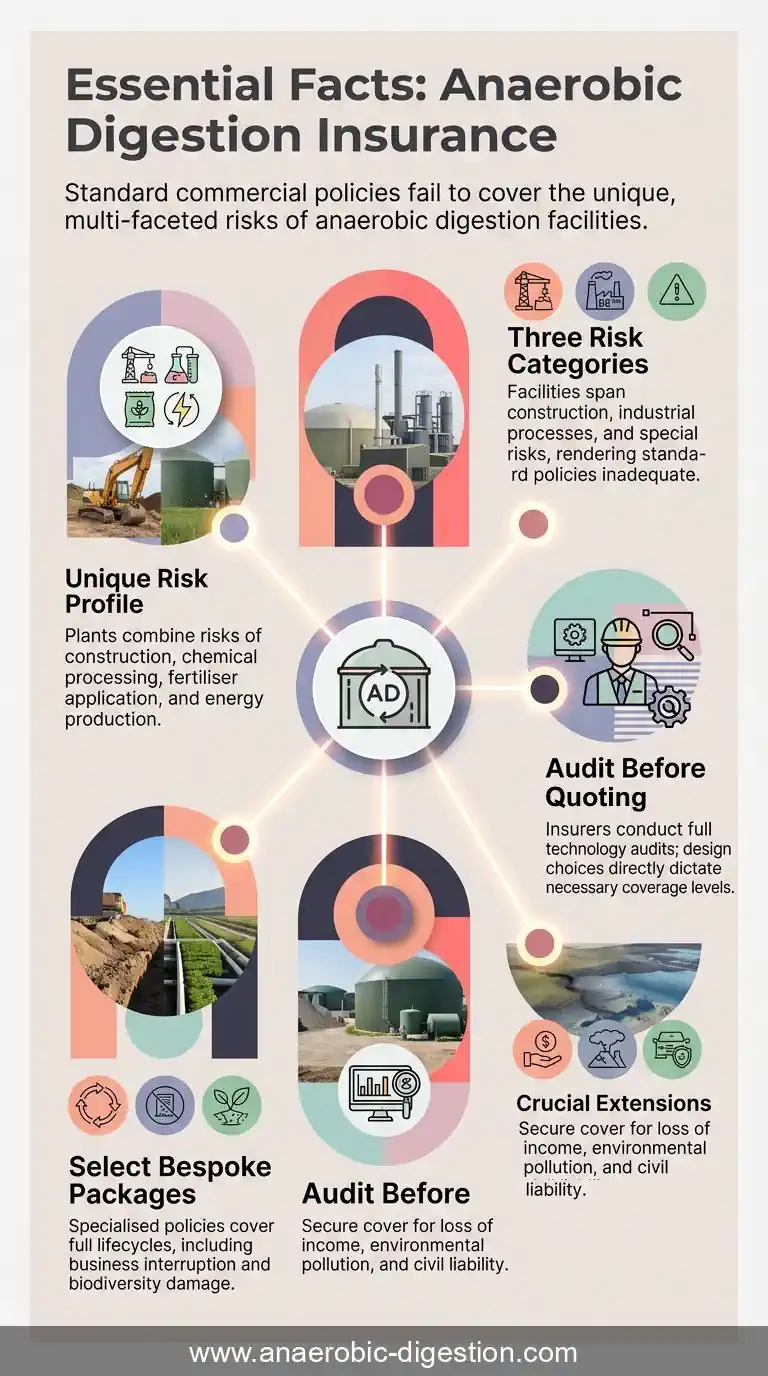
- Anaerobic digestion facilities span three distinct insurance categories — construction, industrial process, and special risks — making off-the-shelf policies structurally inadequate for proper coverage.
- Your design choices during the planning phase directly determine what coverage you need, which is why insurers conduct a full technology audit before binding any policy.
- Loss of income cover, environmental pollution liability, and civil liability for electricity producers are three critical extensions that many AD operators discover too late that they are missing.
- Specialist insurers offer bespoke AD and biogas packages that cover everything from construction through the operational phase, including business interruption and biodiversity damage claims.
- There is a minimum project value threshold for specialist cover — keep reading to find out if your facility qualifies and what that means for your policy structure.
Getting insurance wrong on an anaerobic digestion facility does not just leave gaps in your policy — it can unravel an entire project's financial viability the moment something goes wrong.
Anaerobic digestion plants are unique in that they combine the risks of construction, chemical processing, and fertiliser application to land, with energy production.
This makes it impossible for a single standard commercial policy to cover all of these risks.
That's the main issue operators face, which is why it's absolutely necessary to have a custom anaerobic digestion insurance policy. If you need expert advice in this area, David McDonald of Konsileo offers specialised biogas and AD insurance that is tailored to the specific characteristics of each plant.
Anaerobic Digestion Insurance Is Not a One-Size-Fits-All Policy
Why This Is Important: An anaerobic digestion plant is a construction project, an industrial chemical processing facility, and a renewable energy generator all in one. Each of these categories has its own unique risk profile — and insurers view them differently. Attempting to cover all three under a single commercial policy is where most operators run into issues.
The financial risks throughout an AD project's lifespan are substantial. During construction, there's contractor liability, materials in transit, and structural risk. Once it's operational, the risks shift to equipment failure, gas leaks, network failure, and environmental pollution. These aren't just different versions of the same risk — they are fundamentally different risks that require different policy frameworks.
Regular industrial property insurance policies are not designed to cover anaerobic process breakdowns. For instance, the collapse of a biogas storage membrane could cause property damage, business interruption, and environmental liability claims all at once. A general policy might cover one of these, but it's unlikely to cover all three the way a policy specifically for anaerobic digestion would.
Why Standard Policies Don't Cut It for AD Facilities
Typical commercial property and liability policies tend to exclude or greatly reduce coverage for biological and chemical processes, gas storage, and energy generation. All three of these are done by an AD facility. Even policies that seem comprehensive enough on the surface often have exclusions for fermentation processes, methane storage, or cogeneration equipment — leaving operators with a significant amount of uninsured exposure that they may not find out about until a claim is rejected.
The Three Types of Insurance Every AD Project Needs
Every anaerobic digestion project requires three types of insurance that must work in harmony without overlap or gap. Construction insurance covers the construction phase, including structural work, equipment installation, and contractor liability. Industrial and chemical process insurance covers the operational heart of the plant, including the digesters, gas handling systems, and related mechanical and electrical components. Special risks insurance covers what the other two don't, such as network failure, loss of income, environmental damage, and crisis management costs. The primary challenge of insuring an AD facility correctly is ensuring all three types of insurance are properly aligned.
How Your Design Decisions Can Influence Your Insurance Requirements
The design choices you make when planning your AD project can have a significant and long-lasting effect on the kind of insurance you'll need. The type of feedstock you choose, whether it's agricultural waste, food processing leftovers, or organic municipal waste, can impact the stability of the digestion process and the related risk of contamination.
The type of storage technology you choose is also important. Open lagoon digestate storage and sealed tank systems have different environmental liability exposures. The type of fermentation your facility uses, whether it's wet or dry, the digestion temperatures, whether they're mesophilic or thermophilic, and whether your facility uses single-stage or two-stage processing can all affect how underwriters evaluate your risk and the premiums they set.
This is the reason why specialised insurance providers evaluate the technology stack before suggesting a policy structure. The insurer needs to comprehend what is being constructed and how it functions, not just the asset value, before the suitable coverage can be created.
Key Types of Insurance Coverage for Anaerobic Digestion Facilities
A well-constructed insurance plan for an AD facility consists of several unique types of coverage, each one addressing a different aspect of operational risk. Knowing what each type of coverage does — and what its limits are — is what distinguishes a well-insured facility from one that is precariously underinsured.
- All Risks Except physical damage cover — This coverage protects the digesters, process equipment, buildings, and civil engineering structures
- Loss of Income cover — This coverage responds to revenue loss caused by equipment failure, network outages, or restricted access
- Environmental Damage Liability — This coverage covers new and historical pollution events, biodiversity damage, and odour claims
- Civil Liability for electricity producers — This coverage addresses third-party claims arising from energy generation activities
- Business Interruption insurance — This coverage covers ongoing costs and lost revenue once the facility is operational
- Crisis management costs — This coverage funds the response to incidents, including leaks, outages, and public-facing environmental events
These coverage types do not function as standalone policies in a well-structured programme. They are interconnected, and the way they interact — particularly around trigger events like a gas leak that simultaneously causes property damage, revenue loss, and environmental contamination — determines whether your claims response is seamless or contentious.

Physical Damage Insurance for Anaerobic Digestion Systems
Most AD property insurance policies are based on the “All Risks Except” structure. This type of coverage includes damage to the components of the system, such as the digesters, mixers, gas filtration systems, and heat exchangers. It also covers the buildings that house these components and the civil engineering structures that support the facility.
The key to this type of coverage is that it covers everything that is not specifically excluded. This makes it more comprehensive than a named perils policy.
For an AD plant, where there are many ways things can go wrong and sometimes in ways that have never happened before, this type of coverage is much more protective.
The benefits of a biogas plant are many, but it's crucial to consider comprehensive insurance coverage at an early stage of any project.
Income Loss Protection, Including Network Failure and Access Problems
Anaerobic digestion businesses depend upon a steady income, and outages occur for many reasons and not necessarily due to any fault of the business.
Income loss protection for AD facilities is much more comprehensive than your typical business interruption coverage. It includes revenue loss due to grid network failure, even if the physical plant is not damaged.
It also covers situations where access to the facility is blocked by events outside of your control, like road closures or incidents at neighbouring sites.
This extension is crucial for AD operators because their income relies on the constant export of gas or electricity. A network outage that lasts two weeks and prevents export can lead to a substantial financial loss, even if the plant is in perfect working order. Without this specific extension, that loss is completely uninsured.

Liability for Environmental Harm and Pollution
For an AD facility, environmental liability spans two time frames, which most operators underestimate.
- Recent pollution events — such as digestate leaks, gas escapes, and process failures that cause instant contamination
- Past pollution liability — contamination that existed on or near the site before the current operator took over, but for which they may still be legally liable
- Biodiversity damage claims — damage to protected species, habitats, or ecosystems caused by the operation of the facility
- Odour nuisance claims — especially relevant for facilities located near residential areas, where complaints about smells can escalate into formal legal proceedings
Pollution liability for AD facilities is typically written on a claims-made and reported basis. This means that it is the policy in force at the time the claim is reported — not when the pollution event took place — that responds. This has significant implications for maintaining continuity of coverage and for operators who switch insurers during the life of a facility.
Insurance coverage for environmental liability should also comply with the UK Environmental Damage Regulations. These regulations require remediation that goes beyond basic clean-up costs and can include restoring natural resources to their original condition. This could be a significant financial risk if a digestate spill occurs near a watercourse.
Legal Responsibility for Electricity Generators
AD facilities that generate and export electricity are subject to certain legal responsibilities that are not adequately covered by standard public liability policies.
Legal responsibility coverage for electricity generators addresses third-party bodily injury or property damage claims that result directly from electricity generation and export activities.
This includes issues related to grid interference, power quality, and metering disputes. For more information on biogas generation, explore the biogas generator details.
Any AD facility operating a combined heat and power (CHP) unit or exporting to the grid must have this coverage layer. Without it, the gap between your public liability policy and your actual legal exposure as an electricity producer can be quite large.

Don't Ignore Construction Phase Coverage
An anaerobic digestion project's construction phase carries risks that are different from operational exposures, but they can also financially derail a project.
A structural failure during installation, a fire during commissioning, or damage to specialist equipment in transit can each cause losses of hundreds of thousands of pounds before a single cubic metre of biogas has been produced. To minimise such risks, it's crucial to stop grit and plastics before they reach the biogas plant.
Insurance for AD projects during construction must be tailored to the complexity of the construction. Standard all-risk contractor policies may not provide sufficient coverage for the specialised process equipment, the unique civil engineering structures of AD facilities, or the longer commissioning periods often required by biogas plants.
Comprehensive Insurance During Construction
While constructing an AD facility, you should have contractors' all-risks insurance that covers all aspects of the physical build. This includes groundwork, constructing the digester tank, installing pipework, handling gas systems, and fitting out the CHP or gas upgrading equipment both mechanically and electrically.
Since AD construction is specialised, the policy should specifically cover the infrastructure for the biological process, not just the civil and structural elements that a regular construction policy would usually cover.
For more information on specialised insurance policies, you can call David McDonald of Konsileo .
Project Start-Up Delay Coverage
Delay in start-up (DSU) insurance is one of the most significant financial aspects of AD construction coverage and is often overlooked. If an AD plant is delayed by three months due to a covered construction loss, it doesn't just incur repair costs. It also loses three months of feed-in tariff revenue, Renewable Heat Incentive payments, gate fees, and electricity export income. DSU coverage fills this revenue gap, safeguarding the project's financial model during the delay caused by an insured event.
For projects that require project financing or have investor obligations, DSU insurance is often a requirement from the lender. Even when it is not required, the potential loss of revenue from a delay in construction is so significant that operating without it represents a serious uninsured financial risk.
Liability for Material Transportation During Construction
Specialised AD equipment like digester membranes, gas filtration units, CHP engines, and heat exchangers can be costly, often custom-made, and sometimes impossible to replace quickly.
Transit insurance for these components during delivery to the site needs to be specifically arranged because standard marine cargo or haulage policies often exclude or underinsure high-value process equipment. The lead times for replacement parts can be several months long, which means a transit loss could be more damaging than just the replacement cost.
The transportation liability component should also include loading and unloading operations at the installation site. This is because there is a real and common risk of damage to specialist components during the construction phase of larger AD projects.
Insurance Coverage for Operational Phase Risks
As soon as the construction of an AD facility is completed and it starts operating, the risks involved change drastically. The risks of a single catastrophic event during the construction phase are replaced by a more complicated mix of process failures, environmental incidents, interruptions in revenue, and exposures to third-party liabilities. Many of these risks can occur at the same time and can compound each other's financial impact.
Insurance for an operational AD plant must be designed considering the interconnected risk profile. For instance, a single overflow event of digestate can cause a property damage claim, a business interruption loss, an obligation for environmental remediation, and a third-party liability claim from a neighbouring landowner all at once.
What Happens if Your Facility Goes Live and Then Business Gets Interrupted?
Business interruption insurance for an operational AD facility needs to cover the full range of potential revenue for a modern biogas plant. This includes the money you’d make from exporting electricity, the income you’d get from Renewable Gas Guarantee of Origin (RGGO) if you produce biomethane, the fees you’d get from waste inputs, the money you’d make from digestate sales, and any payments you’d get from renewable energy incentives tied to operational output. A standard business interruption policy based on gross profit alone might not cover the full amount of money you could lose if a diversified AD business gets interrupted.
The indemnity period — the length of time the BI policy will pay out following a covered loss — is especially crucial for AD facilities. Major process equipment failures, such as a CHP engine requiring a full overhaul or a primary digester requiring decommissioning and relining, can take six to twelve months to fully remediate. An indemnity period of less than 18 to 24 months leaves a dangerous gap at the tail end of a prolonged outage.
Emergency Response Costs for Shutdowns, Leaks, and Odour Claims
Emergency response coverage pays for immediate response costs when an incident occurs — such as environmental consultants, public relations support, regulatory liaison, and emergency containment measures.
For an AD plant, where a gas leak or digestate spill can quickly attract regulatory scrutiny and community concern, the ability to respond quickly and professionally isn’t just about reputation. It can directly impact the results of subsequent regulatory investigations and liability claims. Learn more about anaerobic digestion insurance options.

Claims for Damage to Biodiversity and Exposure to Pollution from the Past
Claims for damage to biodiversity are becoming a bigger and more important liability for operators of anaerobic digestion. The Environmental Damage Regulations stipulate that a pollution event that harms protected species, habitats, or bodies of water can lead to remediation obligations that go much further than just cleaning up the immediate area.
The cost of returning a wetland habitat or watercourse to its original ecological state is a financial commitment with no set limit, and it can far exceed the cost of the original incident. To mitigate such risks, operators should consider measures to stop grit and plastics before they enter the biogas plant.
History of pollution exposure adds another level of complexity, especially for facilities that are built on or near sites that have been previously used for industrial purposes.
An operator can be held liable for pre-existing contamination that is discovered or mobilised during the construction or operation of an AD plant — even if the contamination occurred before they owned or occupied the site.
Coverage Trigger Comparison — Operational Phase AD Risks
Risk Event Coverage Type Required Key Policy Feature Digester equipment failure All Risks Except property cover Includes process plant and civil structures Grid network outage (undamaged plant) Loss of Income — network failure extension Responds even with no physical damage to insured property Digestate spill to watercourse Environmental Damage Liability Covers remediation and biodiversity restoration Odour nuisance complaint escalation Environmental Liability — odour claims Covers legal defence and compensation costs Revenue loss during extended repair Business Interruption Indemnity period minimum 18–24 months recommended Public incident response costs Crisis Management Cover Funds consultants, PR, and regulatory liaison
The interaction between these coverage types during a major incident is where policy design becomes critical. A well-structured AD insurance programme ensures that each coverage layer responds in sequence — property damage first, then business interruption, then environmental liability — without gaps or disputes about which policy responds to which element of the loss.
Operators who patch together their coverage from separate, uncoordinated policies from multiple insurers often find these gaps only when a major claim is in progress — exactly the worst time to be negotiating coverage disputes between underwriters.
Who Requires Anaerobic Digestion Insurance?
The scope is wider than most people think. Anaerobic Digestion insurance isn't just for the owner or operator of the facility. It's for everyone and every organisation in the supply chain that designs, builds, finances, maintains, and provides services to an Anaerobic Digestion plant.
1. Project Developers and Investors
Project developers and financial investors in AD facilities are exposed to the highest financial risk throughout the project lifecycle. From development finance through construction to operational revenue, each phase carries risks that need to be specifically addressed. Lenders and equity investors usually require evidence of appropriate insurance as a condition of funding, and the scope of that insurance is increasingly scrutinised during due diligence. A poorly structured insurance programme can become a project finance obstacle at the worst possible stage.
2. Professional Designers and Installation Experts
Engineering companies, process designers, and specialised installers who work on AD projects each have their own unique professional liability risks. A design mistake that results in poor process performance, equipment failure, or environmental non-compliance can lead to claims that continue for years after the project is finished.
Professional indemnity insurance specifically designed for AD and biogas system design is critical — standard engineering PI policies may exclude or limit coverage for biological process design and renewable energy systems.
3. Component Manufacturers and Maintenance Providers
Component manufacturers and maintenance providers who work with AD facilities are subject to product and service liability risks that are directly related to how well the plant operates. A mistake in maintenance that leads to a CHP engine breaking down, or a defect in a component that causes a gas handling system to malfunction, can result in:
- the facility operator filing liability claims for property damage,
- business interruption losses, and
- subsequent financial losses.
Who Needs AD-Specific Insurance Coverage
Stakeholder Primary Coverage Need Key Risk Project Developer / Investor Construction, DSU, Operational All Risks, BI Financial loss across full project lifecycle Facility Operator All Risks Except, Environmental Liability, BI Process failure, pollution, revenue interruption Design Engineer / Consultant Professional Indemnity (AD-specific) Design error leading to process or environmental failure Installation Contractor Contractors' All Risks, Public Liability Construction defect or third-party injury during build Maintenance Provider Public Liability, Product Liability Maintenance error causing equipment failure or injury Component Manufacturer Product Liability, Professional Indemnity Component defect triggering downstream operational loss
Each of these stakeholders carries a distinct risk profile, and the insurance programmes of each party need to be coordinated — not just adequate on their own. A comprehensive AD project insurance review looks at the entire stakeholder chain to identify where liabilities could fall between policies or be disputed between parties in the event of a significant incident. For more information on potential risks, you can read about anaerobic digestion and pharmaceutical residues.
It's also important to remember that when one party's policy responds to a loss, the insurer may pursue subrogation rights against another party in the supply chain.
This means that even well-insured participants can find themselves on the receiving end of a claim from a co-participant's insurer. Coordinating waivers of subrogation between key project parties is an important and frequently overlooked element of AD project insurance structuring.

FAQs: Anaerobic Digestion (AD) Insurance
The responses below tackle the most frequent inquiries from AD operators, developers, and investors who are first-time seekers of specialised biogas and anaerobic digestion insurance.
Note: These answers are preliminary, and circumstances vary for each AD installation and the owner's business. Always seek professional advice from an expert, specialist broker or insurer.
What does an “All Risks Except” policy cover?
It covers all physical damage unless specifically excluded. For AD plants, this typically includes:
Assets: Digesters, gas handling, heat exchangers, control rooms, and civil works (lagoons/roads).
Incidents: Fire, explosion, impact, storm, flood, and mechanical/electrical breakdown.
Why it matters: AD systems are complex; “All Risks” is safer than “Named Perils” because it captures unforeseen biological or mechanical failures.
Key Exclusions: Usually limited to gradual wear, design defects, or specific biological process failures.
Is Business Interruption (BI) included in standard policies?
Usually, no. Business Interruption Insurance (BI) is typically an extension or separate layer. Standard “Gross Profit” BI often fails AD operators because it ignores diverse revenue streams like:
Gate fees and renewable incentives (RHI/RGGOs).
Digestate sales and biomethane certificates.
Recommendation: Use a specialist broker to ensure a 24-month indemnity period, as major digester repairs often exceed the standard 12-month limit.
BI Coverage Comparison
| Feature | Standard Policy | AD-Specific Recommendation |
| Revenue Basis | Gross profit only | Full stack (Gate fees, RHI, certificates) |
| Indemnity Period | 12 months | 18–24 months |
| Triggers | Damage only | Includes grid failure & access prevention |
| Costs | Limited recovery | High limits for specialist process restart |
Do I need a separate Environmental Liability policy?
Yes. General liability policies rarely cover the high-stakes risks of AD plants, such as:
Liquid digestate leaks or biogas releases.
Slow-developing soil/water contamination.
Odour nuisance claims and biodiversity harm.
Note: These are “claims-made” policies; maintain continuous coverage to avoid gaps for historical incidents.
When should I seek specialised AD insurance?
Specialist packages are essential for projects valued at £1 million or more. While smaller agricultural projects may find cover under general farm policies, commercial-scale plants require bespoke wording to address complex operational risks.
How does plant design impact my insurance?
Underwriters price risk based on your technology and feedstock.
High Risk: Open lagoons, high-pressure storage, or volatile feedstocks lead to higher premiums.
Strategy: Involve an insurer during the design phase. Minor engineering tweaks can significantly lower long-term premiums and prevent “uninsurable” scenarios before financial close.
Those who find this article interesting may like to find out about Business Interruption Insurance here.