Scotland is developing its green gas sector, aiming for net-zero by 2045 through anaerobic digestion (AD) for biogas and pioneering green hydrogen projects. Now is the moment to go faster and simultaneously help their struggling small farms.
Every five years, Scotland gets a new government. And every new government needs a plan. The six-week window before polling day — when parties are still writing promises and candidates are still listening — is when smart industry groups make their move. This is exactly what the Anaerobic Digestion and Bioresources Association (ADBA) is doing right now.
Their target? Scotland's farmers. Their weapon? A technology called anaerobic digestion (AD) — a process that turns farm waste like slurry and crop residues into green gas and natural fertiliser.
Their ask? A £50 million fund from whoever wins on 7 May to help over 100 Scottish farms install their own small-scale AD plants.
It sounds technical. It isn't, really. Farmers are squeezed by soaring energy bills and fertiliser costs that have spiked since the Ukraine war upended global gas markets. AD plants fix both problems at once: they generate on-site energy and produce a digestate that replaces expensive synthetic fertiliser. The farmer saves money. The grid gets green gas. The climate gets a break.
Scotland goes to the polls on 7 May. ADBA wants whoever wins to act immediately. Here's what they're proposing — and why it matters.
Key Takeaways
- The Scottish Parliament elections are on 7 May 2026. ADBA has timed this manifesto deliberately to influence the incoming government before its programme is set in stone.
- Anaerobic digestion (AD) turns farm waste into green gas and biofertiliser. Farms are ideal hosts — they already produce the organic material the process needs.
- ADBA is asking for a £50 million fund to help over 100 Scottish farms install modular AD systems, potentially saving each farm £100,000+ a year in energy and fertiliser costs.
- The environmental case is powerful: equivalent carbon savings to planting 250 million trees, and cutting a million short-haul return flights' worth of emissions through biofertiliser adoption alone if national recommended targets are met (Source: ADBA).
- The UK and Scotland are lagging seriously behind Europe in AD deployment, while Ireland — facing identical rural economy pressures — has begun a major catch-up drive under EU policy.
- Scotland's rural economy and emissions profile make this a near-perfect policy fit. Agriculture is both a large part of Scotland's GDP and a disproportionately large source of its carbon emissions.

ADBA Press Release:
13 March 2026
Green gas industry calls for £50m fund to support Scotland's farmers after May Elections
Why Biogas, Why Now?
The Anaerobic Digestion and Bioresources Association (ADBA) advocates that the next Scottish Government should embrace the full potential biogas offers to energy security, rural economies and Scotland's key farming and distilling sectors.
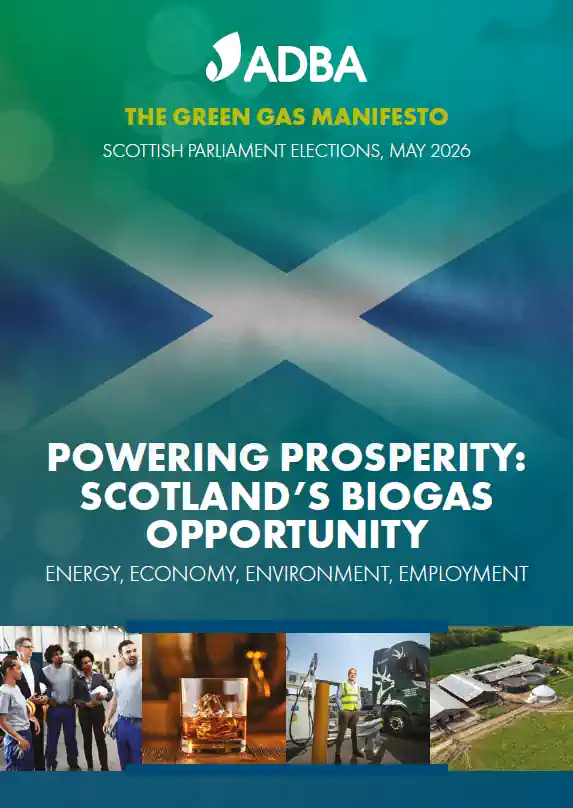
In a Green Gas Manifesto entitled ‘Powering Prosperity: Scotland's Biogas Opportunity' launched ahead of the Scottish Elections on 7 May, ADBA highlights how the biogas sector is uniquely positioned to provide dispatchable green energy, cut emissions from the hardest to decarbonise sectors, support rural and economic growth, and cement Scotland's place as a leader in biogas and green energy.
The £50 Million Fund Proposal
In the manifesto, ADBA is calling for the implementation of a £50 million fund to support farmers across Scotland to finance the installation of modular systems that will reduce their own heating and energy bills, and offer the opportunity to diversify their income.
This fund could see more than 100 farmers benefit from the circular system, saving the equivalent of more than half a million tonnes of CO2, and possibly £100,000 a year off their bills.
Environmental Benefits
The manifesto highlights the environmental benefits the sector can bring, including reducing food waste in landfill, and enabling Scottish farmers to replace synthetic fertilisers with the biofertilisers (digestate) generated through anaerobic digestion (AD) – the process used to produce biogas.
Collectively, these actions could save the equivalent of one million short-haul return flights' worth of carbon with the adoption of a “digestate first” fertiliser plan, and carbon removals similar to the planting of a quarter of a billion trees across Scotland.
Industry Voice
Chris Huhne, chair of ADBA, said:
“With volatile energy markets, fertiliser price shocks and accelerating climate impacts, ADBA is calling on the next Scottish Government to act immediately and establish green gas and biofertiliser as part of its net zero plan.”
“If the Government takes these actions, we could see over 25% of Scottish Gas supply being met by biomethane, and a 50% reduction in the use of synthetic fertiliser – producing massive carbon savings and keeping over £40m in the Scottish economy – thus ensuring energy resilience, supporting Scotland's world famous farming and distillery sector and meet the country's net zero ambitions.”
ADBA Press Release Ends
What Does an On-Farm AD Plant Actually Look Like?
For readers unfamiliar with the technology, it helps to picture what ADBA is actually proposing farmers install.
A modular on-farm anaerobic digestion plant is a relatively compact system — not the large industrial biogas facilities you might see on an industrial estate. The core components are:
- A sealed digester tank, typically the size of a large agricultural shed, into which organic material — slurry, manure, food waste, silage, crop residues — is fed continuously
- A biogas capture system that collects the methane-rich gas produced as bacteria break down the organic matter in the absence of oxygen (hence “anaerobic”)
- A combined heat and power (CHP) unit or gas upgrading equipment that converts the biogas either into electricity and heat for on-farm use, or into biomethane that can be injected into the gas grid
- , holding the nutrient-rich liquid and solid residue left after digestion, which is then applied to fields as a direct replacement for synthetic fertiliser
The whole system operates as a closed loop. Waste goes in one end; energy, heat and natural fertiliser come out the other. For a typical Scottish livestock farm generating significant volumes of slurry and manure, the economics can be compelling — especially when synthetic fertiliser prices remain elevated, and energy bills have not returned to pre-2022 levels.
The “modular” systems ADBA references in the manifesto are specifically designed to be right-sized for individual farms rather than requiring the scale of a large centralised plant, bringing the capital cost down to a level where a targeted government subsidy makes the investment viable for farms that would otherwise be unable to fund it.
The Bigger Picture: Britain Is Falling Behind Europe
Where the UK Stands
The United Kingdom has a functioning AD sector — around 750 operational AD plants as of recent counts — but the pace of development has stalled relative to the scale of the opportunity and, critically, relative to what comparable countries are achieving. Government support mechanisms have been inconsistent, planning processes remain slow, and there has been no coherent national strategy for biogas in the way that solar or offshore wind have attracted sustained policy attention.
Scotland has natural advantages — significant agricultural land, a large livestock sector generating abundant organic feedstocks, and a stated commitment to net zero by 2045, five years ahead of the rest of the UK. Yet the Scottish biogas sector remains a fraction of what the resource base could support.
Europe's Lead
Across the EU, anaerobic digestion has been driven forward by sustained subsidy frameworks, clear regulatory support for biomethane grid injection, and the REPowerEU strategy — launched after Russia's invasion of Ukraine — which set a target of producing 35 billion cubic metres of biomethane annually by 2030. Germany, Denmark, Italy and the Netherlands have all built large, mature AD sectors on the back of long-term, predictable support schemes. Germany alone operates over 9,000 biogas plants. The contrast with the UK's 650 is stark.
Ireland's Awakening
Perhaps the most instructive comparison for Scotland is the Republic of Ireland. For years, Ireland sat with the UK as a laggard in AD development — aware of the potential, but without the policy infrastructure to unlock it. That has now changed significantly.
Under pressure from EU climate policy and its own legally binding carbon budgets, Ireland has begun accelerating AD deployment with genuine urgency. The Irish government has introduced support tariffs for biomethane, streamlined planning for agricultural AD facilities, and set a target of 5.7 TWh of biomethane production by 2030. The National Biomethane Strategy, published in 2024, set out a clear roadmap and committed state support — the kind of joined-up approach that the ADBA manifesto is now asking Scotland to replicate.
Why is Ireland moving so fast? Because it has no choice. Agriculture accounts for around 37% of Ireland's total greenhouse gas emissions — by far the largest share of any EU member state — and the rural economy is central to Irish GDP, employment and cultural identity in a way that makes simply taxing or restricting farming politically and economically unacceptable.
Anaerobic digestion offers Ireland a way to decarbonise its agricultural sector without dismantling it: farms keep operating, but their waste becomes an energy asset rather than an emissions liability, and synthetic fertiliser imports — expensive, carbon-intensive, and a source of dangerous dependency — are progressively replaced by home-produced digestate.
<>The logic is overwhelming. Ireland's rural emissions are too large to ignore, its farming sector too important to punish, and AD too practical a solution to keep deferring. The result has been a genuine policy acceleration after years of delay.
Scotland's Parallel
Scotland's situation rhymes closely with Ireland's. Agriculture and land use represent a major and disproportionate share of Scotland's emissions — a persistent challenge in meeting the 2045 net zero target. Scotland's rural economy, from livestock farming to the globally renowned whisky distilling industry (which itself generates significant organic waste ideally suited to AD feedstocks), is both economically vital and emissions-intensive.
The difference is that Scotland is no longer inside the EU and therefore does not face the regulatory compulsion that is driving Ireland's hand. But that is an argument for the Scottish Government to show leadership, not an argument for inaction.
The ADBA manifesto is, at its core, asking Holyrood to do voluntarily what Brussels is compelling Dublin to do: build the support framework that allows farming communities to become energy producers rather than remaining purely energy consumers.
The £50 million fund proposed is not a large sum in the context of Scottish Government spending. Set against the long-term savings in energy imports, synthetic fertiliser costs, and carbon compliance, the return on investment — for farmers, for the rural economy, and for Scotland's net zero credibility — is substantial.

Conclusion
The timing of ADBA's manifesto is no accident. Six weeks before a Scottish election is precisely the moment when a well-argued, costed, and politically sympathetic policy proposal has the best chance of becoming a government commitment.
The case for on-farm anaerobic digestion in Scotland is not complicated:
- farmers need relief from energy and fertiliser costs,
- Scotland needs dispatchable green gas, and
- the climate needs agricultural emissions to fall.
AD addresses all three simultaneously.
Ireland, after years of delay, has accepted the logic and is now building the sector at pace. Germany built it decades ago. Scotland has the feedstocks, the rural economy, the net zero targets, and now — thanks to ADBA — a clear and affordable blueprint. What it needs next is a government willing to act on it.
Frequently Asked Questions
What is anaerobic digestion? It is a natural biological process in which microorganisms break down organic material — manure, food waste, crop residues — in a sealed, oxygen-free environment. The process produces biogas (mainly methane) which can be used for energy, and digestate, a nutrient-rich residue that acts as a natural fertiliser.
Why are farms particularly suitable for AD plants? Farms continuously generate the organic waste that AD requires — slurry, manure, silage, and crop residues. They also typically have the land and existing infrastructure to accommodate the equipment, and they have a direct use for both the energy output (reducing bills) and the digestate (replacing bought-in fertiliser).
What is the difference between biogas and biomethane? Biogas is the raw gas produced by AD, a mixture of methane and carbon dioxide. Biomethane is biogas that has been upgraded — the CO₂ removed — to the same quality as natural gas, allowing it to be injected directly into the national gas grid.
What is digestate, and why does it matter? Digestate is the material left over after AD has taken place. It retains the nutrients — nitrogen, phosphorus, potassium — from the original feedstock in a form that plants can readily absorb. Used as a field fertiliser, it directly replaces synthetic alternatives, reducing both farm costs and the carbon footprint associated with manufacturing synthetic fertilisers.
Why does it matter that the UK has left the EU? EU member states are subject to the REPowerEU biomethane targets and associated regulatory and subsidy frameworks that are compelling investment in AD across Europe. The UK, including Scotland, no longer faces those external obligations. ADBA's argument is that Scotland should adopt equivalent support policies by choice, because the domestic economic and environmental case is just as strong.
How much could a farm actually save? ADBA estimates that farms benefiting from the proposed fund could save upwards of £100,000 per year in combined energy and fertiliser costs, depending on the scale of the operation and feedstock availability.
What does the £50 million fund actually mean in practice? ADBA proposes that the fund be used to help farmers finance the capital cost of installing modular AD systems — the upfront hardware and construction cost being the main barrier to adoption. The fund is not an ongoing subsidy but an investment mechanism to get plants built; savings and revenues from energy and digestate then sustain operations commercially.
When are the Scottish Parliament elections? 7 May 2026.