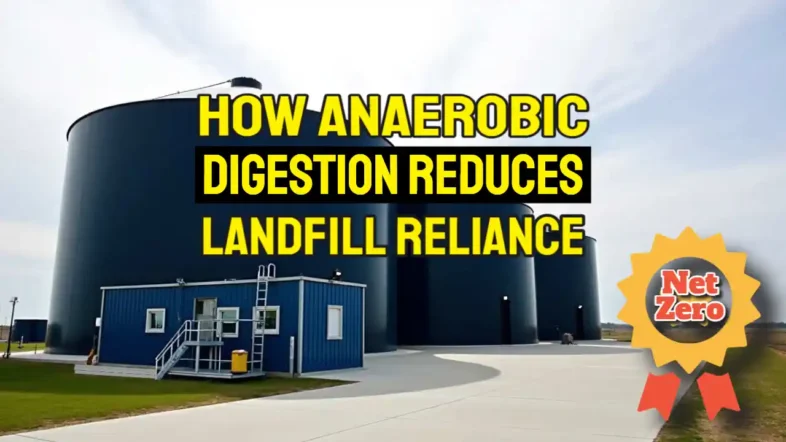
Anaerobic digestion (AD) is remarkable for its ability to reduce landfill reliance by diverting organic waste from landfills, where it would otherwise release methane, and transforming it into valuable products like renewable biogas and fertiliser.
Read on and find out how it gets even better, because this process significantly decreases the volume of waste sent to landfills, reduces harmful greenhouse gas emissions, creates a source of clean energy, and promotes a circular economy by turning waste into a resource.
Finding this hard to believe? If so, leave a comment and we will do our best to reply.
Introduction: The Hidden Cost of Landfilling Waste
Even in 2025, vast amounts of biodegradable waste still end up in landfills. Each tonne of food waste buried underground slowly decomposes, releasing methane — a greenhouse gas at least 28 times more potent than carbon dioxide. Beyond climate impacts, landfill leachate can pollute groundwater, and the valuable nutrients locked in organic materials are lost forever.
But there is a cleaner, circular alternative. Anaerobic digestion (AD) — the controlled breakdown of organic matter to produce renewable biogas and fertiliser — offers a way to end our reliance on landfill while creating useful products instead of pollution.
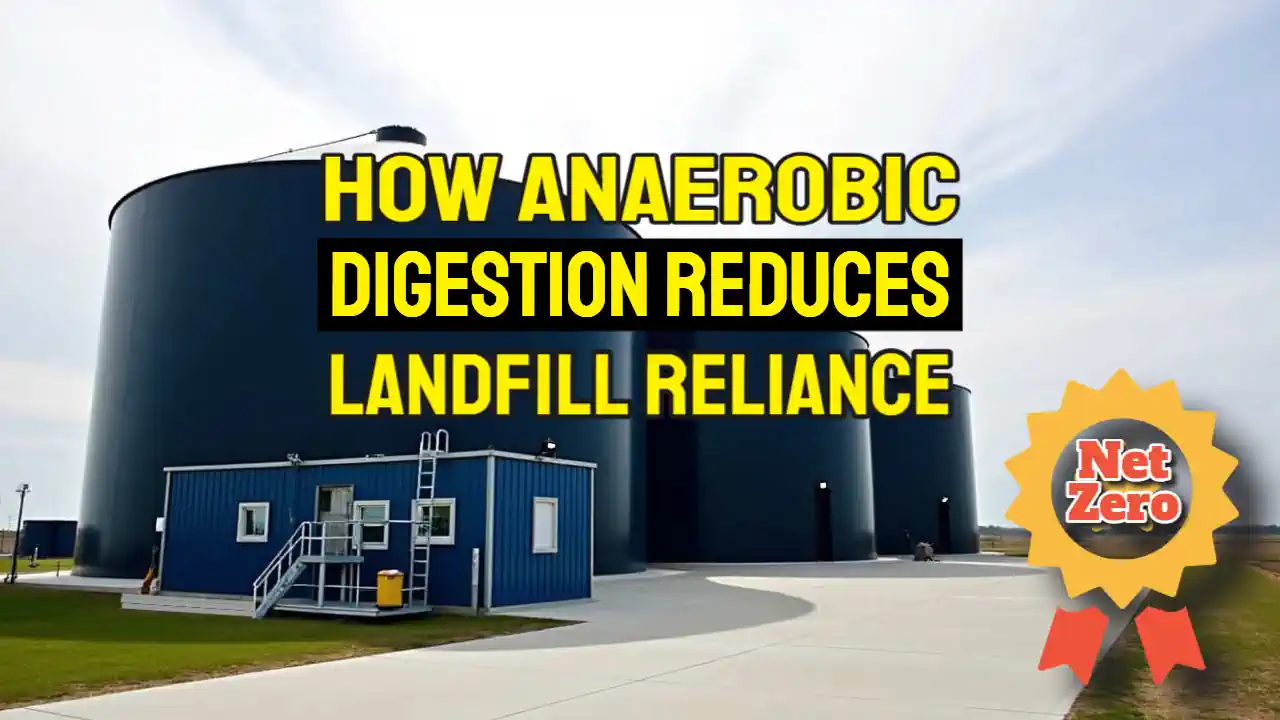
How Anaerobic Digestion Works to Reduce Landfill Waste
Anaerobic digestion is a biological process that takes place in sealed, oxygen-free tanks called digesters. Inside, naturally occurring microbes feed on organic waste — such as food scraps, crop residues, and farm manures — and convert it into two valuable outputs:
- Biogas, a methane-rich renewable energy source, and
- Digestate, a nutrient-rich material used as a soil improver.
By treating organic waste through AD, up to 95% of the material that would otherwise rot in landfill can be diverted. In cities with strong food waste collection systems, AD plants already reduce landfill dependency by tens of thousands of tonnes per year — saving both carbon and landfill space.
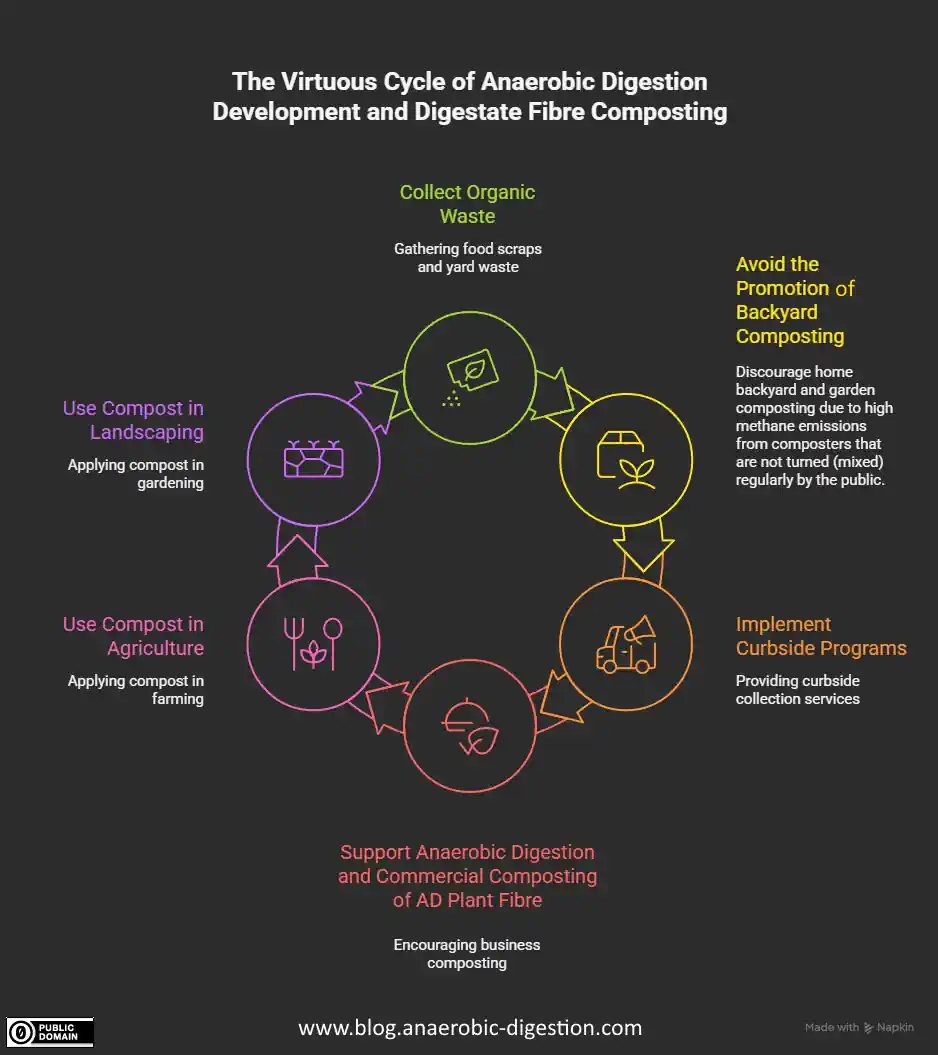
Why Diverting Organic Waste from Landfill Matters
Organic waste is the main driver of methane emissions from landfills. Unlike in a digester, where gas is captured and used, landfill methane seeps out slowly over decades, often escaping even from well-managed sites.
Diverting these materials to anaerobic digestion:
- Prevents methane leaks,
- Produces renewable biogas, and
- Recycles nutrients back to the soil through digestate.
This approach directly supports the Global Methane Pledge and complies with the EU Methane Regulation (2024/1787), both aiming to reduce global methane emissions by 30% before 2030.
Anaerobic Digestion vs. Incineration: Which Is Better?
Both anaerobic digestion and incineration appear in the waste management hierarchy as “recovery” options — ways to recover value rather than dispose of waste. However, the type of value recovered is fundamentally different.
| Aspect | Anaerobic Digestion | Incineration (Energy Recovery) |
|---|---|---|
| Feedstock | Organic, biodegradable materials | Mixed waste, including plastics |
| Main Output | Renewable biogas + fertilising digestate | Heat and electricity from burning waste |
| Circularity | Recycles carbon & nutrients | Destroys organic materials permanently – prevents valuable materials from being reused |
| Air Emissions | Minimal (controlled biogas combustion) – Odour prevention is simply a matter of proper AD plant design and responsible plant operation. | Significant, requiring strict pollution controls |
| Carbon Impact | Carbon-neutral or negative | CO₂ released from fossil-based fractions |
The Role of RDF and SRF
To fuel incineration plants, residual waste is often processed into Refuse-Derived Fuel (RDF) or Solid Recovered Fuel (SRF).
- RDF is made by shredding mixed municipal waste and removing recyclables and metals, leaving a combustible fraction.
- SRF is a higher-grade, more consistent product that meets tighter quality standards for energy content and ash.
However, while these can power cement kilns or waste-to-energy plants, they can never safely become cheap retail fuels for public use. Environmental regulations demand precise combustion control, continuous emissions monitoring, and high-temperature burn conditions to ensure complete destruction of harmful pollutants such as dioxins, heavy metals, and particulates.
For this reason, incineration — though classed as “energy recovery” — should be viewed as a last resort before landfill, not a substitute for circular biological treatment like anaerobic digestion.
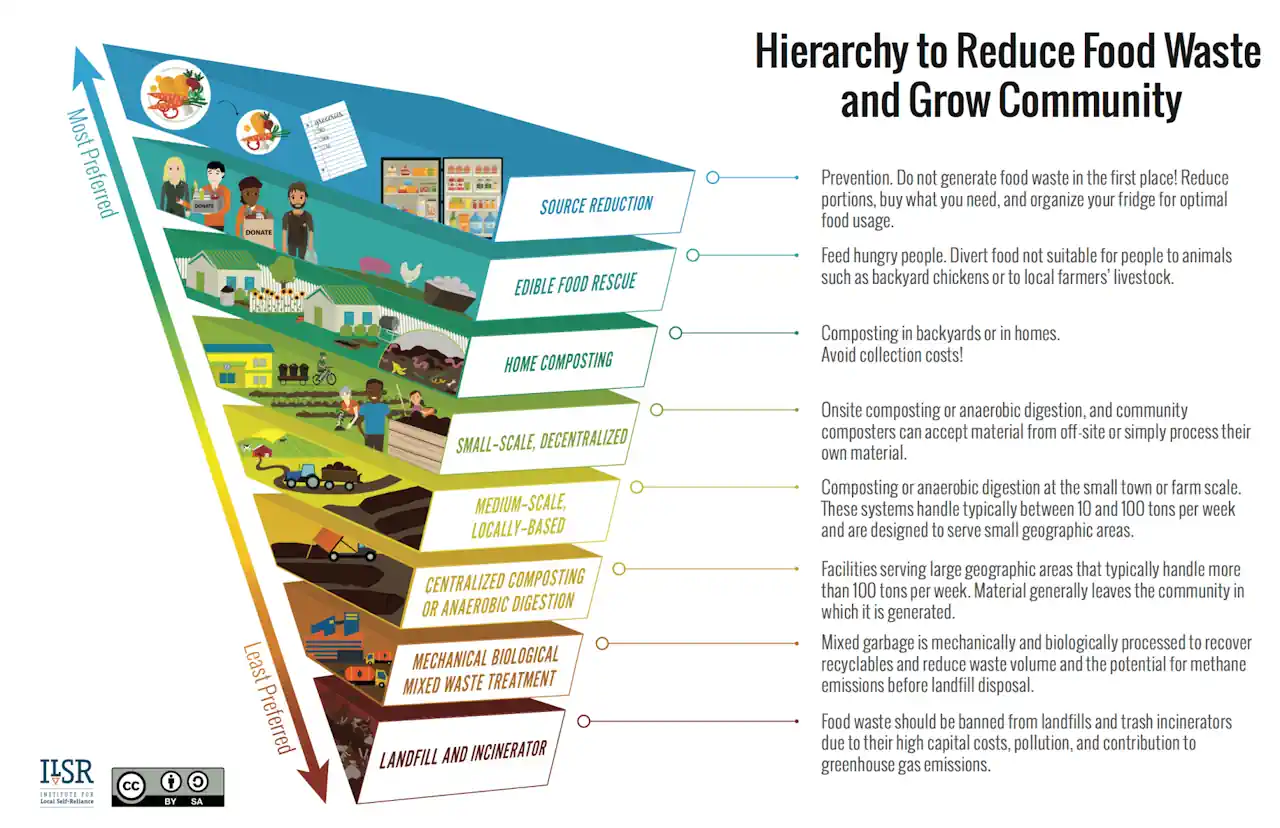
“Hierarchy to Reduce Food Waste …” from ilsr.org and used with no modifications.
Biogas and Digestate: Turning Waste into Energy and Fertility
Anaerobic digestion stands apart because it creates value instead of destroying it.
- Biogas can be used for:
- Electricity generation in CHP engines,
- Renewable heating, or
- Upgrading to biomethane for grid injection or vehicle fuel.
- Digestate (the leftover liquid and solid material) is a natural fertiliser that improves soil structure and reduces reliance on synthetic nitrogen fertilisers.
When produced to standards such as PAS110 in the UK, digestate may even be classed as a product rather than a waste, freeing it from waste regulatory controls. Together, these outputs form a closed carbon and nutrient loop, making AD one of the most sustainable waste-to-resource technologies available.
Case Studies: How AD Has Cut Landfill Dependence Worldwide
- United Kingdom – Local authorities such as Surrey and Lincolnshire are implementing plans to achieve “zero waste to landfill” for food waste by introducing separate collections and sending organics to AD.
- Denmark – Farm-based biogas plants digest manure and energy crops, injecting biomethane directly into the national gas grid.
- California (SB1383) – The state mandates diversion of organic waste from landfill to reduce methane emissions, driving rapid expansion of AD and composting infrastructure.
Each example proves that where policy, infrastructure, and markets align, AD can become the backbone of landfill reduction strategies.
When Incineration Still Plays a Role (and When It Shouldn’t)
Incineration can be a necessary component of an integrated waste system — dealing with non-recyclable, non-digestible materials like contaminated plastics or certain industrial residues. But it should not compete with AD for clean organic feedstocks.
Once organic matter is burnt, its nutrients are lost forever, and only a small fraction of its energy potential is recovered compared to the combined energy and fertiliser benefits from anaerobic digestion.
In a truly circular economy, incineration handles only the fraction that cannot be reused, recycled, or biologically treated — keeping landfill as the absolute last resort.
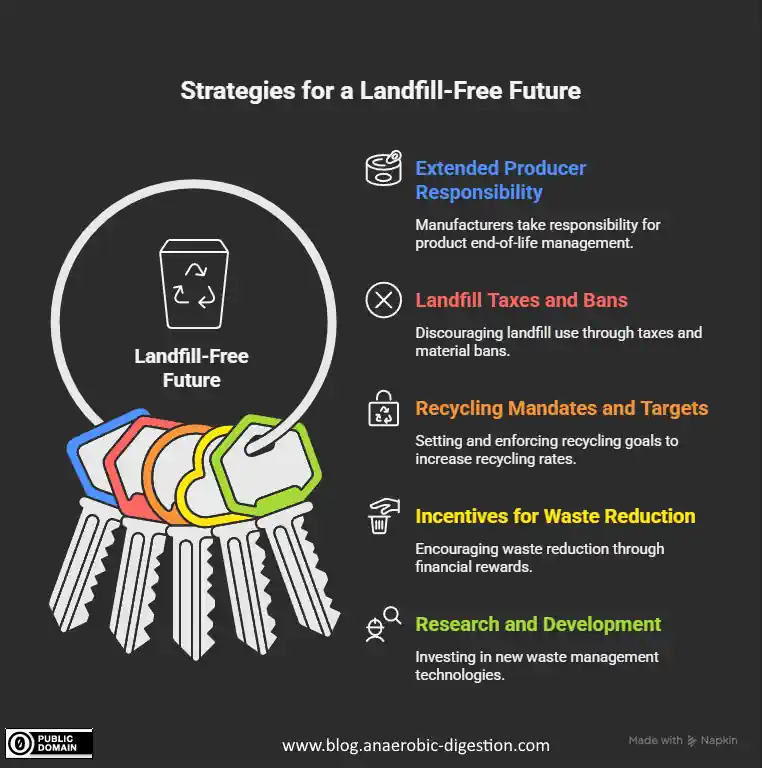
Towards the End of Landfill: A Vision for the Future
With separate food waste collections becoming mandatory under the UK’s Simpler Recycling rules, the conditions are finally right to scale up anaerobic digestion nationwide.
By combining:
- Local food waste AD facilities,
- Biogas upgrading and grid injection,
- Nutrient recycling through digestate use, and
- Smart policy incentives,
societies can wean themselves off landfill completely.
In future, AD plants may integrate with carbon capture, biochar production, or even green hydrogen systems, further enhancing their climate value. Landfills will remain as historical relics — capped, monitored, and repurposed for solar farms and green spaces.
Conclusion: Anaerobic Digestion as the Engine of the Circular Economy
Anaerobic digestion is not merely an alternative to landfill — it’s the foundation of a sustainable resource economy.
- Diverting organic waste from landfill,
- Capturing methane as renewable energy, and
- Returning nutrients to the soil,
AD transforms a waste problem into an energy and climate solution. With widespread adoption, landfill will become obsolete, and the world can finally move from a throwaway culture to a truly circular one.
Learn more at Anaerobic-Digestion.com — your trusted source for expert insights on biogas, biomethane, and circular waste management.
FAQs
Is anaerobic digestion really carbon neutral?
Yes. The carbon released when biogas is used comes from recently grown organic matter, not fossil fuels, so it is part of the short-term carbon cycle. With carbon capture and efficient plant operation, AD can even approach carbon-negative performance.
Can all organic waste go to anaerobic digestion?
Most biodegradable materials can be digested—including food waste, crop residues, and manures—but contamination (plastics, metals, grit) must be removed to protect equipment and ensure high-quality digestate.
Why can’t incineration replace anaerobic digestion?
Incineration destroys organics and releases CO₂ from fossil fractions, while AD preserves nutrients and produces renewable methane plus fertiliser. AD supports circularity; incineration is a last-resort energy recovery step for non-recyclable, non-digestible residues.
What are RDF and SRF, and why aren’t they public fuels?
RDF (Refuse-Derived Fuel) and SRF (Solid Recovered Fuel) are processed residual wastes used in industrial energy recovery (e.g., cement kilns, EfW plants). They are unsuitable as household fuels due to stringent environmental regulations that require controlled, high-temperature combustion and continuous emissions monitoring.
How much landfill waste could AD eliminate globally?
If all food and other organic waste were separately collected and digested, global landfill methane emissions could be substantially reduced, materially advancing methane reduction goals and easing reliance on landfills.