If you think that the true benefits of a farm biogas plant, cited by farmers, would be lower energy bills and income from energy sales alone, you would be wrong. Those aren't enough to secure a farm's future.
British farmers face mounting pressure from unstable fossil fuel markets, tighter emissions regulations, and mounting fertiliser costs. A 2025 ADBA report notes that the UK now operates approximately 750 commercial anaerobic digestion plants with a combined capacity exceeding 2,800 MW of renewable energy.
Biogas plant benefits extend far beyond fuel cost savings and the possibility of energy sales. These systems convert waste into nutrient-rich digestate whilst slashing methane emissions by up to 70%. This guide reveals how AD transforms farm economics, reduces environmental impact, and positions your operation for long-term resilience.
Benefits Of A Biogas Plant: Key Takeaways
- UK biogas plants now number around 750 facilities, generating over 2,800 MW of renewable energy for heat, electricity, and biomethane injection into the national grid.
- Anaerobic digestion cuts greenhouse gas emissions by up to 1% of the UK's total national output whilst processing 36 million tonnes of organic waste annually.
- Combined Heat and Power (CHP) systems achieve efficiency rates above 80%, compared to 30-40% for traditional power stations.
- The Simpler Waste Collection Strategy takes effect in 2026, mandating weekly food waste collections across England and creating expanded feedstock supplies for AD plants.
- Digestate from AD plants offers nitrogen uptake rates 10-20% higher than undigested slurry, enabling some UK farms to cut synthetic fertiliser costs by over 80%.
- The Green Gas Support Scheme runs until March 2028, providing 15-year tariff guarantees for new biomethane plants meeting waste feedstock requirements.
Key Benefits and Functions of Biogas Plants
There are many benefits of a Biogas Plant. Biogas plants deliver measurable advantages across waste management, energy production, and farm economics. They convert slurry and organic feedstock into renewable power whilst addressing environmental compliance challenges.
What are the uses of biogas plants beyond producing energy?
Farm biogas plants tackle waste challenges that traditional methods cannot solve. Digesters stabilise slurry, cutting ammonia and methane emissions from untreated manure by up to 70% through controlled processing.
Processed digestate produces significantly less odour than raw manure. Your neighbours will notice the difference, and air quality improves across the farm.
More Benefits Of A Biogas Plant
The technology enables extended application windows for manure spreading. You gain flexibility to apply nutrients when crops need them most, rather than working around restrictive spreading dates. This precision timing boosts nutrient uptake whilst reducing leaching risks. Livestock can return to treated pastures faster because biogas processing reduces pathogen loads in the digestate.
Biogas plants reduce crop taint and help protect valuable soil resources.
What advantages do farmers experience with biogas plants?
Digestate from anaerobic digesters delivers nitrogen in forms that crops can use immediately. Research shows nitrogen uptake from digested slurry runs 10-20% higher than from untreated waste.
This improved availability translates to stronger crop performance. Fields receive readily available nutrients precisely when growth demands them.
Odour reduction creates tangible benefits for farm relations. Processed digestate smells far less offensive than raw slurry, easing tensions with nearby residents and reducing complaints.
Energy independence: One of the Most Underrated Benefits Of A Biogas Plant
Energy independence shields you from volatile fuel markets. One example, Gask Farm in Scotland, cut its annual fertiliser spend from £52,000 to £10,100 over six years by switching to digestate. The farm now applies only one-fifth of its previous synthetic fertiliser volume on wheat and barley, with winter oilseed rape receiving digestate exclusively.
Biogas systems close the waste loop efficiently. Material that would otherwise accumulate in lagoons becomes a productive asset. This shift reduces landfill dependency whilst cutting methane emissions that would escape from untreated organic matter. UK regulations increasingly favour such circular approaches, and AD plants position farms ahead of tightening environmental standards.

Anaerobic Digestion in Sustainable Farming
Anaerobic digestion systems enable farms to meet sustainability targets whilst improving operational efficiency. UK agricultural policy and industry bodies increasingly recognise AD as essential infrastructure for the sector's future.
How do the UK Government and agricultural sectors view anaerobic digestion?
The UK Government positions anaerobic digestion as a cornerstone technology for agricultural emissions reduction. DEFRA's Shared Vision for Anaerobic Digestion outlines clear expansion targets for biogas capacity nationwide.
Policy documents emphasise AD's dual function. The technology addresses waste management challenges whilst generating renewable energy. It recycles nutrients back to farmland rather than sending sewage sludge or organic waste to landfill sites.
The National Farmers' Union set an ambitious target in 2011 to deploy 1,000 on-farm digesters by 2020. Research from RASE and the AEA Group recommends focusing small-scale AD development on dairy farms with at least 100 cows, where consistent feedstock volumes support reliable operation.
Government support would not usually be considered one of the benefits of a biogas plant, but AD support remains evident through several mechanisms:
- The Simpler Waste Collection Strategy, taking effect in 2026, mandates weekly food waste collections across England. This regulatory change will significantly expand feedstock availability for AD plants.
- The Green Gas Support Scheme, extended to March 2028, provides 15-year tariff guarantees for new biomethane facilities, with rates of 6.86 pence per kWh for the first 60,000 MWh produced annually.
How Anaerobic Digestion Solves Farming Challenges
AD systems address three pressing farm challenges simultaneously. They convert problematic waste streams into valuable products whilst reducing environmental liabilities and generating income.
Results of a Report on the Structure and Function of Biogas Plants
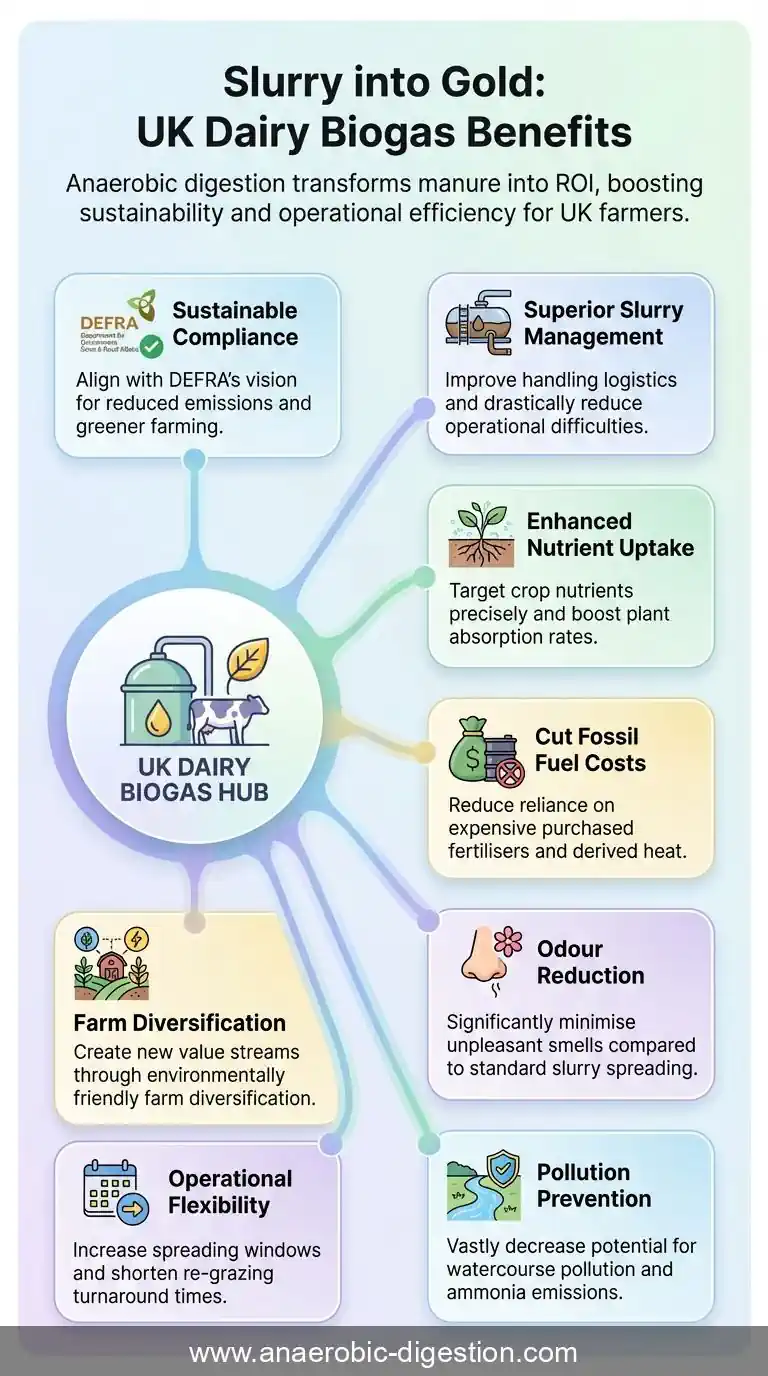
“All of the farmers involved in the case studies in a Royal Agricultural Society of England (2018) study lauded the numerous benefits of a Biogas Plant, which included:
• improved slurry handling;
• the ability to target crop nutrients;
• increased nutrient uptake;
• increased spreading windows;
• less crop taint and decreased re-grazing times;
• significant odour reduction when compared with slurries;
• a reduced or nil reliance on fossil-fuel-based fertilisers;
• reduced reliance on fossil fuel-derived heat;
• a vastly decreased potential for watercourse pollution;
• fewer emissions to air (odour, ammonia and GHGs);
• environmentally friendly farm diversification.
In other words, on-farm anaerobic digestion offers a significant step towards more sustainable farming.
It is for these reasons that the UK Government and the agriculture industry see anaerobic digestion as the ideal way to treat slurry. As stated in DEFRA’s Shared Vision for Anaerobic Digestion, the NFU would like to see 1000 on-farm digesters by
2020.
Work done by the RASE and AEA Group indicates that for the greatest impact, low-cost AD plants should be targeted at dairy farms, starting from about 100 cows and upwards.“
Anaerobic digestion is able to address waste, energy, sustainable food production, and nutrient recycling challenges in a sustainable and circular manner. It does this by connecting and closing the loop on previously linear processes of sending organic waste to landfills.
Source: The above excerpt is from: “A Review of Anaerobic Digestion Plants on UK Farms – Barriers, Benefits and Case Studies“; Supporting Sustainable Agriculture, By Angela Bywater, Royal Agricultural Society of England – Executive Summary.
How does anaerobic digestion improve waste management?
Biogas digesters process diverse organic materials through controlled fermentation. Animal manure, crop residues, and food waste enter sealed tanks where bacteria break down substrates without oxygen.
This stabilisation process dramatically reduces the total volume destined for landfills. Digesters cut material mass whilst transforming potentially polluting substances into renewable natural gas and nutrient-rich biofertiliser.
The system prevents odours and lowers water pollution risks. On-site treatment eliminates the need for large slurry lagoons, which can leak or overflow during heavy rainfall. Processed material becomes safer to handle and apply to fields.
The benefits of many a biogas plant are already with us. According to WRAP data, England's operational AD capacity reached 9.6 million tonnes for all feedstocks in 2019, including 3.2 million tonnes dedicated to food waste. This processing capacity diverts substantial volumes from landfill whilst recovering energy that would otherwise be lost.

Can anaerobic digestion generate energy effectively?
Biogas contains 50-70% methane, giving it strong energy density. This methane concentration allows direct combustion in engines or boilers for reliable power generation.
Combined heat and power systems capture both electricity and thermal output from biogas. Modern CHP units achieve total efficiency rates exceeding 80%, far surpassing the 30-40% typical of conventional power stations. This means 80% of the fuel's energy becomes usable output rather than waste heat.
Biogas technology transforms farm waste into clean cooking gas and power.
Farm-scale installations provide energy security. You generate electricity and heat on-site, reducing exposure to grid failures or price spikes. Excess power can be sold back to the network, creating an additional revenue stream.
The UK's AD sector now supports approximately 4,800 jobs across operations, maintenance, and equipment manufacturing. This growth reflects biogas's proven effectiveness as both a waste solution and an energy technology within British agriculture.
How does it support sustainable food production?
Digestate from AD plants delivers concentrated nutrients that crops can absorb quickly. This biofertiliser cuts dependence on synthetic nitrogen, phosphorus, and potassium products manufactured from fossil fuels.
Spreading windows extend significantly with processed digestate. You can apply nutrients throughout more of the growing season, matching supply to crop demand with precision. This timing flexibility improves nitrogen efficiency whilst reducing losses to waterways.
Soil health improves with regular digestate application. At Apsley Farms, continuous digestate use elevated all soil organic matter tests to ‘high' or ‘very high' ratings. Healthy soils support diverse microbial communities, which in turn foster insect populations and provide food sources for birds and mammals.
The technology enables farms to maintain productivity whilst meeting environmental standards. UK agricultural strategy increasingly emphasises nutrient management and emissions reduction. AD systems deliver on both fronts without compromising yield potential.
What role does anaerobic digestion play in nutrient recycling?
AD transforms organic waste into digestate containing readily available nitrogen, phosphorus, and potassium. Farmers apply this material directly to cropland as organic fertiliser, recovering nutrients that would otherwise be lost or underutilised.
The digestate's nutrient profile often exceeds that of raw feedstock. Anaerobic digestion concentrates minerals whilst converting complex organic forms into simpler compounds that crops can absorb quickly. Research demonstrates that nitrogen uptake rates from animal slurry digestates run 10-20% higher than from undigested slurry.
Precision application becomes possible with liquid digestate. Flow meters and GPS mapping enable accurate spreading at targeted rates. This precision prevents over-application whilst ensuring crops receive optimal nutrition.
The system creates a closed loop within farming operations. Nutrients cycle from crops to livestock feed, then to manure, through digestion, and back to fields as enhanced fertiliser. This circular approach reduces external input costs whilst supporting compliance with nutrient management regulations across UK agriculture.

Financial Support and Subsidies for Anaerobic Digestion Systems
Government support schemes significantly influence AD project viability. Understanding available incentives helps farmers assess investment potential and plan financing strategies.
What financial opportunities are farmers missing?
The initial Feed-in Tariffs Scheme excluded many small farm-based AD systems from financial support. Defra rule changes made farm digesters under 5 MW capacity ineligible for FiT payments, cutting off a key revenue stream for small operators.
This exclusion prevented farms from securing guaranteed rates for electricity generation. Without FiT backing, many could not justify the capital outlay or obtain competitive financing from lenders.
The policy gap meant missed opportunities across multiple revenue channels. Farms lost the chance to earn from selling surplus electricity at subsidised rates. They also could not fully monetise organic fertiliser production or processed pellet sales as alternative products. Restricted funding slowed the adoption of cleaner farming practices and left larger agri-businesses dominating biogas development.
Many farmers still remain unaware that the RHI scheme closed to new applicants in April 2021, though existing participants continue receiving 20-year tariff payments. This knowledge gap causes continued missed opportunities for understanding current support mechanisms.
What future subsidies or support might be available?
The Department for Energy Security and Net Zero is developing a Future Biomethane Policy Framework, with consultation expected by spring 2026. This new structure aims to replace and extend current support beyond the Green Gas Support Scheme's March 2028 deadline.
Policy experts emphasise the need for continuity. A smooth transition between schemes prevents investment stalls and maintains sector momentum. The ADBA projects that UK biomethane production could reach 5.7 billion cubic metres annually by 2030, enough to heat 4.5 million homes, if appropriate support continues.
Potential changes may include:
- Enhanced grants for small-scale farm digesters processing only agricultural waste
- Bonus payments for facilities meeting advanced sustainability criteria
- Support for carbon capture integration at biomethane plants
- Funding for low-emission digestate application equipment
The Sustainable Farming Incentive may expand to reward low-emission digestate spreading techniques. Environmental regulators recognise AD's role in reducing national methane output, which currently represents 14% of UK greenhouse gas emissions.
Biogas Production and Usage
Biogas generation relies on specific feedstocks and controlled biological processes. Understanding these fundamentals helps farmers optimise plant performance and energy output.
What raw materials are used for biogas production?
Cattle manure serves as an ideal biogas feedstock because its natural carbon-to-nitrogen ratio of 25:1 supports optimal bacterial activity. This balance enables efficient gas generation without chemical adjustments.
Farms supply diverse materials beyond manure. Crop residues, surplus silage, green waste, and plant matter all contribute organic content. Government data shows that in 2023, UK AD plants processed approximately 4.9 million tonnes of crop-derived feedstock, representing 29% of total inputs.
Food waste from municipal collections and commercial sources provides a high-energy substrate. Sewage sludge from treatment works adds volume and consistency. Agricultural by-products like straw or chaff improve gas yields whilst maintaining balanced nutrient levels in the final digestate.
The UK's maize cultivation area attributed for AD varies in reports. One report says it reached 73,000 hectares in 2023, covering 34% of the total maize area and 1.3% of all arable land. Another report more than doubles this. But even only relying on the first report, this dedicated energy crop production demonstrates the sector's scale and agricultural integration across Britain.
How is biogas produced through the process?
Organic material enters sealed digesters where bacteria break down substrates in oxygen-free conditions. Microorganisms work through several stages, first converting complex molecules into simpler compounds through fermentation.
Small digesters may produce only carbon dioxide during the initial 48 hours. Larger systems can take weeks before methane generation begins. This startup phase frustrates operators who expect immediate gas production, leading some to abandon projects prematurely.
Archaea microbes then convert organic acids into methane and CO2. The process separates biogas from solid and liquid fractions, with gas rising to collection points at the tank top.
Temperature control proves critical throughout. Mesophilic digestion operates between 20-40°C, promoting steady bacterial growth. Thermophilic digestion runs at 50-65°C, working faster but requiring careful management to protect microbial populations.
Sulphur compounds like hydrogen sulphide can form during breakdown. Modern plants install scrubbing systems to remove these contaminants before using biogas for energy generation or vehicle fuel. The remaining digestate becomes a nutrient-rich biofertiliser ready for field application.
How can biogas be used as a renewable energy source?
Biogas combusts in boilers to generate heat for buildings or agricultural processes. Many UK farms use this renewable source to warm homes, dry grain, or heat dairy parlours and livestock housing.
CHP units convert biogas into both electricity and usable heat simultaneously. These systems achieve efficiency rates above 80%, compared to 30-40% for separate heat and power generation. For example, a 200 kW Tedom CHP unit generates 200 kW of electrical output alongside 322 kW of thermal energy, with electrical efficiency around 34.4%.
Biomethane, produced by removing CO2 and impurities from raw biogas, can be injected directly into the national gas grid. The UK now operates over 50 biomethane-to-grid facilities. Future Biogas, one of Britain's largest operators with 11 sites, demonstrates how upgraded biogas integrates seamlessly into existing natural gas infrastructure without requiring modifications.
Processed biomethane also fuels vehicles designed for compressed natural gas. This application offers significant greenhouse gas savings, with Bio-CNG delivering a 72% reduction in CO2 emissions across the full lifecycle compared to diesel fuel.
Why are some biogas projects abandoned?
Many operators shut down digesters during the initial startup phase, mistaking normal CO2 production for system failure. Small units can generate only carbon dioxide for up to 48 hours. Large digesters may take weeks before methane output begins.
This delay frustrates owners who expect immediate gas production. Without understanding the biological timeline, they conclude their investment has failed and cease operations before methane generation starts.
Limited training and unclear documentation compound the problem. New operators lack guidance on distinguishing between normal startup patterns and actual malfunctions. They cannot recognise that patience and proper monitoring will lead to successful methane production.
Experience demonstrates that biogas plants need time to establish stable microbial communities. UK farm operators who maintain systems through the initial weeks achieve reliable, long-term performance. Those who understand startup timelines avoid unnecessary project loss across Britain's agricultural biogas sector.
What is the Composition of Biogas?
Biogas composition varies based on feedstock and digestion conditions. Understanding these gas mixtures helps operators optimise energy generation and meet quality standards.
What are the typical methane and CO2 levels in biogas?
Methane typically comprises 50-70% of biogas volume from anaerobic digestion. This high-energy component provides the fuel value that makes biogas useful for power generation.
Carbon dioxide forms the second major fraction, usually ranging between 30-50% of total gas. The precise balance depends on feedstock composition and how well operators manage the digestion process.
Food waste and animal slurry often produce biogas at the upper end of the methane range. These substrates support bacterial communities that favour methane generation over CO2 production.
Methane concentration directly determines energy content. Higher percentages mean more usable power for heating or electricity through CHP systems. UK agricultural biogas plants monitor methane levels using portable analysers to optimise output and confirm quality meets standards for renewable energy generation.
What trace gases like H2S, moisture, and siloxane are present?
Hydrogen sulphide emerges as bacteria break down sulphur-containing compounds in feedstock. This gas produces the characteristic rotten egg smell and can corrode engines or metal pipes if concentrations remain high.
Water vapour enters biogas naturally during the digestion process. Moisture condenses inside pipelines and storage tanks, increasing corrosion risks and potentially damaging equipment. Most UK plants install dryers or coolers to remove excess humidity before gas enters engines.
Siloxanes originate primarily from treated sewage sludge and certain food wastes. These silicon-based compounds burn to form silica particles that accumulate on engine parts, reducing efficiency and causing premature wear.
British biogas facilities typically install scrubbers to remove H2S and moisture before using gas for electricity or heat generation. These cleaning systems protect expensive CHP equipment whilst maintaining reliability for farms and businesses supplied through WRAP and Defra-supported AD infrastructure nationwide.
Modern Biogas Plants as Decentralised Energy Solutions
Contemporary AD facilities operate as local power stations, converting organic waste into reliable energy near consumption points. This distributed approach reduces transmission losses whilst improving supply security.
How do biogas plants improve energy efficiency?
On-site generation eliminates transmission losses that occur when electricity travels long distances through the grid. You capture nearly all the energy your biogas produces, rather than losing 5-10% to power lines.
Combined heat and power systems deliver both electricity and thermal energy from the same fuel input. Modern CHP units achieve overall efficiency rates exceeding 80%, whilst traditional power stations waste most energy as unused heat.
Many UK farms integrate biogas with solar panels or wind turbines. This combination creates resilient energy systems that maintain supply even when one source underperforms. Biogas fills gaps when sunlight fades or wind drops, ensuring continuous power availability.
Resource efficiency extends beyond the digester. Farms capture waste heat from engines to warm buildings, dry grain, or maintain optimal temperatures for livestock housing. This complete utilisation makes British agriculture more competitive and less vulnerable to external energy market fluctuations.
How do they reduce environmental pollution?
Biogas plants capture methane that would otherwise escape from decomposing organic waste. Uncontrolled manure releases this potent greenhouse gas directly into the atmosphere, where its warming effect exceeds CO2 by 28 times over a century.
Processing waste through AD significantly cuts these fugitive emissions. The system converts harmful gases into useful energy whilst stabilising remaining material into safer digestate. Odours drop dramatically, and the risk of ammonia release declines.
Decentralised processing keeps biodegradable material out of landfills, where it would generate both methane and leachate. This prevention protects groundwater and reduces the toxic runoff that threatens rivers and streams.
The UK Government supports biogas solutions because they address multiple pollution sources simultaneously. Current data shows AD plants now deliver a 1% reduction in national greenhouse gas emissions, demonstrating measurable environmental benefits across British agriculture.
Can they supply heat and electricity effectively?
Farm biogas systems generate both heat and electricity reliably throughout the year. Anaerobic digestion produces steady gas flows regardless of weather, unlike solar or wind sources that fluctuate with conditions.
Modern CHP units convert biogas into power with impressive efficiency. A typical 500 kW unit can supply electricity for hundreds of homes whilst delivering thermal energy for farm operations. These systems run 24 hours daily, providing baseload power that intermittent renewables cannot match.
Operators adjust output to match demand patterns. Control systems regulate gas flow to engines, increasing production during peak periods and reducing it when needs are lower. This flexibility helps farms manage lighting, milking equipment, and heating requirements cost-effectively.
Britain's renewable energy infrastructure increasingly relies on biogas for consistent supply. The technology operates independently of grid disruptions, protecting farms from power cuts whilst reducing exposure to volatile energy prices across the UK agricultural sector.
Construction and Functionality of Biogas Plants
Biogas plants use sealed digesters and biological processes to transform organic feedstock into energy and nutrients. Design choices affect both performance and the range of materials systems can process.
What waste materials are suitable for biogas plants?
Animal manure provides consistent, high-quality feedstock for biogas digesters. Cattle, pig, and poultry waste all contain the organic compounds bacteria need for methane generation.
Plant materials work equally well in most systems. Crop residues, leftover silage, food scraps, and grass clippings supply carbon-rich substrates that support robust gas production. Municipal waste from household collections adds volume, whilst sewage solids from treatment works contribute steady inputs.
Design versatility allows operators to process diverse waste streams. UK farms often combine multiple sources, using slurry alongside crop remnants or imported food waste. This flexibility helps maintain consistent digester loading throughout the year.
Careful material selection boosts gas yields whilst supporting operational efficiency. Farms that match feedstock to their digester's capabilities achieve reliable energy production and high-quality fertiliser output across British agricultural operations.
How do biogas plants treat waste and generate energy?
Sealed digesters exclude oxygen, creating conditions where specialised bacteria break down organic waste. These microbes perform anaerobic fermentation, which stabilises material whilst releasing methane-rich biogas.
The biological process reduces pathogens significantly. Harmful organisms die off in the controlled environment, making the resulting digestate safer than raw manure. Odours diminish as volatile compounds convert to stable forms.
Gas collection systems capture methane as bacteria release it. Pipelines channel this renewable energy to CHP engines or boilers for immediate use. After cleaning, operators can inject upgraded biomethane directly into the national grid.
Remaining digestate becomes nutrient-rich fertiliser. Farmers spread this organic material on fields, where it improves soil quality without synthetic chemicals. This integrated approach manages environmental impact more effectively than traditional farming methods across the UK agricultural sector.
Benefits Of A Biogas Plant – A Conclusion
Farm biogas plants deliver measurable improvements across energy security, waste management, and environmental compliance.
These systems convert problematic organic materials into renewable power and nutrient-rich biofertiliser. UK data confirms that AD facilities now process 36 million tonnes of waste annually whilst generating over 2,800 MW of clean energy capacity.
Adoption of anaerobic digestion positions farms ahead of tightening environmental regulations. The technology cuts greenhouse gas emissions significantly, reduces odours, and creates valuable fertiliser that enhances soil health whilst lowering synthetic input costs.
British agriculture's future depends on resource-efficient practices that support both productivity and sustainability. With expanded government support expected through 2028 and beyond, biogas technology offers farmers a practical pathway to improve profitability whilst meeting climate targets across the United Kingdom.
FAQs on the Benefits Of A Biogas Plant
1. What makes farm biogas plants more beneficial than people realise?
Farm biogas plants are incredibly beneficial because they convert organic waste into renewable energy while producing a nutrient-rich digestate that completely replaces costly synthetic fertilisers. This circular process slashes chemical reliance and actively diverts thousands of tonnes of agricultural waste from UK landfills each year, transforming a disposal problem into a valuable resource.
2. How does a biogas system help farmers save money?
A biogas system helps UK farmers save money by slashing their reliance on expensive grid electricity, with 2024 University of East Anglia research revealing that converting dairy farm methane to biogas could save the industry over £400 million a year in fuel costs alone.
3. Can biogas plants reduce a farm's environmental impact?
Yes, biogas plants drastically reduce a farm's environmental impact by capturing agricultural methane, a super-pollutant that currently accounts for 49 percent of all UK methane emissions. By transforming these harmful emissions into clean biomethane, farms prevent the gas from entering the atmosphere and create a carbon-neutral energy source.
4. What types of waste can power a farm biogas facility?
Most organic agricultural materials can power a biogas facility, with cow slurry, poultry litter, and leftover crop residues being the most common feedstocks on British farms. To boost energy yields, operators often co-digest these base materials with higher-energy waste like silage effluent or household food scraps.