
Rising energy costs are squeezing families and businesses in ways that feel increasingly hard to manage – enter biogas energy security. Most communities still depend on fossil fuels that they cannot control the price of, and the environmental damage keeps mounting.
Biogas energy security changes that picture.
This renewable energy source turns organic waste into power. Organic sources are local, and as we all eat, so is organic waste the inevitable consequence of living. Making use of organic waste strengthens local economies whilst fighting climate change, and the global market is already moving fast in this direction – and above all, it is safe and secure from global market price fluctuations.
Biogas is no longer simply a waste management tool. It has become a strategic energy asset. Governments, businesses, and investors now recognise its role in energy security and sustainability planning.
This article covers how biogas energy security works in practice. You will learn how anaerobic digestion converts organic waste into valuable fuel, why co-generation systems deliver both electricity and heat from a single source, and how circular economy frameworks use biogas to reduce greenhouse gas emissions and create local jobs.
We will explore real examples from Brazil, Germany, India, China, and Spain. You will also see why major energy companies like BP, Shell, and TotalEnergies are committing serious capital to this sector, and what the data reveals about the opportunities ahead.
Key Takeaways
- Biogas is becoming capable of delivering energy security as the global biogas market grows from USD 46.54 billion in 2025 to USD 109.62 billion by 2036, representing 8.1% compound annual growth.
- Biomethane upgrading systems currently capture 35.2% market share, delivering both homemade electricity and heat from renewable energy sources.
- Growth is fast. Brazil leads growth at 12.2% annually, whilst Germany, India, China, and Spain expand biogas capacity through agricultural waste and decentralised plants.
- Circular economy frameworks transform 80% of sustainable feedstock into energy, creating jobs and reducing methane emissions simultaneously across communities.
- Traditional energy companies like BP, Shell, and the huge waste management company, Veolia, control 25 to 30 per cent of market share, investing in biomethane infrastructure that strengthens national energy security.

How is the global biogas industry evolving?
Governments and energy companies around the world are investing in biogas infrastructure. Policy initiatives are driving feedstock availability and supporting renewable energy mandates that cut greenhouse emissions.
Biogas plants now connect directly with existing energy grids. They convert municipal solid waste and agricultural biomass into natural gas, strengthening energy system integration and supporting decarbonisation goals aligned with the United Nations Sustainable Development Goals.
This means that biogas energy is now a significant and growing contributor to the energy security of the nations that embrace the industry and fully develop it.

What policy initiatives support biogas growth and how is feedstock availability increasing?
Over 50 new policies supporting biogas have emerged since 2020, fundamentally reshaping how nations approach renewable energy and emissions reduction. 1 Countries across Europe and beyond have adopted anaerobic digestion technologies to meet renewable energy mandates and cut methane reduction goals.
India's SATAT initiative and Brazil's RenovaBio framework stand out as powerful examples. Both offer financial support and market certainty that encourage investment in biogas plants. According to 2026 data from the American Biogas Council, US policies like the federal Renewable Fuel Standard and state-level Low Carbon Fuel Standards drove a record USD 2.1 billion investment across 70 new US biogas projects in 2025 alone.
These policy mechanisms create real demand for biomethane and natural gas alternatives. They make biogas a practical choice for energy companies and investors seeking sustainable pathways forward.
The biogas industry is locally based. It has to be, because of its fuel, organic waste, which is heavy to transport. This makes it inherently a secure source free from the price disruptions of international trading and immune to shipping delays.
Feedstock availability is expanding rapidly across emerging economies. These regions currently hold approximately 80% of the available sustainable feedstock for biogas production. Municipal solid waste, agricultural residues, and biomass resources remain largely untapped, with less than 5% of potential sustainable feedstock currently used for biogas production today.
Policy frameworks increasingly recognise that circular economy approaches can harness this potential. They turn waste streams into valuable energy resources whilst supporting regenerative agriculture practices.
The biogas sector represents one of the most practical solutions for simultaneous energy security and climate action, yet its potential remains largely dormant without strategic policy intervention.
Policymakers understand that targeted support mechanisms, including CO2 pricing and decentralisation incentives, are necessary to make biomethane cost-competitive. These measures also accelerate the shift toward a low-carbon energy system.
However, these costs are low when compared to the unsafe economic effects of war on traditional energy supplies. The Iran war should be a wake-up call to governments to look afresh at anaerobic digestion as an energy source, this time for its energy security.
Not only that, but unsubsidized biomethane plants with carbon capture are springing up. This breed of AD plants no longer needs government assistance to operate profitably.
How is biogas integrated with existing energy grids?
Biogas enters national energy systems through a process that requires minimal infrastructure changes. Technologies for biogas production and upgrading have matured significantly, allowing facilities to connect directly to existing grids near consumption sites. 1
Biomethane upgrading purifies raw biogas to meet natural gas standards, enabling it to flow through pipelines built for conventional natural gas. Energy companies inject this upgraded biogas into distribution networks serving households and industrial users. According to a 2026 industry report by BioCycle, US facilities upgrading biogas to Renewable Natural Gas for pipeline injection reached 659 by the end of 2025, a threefold increase over just five years.
The process works because biomethane shares chemical properties with natural gas. Utilities need no costly modifications to existing pipelines or equipment, which means communities can access renewable energy without building entirely new infrastructure.
Grid integration delivers several practical benefits for communities and energy providers alike:
- Consistent, dispatchable energy output that modern grids need for stable power supply
- Reduced dependence on imported natural gas for households and factories
- Lower transmission losses through decentralised biogas plant placement
- Improved energy efficiency across regions when biogas supplements fossil fuel sources
The International Energy Agency recognises this integration as critical for meeting sustainable development goals. Decentralised biogas plants create local energy independence and boost economic resilience across communities.
Fatih Birol and energy experts point to this waste-to-energy approach as a genuine circular economy framework. It transforms agricultural and organic waste into premium-priced fuel whilst tackling carbon dioxide emissions simultaneously.
Why is biogas vital for national energy security?
Biogas strengthens national energy security by reducing dependence on imported fossil fuels and creating reliable, domestic energy sources that communities control. Circular economy frameworks transform waste into valuable resources, whilst biomethane upgrading unlocks renewable power that supports UN Sustainable Development Goal 7 and drives long-term energy independence.
How do circular economy frameworks incorporate biogas?
Circular economy frameworks transform organic waste into valuable energy through anaerobic digestion, a process that captures methane from decomposing materials. Landfill biogas, agricultural residues, and food processing waste become feedstocks for biogas production, creating a closed-loop system that reduces environmental contamination whilst generating renewable energy. 2
Natural gas systems act as facilitators, allowing biogas to integrate smoothly into existing infrastructure and supply chains. This supports UN Sustainable Development Goal 7 by expanding access to clean, affordable energy whilst addressing waste management challenges at the same time.
Partnerships between energy companies and agricultural sectors strengthen these circular models. They turn what was once considered waste into a resource that powers communities and industries alike. A July 2025 Renewable Natural Gas Supply Assessment by the American Gas Foundation revealed that using US organic waste, including the 74 million tons of food waste generated every year, could cut greenhouse gas emissions by over 300 million metric tons annually whilst meeting the energy needs of all US households currently using natural gas.
Incorporating biogas into circular economy practices delivers benefits well beyond simple energy production. The bioeconomy gains momentum as organisations recognise that organic waste streams hold untapped potential for generating electricity, heat, and biomethane.
Waste management improves dramatically because anaerobic digestion processes organic materials efficiently, reducing the volume of material sent to landfills. Local economies benefit from decentralised biogas plants that create jobs, stimulate investment, and keep energy production within communities rather than relying on distant fossil fuel sources.
Circular economy frameworks transform waste into wealth, proving that sustainability and prosperity travel together.
What does the Future Market Insights report reveal about biogas market size?
The biogas market shows remarkable growth potential over the next decade, with substantial opportunities emerging for investors and policymakers alike. Future Market Insights has released comprehensive forecasts that paint a compelling picture of this expanding sector.
| Market Metric | Value / Details | Key Insight |
|---|---|---|
| 2025 Market Size | USD 46.54 billion | Baseline year establishing current market valuation |
| 2026 Market Size | USD 50.31 billion | Year-on-year growth demonstrates momentum |
| 2036 Market Size | USD 109.62 billion | More than doubles from 2026, signalling long-term expansion |
| Compound Annual Growth Rate (CAGR) | 8.1% from 2026 to 2036 | Steady, predictable expansion across the decade |
| Total Incremental Opportunity | USD 59.32 billion | New revenue potential for emerging market participants |
| Leading Feedstock Type | Crops with 37.8% market share by 2026 | Agricultural waste drives majority of biogas production |
| Top Application Segment | Co-generation (CHP) at 35.2% market share | Combined heat and power systems dominate deployment |
| Fastest-Growing Regional Market | Brazil with 12.2% CAGR | Latin America leads global biogas acceleration |
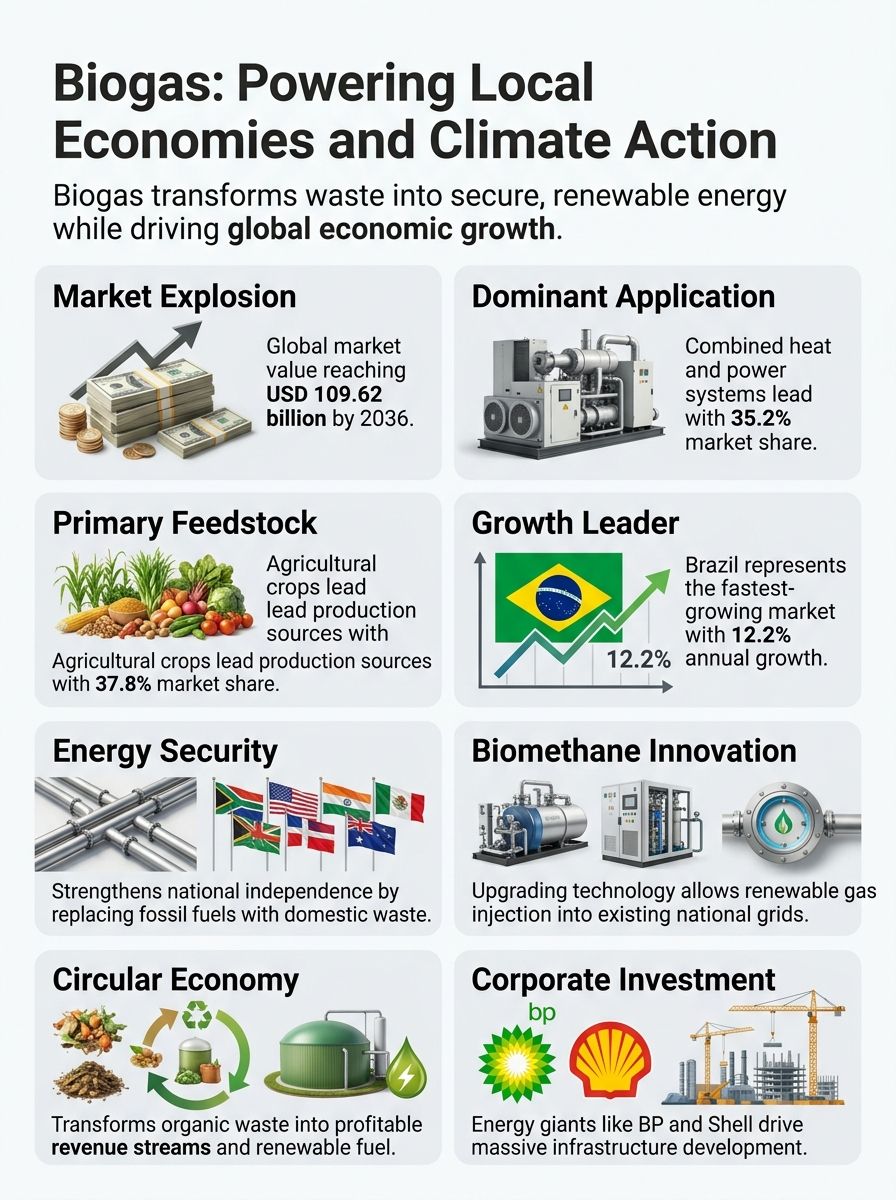
The figures reveal a sector experiencing genuine transformation. Market valuation escalates from USD 46.54 billion in 2025 to USD 109.62 billion by 2036, more than doubling investment value over the period. This trajectory reflects sustained confidence from stakeholders across energy, agriculture, and waste management sectors.
Crops emerge as the dominant feedstock source, commanding 37.8% of the market share by 2026. This reflects the agricultural sector's capacity to supply consistent organic material for biogas production. Co-generation systems capture 35.2% of applications, meaning combined heat and power installations lead the way in how businesses and communities deploy biogas energy.
Brazil's exceptional performance at 12.2% annual growth demonstrates how emerging economies are embracing the renewable energy transition. The incremental opportunity worth USD 59.32 billion creates genuine prospects for new entrants, technology providers, and infrastructure developers seeking market entry points.
What are the main drivers and challenges in the biogas market?
Renewable energy mandates push governments and companies to invest in biogas systems, whilst methane reduction goals drive the industry forward to meet climate targets and the UN Sustainable Development Goals.
Financial barriers and technological constraints challenge biogas producers, yet advances in exergy efficiency and simulation tools like ASPEN HYSYS help operators optimise their plants and push closer to peak fossil fuel displacement.
How do renewable energy mandates and methane reduction goals influence biogas?
Governments across the globe are pushing renewable energy mandates that require energy companies to source power from clean options. These mandates create strong, sustained demand for biogas as a legitimate renewable energy choice.
Countries like India have launched schemes such as SATAT, which channels investment into anaerobic digestion technologies. Brazil's RenovaBio programme goes further by offering decarbonisation credits that reward biogas producers for cutting emissions. These policy frameworks give businesses long-term visibility into market demand, making biogas projects financially worthwhile.
Methane reduction goals work hand in hand with these mandates. Governments recognise that waste streams sitting in landfills release methane, a potent greenhouse gas that accelerates climate change.
By diverting municipal solid waste, food waste, and agricultural residues into biogas production systems, nations tackle two problems at once. They reduce harmful methane emissions whilst generating clean energy.
Premium pricing through renewable energy credits rewards companies that capture biogas from waste. These combined forces, rooted in the outlook for biogases and biomethane, transform waste management from a cost centre into a genuine revenue-generating opportunity that strengthens local economies and supports the UN sustainable development goals.
What technological and financial barriers does the biogas industry face in growing large enough to offer energy security?
Biogas plants face real obstacles that slow their growth worldwide. Understanding these barriers helps communities and investors make better decisions about energy projects. 3
- High capital costs: Building new biogas plants requires significant upfront investment that many smaller communities cannot access. Despite steady industry growth, the American Biogas Council reported in March 2026 that about 86% of US biogas potential remains undeveloped, with over 17,000 viable dairy, poultry, and wastewater sites still untapped because of funding barriers.
- Methane leakage: Emissions from storage tanks and pipes create environmental concerns that worry regulators and the public, undermining the climate benefits of biogas projects.
- Feedstock logistics: Collecting and transporting organic waste from farms and factories to processing sites adds operational costs that can strain project finances.
- Limited policy support: Co-digestion systems without strong backing from local authorities struggle to remain profitable over their lifetime. Without subsidies or clear mandates, many projects fail to deliver on their promise.
- Grid integration resistance: Some utilities resist connecting biogas to existing energy grids due to compatibility concerns, and unclear regulations in some regions add further confusion for potential developers.
- Technology costs: Emerging solutions like proton exchange membrane electrolyser technology and bio-LNG upgrading offer promise for hydrogen production from biogas, but their costs remain prohibitive for many operators today.
Developed nations and developing economies face different versions of these constraints, as the Journal of Environmental Management Literature confirms. Each region needs solutions suited to its unique situation, policy environment, and resource base.
What new energy security opportunities exist and who are the key biogas stakeholders?
Biomethane upgrading technology opens fresh pathways for energy companies, investors, and governments to transform waste into valuable fuel sources that offer energy security and power communities and reduce emissions.
Decentralised biogas plants empower local stakeholders to capture methane from agricultural residues and organic waste. They create independent secure energy networks that strengthen regional economies whilst cutting reliance on fossil fuels.
How is biogas transitioning within the global energy ecosystem?
Biogas has shifted from a marginal energy source to a cornerstone of global energy systems. Governments and energy firms now recognise biogas as essential for meeting renewable energy mandates and reducing methane emissions.
The next decade will see biogas repositioned as a critical player in the energy transition, offering both energy supply stability and the flexibility that grids need. 1 Digital monitoring tools are transforming operations, making biogas plants smarter and more efficient.
Less than 5% of sustainable feedstock is currently used worldwide. This reveals enormous growth potential across agricultural, industrial, and municipal waste sectors, representing a genuine opportunity for energy companies and investors.
Three major shifts are defining the next phase of biogas growth:
- Biomethane upgrading has moved biogas beyond simple electricity generation into transport fuels and direct grid injection
- Decentralised biogas plants now operate in communities across Brazil, Germany, India, China, and Spain, creating local energy independence
- Policy alignment across regions is maintaining investment momentum and integrating biogas into broader waste management strategies
Energy security improves as nations reduce reliance on fossil fuel imports. Stakeholders including governments, energy companies, and investors drive this transition by funding infrastructure and supporting technological advancement. The competitive landscape keeps evolving, with leading players innovating to capture emerging opportunities in biomethane production and grid integration.
What are the key executive takeaways on biogas market growth?
The biogas market is hitting significant value milestones, with projections showing strong expansion across agricultural waste processing, wastewater treatment facilities, and landfill gas recovery segments.
Energy companies, institutional investors, and government bodies drive this growth by deploying biomethane upgrading technologies and establishing decentralised biogas plants that transform organic feedstock into renewable energy solutions.
What is the projected market size and which segments are most profitable?
Biogas market expansion presents remarkable financial opportunities across the coming decade. Markets will reach USD 46.54 billion in 2025 and USD 50.31 billion in 2026, before climbing to USD 109.62 billion by 2036. This growth trajectory delivers an incremental opportunity worth USD 59.32 billion between 2026 and 2036, at a compound annual growth rate of 8.1%.
Biomethane upgrading emerges as the fastest-growing segment, capturing premium pricing and benefiting from strong policy support across multiple regions. Co-generation, or combined heat and power systems, dominates application segments with a commanding 35.2% market share, making it the most profitable deployment method for energy producers and industrial operators.
Feedstock selection drives profitability across different market verticals. Crops lead the feedstock segment with a forecasted 37.8% share in 2026, whilst agricultural and food waste streams attract growing investment due to rising profitability margins. Energy companies, investors, and governments recognise these waste-to-energy pathways as critical revenue generators.
Decentralised biogas plants operating in rural and urban settings unlock value from local organic materials, transforming waste disposal challenges into income-generating assets. This dual benefit, combining waste management with renewable energy production, positions biomethane and biogas infrastructure as cornerstone investments for communities seeking both economic returns and climate action results.
Who are the global leaders driving biogas market expansion?
Major energy corporations and waste management firms are reshaping the biogas sector globally. These companies combine investment power, technology expertise, and market reach to accelerate biogas adoption worldwide.
- BP leads investment in renewable energy infrastructure and biomethane projects that reduce carbon emissions significantly
- Shell expands biogas capacity through strategic partnerships, focusing on decentralised biogas plants that serve local communities and industries
- Veolia dominates waste-to-energy conversion, transforming organic waste into valuable biogas resources for municipalities
- TotalEnergies advances biomethane upgrading technology, enabling biogas producers to inject renewable gas into existing European energy grids
- Engie strengthens energy security by developing integrated biogas solutions that combine circular economy frameworks with national renewable energy mandates
Tier 1 players collectively control 25 to 30 per cent of the global biogas market, establishing industry standards and driving technological innovation. Mid-tier and regional firms capture market share through localised sourcing strategies. Investors fund emerging biogas ventures in Brazil, Germany, and India, recognising these regions as high-growth markets with strong policy support. Governments provide financial incentives and regulatory frameworks that encourage energy companies to expand biogas production capacity.
A Conclusion for Biogas Energy Security
Biogas provides energy security free from traditional energy sources that suffer unpredictable price rises whenever there is global trade disruption. At the same time, it transforms waste into wealth, powering communities whilst cutting carbon emissions at the same time.
Secure from violent cost increases beyond national control, local economies gain real jobs, fresh investment, and energy independence when biogas plants take root in their regions.
The closing of the Gulf of Hormoz, as a result of the Iran War, is accelerating the adoption of biogas energy. It is predicted that the global market will reach USD 109.62 billion by 2036, proving that clean energy and profit go hand in hand.
Governments, companies, and investors now recognise biogas energy security as essential for all nations, as is climate action and long-term stability, making it a cornerstone of all future circular economies.
Communities that embrace biogas today build stronger, more economically secure, greener futures for tomorrow.

FAQs for Biogas Energy Security
1. How does biogas energy security strengthen local economies?
Biogas energy security creates local jobs in waste management, plant operations, and energy distribution. The American Biogas Council reported that the US renewable gas sector supported over 300,000 jobs in recent years. This keeps energy spending within communities, reducing reliance on imported fossil fuels and building stronger, more self-sufficient regional economies.
2. How does biogas help combat climate change?
Biogas captures methane from organic waste and converts it into clean, renewable energy, cutting greenhouse gas emissions directly at the source. According to EPA estimates, biogas systems can prevent millions of metric tonnes of CO2-equivalent emissions annually.
3. Can small communities benefit from biogas energy security?
Yes, small communities can use local organic waste to produce affordable, reliable energy. Studies show rural biogas projects can reduce energy costs by 20 to 30 per cent for participating communities whilst decreasing vulnerability to fuel price fluctuations.
4. What types of waste can produce biogas?
Agricultural waste, food scraps, animal manure, and sewage sludge all produce biogas efficiently. Over 300 farm-based anaerobic digesters currently operate across the US, with dairy and livestock manure being the primary feedstock for most agricultural biogas projects.
References for Biogas Energy Security
- ^ https://www.iea.org/news/biogases-benefits-for-energy-security-local-economies-and-reducing-emissions-are-drawing-renewed-interest (2025-05-28)
- ^ https://www.sciencedirect.com/science/article/pii/S2211467X19301075
- ^ https://scijournals.onlinelibrary.wiley.com/doi/10.1002/ese3.70237
- ^ https://www.iea.org/reports/outlook-for-biogas-and-biomethane-prospects-for-organic-growth/an-introduction-to-biogas-and-biomethane
- ^ https://zerocarbon-analytics.org/nature/biogas-and-its-role-in-the-energy-transition/
- ^ https://www.ieabioenergy.com/blog/publications/state-of-the-biogas-industry-in-12-member-countries-of-iea-bioenergy-task-37/