
Biogas in China is changing. Household digesters helped establish the country’s long association with anaerobic digestion, but they no longer tell the whole story. Larger plants, professional operation and the production of upgraded biomethane are increasingly important.
Understanding that transition means separating China’s historical achievements from its operating plants today, and distinguishing future ambitions from measured production.
Updated 19 October 2026 from our sister website. This article replaces and substantially revises our earlier guide to agricultural, domestic and community-scale biogas production in China, originally published on 16 July 2019. Statistics and forecasts below retain their source dates.
How Household Digesters Shaped Biogas in China
China’s household biogas programmes demonstrated how anaerobic digestion could connect rural sanitation, livestock farming and energy supply. Instead of allowing suitable organic materials to decompose without collecting the gas, a digester could capture biogas for use close to where it was produced.
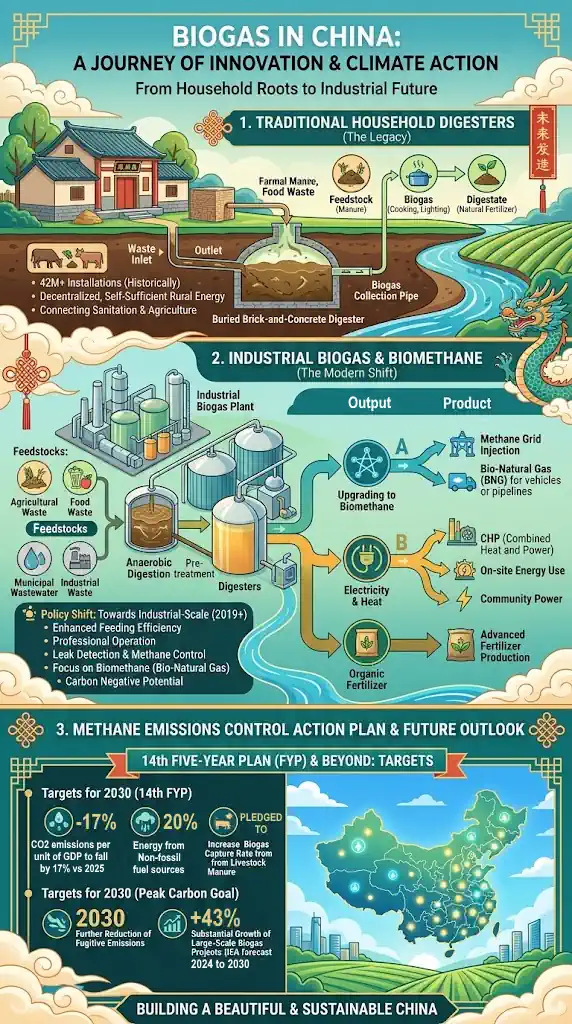
According to the International Energy Agency’s Renewables 2023 report, almost 42 million household digesters had been installed in China by 2015, following substantial investment support.
That figure describes historical installations. It should not be presented as the number of digesters operating today, or used on its own to calculate current gas production.
The same report identifies a policy shift towards engineered combined heat and power plants in 2015, followed by greater emphasis on large biomethane projects from 2019.

Why the Industry Is Moving Towards Larger Plants
The IEA’s Renewables 2025 assessment reports a decline in active household digesters alongside a shift in support towards industrial-scale projects. It also records continued growth in Chinese biogas production during 2024 and new investment by domestic and overseas businesses.

This changes how the industry should be assessed. Counting household digesters is useful historical context, but evaluating modern projects requires attention to feedstock contracts, operating performance, gas quality and customers.
A larger digester is not automatically a successful digester. Its economics still depend on receiving suitable material consistently, keeping the biological process stable and finding a valuable use for the energy produced.
Biogas and Biomethane Are Different Products
Raw biogas contains methane, carbon dioxide and smaller quantities of other constituents. Depending on its intended use, it needs treatment to remove moisture, hydrogen sulphide and other contaminants.
It can then supply suitable boilers or engines. Alternatively, upgrading removes much of the carbon dioxide to produce a methane-rich gas known as biomethane. Chinese industry sources also use the term bio-natural gas, often abbreviated to BNG.
Biomethane must meet the relevant quality and connection requirements before entering a gas network. Producing raw biogas does not automatically make a plant ready for grid injection.
For a fuller explanation, read our guide to upgrading biogas to biomethane. Our comparison of biogas upgrading technologies explains the main equipment options.
What Is Chinese Biogas Used For?
The appropriate use depends on the plant’s location, gas output and available customers.
- Cooking: a familiar application for household systems, using appropriate biogas appliances and safe gas installations.
- Electricity: treated biogas can fuel suitable generating engines.
- Combined heat and power: an engine generates electricity while recovered heat serves a useful thermal demand.
- Industrial heat: suitable equipment can use biogas or biomethane as a fuel.
- Gas supply: upgraded biomethane can serve customers through approved network connections or other suitable delivery arrangements.
Our guide to the uses and applications of biogas explains these options in more detail.
Feedstock Supply and Digestate Still Matter
Any assessment of a Chinese biogas project should begin with its actual feedstock, rather than a national estimate of organic waste availability.
Useful questions include:
- What materials will the plant receive, and how variable are they?
- How far must they travel?
- Who is responsible for removing packaging, grit or other contaminants?
- Are supply arrangements secure enough to support the proposed plant?
- Where will the digestate go throughout the year?
Digestate management deserves the same attention as gas sales. Storage, transport, nutrient planning and suitable outlets all affect whether a project operates successfully.
Digestate is the residual material from digestion, that can be used as a natural fertiliser. Likewise, recovering carbon dioxide during gas upgrading is a separate activity from managing organic carbon in soil. Neither should be treated as automatic evidence of permanent carbon storage, but in many uses this can be the climate change ameliorating effect.

Environmental Benefits Depend on Plant Operation
Capturing gas from organic materials can provide renewable energy and improve waste management. However, environmental performance depends on the whole system.
Methane escaping from equipment or storage reduces the climate benefit. Feedstock transport, energy consumption and digestate handling also matter. The IEA’s assessment of key issues affecting biogas and biomethane projects highlights methane control, covered digestate storage and leak detection and repair among the measures needed.
These are practical considerations for projects in China just as they are elsewhere. A plant’s renewable fuel label should be supported by reliable operation and credible emissions accounting.
China has a national policy to manage and limit fugitive methane emissions, centered on the Methane Emissions Control Action Plan released by the Ministry of Ecology and Environment (MEE) alongside ten other government agencies.
What Is the Outlook for Biogas Production in China?
The IEA’s 2025 main-case forecast projects growth of 23% in China’s combined biogas and biomethane production between 2025 and 2030. Within that outlook, medium- and large-scale projects grow by around 80%.
Those figures are forecasts, not completed results. They describe different parts of the market and should not be added together.
For readers following the industry, the most useful indicators are commissioned plants, sustained gas output and customers taking delivery. Announced projects and production targets are useful signals, but they do not demonstrate that the gas has been produced or sold.
China’s next phase of biogas development therefore deserves attention beyond its household-digester history. The key question is how effectively larger projects can turn available organic materials into dependable energy supplies while controlling emissions and managing digestate.
Frequently Asked Questions
Does China still use household biogas digesters?
Yes, although the IEA reports that the number of active units has declined. Historical installation totals should not be confused with the number operating today.
Is all biogas produced in China upgraded to biomethane?
No. Biogas can be used for heat and electricity without removing most of its carbon dioxide, provided it receives the treatment required by the equipment. Biomethane requires an additional upgrading stage.
How much biogas does China produce?
A useful answer must specify the reporting year and what is included. Household gas, industrial biogas and upgraded biomethane may be reported separately or combined. Gas volumes also need a clear definition because raw biogas and biomethane have different methane contents and energy values.
Are China’s biogas targets the same as actual production?
No. Targets describe intended outcomes, while forecasts estimate future development. Actual production needs to be established from dated operating or statistical data.