
Anaerobic digestion can help combat desertification by protecting vegetation, recycling nutrients and helping degraded soils retain more water. By converting manure and other organic wastes into renewable biogas and nutrient-rich digestate, AD provides useful energy while returning valuable nutrients and organic material to farmland.
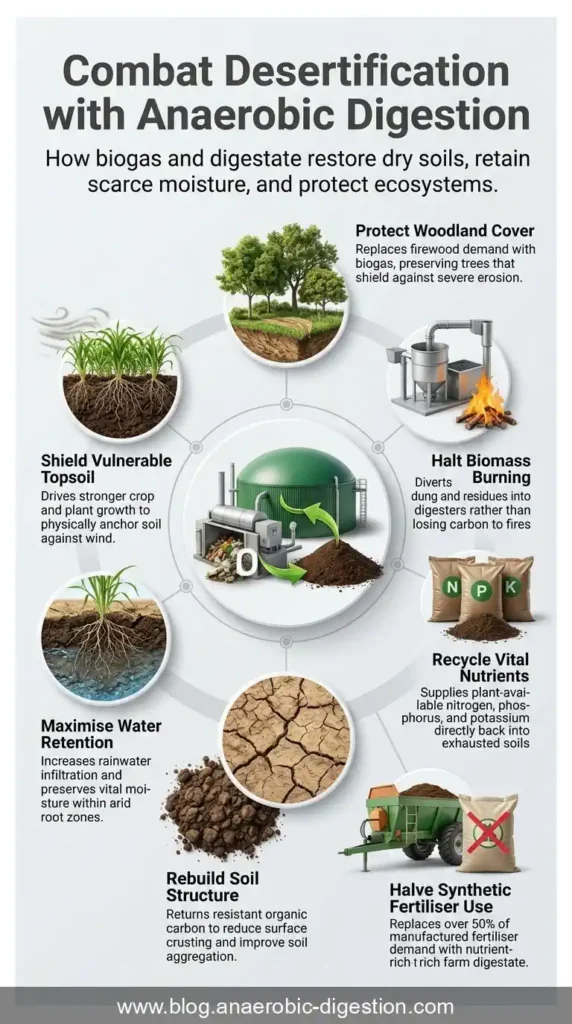
Its benefits work through two complementary pathways. Biogas can reduce the burning of fuelwood, animal dung and crop residues, relieving pressure on trees and keeping more organic material available for agricultural use. Digestate then returns nutrients and residual organic matter to the soil, supporting plant growth, soil structure, moisture retention and protective vegetation cover.
This combination makes anaerobic digestion one of several practical solutions to desertification in rural communities where energy shortages, vegetation loss and declining soil fertility occur together. AD will not address every cause, but within a well-managed farming system it can tackle several of the processes that turn productive land into degraded land.
Key takeaways
- Anaerobic digestion produces both renewable biogas and nutrient-rich digestate from manure and other organic materials.
- Biogas can replace some of the fuelwood and charcoal used for cooking, reducing pressure on trees and shrubs.
- It can also replace the burning of animal dung and crop residues, leaving more organic material available for agricultural use.
- Digestate returns nitrogen, phosphorus, potassium and residual organic matter to the soil.
- Healthier crops and better vegetation cover help protect vulnerable soil against wind and water erosion.
- Organic matter supports soil structure, water infiltration and moisture retention—valuable qualities in arid and semi-arid regions.
The greatest benefits are achieved when AD is combined with good digestate management, erosion control, responsible grazing and vegetation restoration.

What is desertification?
Desertification is often imagined as an existing desert advancing across the landscape. The internationally accepted meaning is broader.
The United Nations Convention to Combat Desertification defines it as land degradation in arid, semi-arid and dry sub-humid areas caused by climatic variations and human activities.
The United Nations uses the collective term drylands for those arid, semi-arid and dry sub-humid regions. It is a technical classification based on the relationship between rainfall and potential water loss through evaporation and plant transpiration. In this article, the more familiar terms arid and semi-arid regions are used wherever possible.
Desertification includes:
- loss of natural vegetation;
- wind and water erosion;
- declining soil fertility;
- deterioration of soil structure;
- reduced agricultural productivity; and
- the declining ability of land to support people, livestock and wildlife.
Anaerobic digestion helps because it addresses several of these problems together. It changes how households obtain energy, preserves organic resources for farming and supports the return of nutrients and organic material to the soil.
How anaerobic digestion helps combat desertification
The connection between anaerobic digestion and desertification becomes clear when we follow the organic material through the complete process.
- Animal manure and suitable organic residues are collected.
- The material is fed into an anaerobic digester.
- Microorganisms convert part of its biodegradable carbon into biogas.
- The biogas is used for cooking, heating, lighting or other energy needs.
- The remaining digestate is collected and returned to agricultural land.
- The nutrients and residual organic matter in the digestate support plant growth and soil condition.
- Healthier crops and vegetation provide more protection against erosion and land degradation.
The system therefore produces energy and recycles nutrients from the same organic resource. That combination gives AD an important advantage in areas where shortages of cooking fuel and declining soil fertility occur together.
1. Biogas reduces pressure on trees and shrubs
Many rural communities in arid and semi-arid regions depend on firewood or charcoal for cooking. When wood is harvested faster than trees and shrubs can regenerate, the gradual loss of vegetation leaves the land increasingly exposed.
Biogas can replace a substantial part of that fuel demand. Retaining trees and shrubs helps to:
- shield the soil from strong winds;
- intercept heavy rainfall;
- reduce the speed of surface runoff;
- hold soil together through established root systems;
- provide shade and reduce extreme surface temperatures;
- support water infiltration; and
- return leaves and other organic material to the ground.
These are valuable defences against land degradation. Once protective vegetation disappears, wind and water can rapidly remove fertile topsoil that may have taken centuries to develop.
A review published in Biomass and Bioenergy found that biogas has significant potential to reduce the portion of African deforestation associated with demand for woodfuel. The size of the benefit depends on where the wood comes from. Replacing wood cut unsustainably from living trees delivers the greatest environmental benefit.
The practical message remains positive: where fuelwood harvesting is contributing to vegetation loss, reliable biogas production can directly reduce that pressure.
2. AD preserves manure and crop residues for the land
Where firewood is scarce or expensive, households may burn dried animal dung, straw, stalks and other crop residues. These materials provide essential cooking energy, but burning them removes resources that could otherwise support soil fertility.
Anaerobic digestion provides a better circular route. Manure is used to produce biogas, and the remaining digestate can still be returned to farmland.
This allows the same organic resource to perform two useful jobs:
- Biogas provides energy for the household.
- Digestate returns nutrients and residual organic material to the farm.
The benefit is particularly strong when the alternative is burning dung or crop residues. Instead of losing most of their carbon and nitrogen to the atmosphere, the farmer obtains useful energy and retains a valuable fertilising material.
Crop residues are not all equally suitable for a small digester, particularly when they are dry, fibrous or difficult to break down. Some may be more valuable as animal bedding, surface mulch or compost. The best system uses each available material in the way that provides the greatest combined benefit to the household, livestock and soil.
3. Digestate recycles valuable plant nutrients
Digestate contains nutrients that originated in the digester feedstock. These commonly include:
- nitrogen;
- phosphorus;
- potassium;
- sulphur;
- calcium and magnesium; and
- smaller quantities of trace elements.
During anaerobic digestion, some of the organic nitrogen is converted into ammonium nitrogen, a form that crops can absorb readily. Phosphorus and potassium are also retained within the digestate, although their distribution between liquid and solid fractions will vary.
When applied at the right rate and time, digestate can support crop growth and reduce the amount of purchased fertiliser required. This can be especially valuable in communities where mineral fertilisers are expensive, difficult to obtain or used only in very small quantities.
A UK government-supported study in Uganda found that crops treated with digestate produced significantly higher yields than untreated controls. In those trials, the yields were not significantly different from crops treated with urea or compost.
The result demonstrates that digestate can be a genuinely useful fertiliser. Its exact nutrient value will depend on the original feedstock, the digester and the way the material is stored and applied.
For more practical information, see our guide to using digestate as a fertiliser and soil amendment.
4. Digestate returns organic material to depleted soils
Anaerobic digestion converts part of the easily degradable carbon in manure into methane and carbon dioxide. A proportion of the more resistant organic material remains in the digestate and can be returned to the soil.
This residual organic matter can contribute to:
- better soil aggregation;
- improved resistance to surface crusting;
- greater water infiltration;
- more effective moisture retention;
- increased biological activity; and
- better conditions for plant roots.
These benefits are particularly valuable where the alternative is burning the original manure or allowing it to be lost from the farming system.
Regular additions of suitable organic materials help soil particles form more stable aggregates. These aggregates allow water and air to move through the soil while making it less vulnerable to being carried away by wind or runoff.
Digestate can form part of this soil-restoration process. Where greater additions of fibrous carbon are needed, it can be combined with compost, retained crop residues, cover crops, animal bedding or other locally available organic materials.
5. Organic matter helps soil retain precious water
Water is the limiting resource in most areas threatened by desertification. Increasing rainfall is beyond the control of the farmer, but improving the proportion of rainfall that enters and remains in the soil is often possible.
Soil containing well-managed organic matter generally has a better structure than severely depleted soil. Rainfall can enter more readily instead of immediately running across a sealed or crusted surface. More moisture remains available within the root zone to support crops between rainfall events.
This produces several connected benefits:
- less surface runoff;
- reduced water erosion;
- more moisture available to plant roots;
- better crop establishment;
- greater resilience during short dry periods; and
- more persistent vegetation cover.
The improvement will vary with soil texture, climate, application rate and the other organic materials being used. Sandy soils, clay soils and badly eroded soils will not respond identically. Nevertheless, recycling organic material is an established part of rebuilding soils whose structure and moisture-holding capacity have deteriorated.
6. Stronger plant cover helps combat desertification
Bare soil is highly vulnerable. Raindrops strike it directly, runoff carries fine particles downhill and wind lifts dry topsoil from the surface.
Healthy vegetation creates several layers of protection:
- leaves intercept rainfall;
- stems slow wind near the surface;
- roots bind the soil;
- plant residues cover the ground; and
- root channels help water enter the soil.
By supplying plant-available nutrients and supporting soil condition, digestate can help crops establish more successfully and produce stronger root and leaf growth. Better crop cover then reduces the period during which the soil remains bare and exposed.
This completes the connection between anaerobic digestion and desertification. Fighting desertification requires the protection of vegetation, soil fertility and scarce water resources—three areas in which well-managed biogas and digestate systems can make a practical contribution.
Organic wastes and manure → anaerobic digestion → renewable biogas and digestate → reduced biomass burning and improved nutrient recycling → stronger crops and vegetation → less erosion and land degradation.
Evidence from household biogas projects
Experience from African household-biogas projects shows how large some of these changes can be.
A 2022 study examined 182 households using biogas in the Arba Minch area of southern Ethiopia. Following adoption of biogas, the researchers recorded average reductions of:
- 66% in firewood consumption;
- 72% in charcoal consumption;
- 68% in dung-cake consumption; and
- 89% in crop-residue consumption.
Households applying digestate also reported reducing their use of manufactured fertiliser by just over 50%.
These results demonstrate the combined value of the technology: less dependence on traditional biomass fuels and improved recycling of agricultural nutrients.
The study also found that households continued to use wood and charcoal for some cooking. In particular, the available biogas stoves were unsuitable for baking injera, the staple Ethiopian flatbread. Appropriate appliances are therefore an important part of the system. Biogas will displace more traditional fuel when it can meet the community’s actual cooking requirements.
Research from Uganda has similarly demonstrated the fertiliser value of digestate, while wider studies of Sub-Saharan Africa have identified cattle manure as a particularly important potential feedstock for household digesters.
Making the land-restoration benefits happen
Successful anaerobic digestion projects match the technology to local resources, farming practices and household needs. The following factors help turn the potential benefits into lasting results.
A dependable supply of organic feedstock
The household or community needs enough collectable manure or other suitable organic material to feed the digester regularly. This is easier where livestock are housed for part of the day than in extensive grazing systems where manure is widely dispersed.
A sustainable source of process water
Many small digesters require manure to be mixed with water. This must be planned carefully in low-rainfall regions. Reusing suitable household wastewater may reduce demand for clean water, provided that hygiene and contamination risks are properly controlled.
Biogas appliances suited to local cooking
A digester delivers its greatest vegetation benefit when biogas replaces a substantial proportion of wood and charcoal. Stoves and burners must therefore accommodate the foods, utensils and cooking temperatures used locally.
Good digestate storage
Digestate should be contained so that its nutrients are not lost through leakage, runoff or unnecessary exposure. Covering storage can help conserve ammonium nitrogen and prevent rainwater from creating excessive volumes.
Application when crops need nutrients
Applying digestate close to the period of crop demand improves nutrient uptake. Incorporation or low-emission application can reduce ammonia losses where farming methods and soil conditions allow.
Safe handling
Anaerobic digestion can reduce many pathogens, but a small digester operating at ambient temperature does not sterilise manure. Sensible hygiene, suitable storage and careful agricultural application remain essential.
Maintenance and local support
A functioning digester provides benefits year after year. Users need practical training, access to repairs and an understanding of routine feeding, mixing and maintenance. Long-term support is often more valuable than simply increasing the number of installations.
Anaerobic digestion among the wider solutions to desertification
Anaerobic digestion is one of several complementary solutions to desertification. It becomes even more effective when combined with other measures that protect soil, conserve water and restore vegetation.
The most effective desertification solutions may include:
- agroforestry and protection of existing trees;
- controlled grazing;
- restoration of degraded pasture;
- cover crops and mulching;
- retention of suitable crop residues;
- composting of fibrous organic materials;
- contour cultivation and erosion-control banks;
- rainwater harvesting;
- appropriate irrigation management; and
- soil testing and nutrient planning.
AD contributes energy and nutrient recycling to this wider programme. Biogas helps protect woody vegetation and preserves manure for agricultural use. Digestate supports soil fertility and crop cover. Better-managed soil then captures water more effectively and resists erosion.
For further examples of how recovered gas can benefit households, farms and communities, see our guide to the 10 most important uses of biogas.
A practical way to combat desertification
Anaerobic digestion provides a practical way to combat desertification by connecting renewable energy production with the restoration and protection of agricultural resources.
Where biogas replaces unsustainably harvested fuelwood, more trees and shrubs can remain in the landscape. Where it replaces burning dung and crop residues, more of those organic resources can return to farmland. When the resulting digestate is well managed, it supplies nutrients, residual organic matter and support for healthier crop growth.
That stronger vegetation protects the soil, reduces erosion and helps rainfall remain available to plant roots.
AD is therefore much more than a way to produce methane. In regions where energy scarcity, declining soil fertility and vegetation loss reinforce one another, it provides a practical way to begin breaking that cycle.
Frequently Asked Questions
How can anaerobic digestion help combat desertification?
Anaerobic digestion helps combat desertification by reducing pressure on trees, preserving manure and crop residues for agricultural use, and producing digestate that supports soil fertility, water retention and protective vegetation cover. It achieves the greatest impact alongside good water, grazing, cultivation and vegetation management.
What are the most effective ways to stop desertification?
The most effective solutions to desertification combine soil, water and vegetation management. They include protecting trees, controlling grazing, reducing erosion, retaining organic matter, harvesting rainwater, growing cover crops and applying nutrients responsibly. Anaerobic digestion supports these measures by providing biogas and returning valuable digestate to farmland.
How does biogas help protect forests and woodlands?
Biogas provides an alternative cooking fuel. Where households currently depend on unsustainably harvested wood or charcoal, replacing part of that demand reduces pressure on trees and shrubs. Retained vegetation helps shield the soil from wind, intense rain and excessive runoff.
Why is burning animal dung harmful to soil fertility?
Dung contains nitrogen, phosphorus, potassium and organic material that can benefit farmland. Burning it provides energy but prevents most of those resources from being returned to the soil. Anaerobic digestion produces energy while preserving much of the fertiliser value in the digestate.
Does digestate contain organic matter?
Yes. The digestion process converts part of the biodegradable carbon into biogas, but more resistant organic material remains in the digestate. Returning it to farmland can contribute to soil aggregation, biological activity and improved soil condition.
Can digestate improve soil water retention?
Digestate contributes organic material that can support soil structure, water infiltration and moisture retention. The improvement depends on the soil, feedstock, application rate and other land-management practices. Combining digestate with compost, mulch, cover crops or retained plant residues can strengthen the effect.
Is digestate better than raw manure?
Each has advantages. Digestate contains a larger proportion of its nitrogen in readily plant-available ammonium form and is produced alongside useful renewable energy. Raw manure retains more of its original carbon. The best choice depends on crop requirements, soil condition and how efficiently each material can be stored and applied.
Can digestate replace manufactured fertiliser?
Digestate can replace part of the requirement for manufactured fertiliser by supplying nitrogen, phosphorus, potassium and other nutrients. The amount replaced should be based on digestate analysis, soil conditions, crop requirements and expected nutrient availability.
Do household anaerobic digesters require water?
Most wet household digesters require water to produce a pumpable mixture of manure and organic material. Projects in arid regions therefore need a sustainable water plan. Suitable reused water may sometimes be employed so that scarce clean water is not unnecessarily consumed.
Does anaerobic digestion kill pathogens in manure?
Anaerobic digestion can reduce pathogen numbers, but small digesters operating at ambient temperature should not be regarded as sterilisation systems. Digestate must still be stored, handled and applied hygienically.
Are these benefits limited to small household digesters?
No. Farm and community-scale AD plants can also reduce biomass burning and improve nutrient recycling. Household digesters provide the most direct connection between cooking fuel, manure management and local soil fertility, while larger plants require effective digestate storage, transport and distribution systems.
References and further reading
- United Nations Convention to Combat Desertification: Convention Text. See Article 1 for the definitions of desertification, land degradation and arid, semi-arid and dry sub-humid areas.
- Subedi, M. et al. (2014). Can biogas digesters help to reduce deforestation in Africa? Biomass and Bioenergy, 70, 87–98. DOI: 10.1016/j.biombioe.2014.02.029.
- Smith, J. et al. (2014). What is the potential for biogas digesters to improve soil fertility and crop production in Sub-Saharan Africa? Biomass and Bioenergy, 70, 58–72. DOI: 10.1016/j.biombioe.2014.02.030.
- Smith, J.U. (2013). The potential of small-scale biogas digesters to improve livelihoods and long-term sustainability of ecosystem services in Sub-Saharan Africa. University of Aberdeen final report.
- Mengistu, M.G. et al. (2016). The environmental benefits of domestic biogas technology in rural Ethiopia. Biomass and Bioenergy, 90, 131–138. DOI: 10.1016/j.biombioe.2016.04.002.
- Tekle, T. and Sime, G. (2022). Technical potential of biogas technology to substitute traditional fuel sources and chemical fertilizers and mitigate greenhouse gas emissions: the case of Arba-Minch Area, South Ethiopia. The Scientific World Journal. DOI: 10.1155/2022/6388511.