
As a technically minded guy, I seldom think about obtaining anaerobic digestion planning permission for projects, but I should, because without consent to build, the AD industry will fail to grow. A few days ago, an anaerobic digestion developer contacted me with a question.
He is developing biomethane plants in Europe and finding that local communities are worried about two things in particular: odour and traffic.
He wanted to know whether we had experienced the same problem in the UK.
I thought I knew the answer. I’ve worked around anaerobic digestion for decades and I’ve certainly seen my share of planning objections.
But rather than simply reply from experience, I decided to look at what has actually been happening to planning applications in England.
What I found surprised me.
Three substantial rural anaerobic digestion plants were refused planning permission in England in just 59 days during the summer of 2026.
And they weren’t the first.
That led me to ask whether anaerobic digestion planning permission is becoming genuinely harder to obtain in England – or whether we are simply seeing the familiar local opposition that accompanies almost any large new development in the countryside.
The answer, I think, is more complicated – and considerably more interesting – than either explanation on its own.
Key Takeaways
- Three substantial rural AD proposals were refused in England in just 59 days between July and September 2026.
- Several other significant AD proposals have been refused during the preceding two years, sometimes despite planning officers recommending approval.
- The recurring concerns are remarkably similar: traffic, odour, landscape impact, scale, pollution risk and the industrialisation of the countryside.
- However, new anaerobic digestion plants are still being approved. This is not evidence that England has stopped consenting AD.
- There are interesting examples of established AD sites obtaining permission for expansion, suggesting that familiarity with a well-run plant may sometimes reduce community anxiety.
- England simultaneously wants more renewable energy, better organic-waste recycling and greater energy security. That creates a difficult question: where are the additional AD and biomethane plants going to go?

NIMBY Is Alive and Well – But Let’s Be Fair
NIMBY stands for “Not In My Back Yard.”
It is normally used to describe somebody who supports something in principle – renewable energy, waste recycling, new housing, wind turbines, electricity infrastructure or whatever else it might be – provided it isn’t built close to them.
There is undoubtedly an element of NIMBYism in the planning debate surrounding some anaerobic digestion plants.
But I don’t think people in the AD industry should use that expression to dismiss everyone who objects to a proposed plant.
Some of their concerns are perfectly understandable.
If somebody proposed several enormous digester tanks near my home and then told me that dozens of additional HGVs and tractors would be travelling along the local roads every day, I would want to know a great deal more about it too.
Modern biomethane plants can be large developments.
They may include digesters, feedstock reception and storage areas, silage clamps, digestate storage, gas upgrading equipment, carbon dioxide recovery equipment, grid connections and substantial areas of hardstanding.
And there is one unavoidable fact that developers cannot design away:
Everything that goes into an anaerobic digester has to get there somehow – and much of what comes out ultimately has to leave again.
For a large rural plant processing tens of thousands of tonnes each year, that can mean a considerable number of vehicle movements.
It is therefore hardly surprising that traffic appears again and again in contentious AD planning applications.
Three Refusals in 59 Days
The sequence that particularly caught my attention began in July 2026.
Cotswold Water Park – Refused
On 17 July, councillors rejected plans for an anaerobic digestion facility at Cotswold Water Park on the Wiltshire-Gloucestershire border.
The proposed plant would have processed approximately 91,000 tonnes of agricultural feedstock each year and produced around 10 million cubic metres of renewable biomethane, together with digestate fertiliser and recovered carbon dioxide.
The applicant estimated an average of around 35 to 40 lorry movements a day. Opponents argued that movements could rise substantially during harvest periods.
The application attracted about 1,850 objections, and concerns included traffic, the rural road network, landscape effects and potential pollution.
Interestingly, farmers also attended the meeting in support of the development, arguing that it would provide an additional market for agricultural materials.
So even this was not a simple case of “developer versus countryside”. There were people from the farming community on both sides of the argument.
Hornage Farm – Refused
Then, on 2 September, another major anaerobic digestion proposal was refused at Hornage Farm in Buckinghamshire.
This case is particularly interesting because planning officers had recommended approval.
Opposition, however, was substantial. Eight parish councils objected and a petition attracted more than 1,600 names.
The concerns again sound familiar: highways and road safety, landscape, local amenity, heritage and the overall scale and location of the development.
After considering the application, Buckinghamshire Council’s Strategic Sites Committee went against the officer recommendation and refused permission.
That distinction is worth remembering.
It suggests that the challenge facing some new AD plants isn’t necessarily that they cannot satisfy professional planning assessment. There can also be a substantial gap between a technically supportable application and what elected councillors believe their communities should be expected to accept.
Marigold Farm – Refused
Just 12 days later, on 14 September, another proposed anaerobic digestion plant came before councillors at Marigold Farm, Great Bowden, Leicestershire.
Once again there had been substantial local opposition, and once again concerns included the size and industrial character of the development, traffic, odour and its effect on the surrounding countryside.
The application was refused.
Three substantial rural AD projects had therefore been refused in England in less than two months.
That doesn’t prove that England has suddenly become hostile to anaerobic digestion.
But it was enough to make me look further back.
And These Weren’t Isolated Cases
Other significant proposals have run into trouble during the last couple of years.
A large proposed anaerobic digestion and carbon-capture development near Sewstern in Lincolnshire was refused in January 2025. Again, officers had recommended granting planning permission.
The proposed Whitwick Manor AD plant in Herefordshire was also refused and is now the subject of a planning appeal.
Another proposal at Spring Grove Farm near Haverhill encountered substantial public opposition before being refused in 2025.
The details vary from site to site, and it would be wrong to lump every refusal together.
But certain themes keep returning.
- How many HGVs and tractors will use local roads?
- Will the plant smell?
- Is the development too large for its rural surroundings?
- What will it do to the landscape?
- Could there be pollution of nearby watercourses or groundwater?
- Where will the feedstock come from?
- Where will the digestate go?
- And increasingly: is this really agricultural diversification, or is it an industrial development being placed in the countryside?
I think that last question deserves particular attention.
When Does a Farm AD Plant Become an Industrial Plant in the Countryside?
Twenty years ago it was relatively easy to picture a “farm digester”.
A farmer puts manure, slurry and perhaps some crops into a digester, produces biogas and uses the energy on the farm.
Today’s commercial biomethane project can be something quite different.
A large plant may import tens of thousands – or more than 100,000 – tonnes of feedstock each year, upgrade its biogas to biomethane, export gas to the grid, recover carbon dioxide and distribute digestate across a considerable area.
Technically, that development makes a great deal of sense.
But viewed from a nearby village, it can look much more like an industrial processing facility than an extension of traditional farming.
That appears to be one of the central tensions now emerging in rural AD planning.
The industry has become more sophisticated, efficient and ambitious.
But bigger and better plants can also be much harder to hide in the landscape – and they need more material moving to and from them.
But England Is Still Approving Anaerobic Digestion Plants
There is an important warning here before anyone concludes that the planning system has turned against AD.
It hasn’t.
On 7 September 2026 – right in the middle of the refusal cluster – councillors approved a substantial new biogas development at Anwick near Sleaford in Lincolnshire.
That proposal is for a plant capable of processing around 120,000 tonnes of chicken waste and other feedstock each year.
The plans include eight digester tanks around 25 metres high, and local opposition included a petition signed by more than 600 people.
There was another remarkable feature.
Planning officers had recommended refusal.
Yet councillors approved the application, concluding that its public benefits – including renewable energy, employment and economic benefits – outweighed the disadvantages.
Think about that alongside Hornage Farm.
At Hornage, officers recommended approval and councillors refused it.
At Anwick, officers recommended refusal and councillors approved it.
If nothing else, that tells us that anaerobic digestion planning permission remains highly dependent on the circumstances of the individual site.
The Curious Case of the AD Plant That Is Already There
There is another aspect of this subject that particularly interests me.
Over the years I have been told by operators that local attitudes can become considerably more relaxed once an AD plant has been operating successfully for some time.
That is anecdotal. I haven’t found national statistics that prove it.
But there are certainly planning cases that make the idea worth investigating.
Established AD facilities at places such as Station Farm in Lincolnshire and Westwood in Northamptonshire have subsequently obtained permission for extensions or increased capacity. At Hemswell Cliff, permission was granted for another AD facility alongside an existing plant.
That doesn’t prove that existing sites always have an easy ride. They don’t.
But there is a perfectly plausible reason why familiarity might make a difference.
A completely new AD plant exists in people’s imaginations.
They imagine the smell. They imagine constant noise. They imagine tractors queueing through the village. They imagine what those huge tanks might look like from their bedroom window.
Once a well-operated plant has been there for several years, residents have something real to judge instead.
And sometimes the reality may be considerably less alarming than the original fear.
The planning application shows residents what might happen. An operating AD plant shows them what actually happens.
The maintenance gang patronises the village shop, a local lad gets an apprenticeship, and the biogas business sponsors the local youth football teams with brand new kit. Odours don’t happen, or may even be less than previous fresh manure land-spreading, and trees grow around those big tanks, softening the landscape.
That may help explain why expanding a good existing site can sometimes be easier than starting again on an untouched greenfield location.
Don’t Wait for the Planning Application to Meet Your Neighbours
This brings me back to the developer whose question started me looking into all this.
One piece of advice I gave him was very simple:
If you are developing a new biogas plant, start engaging with the local community now.
Don’t make the first contact between the project and its neighbours a formal planning notice.
Show people the initial plans. Explain what the plant will do. Explain where the feedstock will come from and where the digestate will go.
And be completely open about traffic.
If somebody points out that your proposed HGV route passes a school, a dangerous junction or a narrow row of houses, listen to them.
They may know something about that road that your transport consultant doesn’t.
Better still, where possible, invite local residents and councillors to visit a well-run anaerobic digestion plant already in operation.
A computer-generated image showing enormous circular tanks can look alarming.
Standing beside an established plant and discovering that it isn’t excessively noisy, isn’t surrounded by a permanent cloud of odour and hasn’t destroyed the neighbouring community may be considerably more persuasive than another 100 pages added to a planning statement.
Developers can also become part of the community long before asking that community to accept a major development.
Supporting the local football team, village event or community project isn’t going to make an unsuitable development acceptable – and nor should it.
But there is a substantial difference between being a business that participates in a community and arriving as a previously unknown developer with a planning application for an industrial-scale plant.
The Bigger Problem: The Costs Are Local but the Benefits Are Not
I think this is where we reach the heart of the problem.
The disadvantages of an anaerobic digestion plant are intensely local.
The person living beside the access road gets the lorries.
The nearby village sees the tanks.
The immediate neighbours carry the risk that poor management might result in odour.
But many of the benefits occur much further away.
A well-designed and well-operated AD plant can:
- produce renewable biogas and biomethane;
- recycle food waste, manure and other organic materials;
- capture methane that might otherwise be released;
- produce digestate that can replace part of the requirement for manufactured fertiliser;
- provide a storable renewable fuel;
- reduce dependence on fossil natural gas;
- potentially recover biogenic carbon dioxide for useful applications; and
- support rural businesses and employment.
Those are genuine benefits.
But telling somebody who lives beside a proposed haulage route that the development contributes to national energy security doesn’t make the lorries disappear.
Planning therefore has to reconcile a rather awkward geographical mismatch: local communities experience most of the disruption while many of the benefits are regional or national.
That is not unique to anaerobic digestion. Electricity pylons, wind farms, reservoirs, roads and many other forms of essential infrastructure create exactly the same problem.
Yet Britain Needs Much More Biomethane
This makes the planning question particularly important.
The Parliamentary Office of Science and Technology (POST) reported in July 2026 that there were around 750 municipal, commercial and smaller agricultural AD plants operating in the UK as of March 2026.
POST estimated that they were producing around 21 TWh of biomethane annually, with about 7 TWh being injected into the gas grid.
It also highlighted a National Energy System Operator future-energy scenario involving 64 TWh of biomethane production by 2050.
Whatever precise future pathway Britain ultimately follows, that points toward the possibility of a much larger biomethane sector.
At the same time, England’s requirement for weekly household food-waste collections is increasing the amount of separately collected organic material requiring suitable treatment.
So here is the uncomfortable question.
If we want more organic waste recycled through anaerobic digestion, more renewable gas and less dependence on fossil fuels, but communities increasingly resist large new rural AD plants…
where exactly are the additional anaerobic digestion plants going to go?
The Planning Rules Are Changing Too
The timing of all this is interesting because England’s planning system is itself changing.
A new National Planning Policy Framework (NPPF) was published on 17 August 2026 – actually during the period in which these three recent AD refusals occurred.
It is therefore far too early to judge what effect the new framework will ultimately have on anaerobic digestion planning applications.
What is clear is that the government wants a planning system capable of delivering necessary infrastructure more efficiently while still taking proper account of local impacts.
AD may provide a particularly interesting test of whether those two ambitions can be reconciled.
So Is Anaerobic Digestion Planning Permission Getting Harder?
I don’t think the available evidence allows me to say that – at least not statistically.
The Department for Energy Security and Net Zero maintains the Renewable Energy Planning Database (REPD), and it is extremely useful for following renewable energy projects through planning, construction and operation.
But it primarily tracks renewable electricity projects above its capacity threshold. Modern biomethane-to-grid developments don’t necessarily fit neatly into that dataset.
News reporting has the opposite problem: controversial refusals make news, while an uncontroversial delegated approval may receive almost no coverage.
It would therefore be misleading for me to calculate a national “AD refusal rate” from the information I have examined.
What I can say is that there has been a conspicuous cluster of significant rural AD refusals, and the same planning conflicts are appearing repeatedly.
Traffic. Scale. Landscape. Odour. Pollution concerns. Industrial development in rural locations.
And in several cases the controversy has been strong enough for councillors to reject applications that their own professional planning officers recommended approving.
That deserves attention from anyone planning the next generation of British biomethane plants.
Perhaps We Need to Build the Next Generation Differently
The answer cannot simply be that local communities should stop objecting.
Badly located AD plants should be refused.
Putting a very large plant at the end of an unsuitable rural road and then complaining about NIMBYism when residents object isn’t a sensible development strategy.
Instead, perhaps the current planning difficulties are telling the industry something useful.
Future plants may need to place even greater emphasis on:
- sites with direct access to suitable roads;
- avoiding HGV routes through villages wherever practicable;
- lower-profile plant design and effective landscaping;
- enclosed feedstock reception and robust odour control;
- co-location with food producers, waste facilities or other existing industrial infrastructure;
- making maximum use of successful established AD sites where expansion is appropriate;
- explaining vehicle movements honestly rather than burying them deep in a transport assessment;
- engaging communities before designs become fixed; and
- finding meaningful ways for host communities to share in the benefits.
Above all, developers need to recognise that planning permission isn’t merely an engineering exercise.
A technically excellent AD plant in the wrong location can still be a bad project.
Conversely, a well-sited plant whose developer has listened to neighbours, addressed genuine concerns and demonstrated what modern AD actually looks, sounds and smells like may have a very different reception.
NIMBY Is Alive and Well – But Something Else Is Happening Too
When I began researching this article, I expected to find the usual collection of local campaigns objecting to anaerobic digestion plants.
I certainly found those.
But I also found something more interesting.
I found large projects refused despite officer recommendations for approval.
I found remarkably similar arguments appearing in different counties.
I found communities struggling with the distinction between a farm development and an industrial renewable-energy facility.
I found other substantial plants being approved despite equally determined opposition.
And I found examples suggesting that once a well-run AD plant becomes an established neighbour, some of the fear surrounding it may diminish.
That last point may ultimately be one of the most important.
People fear what they don’t know.
The AD industry cannot eliminate every objection, and nor should planning authorities ignore legitimate concerns simply because a development produces renewable energy.
But developers can do a much better job of allowing communities to understand what they are actually being asked to live beside.
Don’t wait until the planning application is submitted.
Talk to the neighbours. Show them the plans. Discuss the traffic. Take them to an operating plant. Listen when they identify genuine problems.
And if the site really is wrong, perhaps listen to that too.
Because England faces a larger strategic question.
If the country wants significantly more biomethane, better recycling of organic wastes, greater use of digestate nutrients and less dependence on fossil natural gas, more anaerobic digestion infrastructure will have to be accommodated somewhere.
Finding places where the benefits outweigh the local costs – and bringing local communities along rather than confronting them at the planning committee – may become one of the biggest challenges facing the next phase of the UK’s AD industry.
Free Report: England AD Planning Report 2026
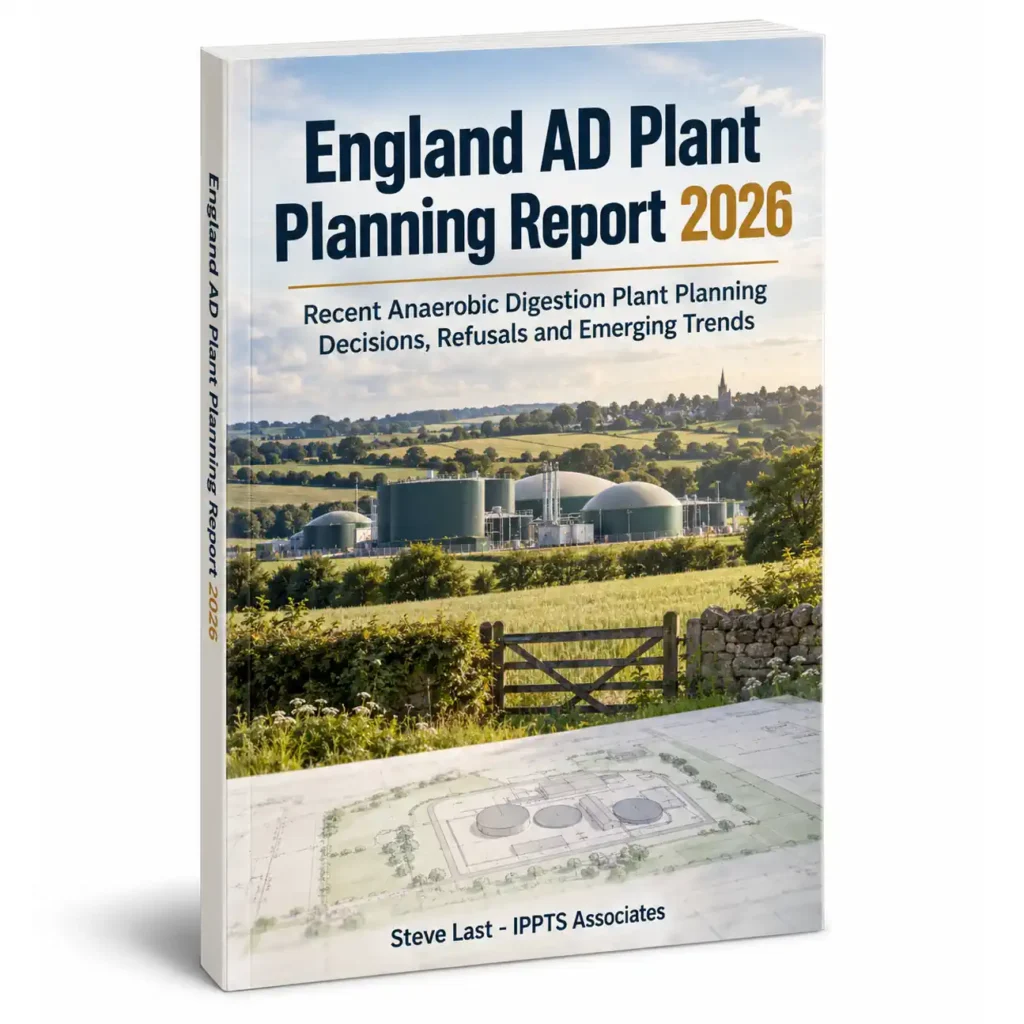
This article is based on a wider review of recent anaerobic digestion planning decisions in England.
I have prepared a free downloadable report bringing together the individual applications, planning outcomes, officer recommendations, principal objections and emerging planning themes behind this article.
The report will be particularly relevant to AD and biomethane developers, farmers, landowners, consultants, technology suppliers and others considering new projects.
It is available as a free download, with the option to pay whatever you think the research is worth.
England AD Planning Report 2026Note: We have omitted many links to our sources in this article, for brevity, but you will find them in the pdf.
Research Note
I have deliberately avoided claiming that England has experienced a statistically proven increase in the refusal rate for anaerobic digestion plants.
The research for this article used the UK Government’s Renewable Energy Planning Database alongside individual local authority planning records and contemporary reporting of significant applications.
The REPD is an extremely useful resource but does not provide a complete dataset for every modern biomethane development. Conversely, newspaper reporting naturally gives greater prominence to controversial applications and refusals than to routine approvals.
The cases discussed here should therefore be regarded as evidence of recent planning pressures and recurring themes, rather than a statistically complete sample of every English AD planning application.
Sources and Further Reading
The following sources were among those used in researching this article. Wherever possible I have linked to government, parliamentary or local-authority records rather than relying solely on secondary reporting.
- Department for Energy Security and Net Zero: Renewable Energy Planning Database (REPD) – quarterly extract. The July 2026 database was published in August 2026 and records renewable-energy projects through planning, construction and operation.
- Parliamentary Office of Science and Technology (POST): Upscaling Anaerobic Digestion, published 7 July 2026. This provides the UK AD plant numbers, biomethane-production estimates and discussion of future expansion used in this article.
- Ministry of Housing, Communities and Local Government: National Planning Policy Framework, published 17 August 2026.
- Leicestershire County Council: Marigold Farm anaerobic digestion planning application – Development Control and Regulatory Board, 14 September 2026. The page includes the main planning report, addenda, conditions and representations considered by the committee.
- Ministry of Housing, Communities and Local Government: Creating a Clear, Rules-Based Planning System, published 17 August 2026, setting out the government’s wider planning-reform programme.
Individual local-authority planning records and contemporary BBC and local-news reports were also consulted when checking the individual AD planning cases discussed above. A fuller case-by-case source list will be included in the forthcoming England AD Planning Report 2026.
This article was written by Steve Last, Chartered Civil & Environmental Engineer, Chartered Waste Manager and Chartered Environmentalist, drawing on more than 30 years of experience in environmental engineering, waste management, anaerobic digestion, biogas and associated infrastructure.