




Biogas technology in the UK is a proven renewable energy source that converts organic waste into electricity, heat and renewable gas. Anaerobic digestion (AD) plants use naturally occurring microorganisms to break down feedstocks—including agricultural residues, food waste, sewage sludge and purpose-grown crops—in the absence of oxygen. This process captures biogas (primarily methane and carbon dioxide), avoiding landfill disposal and reducing greenhouse gas emissions. The biogas can be used directly in combined heat and power (CHP) systems, upgraded to biomethane for injection into the gas grid, or refined for use as a low-carbon transport fuel.
The UK biogas industry has expanded significantly and is now a material part of the country’s renewable energy mix. As of March 2026, there are 750 anaerobic digestion plants in operation across the UK, generating an estimated 21 TWh of biomethane annually, with approximately 7 TWh injected into the gas network. This growth reflects both the maturity of the technology and increasing investment in waste-to-energy solutions as part of the UK’s transition to net zero.
Anaerobic Digestion in the UK: Current Scale and Development
Anaerobic digestion has become an established waste management and energy production tool across UK agriculture, food processing, wastewater treatment and waste sectors. The technology is now a key pillar of the UK’s energy security and climate change strategies.
Plant Distribution and Feedstock Types
The UK’s 750 operational AD plants operate across multiple sectors and feedstock types:
- Agricultural/farm-based plants remain the largest category, processing cattle slurry, poultry litter, crop residues and purpose-grown energy crops such as maize and wholecrop cereals
- Food waste digesters are expanding, processing waste from food manufacturing, retail, hospitality and households
- Wastewater treatment plants with integrated biogas recovery systems, treating sewage sludge to produce both renewable energy and a nutrient-rich digestate fertiliser
- Landfill gas capture systems, recovering methane from existing and historic landfill sites
- Stand-alone community and commercial digesters, increasingly designed for grid-injection of upgraded biomethane
The UK water industry is a particularly significant player, operating an extensive network of biogas plants at wastewater treatment sites. The UK currently ranks as the second-largest user of sewage sludge in anaerobic digestion within Europe, after Sweden, reflecting substantial investment in sewage biogas infrastructure.
A critical emerging trend is the shift toward grid-injection projects. Rather than generating electricity and heat on-site via CHP, more new plants are upgrading raw biogas to biomethane—a refined fuel with 95%+ methane content—for direct injection into the gas network. This approach offers greater flexibility, enables use across heat, transport and industrial sectors, and reduces reliance on fossil gas imports.
Recent Industry Growth Statistics
The scale of expansion reflects strong policy support and growing recognition of AD’s role in decarbonisation:
- 750 operational plants (as of March 2026)
- 21 TWh annual biomethane production
- 7 TWh grid-injected biomethane (approximately one-third of production currently enters the gas network)
- Industry growth trajectory: The sector has expanded substantially since the late 1990s, with most significant expansion occurring over the past 15 years
Source: Parliamentary Office of Science and Technology (POST), July 2026
Note: Strikethrough indicates that visitors must prove themselves to be human.

Biogas UK Map and Facility Information
The Anaerobic Digestion and Bioresources Association (ADBA) maintains an interactive map of active AD plants across the UK and a searchable database of operational and planned facilities. These tools are updated regularly and provide current information on plant location, capacity, feedstock type, technology, and operational status.
The ADBA map excludes wastewater treatment plants (tracked separately by water companies) but comprehensively covers agricultural, food waste, and commercial waste-to-energy facilities. Users and operators can submit updates and new facility information through ADBA’s formal update process.
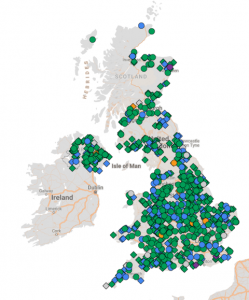
For strategic planning information on the AD sector, the NNFCC (National Non-Food Crops Centre) publishes annual biogas reports and feasibility studies via its Biogas Information and Co-ordinating Centre. These resources provide detailed analysis of the facility pipeline, feedstock potential and market trends.
UK Biomethane Production and Feedstock Potential
Biomethane—raw biogas that has been upgraded to remove carbon dioxide and other impurities—represents a critical renewable gas for the UK’s energy transition. Unlike electricity-based renewables, biomethane can be stored, transported via existing gas networks, and used flexibly for heating, heavy industry, transport and power generation.
Current Feedstock and Waste Volumes
The quantity of organic feedstock available for AD in the UK is substantial. The waste research body WRAP reports that the UK generates approximately 10.2 million tonnes of food waste annually across households, hospitality, food manufacturing, retail and wholesale sectors. In theory, if all of this food waste were treated using anaerobic digestion, the industry could generate 11 TWh of biogas—enough renewable energy to heat approximately 830,000 homes annually—while reducing emissions by 8.8 million tonnes of CO₂ equivalent, equivalent to roughly 2% of the UK’s total annual greenhouse gas emissions.
Seasonal waste peaks illustrate the scale of untapped opportunity. During the Christmas period alone, the UK generates approximately 270,000 tonnes of food waste. If processed through anaerobic digestion, this could produce 300 GWh of biogas, sufficient to heat 25,000 homes and avoid 236,000 tonnes of CO₂ emissions.
Beyond food waste, the UK has access to substantial agricultural residues, sewage sludge, and purpose-grown energy crops. These combined feedstocks represent a significant renewable resource base for expansion of the AD sector.
Biomethane Production Potential to 2050
The Green Gas Taskforce, a collaborative industry body, commissioned a detailed assessment of UK biomethane feedstock potential in 2025. The September 2025 report by Alder BioInsights, titled A Green Gas Future: Unlocking the Potential of Biomethane, provides updated guidance on sector scaling:
- 2030 target: 50 TWh of sustainable biomethane production annually (from current ~7 TWh grid-injected)
- 2050 target: 120 TWh of biomethane production annually, utilising wastes and residues from agriculture, food processing, sewage treatment and sustainably grown energy crops
- Feedstock sufficiency: Analysis concludes that sustainable feedstock availability is not the limiting factor for sector growth. Rather, constraints lie in policy frameworks, planning and permitting processes, grid access infrastructure, and investor confidence
- Carbon savings potential: Scaling biomethane production to these levels could achieve significant greenhouse gas reductions, particularly when displacing fossil gas in heating, transport and industrial applications
Source: Green Gas Taskforce, September 2025
This 2025 analysis updates earlier projections. A 2021 study commissioned by Cadent (the UK’s largest gas distribution network) had projected that renewable gas could heat up to 15 million homes annually by 2050; the more recent Green Gas Taskforce report provides greater technical detail on feedstock mobilisation, policy barriers and cost trajectories.
Biogas Energy Production Trends
The following chart illustrates historical biogas energy production in the UK from 2013 to 2018 (in metric kilotons of oil equivalent). While this data is now several years old, it provides context for the sector’s earlier growth trajectory:
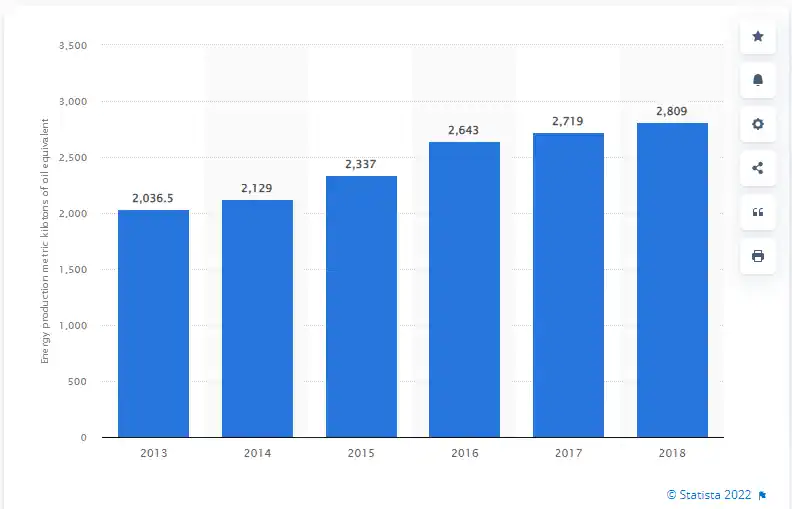
Note: This chart reflects 2013–2018 data. More current production statistics (2024–2026) are referenced in the main article and sourced from POST and industry databases.
Policy Support and Regulatory Framework
The UK government supports anaerobic digestion and biomethane production through several policy mechanisms:
Green Gas Support Scheme (GGSS)
The Green Gas Support Scheme, administered by Ofgem, provides financial support for biogas upgrade projects that inject biomethane into the gas network. The scheme is funded by a green gas levy applied to all licensed fossil fuel gas suppliers. This framework has been extended and now represents the primary support mechanism for new commercial biomethane projects, replacing earlier schemes such as the Feed-in-Tariff (FIT) and Renewable Heat Incentive (RHI), which closed to new applications.
UK Emissions Trading Scheme and International Policy
Under the UK Emissions Trading Scheme (UK ETS), the carbon accounting treatment of biomethane depends on its delivery method:
- Dedicated pipeline supply: Biomethane delivered directly via dedicated pipeline to an industrial end-user (such as manufacturing or power generation) qualifies as zero emissions under UK ETS rules
- Grid-injected biomethane: Gas injected into the public gas network does not currently qualify as zero emissions under UK ETS, as there is no accounting mechanism in place to track origin and end-use
- EU comparison: By contrast, under the EU Emissions Trading Scheme, grid-injected biomethane qualifies as zero emissions if certified by an approved scheme as meeting sustainability criteria
This regulatory difference has significant implications for project economics and deployment strategy, and remains an area of policy discussion between industry stakeholders and government.
Other Support Mechanisms for Biogas UK
Beyond direct energy support, anaerobic digestion projects may benefit from:
- Sustainable Farming Incentive (SFI): Government payments for farmers implementing sustainable practices, which can include on-farm AD for manure management
- Countryside Stewardship Scheme: Environmental grant schemes that support nutrient management and waste reduction through AD deployment
- Methane reduction commitments: The government’s Environment Agency Methane Action Plan 2024–2026 recognises AD as a key tool for reducing fugitive methane emissions from waste and agriculture sectors
Industry Challenges and Future Outlook
Despite substantial progress, the UK anaerobic digestion sector faces several barriers to accelerated growth:
Key Challenges
- Planning and permitting delays: Long lead times for planning approval and environmental permits slow project development timelines and increase capital costs
- Grid access constraints: Limited capacity in some regions of the gas distribution network to accommodate new biomethane injection points; grid infrastructure upgrades are necessary
- Fugitive methane emissions: The House of Lords Environment and Climate Change Committee has flagged concerns about methane leakage from AD plants and storage tanks, recommending stronger regulatory oversight and mandatory leak assessments
- Policy uncertainty: Gaps in long-term policy direction reduce investor confidence; clearer government commitment to biomethane targets and support mechanisms is needed
- Feedstock competition: As biomethane production scales, competition for sustainable feedstocks—particularly between transport (sustainable aviation fuel, HGV fuel), heating and power sectors—will intensify. Strategic planning is essential to direct biomass where it delivers greatest carbon and system-wide benefits
- Waste prevention alignment: Some stakeholders raise concerns that anaerobic digestion subsidies may create perverse incentives for food waste generation in the supply chain, rather than prioritising waste prevention and food redistribution programmes
Source: Parliamentary Office of Science and Technology (POST), July 2026 and House of Lords Library
Certification and Operational Standards
As the anaerobic digestion industry has matured, the importance of consistent operational standards has become clear. Poor operation of AD plants can lead to odour complaints, fugitive methane emissions, and loss of community support—issues that occasionally attract regulatory scrutiny.
In response, ADBA established the AD Certification Scheme to establish and promote best practice across the industry. The scheme provides trained and certified operators with formal recognition of compliance with high standards in plant installation, operation and maintenance.
Certification benefits include:
- Reduced insurance premiums for participating sites
- Improved operational reliability and biogas yield
- Enhanced community relations and environmental performance
- Access to industry knowledge sharing and technical benchmarking
- Demonstration of regulatory compliance and best practice adherence
A growing number of UK AD operators pursue certification, supporting the industry’s reputation and long-term viability. Ongoing investment in operator training and technical support helps reduce operational failures and environmental incidents.
The Strategic Role of Biogas in UK Energy Security and Climate Goals
Biogas and biomethane occupy a strategic position in the UK’s energy transition, complementing other renewables and supporting multiple policy objectives:
Key Strategic Benefits
- Flexibility and dispatchability: Unlike intermittent wind and solar, biogas can be produced and used on demand, providing a stable, controllable renewable energy source
- Waste reduction and circular economy: Anaerobic digestion diverts organic waste from landfills, where it would decompose anaerobically and release methane—a potent greenhouse gas—to the atmosphere. This circular approach recovers energy value from waste streams
- Nutrient recovery and soil health: The digestate residue from AD is nutrient-rich and can replace synthetic fertilisers, reducing reliance on energy-intensive chemical production and supporting agricultural sustainability
- Existing infrastructure utilisation: Biomethane can be distributed via the existing gas network, avoiding the need for parallel energy distribution systems and reducing infrastructure investment
- Rural economic development: AD plants create employment, income and investment opportunities in rural areas, supporting government “levelling up” and rural regeneration objectives
- Industrial decarbonisation: Biomethane can replace fossil gas in industrial processes where electrification is technically difficult or uneconomical, such as high-temperature heating, chemical manufacturing, and specialised food processing
- Transport decarbonisation: Refined biomethane can power heavy goods vehicles (HGVs) and maritime shipping, sectors where battery electrification faces significant technical and cost barriers
- Methane abatement: Anaerobic digestion directly reduces methane emissions from livestock manures and organic waste—a primary UK source of greenhouse gases
Government Policy Direction
The Department for Energy Security and Net Zero (DESNZ) and Ofgem increasingly recognise biomethane as a core component of the UK’s energy transition pathway. Recent policy consultations and budget announcements have signalled sustained government interest in the sector, though industry representatives continue to call for greater policy clarity, extended support scheme timelines, and streamlined planning and grid access processes to unlock the potential outlined in 2050 scenarios.
Current Industry Outlook and Future Prospects
The outlook for UK biogas and biomethane remains positive, though shaped by ongoing policy and investment dynamics:
Growth Drivers
- Policy continuity: The Green Gas Support Scheme continues to provide financial support, and government consultations on biomethane policy frameworks signal sustained political commitment
- Technology maturity: Anaerobic digestion equipment and biogas upgrading technologies are well-established, with proven suppliers and operators. Modular and smaller-scale systems are becoming more commercially viable
- Cost trajectory: Capital and operating costs for AD plants have declined in real terms over the past decade. Further cost reductions are expected as production volumes increase and technology matures
- Feedstock security: Abundant agricultural residues, food waste and sewage sludge ensure feedstock will not constrain growth, provided regulatory and market conditions align
- Institutional investment: Larger energy sector players and institutional capital are increasingly attracted to biomethane projects, signalling confidence in sector fundamentals
- Regulatory momentum: Government methane reduction targets and waste management policies actively support AD deployment
Investment and Development Pipeline
The UK anaerobic digestion sector has demonstrated resilience and expansion despite economic uncertainties. New large-scale biomethane plants have come online, and the pipeline of planned projects remains substantial. Industry bodies such as ADBA and the Renewable Energy Association (REA) continue to advocate for policy measures that would unlock faster growth, including:
- Streamlined planning and permitting processes
- Investment in gas grid infrastructure to accommodate biomethane injection
- Extended or expanded support scheme funding
- Regulatory clarity on carbon accounting for grid-injected biomethane
- Recognition of wider environmental and social benefits beyond energy production
The evidence suggests that biogas and biomethane will play a material and growing role in the UK’s energy transition. A combination of supportive policy, continued infrastructure investment, and operational excellence across the sector could enable the UK to move toward the 120 TWh biomethane production target by 2050, delivering significant emissions reductions, energy security benefits and support for rural development.
<
script>




You asked for comments. Well. Not good. Based upon other parts of this site, this page is disappointing. I had expected a decent list of United Kingdom biogas companies.