



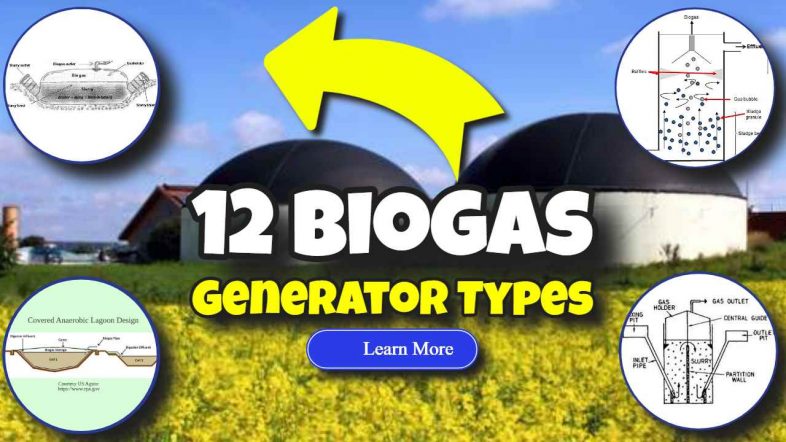
Many people want clean energy but struggle to find the right biogas generator for their needs. Choosing the wrong type can waste money and produce poor results. Different biogas systems work better for different situations, from small homes to large farms. 2
Food waste across Europe and the US increasingly feeds biogas plants, creating renewable energy whilst reducing landfill waste. 1 This shift helps tackle two major problems: energy needs and waste management.
Our guide covers 12 distinct biogas generator types, explaining how each system works and which situations suit them best. You’ll discover which biogas generator fits your specific requirements and budget. 3
Ready to find your perfect match?
Key Takeaways – for Our List of 12 Biogas Generator Types
- Twelve distinct biogas generator types range from simple balloon plants to advanced industrial systems, each suited for specific waste types and energy needs.
- Fixed dome plants provide a continuous household gas supply through 30-day digestion processes, whilst floating drum systems offer visual monitoring of gas production by viewing the drum height and a consistent gas pressure.
- Over 640 US landfills use gas-to-energy technology, with landfill power generation that exceeded solar energy production in New York and New Jersey in the 2000s.
- Methane proves up to 80 times more potent than carbon dioxide as a greenhouse gas, making biogas capture essential for reducing atmospheric emissions.
- Proper pH balance above 6.0 remains critical for methane production, as acidification below this level kills beneficial bacteria and stops gas generation.
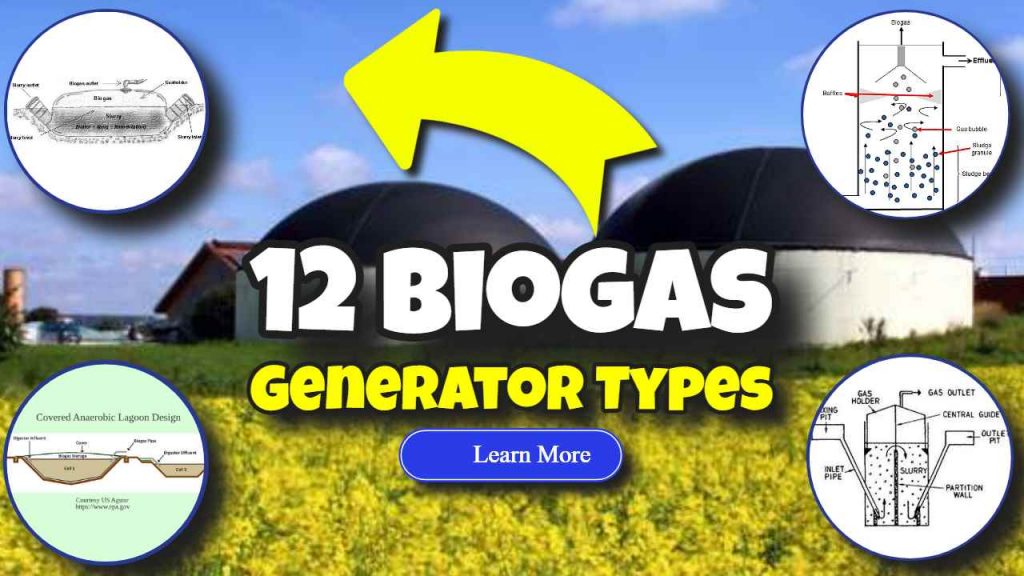
Common Types of Biogas Generators
A biogas generator is a biological process within a system that “generates” (i.e creates) biogas (a gas rich in methane). It is not a biogas generating set. That’s something quite different!
NOTE: This point is important because online searches and AI results frequently get this wrong. The full name of those generators is “biogas fuelled electric generator”!
The YouTube video below describes an electric generator that has been modified (converted) to run on biogas instead of diesel or any other traditional fuel. It is hard to acheive, unless you can find an electric generator designed to run on biogas and afford to buy it. We don’t recommend converting the fuel to a standard off-the-shelf electric generator. The person who uploaded the video below hit trouble himself, as the video explains (see below):

Biogas generators transform organic waste into clean energy through anaerobic digestion, offering sustainable alternatives to fossil fuels. These systems range from simple farm-scale digesters to advanced commercial plants, each designed for specific waste types and energy needs.
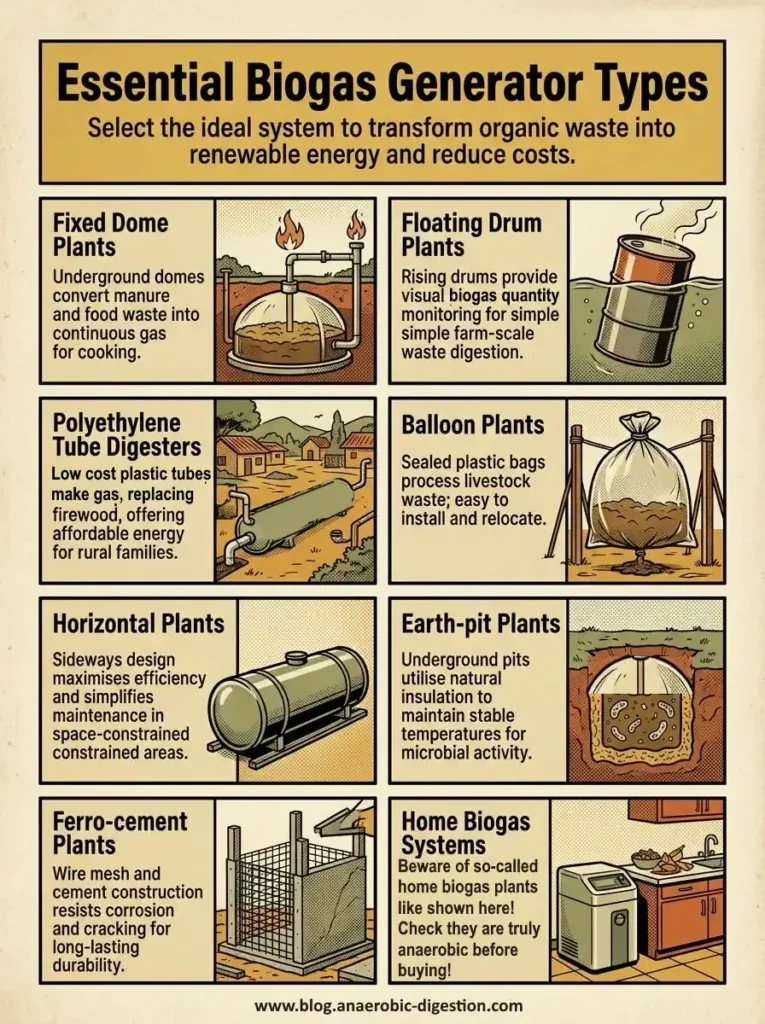
1. Fixed Dome: What are Fixed Dome Biogas Plants?
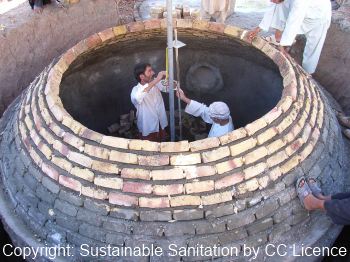
Fixed dome biogas plants feature a closed, dome-shaped digester that transforms organic waste into renewable energy through anaerobic digestion. 1 These underground structures use rigid gas-holders and displacement pits to capture methane gas produced by bacteria breaking down animal manure, agricultural residues, and food waste.
Most designs sit below ground level for natural insulation, with earth and masonry supporting the dome structure.
Fixed dome plants provide households with a continuous supply of gas for cooking and electricity generation.
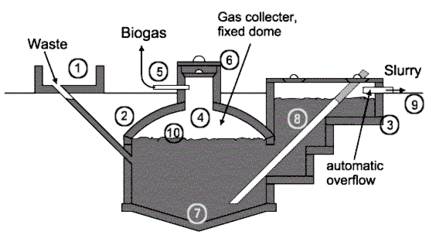
A fixed-dome plant consists of a digester with a fixed, non-movable gas holder, which sits on top of the digester.
The digestion process spans approximately 30 days, producing significant gas output during the initial two weeks. 1 This sustainable fuel system reduces greenhouse gas emissions by diverting organic matter from landfill sites whilst generating clean energy.
Studies examine different reactor sizes ranging from 3 to 6 cubic metres, making these systems suitable for various household needs and waste management requirements.
2. Floating Drum Biogas Digesters: How do Floating Drum Plants work?
Floating drum plants feature a gas-holder that sits directly on the slurry surface inside the biogas digester. The drum rises and falls as biogas accumulates or gets consumed, providing a clear visual indication of gas production levels.
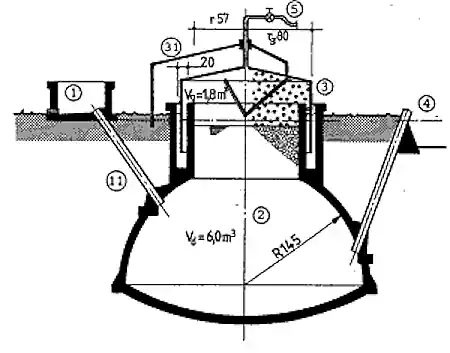
This simple design makes the system easy to monitor and operate for small to medium-scale waste digestion projects. The floating mechanism maintains constant gas pressure during use, ensuring steady energy production from organic waste materials.
Construction and operation remain straightforward, with sizing that adapts to various farm and household needs. The gas-holder drum requires regular maintenance to prevent corrosion from exposure to biogas contents and moisture. 1 These anaerobic digestion systems work well for processing animal waste and agricultural residues on farms. The floating drum design offers reliable renewable energy generation whilst managing organic matter through natural anaerobic decay processes. 2
3. Polyethylene Tube: What is a Low-Cost Polyethylene Tube Digester?
Low-cost polyethylene tube digesters represent portable biogas systems built from lightweight polyethylene materials. These digesters convert biodegradable waste, including agricultural trash and animal waste, into renewable energy through anaerobic digestion.
Rural families find these systems particularly valuable because they reduce energy costs and dependence on firewood. The simple design requires minimal maintenance, making them accessible for household applications. 3
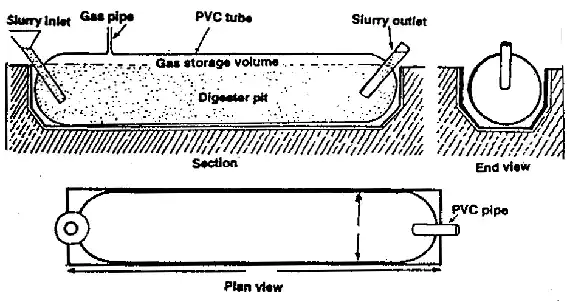
Economic feasibility studies demonstrate significant cost savings for rural users who adopt this waste to energy technology. These portable systems support decentralised waste management while generating biogas for power generation.
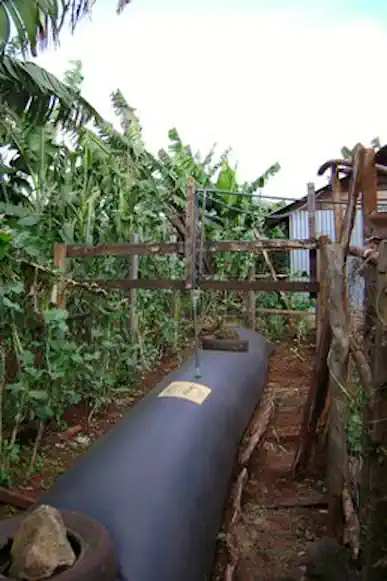
Source: Energypedia, a Low-Cost Polyethylene Tube Digester (Pioneer_Biogas_Technologies_Kenya.JPG) CC BY-SA 4.0 without modification.
Small rural communities benefit from reduced energy expenses and improved organic waste processing. Research continues to optimise design and operational conditions for enhanced performance in converting organic matter into clean energy sources.
4. Biogas “Ballon Style”: How do Balloon AD Plants operate?
Balloon biogas plants use heat-sealed plastic or rubber bags as digesters to process organic waste through anaerobic digestion. Small farmers primarily use these systems to convert livestock waste and food scraps into renewable energy.
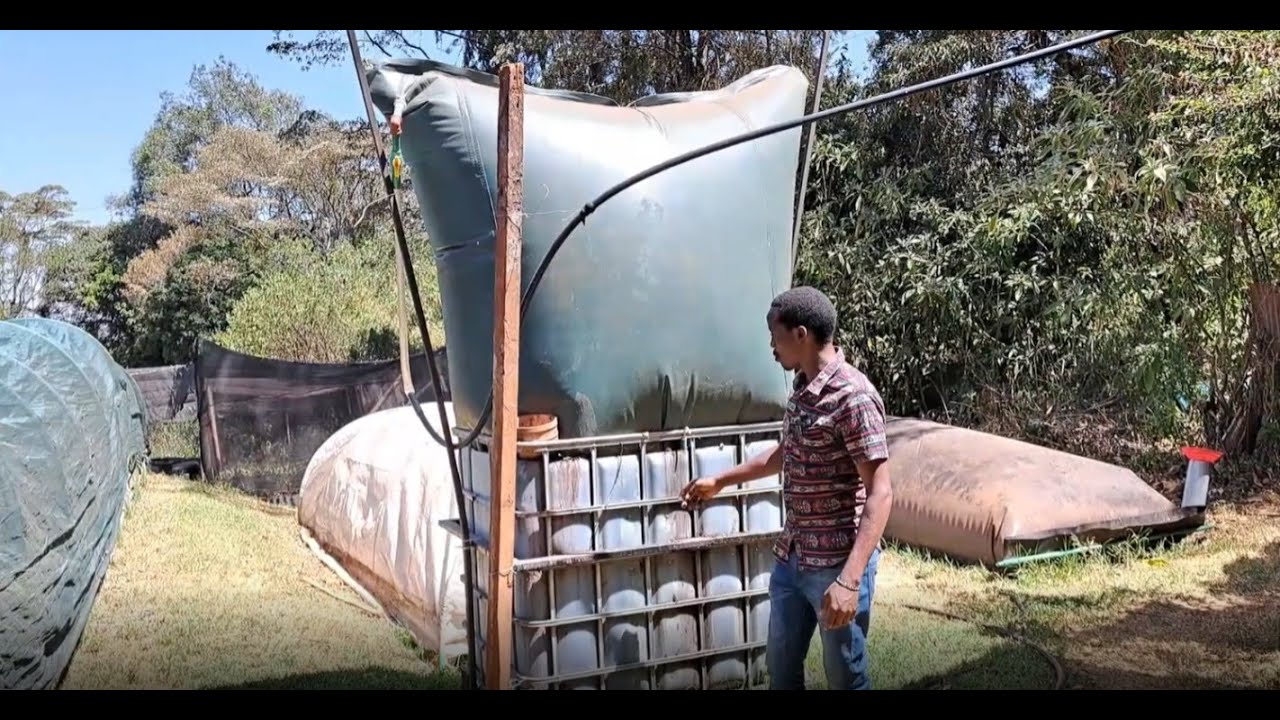
The sealed bags create an oxygen-free environment where bacteria break down organic matter, producing biogas that contains methane and carbon dioxide. This biogas can fuel cooking stoves and provide lighting for rural households. 4
These semi-portable systems offer cost-effective waste management solutions using locally sourced materials. Farmers can easily install and relocate the balloon digesters as needed. The weather-resistant design protects the anaerobic digestion process from external conditions.
Maintenance and technical knowledge ensure the effective operation of these biogas generators. The digestate byproduct improves soil fertility and boosts agricultural productivity. Educational initiatives help farmers successfully manage their balloon biogas systems and maximise energy efficiency from agricultural residues.
5. What are Horizontal Biogas Plants?
Horizontal biogas plants feature a sideways construction design instead of the traditional vertical setup. These systems use anaerobic digestion to convert organic waste into renewable energy through natural bacterial processes.
The horizontal orientation provides enhanced system stability and improves biogas production efficiency compared to upright models. 1

“Dairy Digester Spawns Multiple …” from www.biocycle.net and used with no modifications.
Construction and maintenance become much simpler with horizontal designs. Space-constrained areas benefit greatly from this layout, as the plants require less vertical clearance. Waste feeding and digestate removal prove more convenient due to the accessible horizontal configuration.
These generators adapt well to both small and medium-scale operations, making them suitable for farms, communities, and industrial facilities. The design flexibility allows operators to customise installations based on specific site requirements and available space.
Horizontal biogas systems represent a practical evolution in anaerobic digester technology, offering improved accessibility whilst maintaining efficient organic matter processing capabilities. 1
6. Earth-pit Biogas Generators: How do Earth-pit Plants function?
Earth-pit plants operate as underground biogas generators that harness natural insulation for optimal performance. These systems sit below ground level, which protects them from external temperature fluctuations and maintains consistent conditions for anaerobic digestion.
They are simply another name for a fixed dome or earth pit biogas plant.
The underground environment creates stable temperatures that support microbial activity throughout the year. Organic waste enters the digester chamber, where bacteria break down organic matter without oxygen present. 1
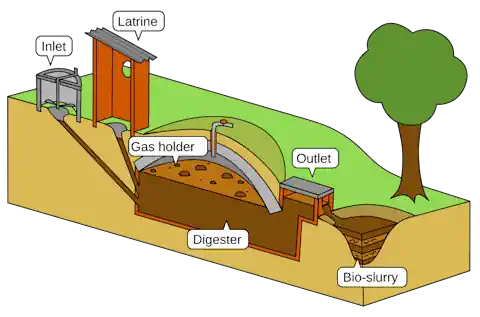
Methane production occurs as microorganisms decompose agricultural residues, municipal solid waste, and other organic feedstock within the sealed underground chamber. The earth-pit design captures both methane and carbon dioxide gases produced during fermentation.
Construction costs remain low because minimal above-ground structures are needed. These renewable energy systems reduce greenhouse gas emissions by converting waste products into useful biogas energy. 5 The consistent underground temperatures ensure reliable gas production while the natural insulation eliminates the need for external heating systems.
7. What are Ferro-cement Biogas Plants?
Ferro-cement biogas plants combine cement with wire mesh to create durable anaerobic digestion systems. These structures offer excellent resistance to corrosion and cracking from biogas exposure.
These are simply fixed dome style or buried biogas plants that are constructed from “ferro cement” (also known as reinforced concrete) instead of reinforced brickwork.
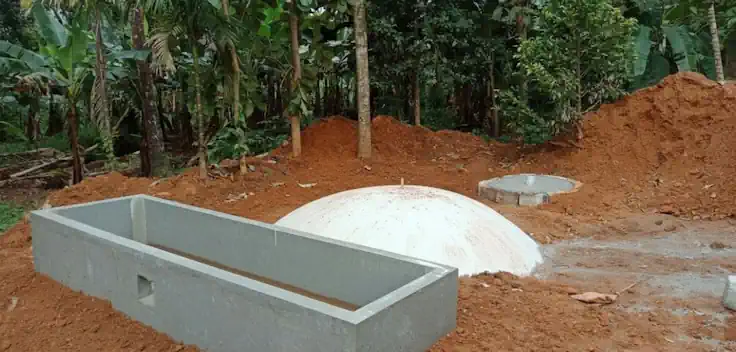
Construction workers can build these plants in various sizes for household or community use. The design adapts well to above-ground or partially buried installations, making them suitable for regions with limited access to bricks or other masonry materials. 6
Skilled labour is essential for construction to ensure leak-proof joints in these renewable energy systems. The composite material influences the properties and durability of the biodigester significantly.
These plants provide an effective solution for organic waste management whilst generating natural gas for energy production. Ferro-cement digesters can process agricultural residues and municipal solid waste to produce biogas for generating electricity or combined heat and power applications.
8. How do Batch Biogas Plants work?
Batch biogas plants operate through a simple cycle-based system that processes organic waste in discrete loads rather than continuous feeding. Operators fill the digester with agricultural residues, municipal solid waste, or other organic matter, then seal it completely for the full retention period of typically 30 days.
These biogas plants are simply an alternative name for “Dry Biogas Plants” as shown below:
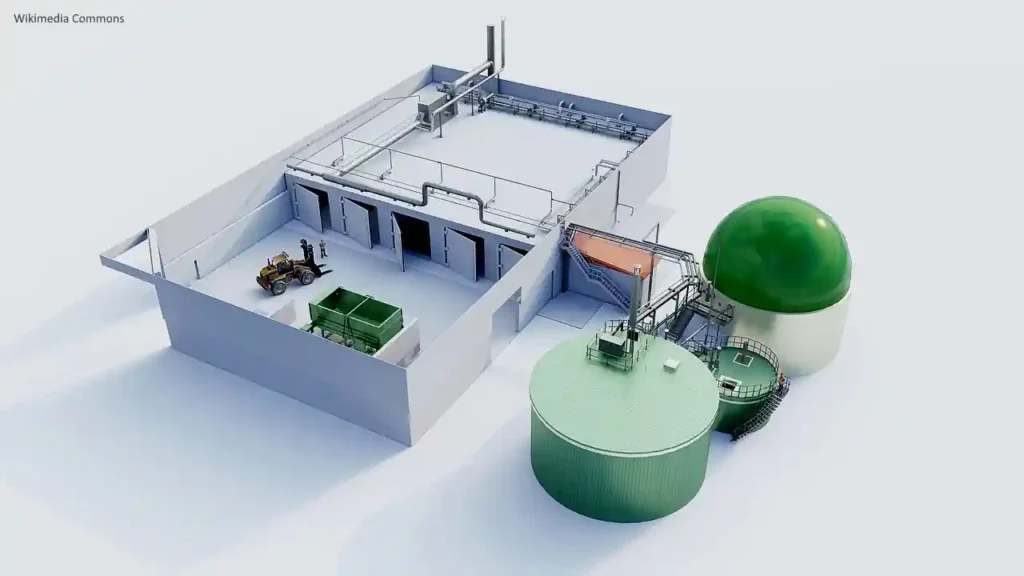
During this sealed period, anaerobic digestion breaks down the waste materials without oxygen, producing methane and carbon dioxide through natural fermentation processes.
Gas production reaches peak levels during the initial weeks as microorganisms anaerobically digest the organic waste most efficiently. Production gradually declines as the digestion process nears completion and available organic matter decreases.
Multiple digesters often operate in rotation to ensure continuous gas supply for power generation or heating applications. The digester requires complete emptying and cleaning between each batch cycle, making this design particularly suitable for seasonal waste availability or agricultural operations with intermittent feedstock supplies.
9. Farm-scale Biogas: What are Small Farm-scale Generators?
Small farm-scale generators transform manure and agricultural waste into renewable energy directly on farms. These compact biogas systems help farmers manage organic waste whilst producing methane for cooking, heating, or electricity generation.

Farmers can build these digesters using locally available materials, which reduces construction costs significantly. The systems integrate seamlessly with existing crop and livestock operations, creating efficient nutrient recycling loops.
Farm-scale biogas production cuts reliance on firewood and fossil fuels for rural communities. These generators suit individual farms or small communities perfectly, processing agricultural residues through anaerobic digestion. 1 Regions with high livestock densities actively promote this sustainable approach to waste management. The technology supports energy transition goals by converting organic matter into clean-burning natural gas, reducing greenhouse gas emissions from decomposing waste.
10. IBC Biogas Digesters: How do IBC Tank-based Generators work?
IBC tank-based biogas generators transform organic waste into renewable energy through a straightforward process. These systems process around 100 pounds of food scraps daily, making them perfect for small-scale waste management.
The design uses standard industrial containers that many businesses already have available. Operators feed kitchen waste and agricultural residues into a macerator first. This machine breaks down the organic matter into smaller pieces for faster anaerobic digestion.
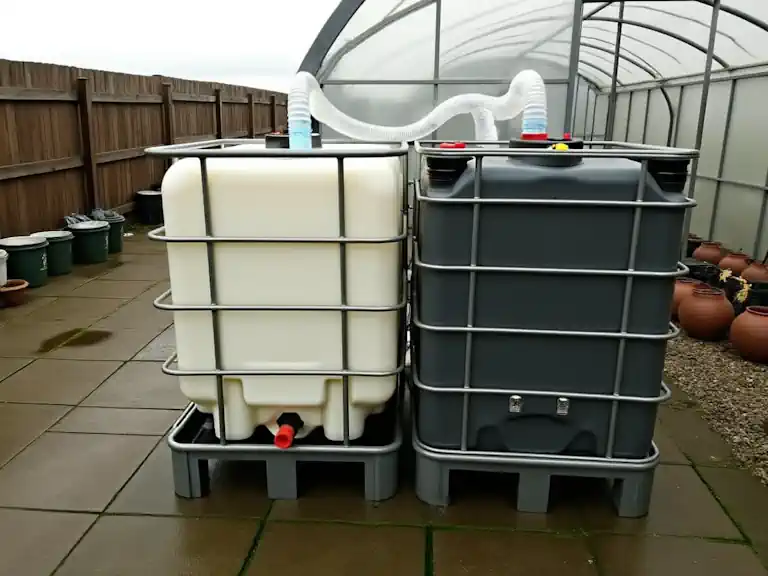
Painting the tank black helps absorb sunlight and maintain reaction temperatures needed for methane production. The waste processed in the macerator typically sustains methane production for 7-8 weeks inside the sealed container.
Bacteria break down the organic material without oxygen, creating biogas and liquid fertiliser. The system allows recycling of waste into clear liquid fertiliser, collected via an overflow valve.
Uniseal products are recommended to prevent gas leakage during storage of the produced biogas. These generators suit both household and small business food waste streams perfectly.
The design is adaptable for heating greenhouses using the tank’s heat, creating combined heat and power applications for distributed energy resources.
11. What are Home Biogas systems?
Home biogas systems enable simple, on-site production of methane for cooking, lighting, and heating. These compact units transform organic waste into renewable energy right at your doorstep.

A typical setup uses two cylinders to create a pressurised system for methane capture. Organic matter, such as food scraps and manure, gets fed into the system daily. The captured methane flows to utility appliances under pressure, providing clean fuel for household needs.
Systems are compact and suitable for urban or suburban households seeking sustainable alternatives to conventional fossil-fuel-based energy. Maintenance remains minimal if operators use appropriate feedstocks consistently.
The design supports waste recycling whilst reducing landfill contributions significantly. Homeowners can cut their reliance on natural gas supplies through this efficient waste management solution.
These generators convert municipal solid waste into valuable energy, helping reduce greenhouse gas emissions from decomposing organic waste.
12. Landfill as a Biogas Generator: How is biogas generated at landfill sites?
Landfill sites generate biogas through anaerobic decomposition of organic waste in oxygen-free environments. Municipal solid waste breaks down naturally when buried beneath layers of rubbish, creating perfect conditions for methanogenic bacteria to thrive.
These specialised microorganisms consume organic matter and produce landfill gas as a byproduct. The process occurs without oxygen, making it fundamentally different from traditional waste decomposition methods. 7
Methanogenic bacteria transform municipal waste into biogas containing 50-70% methane and 30-50% carbon dioxide. This renewable energy source emerges as trash decomposes over time, releasing significant amounts of methane into the atmosphere.
Over 640 out of 1,900 US landfills have adopted gas-to-energy technology to capture this valuable resource. Landfill methane collection systems now power several million homes across America, demonstrating the massive potential of waste-to-energy conversion.
How does biogas technology reduce greenhouse gases?
Biogas technology cuts greenhouse gas emissions by capturing methane that would otherwise escape into the atmosphere. Methane proves 80 times more potent than carbon dioxide as a greenhouse gas, making its capture essential for climate protection.
Anaerobic digestion systems trap this powerful gas from organic waste, agricultural residues, and municipal solid waste before it can contribute to global warming. Power plants and cogeneration facilities then convert this captured methane into renewable energy, replacing conventional fossil fuel sources. 9
Learn more about greenhouse gas emissions here.
Upgrading biogas to biomethane creates opportunities for carbon dioxide capture during the purification process. This captured CO₂ supports carbon capture initiatives and can lead to negative carbon emissions when properly managed.
Biogas engines and combined heat and power systems maximise energy recovery from organic matter, reducing emissions compared to traditional waste management methods. The technology transforms waste water treatment plants and landfill sites into renewable energy sources, cutting both waste volume and pathogen levels while generating clean electricity.
Conclusion of our Article of 12 Biogas Generator Types
Biogas technology offers twelve distinct generator types that transform organic waste into valuable renewable energy. Small-scale systems like balloon plants and polyethylene tube digesters make clean energy accessible to rural communities and individual households.
Large municipal operations capture landfill gas and process agricultural residues through sophisticated anaerobic digestion facilities. These generators reduce greenhouse gas emissions while producing natural gas for electricity generation and heating applications.
Smart waste management through biogas systems creates a sustainable cycle that benefits both the environment and energy security.
12 Biogas Generator Types – FAQs
1. What are biogas generator sets and how do they work?
Biogas generator sets convert organic waste into renewable energy through anaerobic digestion. This process breaks down organic matter without oxygen, producing natural gas that powers electricity generation. These systems reduce greenhouse gas emissions whilst managing waste effectively.
2. Which types of organic waste can fuel biogas generators?
Agricultural residues, municipal solid waste, and sewage provide excellent fuel sources for biogas systems. Wastewater treatment facilities often use sewage gas, while farms utilise crop waste and animal manure. Landfill gas from decomposing waste also powers these renewable energy systems.
3. How do combined heat and power systems improve energy efficiency?
CHP systems capture waste heat during electricity generation, maximising energy efficiency from biogas. These cogeneration plants simultaneously produce thermal power and electricity from the same fuel source. This dual output significantly reduces energy waste compared to separate heat and power generation.
4. What role does anaerobic digestion play in biogas production?
Anaerobic digestion transforms organic matter into biogas through bacterial breakdown without oxygen. Microorganisms convert complex materials into volatile fatty acids, then into acetic acid, and finally into methane and carbon dioxide. This natural process creates clean renewable fuels whilst treating organic waste.
5. Can biogas generators reduce water pollution and greenhouse gas emissions?
Biogas systems significantly cut methane emissions that would otherwise escape from decomposing waste. They prevent water pollution by treating sewage and agricultural runoff before discharge. These renewable energy systems replace fossil fuels, reducing overall carbon dioxide emissions throughout their lifecycle.
6. How do biogas generators compare to wind power for renewable energy use?
Biogas generators provide consistent power output regardless of weather conditions, unlike wind systems. They offer additional benefits through waste management and can operate continuously without surcharges for grid stability. Both technologies support renewable energy goals, but biogas systems deliver reliable baseload power whilst addressing waste treatment needs.
References
- ^ https://blog.anaerobic-digestion.com/biogas-generator/
- ^ https://www.researchgate.net/publication/325206668_An_innovative_approach_to_construction_and_operation_of_biodigesters_a_consideration_of_floating_drum_biogas_plant (2018-07-25)
- ^ https://www.mdpi.com/2673-5628/4/3/12
- ^ https://www.researchgate.net/publication/374693481_Development_of_Balloon_Biogas_Plant_for_Small_Farmers
- ^ https://www.worldbiogasassociation.org/wp-content/uploads/2019/07/WBA-globalreport-56ppa4_digital.pdf
- ^ https://www.researchgate.net/figure/Ferro-cement-biogas-plants-Construction-of-a-biogas-plant-in-Mirpurkhas-Sindh-Pakistan_fig3_275273428
- ^ https://www.sciencedirect.com/science/article/pii/S2211715624002455
- ^ https://www.mdpi.com/2227-9717/13/11/3648
- ^ https://pmc.ncbi.nlm.nih.gov/articles/PMC10992758/
- ^ https://www.sciencedirect.com/org/science/article/pii/S1874331520000211
- ^ https://www.researchgate.net/publication/345902100_Plant_Feedstocks_and_their_Biogas_Production_Potentials (2020-11-15)
- ^ https://www.researchgate.net/publication/353777687_Effect_of_pH_on_biogas_production_during_anaerobic_digestion
- ^ https://anaerobic-digestion.com/biogas-engine-generator-electricity/
- ^ https://www.sciencedirect.com/science/article/pii/S0959652624033857
- ^ https://www.researchgate.net/publication/313812488_Upgrading_techniques_for_transformation_of_biogas_to_bio-CNG_a_review_A_review_on_upgradation_techniques_to_transform_biogas_to_bio-CNG
- ^ https://www.researchgate.net/publication/360929672_How_to_use_biogas_A_systematic_review_of_biogas_utilization_pathways_and_business_models
[First posted in February 2018. Updated January 2022.]



Great overview of the different types of biogas generators! I found the comparisons really helpful for understanding which type would best suit my needs. The details on efficiency and maintenance requirements were particularly useful. Thanks for sharing such valuable information!