



AD pumps – short for anaerobic digestion pumps – are used throughout biogas plants to move manure, food waste, sewage sludge, biomass, digestate and other organic materials. They perform some of the hardest pumping duties on an anaerobic digestion plant because the materials being handled may be fibrous, abrasive, viscous and high in suspended solids.
Selecting the right AD pump is therefore about much more than obtaining the required flow rate and pumping head. Reliability, resistance to blockage, solids handling, maintenance access, wear and compatibility with the feedstock can all have a major effect on plant availability.
Landia is one of the established manufacturers supplying pumps and mixing equipment for anaerobic digestion and biogas applications. Its Chopper Pumps and GasMix digester mixing system provide useful examples of equipment developed specifically for demanding organic-waste and biomass duties.
This article was originally published when Landia joined the World Biogas Association (WBA). It has now been substantially expanded as our main Landia resource and as a practical introduction to AD pumps and their applications within anaerobic digestion plants.
Originally published following Landia’s WBA membership announcement. Substantially revised and updated September 2026.
What Are AD Pumps?
AD pumps are pumps used for liquid, slurry, sludge, biomass and digestate duties within anaerobic digestion plants. The term describes the application rather than one particular pump design.
Different stages of the anaerobic digestion process can impose very different pumping requirements. A pump transferring relatively dilute liquid manure, for example, has a different duty from a pump feeding a thick fibrous substrate into a digester.
Typical AD pump applications include:
- liquid manure pumping;
- food-waste and organic-waste transfer;
- reception tank circulation;
- digester feed pumping;
- substrate transfer;
- sludge pumping;
- digester recirculation;
- digestate transfer;
- tank emptying and transfer duties; and
- pumping associated with external digester mixing systems.
This wide range of duties explains why there is no single design that can simply be described as the anaerobic digestion pump.
For our broader technical discussion of pump selection, operation and maintenance, also see our main guide to anaerobic digestion pumps.
Why AD Pumps Have Such a Difficult Job
Pumping clean water is comparatively straightforward. Pumping anaerobic digestion feedstock can be anything but straightforward.
Depending on the type of AD plant, pumps may encounter:
- long fibres from crops, grass and straw;
- manure containing bedding material;
- high concentrations of suspended solids;
- thick and viscous biomass;
- food waste;
- vegetable and plant fibres;
- grit and abrasive mineral material;
- rags and stringy material;
- small fragments of packaging or other contaminants; and
- digestate with variable solids content.
Material characteristics may also change from day to day as feedstocks vary.
This means that an AD pump that performs satisfactorily with one substrate may be poorly suited to another.
Blockages are particularly undesirable because a feed pump that repeatedly fails can interfere with the biological process itself. Anaerobic digesters generally perform best with controlled and reasonably consistent feeding rather than repeated interruptions followed by large catch-up feed additions.
How to Select an AD Pump
Choosing an AD pump should therefore start with the characteristics of the material to be handled and the actual plant duty.
Factors that deserve consideration include:
- solids concentration;
- particle size;
- fibrous content;
- viscosity;
- abrasiveness;
- presence of foreign material;
- required flow rate;
- static and friction head;
- suction conditions;
- temperature;
- frequency of operation;
- ease of access for servicing;
- energy consumption; and
- whole-life maintenance requirements.
The lowest-cost pump at the procurement stage is not necessarily the lowest-cost AD pump over its operating life.
Repeated blockage clearance, wear-part replacement, production interruptions and labour can rapidly outweigh an apparently attractive initial purchase price.
Different Types of AD Pumps
A number of pumping technologies are used in anaerobic digestion, depending on the application.
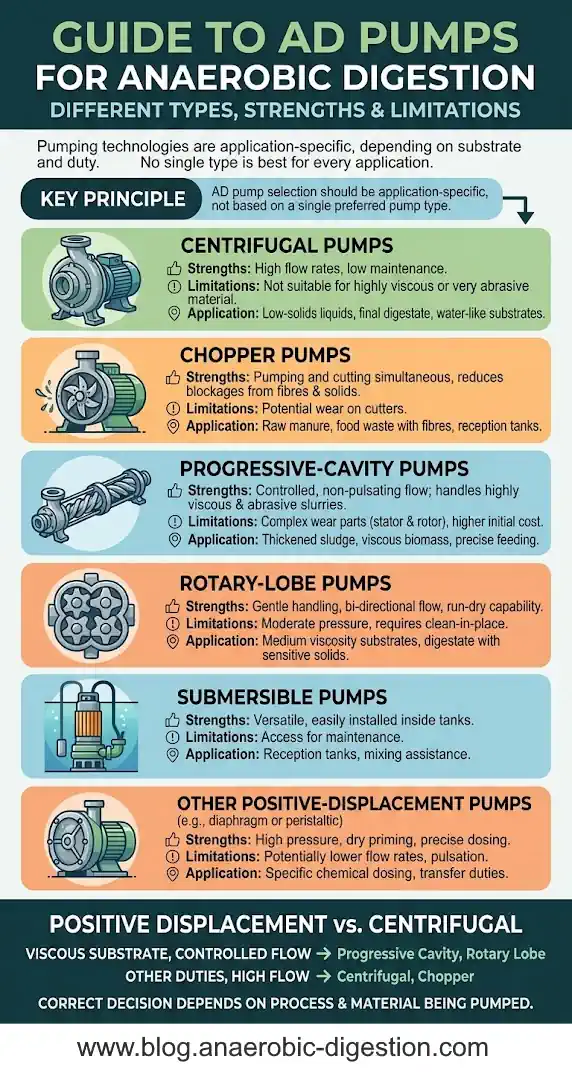
These can include:
- centrifugal pumps;
- chopper pumps;
- progressive-cavity pumps;
- rotary-lobe pumps;
- submersible pumps; and
- other positive-displacement pumps.
Each has strengths and limitations.
A positive-displacement pump may be appropriate for a viscous substrate requiring relatively controlled flow. A centrifugal or chopper pump may offer advantages on other duties. The correct decision depends upon the process and material being pumped.
AD pump selection should therefore be application-specific rather than based simply on a preferred pump type.
Landia AD Pumps
Landia has been manufacturing pumps and mixers for difficult wastewater, agricultural and industrial applications for many decades, and its equipment has subsequently found extensive application in the anaerobic digestion industry.
In biogas plants, Landia equipment may be used for duties involving:
- manure;
- biomass;
- food waste;
- organic slurry;
- sewage sludge;
- digestate; and
- other solids-containing liquids.
A technology particularly associated with the company is the Landia Chopper Pump.
Landia Chopper Pumps as AD Pumps
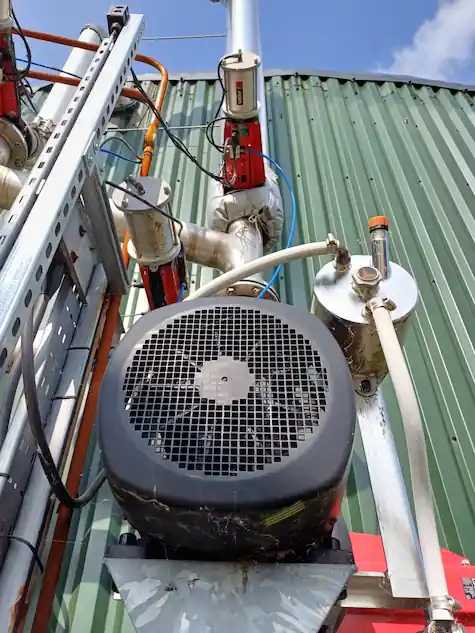
A fundamental problem with many AD pumping duties is that fibres and solid material can obstruct equipment, wrap around components or accumulate elsewhere in the process.
A chopper pump combines pumping with cutting action designed to reduce troublesome solids and fibres as the material is pumped.
For anaerobic digestion this can be particularly useful for manure, fibrous biomass and organic substrates where larger pieces of material might otherwise contribute to blockage or poor downstream handling.
Landia’s Chopper Pump range has been applied to agricultural, wastewater and biogas installations, including duties involving liquid biomass and high-solids materials.
The important point is that in an AD installation the pump can sometimes perform more than the simple function of moving liquid from A to B. Conditioning difficult material while it is pumped can improve its suitability for subsequent transfer, mixing and processing.
AD Pumps for Reception Tanks
The reception or pre-treatment area is one location where suitable AD pumps can be particularly important.
Feedstock arriving at an anaerobic digestion plant is often at its least homogeneous at this stage. Material may need to be mixed, chopped, diluted or homogenised before controlled feeding to the digesters.
In agricultural AD, manure and crop material may contain long fibres. At a food-waste facility, incoming organic material can vary considerably in consistency and solids content.
An AD pump used in a reception tank therefore needs to be selected with the actual incoming material in mind rather than merely its nominal liquid volume.
Effective reception-tank mixing and pumping can also help prevent solids settling and floating material accumulating before digestion begins.
AD Feed Pumps and Digester Feeding
Once feedstock has been conditioned, another important duty is transferring it into the anaerobic digester.
AD feed pumps play a direct role in maintaining a controlled feed regime.
Depending on the plant, feeding may be continuous or carried out at frequent intervals. Either way, dependable transfer is important because variations in organic loading can affect digester stability.
A feed pump must therefore be compatible not only with the design flow but also with:
- the maximum anticipated solids content;
- the feedstock’s viscosity;
- fibrous material;
- the required operating pressure; and
- the control system used to meter feed into the process.
AD Pumps for Digestate
The pumping requirement does not finish once digestion has taken place.
Large quantities of digestate must normally be moved from the digester to secondary digestion, storage, separation or further treatment.
Digestate pumps are therefore another important category of AD pumps.
Although digestion breaks down much of the biodegradable organic matter, digestate still contains suspended solids and fibres. Pump selection must therefore reflect its actual characteristics and the intended downstream treatment or storage system.
Digestate management is increasingly important in its own right because digestate contains valuable plant nutrients and organic matter that can potentially be returned to land.
AD Pumps and Digester Mixing
Pumping and mixing duties often overlap in anaerobic digestion.
A well-designed digester mixing system should help:
- distribute incoming feed;
- maintain contact between microorganisms and substrate;
- reduce temperature gradients;
- keep appropriate solids in suspension;
- limit sediment accumulation;
- discourage formation of floating layers; and
- make effective use of the available digester volume.
However, mixing is a substantial engineering subject in its own right, and this page is intentionally focused on AD pumps.
For our detailed discussion of mixer configurations and selection, see Anaerobic Digester Mixing Systems.
Landia GasMix: When an AD Pump Becomes Part of the Mixing System
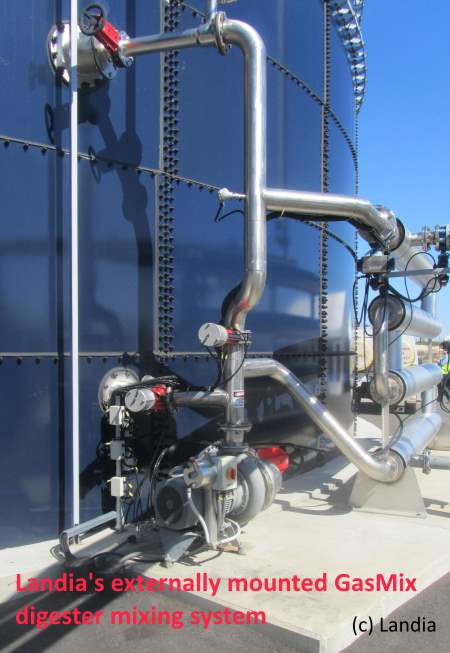
Landia’s GasMix system provides a useful example of the relationship between pumping and digester mixing.
Rather than relying solely on a conventional mechanical mixer mounted inside a digester, the system uses externally located equipment to withdraw and return digester contents in a way designed to create mixing within the tank.
This illustrates an important principle for AD plant designers and operators: a pump can form part of the process solution rather than simply being an ancillary transfer device.
Another potentially important consideration is maintenance accessibility.
Servicing equipment mounted within an operating anaerobic digester can be highly disruptive. Emptying a digester is not comparable with draining an ordinary process-water tank. Biological activity has to be considered, as do methane and other hazardous gases, isolation requirements and the potentially lengthy process of returning the digester to full operation.
Equipment that can be maintained externally can therefore offer significant practical advantages where the installation permits it.
AD Pump Reliability and Maintenance
Reliability should be treated as a fundamental part of AD pump specification.
Plant operators should consider:
- how easily blockages can be cleared;
- whether wear components are accessible;
- how quickly seals can be replaced;
- whether the pump can be isolated without shutting down major plant areas;
- availability of spare parts;
- whether standby capacity is justified;
- maintenance frequency;
- condition monitoring; and
- the consequences of a pump being unavailable.
The consequence of failure is particularly important.
A relatively inexpensive transfer pump used occasionally may justify a different redundancy strategy from the main AD feed pump upon which continuous digester operation depends.
AD Pumps Should Be Considered as Part of the Whole Process
One recurring mistake in process engineering is to treat pumps as isolated mechanical components.
For an AD plant, pump performance may be influenced by:
- reception-tank design;
- screening and contaminant removal;
- depackaging equipment;
- pipe diameter;
- bends and valves;
- suction conditions;
- feedstock preparation;
- tank geometry;
- mixing arrangements; and
- the plant control philosophy.
An AD pump can only perform reliably when the system around it has also been designed for the material being handled.
For example, repeatedly asking a pump to handle material containing contaminants that should have been removed upstream is unlikely to be a satisfactory long-term solution regardless of pump quality.
Why Landia’s Experience in AD Pumps Matters
Anaerobic digestion has developed considerably from the relatively simple farm digesters and sewage-sludge systems that dominated the industry’s earlier years.
Modern plants may process highly variable commercial food wastes, source-separated household food waste, agricultural residues, industrial organic wastes and mixtures of several substrates.
This creates value in equipment manufacturers gaining experience from many installations.
The recurring operational problems encountered by AD pumps – fibres, solids, blockage, wear and access for maintenance – are practical engineering issues as much as theoretical design calculations.
Landia’s long involvement in pumps, mixers and biogas equipment provides one example of how specialist suppliers have developed products around these operational realities.
Landia and the World Biogas Association
This article originally came into existence because Landia joined the World Biogas Association.
That original announcement remains relevant.
The anaerobic digestion industry depends upon many different organisations working together, including:
- AD plant operators;
- developers;
- farmers;
- waste-management companies;
- pump and mixer manufacturers;
- biogas upgrading suppliers;
- engineers and consultants;
- research organisations;
- financiers; and
- regulators and policymakers.
No individual organisation sees every problem or every successful solution.
Industry associations provide a mechanism for practical experience from individual AD plants to become knowledge that benefits the wider sector.
What Does the World Biogas Association Do?
The World Biogas Association describes itself as the global trade association for the biogas, landfill gas and anaerobic digestion sectors.
Its activities include promoting best practice, technical knowledge, research and innovation, gathering industry data, publishing market information and representing the biogas industry internationally.
Current WBA membership information highlights areas including technical expertise, policy guidance, market intelligence, training, publications, research, networking and international industry representation.
You can see the Association’s current membership information here:
World Biogas Association – Membership Benefits
Other AD Companies Should Consider Joining the WBA
Landia’s decision to join the World Biogas Association was a positive example that other companies serving the anaerobic digestion industry should consider following.
This does not apply only to large AD developers or plant operators.
The reliability of an anaerobic digestion plant depends upon an entire supply chain – including the manufacturers of AD pumps, mixers, tanks, instrumentation, gas upgrading equipment, CHP units and feedstock-processing systems.
Those companies gain knowledge from real installations that can contribute to better industry practice.
Conversely, manufacturers benefit from understanding the problems that developers and operators experience in different countries and with different feedstocks.
Greater participation in industry organisations can therefore help:
- share engineering experience;
- improve technical standards;
- identify recurring operational problems;
- support research and innovation;
- build international business relationships;
- promote health and safety;
- improve understanding of emerging markets; and
- provide a stronger collective voice for the biogas industry.
If your organisation supplies technology or professional services to anaerobic digestion and biogas projects, it is worth reviewing the WBA’s current membership offering:
Find Out About Joining the World Biogas Association
A Lower-Commitment Way to Join the Global Biogas Community
The WBA now also operates WBA Connect+, a free online professional community for people working across biogas, biomethane and related sectors.
This provides another route for individuals who want to network, exchange knowledge and follow developments across the international industry.
For people working with AD technology – including pumps, mixers and other process equipment – greater exchange of real operational experience should ultimately help the whole industry improve.
Why AD Equipment Collaboration Matters in 2026
Anaerobic digestion is increasingly expected to perform several roles simultaneously.
Modern AD plants can provide:
- renewable biogas and biomethane;
- treatment of biodegradable wastes;
- recycling of food waste;
- improved manure management;
- renewable electricity and heat;
- locally produced energy;
- nutrient recycling through digestate; and
- potential reductions in uncontrolled methane emissions.
Recent volatility in internationally traded energy has also increased interest in locally produced, dispatchable and storable renewable gas.
If anaerobic digestion is to fulfil that potential, however, the plants themselves have to be reliable.
That brings the subject directly back to apparently ordinary components such as AD pumps.
A digester cannot deliver renewable gas reliably if its reception system repeatedly blocks, its feed pump is unreliable, its digestate cannot be transferred or its mixing equipment cannot be maintained.
Reliable AD is ultimately built from reliable engineering.
Archive: Landia Joins the World Biogas Association
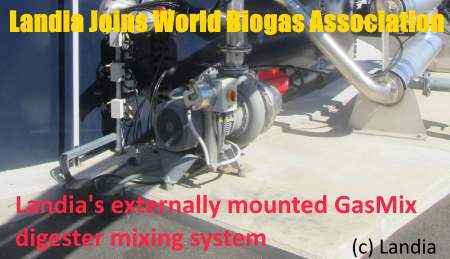 The original version of this article reported Landia becoming a member of the World Biogas Association.
At the time, the announcement highlighted Landia’s established role supplying pumps and mixing equipment to anaerobic digestion projects and its support for the development of the international biogas industry.
The WBA welcomed the involvement of an experienced equipment supplier whose products were already installed at anaerobic digestion plants in several countries.
Although the original announcement dates from an earlier period in the industry’s development, its underlying message remains valid:
equipment suppliers have valuable practical knowledge to contribute to the growth and professionalisation of anaerobic digestion.
About Landia AD Pumps and Mixers
Landia manufactures pumps, mixers and related process equipment for wastewater, agriculture, food processing, industry and anaerobic digestion.
Its equipment used in biogas and AD applications includes Chopper Pumps, submersible mixers and GasMix digester mixing systems.
The company’s products have been used for applications involving manure, food waste, biomass, sludge, digestate and other challenging solids-containing liquids.
For current information on Landia products and applications, visit:
AD Pumps: Frequently Asked Questions
What are AD pumps?
AD pumps are pumps used within anaerobic digestion plants. They are used to move materials including manure, food waste, biomass, sludge, digester feed and digestate. AD pump is an application term rather than one specific pump design.
What does AD pump mean?
AD pump normally means an anaerobic digestion pump when used in the biogas and organic-waste industries. These pumps are selected for duties associated with feedstock preparation, digester feeding, recirculation, sludge handling and digestate transfer.
What type of pump is best for anaerobic digestion?
There is no single pump type that is best for every anaerobic digestion application. Selection depends on solids concentration, viscosity, fibre content, particle size, abrasiveness, required flow, pressure and maintenance requirements. Chopper pumps, progressive-cavity pumps, rotary-lobe pumps, centrifugal pumps and other technologies may all be appropriate for particular AD duties.
Why do AD pumps block?
AD pumps can become blocked when the feedstock contains long fibres, rags, oversized particles, packaging fragments or other foreign material. Poor suction conditions, unsuitable pipework and selection of a pump that is inappropriate for the feedstock can also cause problems.
What is an AD feed pump?
An AD feed pump transfers prepared organic material into an anaerobic digester. Reliable feeding is important because digesters generally benefit from a controlled and consistent organic loading regime.
What is a digestate pump?
A digestate pump transfers material after anaerobic digestion to secondary digestion, storage, separation or other treatment. Digestate still contains suspended solids and fibres, so pump selection must reflect its physical characteristics.
What is a chopper pump?
A chopper pump incorporates a cutting action that reduces troublesome fibres and solids while the material is being pumped. This can make chopper pumps particularly useful for manure, biomass and other challenging AD pump duties.
Does Landia manufacture AD pumps?
Yes. Landia supplies pumps used in anaerobic digestion and biogas applications, including its Chopper Pump range, as well as mixers and its GasMix digester mixing system.
Are AD pumps also used for digester mixing?
They can be. Some digester mixing arrangements use external pumping and recirculation as part of the mixing process. However, the appropriate mixing method depends on tank geometry, substrate characteristics and process requirements.
Why is AD pump maintenance important?
A pump failure can interrupt feedstock transfer, digester feeding, recirculation or digestate movement. Maintenance accessibility, wear, blockage clearance, spare parts and redundancy should therefore be considered when specifying an AD pump.
Further Reading on AD Pumps and Landia Equipment
- Anaerobic Digestion Pumps – 6 Ownership and Maintenance Tips – our broader pump-selection and maintenance guide.
- Anaerobic Digester Mixing Systems – our detailed guide to digester mixing rather than pumping.
- Landia Chopper Pumps at Hendwr Farm – an example of chopper pumps operating at an agricultural biogas plant.
- Landia Long-Coupled Chopper Pumps for a Food-Waste Biogas Application – a specialist AD pump configuration developed for a particular installation.
- World Biogas Association Membership Benefits.
- Join the World Biogas Association.
AD pumps may represent only one part of an anaerobic digestion plant, but dependable pumping is fundamental to dependable biogas production. Correct pump selection, good system design and accessible maintenance can make the difference between a component that quietly performs its duty for years and one that becomes a recurring operational problem.
FOOTNOTE – Never Forget that Tragedy for Landia struck in May 2017:
Shropshire couple killed in road accident in Mauritius
Hugh Vaughan, and his wife Liz, were travelling together in a taxi. It is with deep sadness and shock that we have to report the untimely death of Hugh Vaughan, Director of Landia UK, who together with his wife Liz passed away after a road accident. via Shropshire couple killed
[Article first published in July 2018. Updated July 2022. Rewritten September 2026.]




Good to read of a British organisation taking the World Stage. Well done.
Time is running out. Climate change ain’t waitin for experts.
You guys need to stop talking and take action.
Join up and start marching? Thanks!