
Large seaweed strandings are usually regarded as a coastal nuisance, but could some of that troublesome biomass instead become a feedstock for anaerobic digestion?
Recent research has again highlighted a serious problem associated with decomposing seaweed on beaches: it can release hydrogen sulphide and other potentially harmful gases. Large accumulations can affect nearby communities, while the people tasked with clearing the material may face particularly high exposure.
That raises an intriguing question for the biogas industry.
If stranded seaweed needs to be removed anyway, could it be collected, preserved as seaweed silage and progressively fed to an anaerobic digestion plant to produce renewable biogas?
The concept has considerable attractions. Seaweed is biodegradable biomass, anaerobic digestion of macroalgae has been demonstrated repeatedly, and research shows that some seaweeds can be preserved by ensiling for months or potentially throughout the year.
However, this is not simply a matter of loading rotting beach seaweed into a farm digester.
Worker safety, hydrogen sulphide, high moisture content, sand and debris, salt, sulphur, potentially contaminated biomass and the management of seaweed silage liquor all need serious consideration.
Key Takeaways
- Stranded seaweed can release hazardous gases as it decomposes, particularly hydrogen sulphide (H2S), creating risks for the public and especially for workers collecting it.
- Seaweed can produce methane by anaerobic digestion, although methane yield varies greatly between species, season and pretreatment.
- Ensiling may overcome the seasonal nature of seaweed strandings and allow biomass collected during a short period to be fed to a digester over many months.
- Seaweed is generally much wetter than maize or grass silage and may produce substantial quantities of silage liquor.
- That liquor should not simply be discarded. Research has shown that it can contain considerable methane potential.
- Salinity is a potentially important AD inhibitor. Sodium and other dissolved salts need to be included in the digester feedstock assessment and mass balance.
- High sulphur concentrations may also increase hydrogen sulphide concentrations in raw biogas, potentially increasing gas-cleaning requirements.
- For many existing AD plants, controlled co-digestion with conventional low-salinity feedstocks may be more realistic than digestion of seaweed alone.
Why Seaweed Strandings Are More Than Just an Unpleasant Smell
Seaweed washed onto beaches is perfectly natural in modest quantities. Problems arise when very large quantities accumulate and begin decomposing.
A study published in Science of the Total Environment in September 2026 examined gases produced by decaying Ulva intestinalis and Sargassum muticum.
The researchers identified several sulphur-containing volatile compounds, including:
- hydrogen sulphide;
- methanethiol;
- dimethyl sulphide; and
- dimethyl disulphide.
They found substantially higher sulphur emissions from the green seaweed Ulva intestinalis than from the Sargassum tested under the experimental conditions.
The study also identified potentially harmful bacteria associated with decomposing seaweed, including some antimicrobial-resistant organisms.
This means that large decaying seaweed accumulations should not be regarded merely as an aesthetic or odour nuisance.
Read the 2026 seaweed strandings health-risk study in Science of the Total Environment.
Safety Must Come Before Seaweed Recovery for Biogas
Any discussion of recovering stranded seaweed for anaerobic digestion needs to start with an important warning.
The existence of a possible energy use for stranded seaweed does not mean that decomposing seaweed can be collected or handled casually.
Hydrogen sulphide is toxic. At sufficiently high concentrations it can rapidly cause serious injury, unconsciousness and death.
Perhaps particularly dangerously, the smell of hydrogen sulphide cannot be relied upon as a warning system. Although the familiar rotten-egg smell may initially be noticeable, exposure can impair the sense of smell.
UK Health and Safety Executive guidance gives workplace exposure limits for hydrogen sulphide of:
- 5 ppm as an 8-hour time-weighted average; and
- 10 ppm as a 15-minute time-weighted average.
H2S is also heavier than air and may accumulate in low-lying or poorly ventilated locations.
See HSE guidance on hydrogen sulphide exposure and control.

Cleanup workers can receive significant exposure
The risk is not hypothetical.
A 2026 study monitoring workers during shoreline clearance associated with the very large 2025 Atlantic Sargassum bloom found atmospheric hydrogen sulphide concentrations above 1 ppm in 46.3% of measurements.
Concentrations exceeded 10 ppm in 1.7% of measurements and peaks reached 50.8 ppm.
Workers also reported symptoms including headaches, dermatitis, itching, burning sensations and fatigue.
Read the study of hydrogen sulphide exposure among Sargassum cleanup workers.
Consequently, any commercial seaweed recovery operation should be subject to an appropriate occupational-health and safety assessment.
Depending upon the circumstances, controls may need to address:
- the state of decomposition before collection;
- H2S monitoring;
- mechanical rather than prolonged manual collection;
- safe working distances and exclusion zones;
- appropriate personal gas detectors;
- ventilation;
- worker training;
- emergency arrangements;
- transport and unloading;
- storage and silage-clamp operation;
- silage-liquor tanks, pits and sumps; and
- confined-space hazards where applicable.
Risk assessment needs to continue all the way from beach collection to the AD feed system.
Rotting material moved away from the beach has not ceased to be potentially hazardous merely because it has arrived at a biogas plant.
Could Stranded Seaweed Produce Biogas?
Yes.
There is now a substantial scientific literature on the anaerobic digestion of marine macroalgae.
Seaweed contains biodegradable carbohydrates and other organic compounds which anaerobic microorganisms can convert into methane-rich biogas.
However, methane yield varies considerably according to:
- seaweed species;
- season of collection;
- age and condition of the biomass;
- ash and salt content;
- structural carbohydrates;
- polyphenol content;
- pretreatment;
- sulphur content; and
- digester operating conditions.
This makes it dangerous to describe “seaweed” as though it were one consistent AD feedstock.
Beach-cast seaweed would be particularly variable. It could consist of different species, varying degrees of decomposition, sand, shells, litter and seawater.
Feedstock characterisation would therefore be essential before any operator incorporated it into a commercial feeding regime.
Could Seaweed Be Made into Silage?
This is where the concept becomes particularly interesting.
One of the major problems with stranded seaweed as an AD feedstock is seasonality.
A digester requires a reasonably consistent supply of feed throughout the year. A coastline, by contrast, may receive a huge influx of seaweed over a comparatively short period followed by months with little or none.
One possible answer is exactly the technique already familiar to agricultural AD operators:
ensiling.
Research published in Bioresource Technology investigated five seaweed species stored as silage for up to 90 days.
The researchers found that successful natural lactic-acid fermentation could be more difficult than with conventional terrestrial energy crops because seaweed can have:
- relatively low concentrations of rapidly fermentable carbohydrates;
- high buffering capacity; and
- low initial populations of lactic-acid bacteria.
Nevertheless, the original methane-yield potential was preserved in four of the five species studied when the silage effluent was collected and used.
Products formed during ensiling increased measured methane yields by as much as 28% in some cases.
See the research on ensiling seaweed for year-round biofuel production.
Research has now tested storage for a full year
More recent work has extended the principle considerably further.
A 2024 study investigated ensiling cultivated kelp for periods of up to 12 months, both with and without added lactic-acid bacterial inoculants.
Average total mass loss over the year was reported as less than 2%, while the remaining protein, lipid and carbohydrate content remained suitable for subsequent biogas production.
This demonstrates that seaweed ensiling genuinely deserves consideration as a method of turning a seasonal biomass resource into a year-round AD feedstock.
Read the 2024 study of long-term kelp ensiling.
Seaweed Silage Would Not Behave Exactly Like Maize Silage
It would be wrong, however, to assume that an AD operator could handle beach-cast seaweed exactly as they handle maize.
Seaweed typically arrives with a very high water content.
Depending upon the species and collection method, some preliminary operations might therefore include:
- removal of gross contamination and litter;
- separation of sand and gravel;
- draining;
- mechanical dewatering;
- possibly limited washing where salinity requires it;
- chopping or size reduction;
- rapid wilting where practical; and
- ensiling under well-controlled anaerobic conditions.
These additional operations consume energy and cost money, so the environmental attraction of seaweed digestion does not automatically establish its commercial viability.
Seaweed Silage Could Produce a Lot of Liquor
This is another important difference from good maize silage.
In the 90-day seaweed ensiling research, approximately 10% to 28% of the ensiled biomass emerged as liquid effluent.
That is potentially a large liquid-handling requirement.
More importantly, the researchers found that the liquid itself retained substantial biochemical methane potential.
It should therefore be regarded as both a pollution risk and a potential energy resource.
A commercial seaweed silage installation would consequently require proper engineered containment and collection of this liquid. However, the same goes for all silage clamps and there are regulations that once complied with should ensure adequate pollution prevention.
Allowing it to drain uncontrolled would potentially:
- lose readily biodegradable organic material;
- lose potential methane production;
- create an oxygen-demanding effluent;
- release dissolved nutrients; and
- potentially release significant dissolved salts.
For an AD facility, the logical objective would be to determine whether the liquor can be metered into the digester under controlled loading conditions, with the major restraint being salt concentrations.
Will Salt in Seaweed Inhibit Anaerobic Digestion?
Potentially, yes.
This is one of the most important technical qualifications to the whole concept.
Marine seaweed naturally contains considerably more salt than terrestrial AD feedstocks such as maize, grass, manure or food-processing residues.
Reviews of macroalgal anaerobic digestion identify high salinity as a potentially important inhibition mechanism.
At low concentrations sodium can support microbial metabolism, but increasing salinity produces osmotic stress and can progressively inhibit methanogenic microorganisms.
A 2025 review concluded that methane production is particularly susceptible to salinity stress and identified pretreatment, co-digestion, dilution and microbial acclimatisation among the principal mitigation approaches.
Read the review of salinity inhibition in anaerobic digestion.
Sargassum research demonstrates the scale of the effect
An experimental investigation specifically using Sargassum found its maximum methane yield at approximately 4.42 g sodium per litre.
The researchers calculated inhibition levels of approximately:
- 10% inhibition at 6.3 g Na/L;
- 50% inhibition at 11.3 g Na/L; and
- 90% inhibition at 18.7 g Na/L.
These should not be treated as universal design limits. Salt tolerance depends on the substrate, inoculum, microbial population, loading history and degree of acclimatisation.
They nevertheless demonstrate why sodium loading cannot be ignored.
See the Sargassum sodium-inhibition study.
The Digester Needs a Salt Mass Balance
There is another point that is easily missed.
The organic fraction of seaweed disappears progressively as biogas. Sodium and chloride do not.
Those mineral constituents ultimately need to leave with digestate or another outgoing stream.
Consequently, a plant repeatedly receiving marine biomass should consider not only the salt concentration of today’s feed but the overall steady-state salt balance through the digester.
In simplified form:
Salt entering with seaweed + silage liquor + other feeds = salt leaving in digestate and other exported streams.
An apparently modest daily addition could therefore raise reactor salinity progressively if the system is not adequately assessed.
Should Seaweed Be Washed Before Digestion?
Freshwater washing offers one obvious method of reducing surface salts, sand and seawater.
Research reviews indicate that freshwater washing can reduce salt content and, in some Ulva studies, washing did not adversely affect subsequent methane yield.
However, large-scale washing creates another set of questions:
- Where does the freshwater come from?
- How much is required?
- What happens to the saline washwater?
- Are soluble biodegradable compounds being washed away with the salt?
- Does the additional equipment and energy still make the process economical?
The optimum approach may therefore be partial drainage, dewatering and controlled salt management rather than assuming that every tonne of seaweed needs extensive freshwater washing.
Sulphur Creates Another AD Challenge
Salt is not the only marine characteristic that matters.
Many seaweeds contain appreciable quantities of sulphur compounds and sulphate.
Under anaerobic conditions, sulphate-reducing bacteria can compete with methane-producing microorganisms and generate hydrogen sulphide.
This creates several possible problems:
- process inhibition at elevated concentrations;
- higher H2S levels in raw biogas;
- increased corrosion risk;
- greater gas-cleaning requirements;
- additional cost before CHP utilisation; and
- additional gas treatment before biomethane upgrading.
Seaweed feedstock analysis should therefore include sulphur as well as sodium and chloride.
For more information about upgrading raw biogas to biomethane, see our guide to biogas upgrading technologies.
Co-Digestion May Be More Practical Than a Seaweed-Only Digester
For many locations, the most realistic route may not be construction of a dedicated seaweed digester.
Instead, appropriately prepared seaweed might become one component of a controlled co-digestion mixture.
An agricultural or food-waste AD plant already processing substantial quantities of low-salinity feedstock could potentially gain several advantages:
- dilution of sodium and chloride;
- more balanced nutrient ratios;
- a more consistent overall feed mixture;
- use of existing digesters and gas utilisation equipment; and
- gradual introduction allowing biological acclimatisation.
But any change of feedstock must first be compatible with the plant’s environmental permit, planning position, feedstock acceptance procedures and process design.
No AD operator should simply begin accepting beach waste because laboratory research shows that seaweed can produce methane.
The effect on digestate quality and its permitted or intended end use would also have to be considered.
Fresh Seaweed May Be Preferable to Already-Rotten Seaweed
There is potentially an important operational advantage to collecting stranded seaweed relatively quickly.
The US Environmental Protection Agency notes that significant hydrogen sulphide and ammonia production from beached Sargassum commonly develops after the seaweed has been stranded for around 48 hours.
See the US EPA guidance on Sargassum inundation and health.
From an AD perspective, this suggests a possible alignment of objectives:
early removal may reduce the period available for hazardous decomposition while also recovering the biomass before excessive organic matter has already been lost.
This is a reasonable engineering hypothesis rather than a universal operational rule, because ecological restrictions, beach morphology and local environmental management requirements will vary.
A Possible Seaweed-to-Biogas Process
A future commercial scheme might therefore look approximately like this:
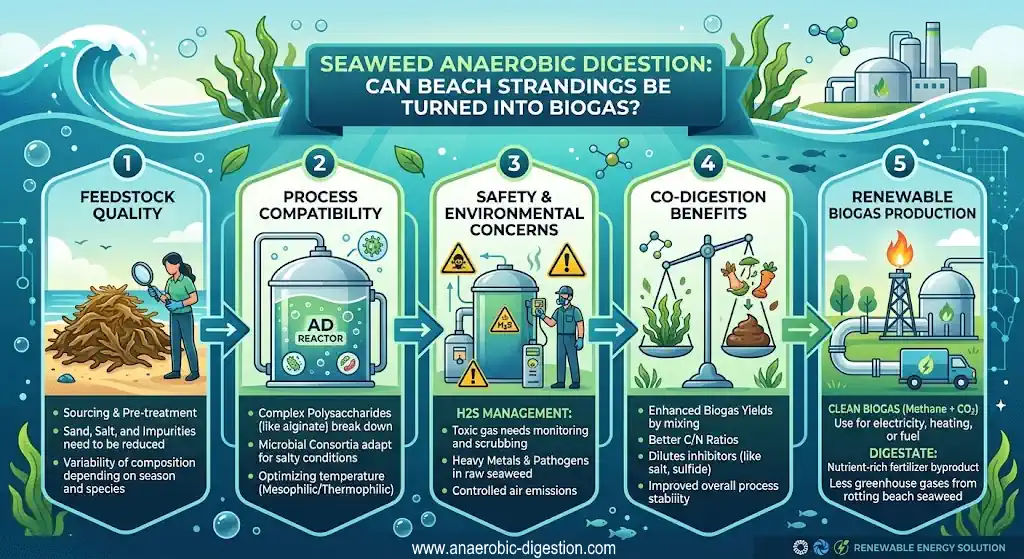
Seaweed stranding → safety assessment → controlled mechanical collection → removal of gross contaminants → drainage/dewatering → salt and feedstock analysis → chopping or preparation → ensiling → collection of silage liquor → controlled co-digestion → biogas cleaning → CHP or biomethane production.
The concept is technically plausible.
Whether it is commercially viable will depend heavily upon local conditions.
Questions That Need Answering Before a Seaweed AD Project Proceeds
A feasibility study should probably answer at least the following:
- How many tonnes of seaweed are actually available?
- How seasonal are the strandings?
- Which seaweed species dominate?
- How quickly is the material collected after stranding?
- What are the total solids and volatile solids contents?
- What methane yield is realistically achievable?
- How much sand and non-organic contamination is present?
- What are the sodium and chloride concentrations?
- What is the sulphur content?
- Are arsenic, heavy metals or other contaminants significant?
- How much silage liquor will be produced?
- Can that liquor safely be incorporated into digester feed?
- How will occupational H2S exposure be controlled?
- Can the receiving digester tolerate the additional salt load?
- Will digestate quality or its permitted use be affected?
- What preprocessing equipment is required?
- What is the transport distance from beach to AD plant?
- What permits and waste controls apply?
- Does the value of the resulting biogas justify the collection and processing costs?
From Coastal Nuisance to Renewable Energy Resource?
The attraction of the idea is easy to understand.
Large seaweed strandings can become a costly environmental, tourism and public-health problem.
Meanwhile, anaerobic digesters require biodegradable organic material.
Converting at least part of a troublesome seaweed accumulation into renewable methane therefore looks like an excellent example of circular resource recovery.
There is also credible research showing that ensiling could help overcome one of the largest practical barriers: seasonality.
Rather than attempting to feed thousands of tonnes of seaweed to a digester immediately after a major stranding event, material could potentially be preserved and progressively introduced over subsequent months.
But this is precisely the sort of apparently simple waste-to-energy idea that requires careful engineering.
Seaweed is not maize.
Its marine origin brings high moisture, salt, sulphur and potentially contaminants. Its decomposition can generate dangerous gases. Its silage may generate large volumes of biologically active liquor. And excessive salinity may inhibit the very methanogens upon which the process depends.
Conclusion
Seaweed anaerobic digestion deserves serious consideration as one possible route for recovering value from problematic coastal strandings.
Research demonstrates that seaweed can produce methane and that at least some macroalgae can be successfully ensiled for prolonged storage, potentially providing feedstock throughout the year rather than only during seasonal beach inundations.
However, any real project needs to address three issues from the outset:
- Safety: collection, transport and handling must not expose workers or the public to dangerous concentrations of hydrogen sulphide or other decomposition products.
- Feedstock quality: salt, sulphur, sand, contaminants, moisture and silage liquor must all be properly characterised.
- Process compatibility: the receiving digester must be capable of accepting the material without salinity, sulphide or other inhibition destabilising methane production.
For many existing plants, carefully controlled co-digestion rather than seaweed-only digestion may offer the most practical starting point.
If those challenges can be overcome economically, an unpleasant and sometimes hazardous coastal waste could become another useful source of locally produced renewable biogas.
For readers interested in the wider process, see our guide explaining how to make biogas and our overview of the uses of biogas.
Frequently Asked Questions About Seaweed Anaerobic Digestion
Can seaweed be used in an anaerobic digester?
Yes. Many species of marine macroalgae have been tested as anaerobic-digestion feedstocks and can produce methane-rich biogas. However, methane yield, salt concentration, sulphur content and other characteristics differ substantially between species and seasons.
Can seaweed be made into silage?
Yes. Research has demonstrated preservation of several seaweed species by ensiling. A 2015 study stored seaweed for up to 90 days, while later research has investigated kelp storage for up to 12 months. Ensiling could therefore help provide a year-round supply from a highly seasonal resource.
Is seaweed silage the same as maize silage?
No. The preservation principle is similar, but seaweed can have much higher moisture and salt content and may contain fewer readily fermentable sugars and naturally occurring lactic-acid bacteria. It can consequently require different preparation and silage-management techniques.
Does seaweed silage produce effluent?
Potentially a substantial amount. One published study reported that 10% to 28% of ensiled seaweed biomass emerged as liquid effluent. Importantly, the liquid retained significant methane potential, so engineered collection and potential controlled digestion of the liquor should be considered.
Can salt from seaweed inhibit anaerobic digestion?
Yes. High salinity can inhibit methanogenic microorganisms. The severity depends on sodium concentration, feedstock, reactor conditions and whether the microbial population has been gradually acclimatised. Co-digestion and dilution with low-salinity feedstocks may help manage the risk.
Does seaweed produce hydrogen sulphide?
Decomposing seaweed can release hydrogen sulphide, and sulphur contained in seaweed may also contribute to H2S formation during anaerobic digestion. This is both an occupational-safety issue and a potential biogas-cleaning requirement.
Is it safe to collect rotting seaweed for a digester?
Collection may involve significant hazards and should only take place under an appropriate risk-assessed system of work. Decomposing seaweed can release toxic hydrogen sulphide, and odour must not be relied upon to indicate whether concentrations are safe.
Would seaweed be better co-digested with other feedstocks?
Often this is likely to be preferable. Mixing seaweed with manure, crop silage, food waste or other suitable feedstocks can dilute its salt content and produce a more consistent digester feed. Any feedstock change must nevertheless comply with the plant’s permit and other applicable regulatory requirements.
Sources and Further Reading
- MedicalXpress – Seaweed strandings cause a stink: here’s why they harm your health
- Science of the Total Environment – Health risks associated with seaweed strandings
- Harmful Algae – Assessment of hydrogen sulphide exposure in shoreline cleanup workers
- Bioresource Technology – Ensiling of seaweed for a seaweed biofuel industry
- Sustainability – The Storage and Production of Bioenergy Using Macroalgae Biomass: Ensiling
- Energy & Fuels – Inhibition Effect of Sodium Concentrations on Anaerobic Digestion of Sargassum
- Renewable and Sustainable Energy Reviews – Salinity in anaerobic digestion
- Energies – A Brief Review of Anaerobic Digestion of Algae for Bioenergy
- US EPA – Sargassum Inundation Events: Impacts on Human Health
- UK Health and Safety Executive – Hydrogen sulphide health and safety guidance