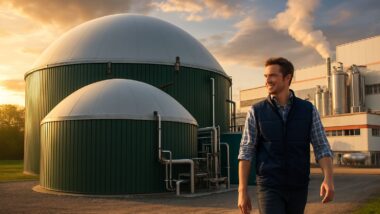
The completion of a landfill gas to renewable natural gas (RNG) project typically takes three to five years. The three main stages are engineering and procurement, construction and commissioning, and feasibility and permitting.
Article-At-A-Glance: Landfill Gas to RNG Projects
- Landfill gas can be converted into pipeline-ready renewable natural gas (RNG) in as little as 12 to 24 months, depending on permitting, site conditions, and construction timelines.
- Converting landfill gas to RNG delivers an energy yield 2 to 3 times greater than converting that same biogas into electricity — making it one of the most efficient uses of captured methane available today.
- The process follows four distinct phases: feasibility analysis, permitting, construction, and RNG marketing — each with specific technical and regulatory milestones that determine project success.
- Waga Energy's WAGABOX® technology purifies landfill gas into 98%-pure biomethane, ready for direct injection into existing natural gas pipeline infrastructure.
- Keep reading to find out which landfill size qualifies for an RNG project, who typically finances construction, and how real-world projects in Louisiana, Pennsylvania, and New Hampshire are already delivering results.
Buried beneath every active landfill is an untapped energy source quietly generating itself — and the technology to capture it has never been more accessible or financially attractive.
Landfill gas (LFG) is produced when organic waste decomposes in the absence of oxygen. That process generates a gas mixture that is roughly 50% methane and 50% carbon dioxide, along with trace amounts of other compounds. Left uncaptured, that methane vents into the atmosphere — and methane is over 80 times more potent than CO₂ as a greenhouse gas over a 20-year period. But when captured and upgraded, it becomes renewable natural gas (RNG), a direct substitute for fossil-derived natural gas with a dramatically lower carbon footprint. Waga Energy, a specialist in landfill gas upgrading, has built its entire model around making this conversion as efficient and accessible as possible for landfill operators.
Understanding how a landfill gas to RNG project actually unfolds — from the first site visit to the day gas starts flowing into a pipeline — is what separates projects that get built from projects that stall in planning. This guide walks through every phase.
“null” from www.epa.gov and used with no modifications.
Landfill Gas Can Become Pipeline-Ready RNG in 12 to 24 Months
The timeline from contract signing to first gas delivery typically falls between 12 and 24 months. That window depends heavily on how quickly permits are obtained, the complexity of the site's gas collection infrastructure, and how far the landfill sits from an existing natural gas interconnection point. Sites with existing LFG collection systems and proximity to a pipeline can move faster. Greenfield gas collection buildouts take longer.
What's notable is that the construction phase itself — once permits are secured — is relatively fast. The WAGABOX® unit is prefabricated and delivered to site as a modular system, which dramatically reduces on-site assembly time compared to custom-built facilities. Most of the timeline is consumed by permitting and administrative approvals, not construction.
Why Landfill Gas Is One of the Most Competitive RNG Sources Available
RNG can be produced from multiple feedstocks: agricultural waste, wastewater treatment plants, food waste digesters, and landfills. Of these, landfill gas consistently ranks as one of the most cost-competitive sources. The organic waste is already concentrated, the decomposition process is already happening, and many landfills already have partial gas collection infrastructure in place. That means a significant portion of the capital investment is already sunk — and the marginal cost of upgrading that captured gas to pipeline quality is relatively low. According to Waga Energy, RNG produced from landfill gas is among the most competitively priced on the market.
How Methane Capture Turns a Pollution Problem Into a Clean Energy Asset
Every landfill that lacks an active gas-to-energy system is essentially a slow-motion methane emitter. Capturing that gas doesn't just produce clean energy — it eliminates a significant source of greenhouse gas emissions at the source. That dual benefit is what makes landfill RNG projects particularly compelling from both an environmental and a regulatory standpoint, especially as emissions reporting requirements tighten across North America and Europe.
Phase 1: Feasibility Study and Site Analysis
Before any equipment is ordered or permits are filed, the project starts with a detailed feasibility study. This is the foundation of everything that follows, and skipping or rushing it is the fastest way to derail a project later. The study evaluates whether the site can physically, economically, and legally support an RNG operation — and it's typically conducted by the technology provider or project developer at no upfront cost to the landfill operator.
Minimum Landfill Gas Flow Requirements (Starting at 500 scfm)
Not every landfill qualifies for an RNG project. The most important threshold is gas flow rate. Generally, a minimum landfill gas flow of around 500 standard cubic feet per minute (scfm) is needed to make an upgrading project economically viable. Smaller sites may not generate enough raw gas to justify the capital expenditure of a full upgrading unit, though this threshold can vary depending on the technology and offtake contract structure.
The feasibility team will analyze historical gas generation data, current collection system performance, and projected future gas output based on the landfill's waste-in-place tonnage and composition. A landfill accepting primarily organic municipal solid waste will generate more methane per ton than one dominated by construction debris or inert fill materials.
Technical, Economic, and Regulatory Feasibility Checks
Technical feasibility covers the gas collection system's current state, the methane concentration in the raw gas, the distance to a natural gas pipeline interconnection point, and the site's physical layout for equipment placement. Economic feasibility runs a full cost-benefit model: capital expenditure, operating costs, projected RNG volumes, expected commodity prices, and available renewable energy credits or incentives. These three lenses — technical, economic, and regulatory — must all return a positive result before a project moves forward.
Regulatory feasibility is often the most complex variable. It maps out which environmental permits, air quality authorizations, and gas quality certifications will be required at the state or national level. In the United States, this typically includes coordination with the EPA's Landfill Methane Outreach Program (LMOP), state environmental agencies, and in some cases, local zoning authorities.
How Results Are Shared With the Landfill Operator
Transparency at this stage is critical. All parameters from the feasibility analysis — gas flow projections, RNG production estimates, revenue forecasts, and risk factors — are shared openly with the landfill operator before any agreements are signed. This isn't just good practice; it's how trust is built for a relationship that will span the 15 to 20-year life of a typical RNG offtake contract.
The feasibility output typically includes a projected RNG production volume (often expressed in MMBtu per year or GWh equivalent), an estimated carbon intensity score for the gas produced, and a preliminary revenue model showing what the landfill operator can expect to earn under a long-term agreement. For more information on how biomethane can serve as a natural gas replacement, explore further insights.
Key outputs from a completed feasibility study include insights into potential biomethane as a natural gas replacement.
- Estimated annual RNG production volume based on waste-in-place and gas flow modeling
- Carbon intensity score of the projected RNG, which determines eligibility for Low Carbon Fuel Standard (LCFS) credits
- Pipeline interconnection assessment showing distance, cost, and timeline for gas injection
- Preliminary revenue forecast under multiple commodity price and credit scenarios
- Permit map identifying every required authorization and the responsible regulatory body
- Risk matrix covering gas quality variability, regulatory change, and market price exposure
“null” from www.epa.gov and used with no modifications.
Phase 2: Permitting and Administrative Approvals
Permitting is where many well-designed landfill gas to RNG projects lose momentum. The regulatory landscape varies significantly by jurisdiction, and the number of distinct permits required can be surprisingly high even for a straightforward project. Getting this phase right — with experienced regulatory counsel and proactive agency engagement — is what separates projects that deliver gas on schedule from those that sit idle waiting for approvals.
The permitting phase typically runs parallel to preliminary engineering work, meaning the project team isn't waiting idle while regulators deliberate. Detailed design work, equipment specifications, and pipeline interconnection planning all advance during this window, so construction can begin quickly once approvals land.
What Permits Are Required to Produce and Commercialize RNG
The specific permits required depend on the project location, but a typical landfill RNG project in the United States will need to navigate several distinct regulatory pathways. Air quality permits are almost always required because the upgrading process handles volatile organic compounds and other trace contaminants present in raw landfill gas. These permits govern emissions from the upgrading unit itself, including any flaring equipment used during startup or upset conditions.
Pipeline injection requires coordination with the local gas utility or pipeline operator, who will impose their own gas quality specifications — typically requiring methane purity above 95%, with strict limits on oxygen, nitrogen, carbon dioxide, hydrogen sulfide, and moisture content. Meeting these specifications is a design requirement for the upgrading unit, not an afterthought. The WAGABOX® system is engineered to consistently produce gas at 98% methane purity, which exceeds most utility interconnection standards.
For projects seeking to generate Renewable Identification Numbers (RINs) under the U.S. Renewable Fuel Standard (RFS), registration with the EPA is required before any RNG is produced and sold. Similarly, projects targeting California's Low Carbon Fuel Standard market must complete a pathway application with the California Air Resources Board (CARB) to establish the carbon intensity score of their specific gas stream.
How Local Regulations Affect the Project Timeline
In jurisdictions with streamlined environmental permitting — some U.S. states and Canadian provinces have developed specific RNG project tracks — the permitting phase can be completed in as little as three to six months. In more complex regulatory environments, particularly where air quality permits require public comment periods or where pipeline interconnection agreements involve lengthy utility negotiations, the permitting phase alone can stretch to 12 months or more.
Experienced project developers build regulatory timelines based on the specific jurisdiction and maintain active relationships with the relevant agencies. The difference between a developer who has previously permitted a project in a given state and one who hasn't can easily translate to six months of timeline savings — and in RNG markets where commodity prices fluctuate, time-to-market matters financially.
Phase 3: Construction and WAGABOX® Unit Installation
Once permits are secured, the project moves into its most visible phase: physical construction. For a typical WAGABOX®-based project, this involves two parallel workstreams — civil engineering and site preparation at the landfill, and fabrication of the WAGABOX® unit at the manufacturing facility. Both streams advance simultaneously, so when the unit arrives on site, the pad, utilities, and gas collection tie-ins are ready to receive it.
How Landfill Gas Is Captured, Purified, and Converted Into RNG
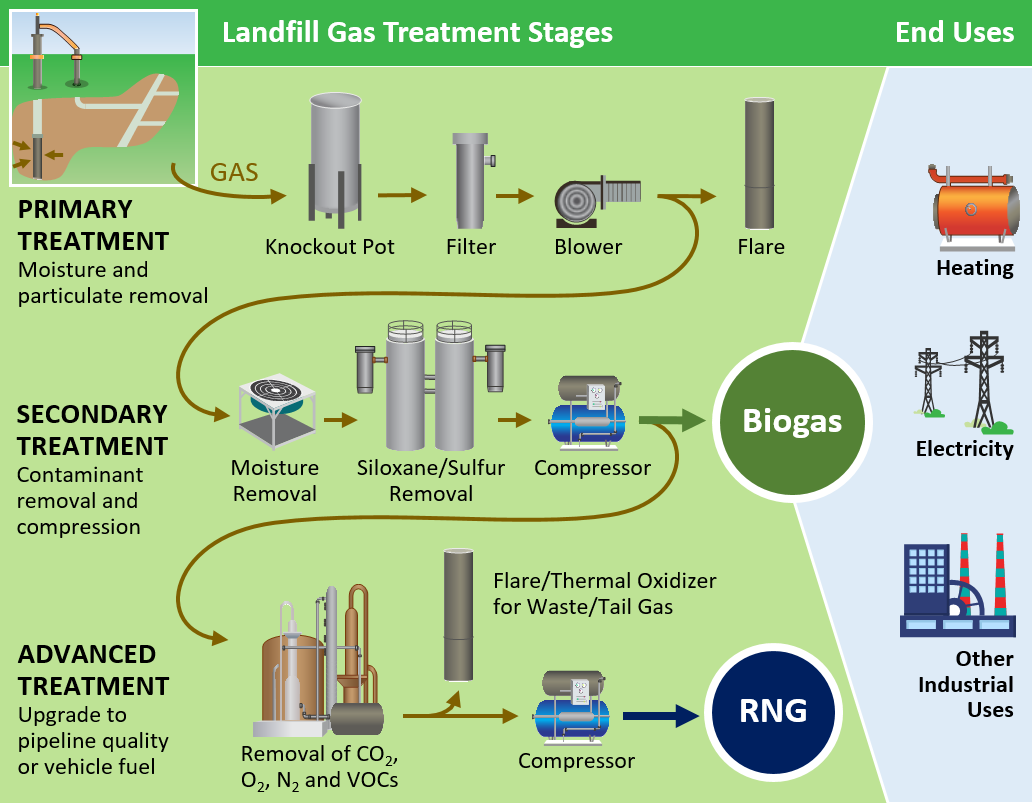
The gas collection system at a landfill consists of a network of vertical extraction wells and horizontal collectors drilled into the waste mass, connected by a series of pipes that route the raw landfill gas to a central header. From there, the gas travels to the upgrading unit — in this case, the WAGABOX® — where it undergoes a multi-stage purification process.
The raw gas entering the unit is typically 45 to 55% methane, with the remainder being primarily CO₂, water vapour, nitrogen, oxygen, and trace contaminants including hydrogen sulfide and siloxanes. The WAGABOX® technology combines two cutting-edge systems: a treatment process that removes contaminants and a membrane or pressure swing adsorption (PSA) separation process that strips out the CO₂, leaving behind a 98%-pure biomethane stream ready for pipeline injection.
The purification sequence matters. Hydrogen sulfide must be removed first because it is corrosive to downstream equipment. Siloxanes — organic silicon compounds common in landfill gas from decomposing personal care products and industrial waste — are removed because they form abrasive silica deposits inside combustion equipment if left in the gas stream. Water vapour is dried out to meet pipeline dew point specifications. Only after these preprocessing steps does the gas enter the main CO₂ separation stage. The result is a consistent, high-purity biomethane stream that meets or exceeds the gas quality standards of virtually every natural gas distribution network in North America and Europe.
Gas Interconnection Construction and Pipeline Connection Requirements
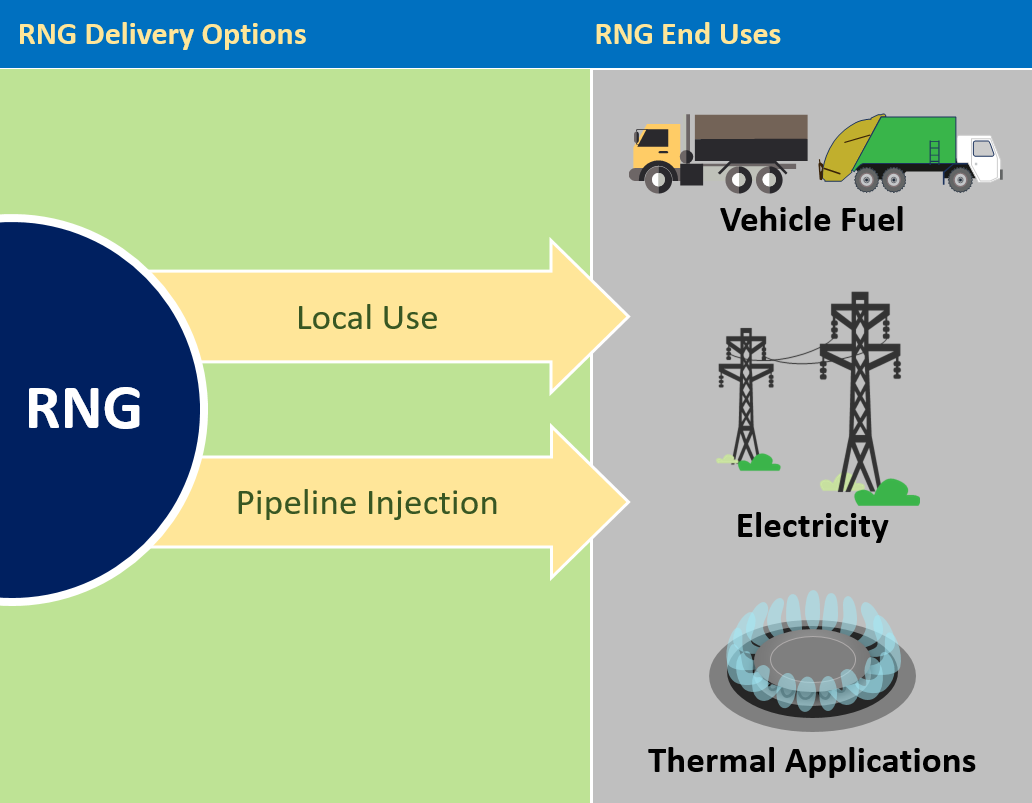
Getting the purified RNG from the upgrading unit into the pipeline network requires a physical interconnection — a metered tie-in point where the biomethane enters the gas distribution or transmission system. The complexity and cost of this interconnection depend entirely on how far the landfill sits from the nearest suitable pipeline. A landfill adjacent to a gas main may require only a short lateral pipeline of a few hundred feet. A more remote site might require a new pipeline segment stretching several miles, which can significantly increase project capital costs and construction timelines. In cases where pipeline injection is not economically feasible due to distance, the purified RNG can alternatively be compressed on-site into CNG and dispensed directly as vehicle fuel — a model that works particularly well for landfill operators or municipalities with captive vehicle fleets.
Who Handles Financing and On-Site Activities
One of the most commercially attractive aspects of a WAGABOX®-based project is the financing model. Waga Energy typically handles the full capital investment for design, equipment fabrication, delivery, and installation — meaning the landfill operator bears no upfront construction cost.
This is a project finance structure where the developer recoups its investment through the RNG revenues generated over the life of the contract. For landfill operators, this transforms what would otherwise be a capital-intensive infrastructure project into a passive revenue stream with no balance sheet impact.
On-site construction activities include civil engineering work such as concrete pad preparation, utility connections, fencing, access road improvements, and gas collection header tie-ins. Waga Energy's technicians lead the mechanical assembly and commissioning of the WAGABOX® unit itself. The commissioning phase — where the system is tested, tuned, and verified against gas quality specifications before injection begins — typically takes several weeks. Once the unit passes all quality checks and the utility confirms the interconnection is ready, gas injection begins and the revenue clock starts.
Phase 4: RNG Marketing and Long-Term Energy Contracts
Producing pipeline-quality RNG is only half the equation. The other half is selling it — and the commercial structure of an RNG offtake agreement is what ultimately determines whether a project delivers strong economics over its operating life. RNG is not sold like electricity through a spot market. Instead, it is typically sold under long-term bilateral contracts with energy buyers, utilities, or fuel distributors who value both the physical gas commodity and the environmental attributes attached to it.
The value of RNG in the market comes from two distinct components. The first is the commodity value of the gas itself — essentially the price of natural gas, since RNG is a direct substitute. The second, and often more valuable, component is the environmental attributes: the Renewable Identification Numbers (RINs) generated under the U.S. Renewable Fuel Standard, and in California, the Low Carbon Fuel Standard (LCFS) credits generated based on the carbon intensity score of the specific gas pathway. For landfill-derived RNG, which carries a strongly negative or near-zero carbon intensity score, LCFS credit values can be substantial.
The total revenue stack for a landfill RNG project typically includes:
- Natural gas commodity revenue — the base price for the physical gas delivered to the pipeline, indexed to Henry Hub or a regional benchmark
- D3 RINs — Renewable Identification Numbers generated under the EPA's Renewable Fuel Standard for cellulosic biogas, currently among the highest-value RIN categories
- LCFS credits — California's Low Carbon Fuel Standard credits, available to projects selling RNG into California markets regardless of where the gas is physically produced
- State-level incentives — several U.S. states and Canadian provinces offer additional production incentives, green gas premiums, or RNG portfolio standards that add incremental value
- Carbon credits — in some markets, voluntary carbon market credits can be layered on top of compliance market revenues for additional upside
Long-term contracts with creditworthy offtakers are the foundation that makes project financing possible. Without a secured revenue contract, lenders and equity investors cannot underwrite the project with confidence. Most landfill RNG projects are structured around 15 to 20-year offtake agreements, which align with the expected productive life of the landfill gas resource and provide the cash flow visibility needed to service project debt.
How Long-Term Off-Take Agreements Generate Reliable Revenue
For landfill operators, the long-term offtake agreement is where the financial benefit becomes concrete. Under a typical agreement, the landfill operator receives either a fixed royalty per unit of RNG produced, a revenue share tied to the market value of the gas and its associated credits, or a combination of both. This arrangement provides a new, recurring income stream from a resource the landfill was previously either flaring or venting — with no capital at risk and no operational burden on the landfill's core business.
RNG as a Vehicle Fuel Versus Pipeline Injection
When pipeline access is available, injection is almost always the preferred delivery method because it maximizes the volume of gas that can be monetised and qualifies the project for the full suite of environmental attribute credits. However, when a landfill has a nearby captive fleet — municipal garbage trucks, transit buses, or industrial vehicles — selling the RNG locally as compressed natural gas (CNG) can be equally or more profitable, particularly if it eliminates diesel fuel costs for the operator and generates RINs based on vehicle fuel displacement. The Vogel Disposal Service project in Pennsylvania is one real-world example of this model, where landfill gas is upgraded and used directly as CNG vehicle fuel for collection trucks — a genuinely circular system where the trucks that deliver waste to the landfill are fueled by the gas that waste produces. For more insights, explore the biomethane price comparison.

“null” from en.wikipedia.org and used with no modifications.
The Environmental Impact of Landfill Gas to RNG Conversion
The environmental case for landfill gas to RNG conversion is compelling from multiple angles simultaneously. It's not a single-benefit technology — it addresses methane emissions, displaces fossil fuel consumption, generates renewable energy, and supports carbon markets all at once. Understanding the specific numbers behind these benefits is important for landfill operators, municipal governments, and investors who need to quantify the environmental value of a project for reporting, permitting, or ESG purposes. For more detailed data on such projects, you can explore the landfill gas energy project data provided by the EPA.
Up to 90% Reduction in Greenhouse Gas Emissions vs. Fossil Fuels
When landfill-derived RNG displaces fossil natural gas in residential heating, industrial processes, or power generation, the lifecycle greenhouse gas reduction can reach up to 90% compared to conventional fossil fuel use. This figure accounts for the full lifecycle: methane captured that would otherwise have been emitted, CO₂ avoided by not burning fossil gas, and the minor emissions associated with the upgrading and compression process itself. The exact reduction depends on the specific gas pathway, the end use application, and the carbon intensity methodology applied — but across all credible lifecycle analyses, landfill RNG consistently delivers deep decarbonization compared to the fossil fuels it replaces.
80% Lower CO2 Emissions Compared to Diesel When Used as CNG
When landfill RNG is used as compressed natural gas in heavy-duty vehicles, the emissions comparison against diesel becomes especially stark. Using RNG-fueled CNG vehicles instead of diesel produces approximately 80% lower CO₂-equivalent emissions on a lifecycle basis. For municipal fleets and waste haulers, this is a straightforward sustainability win that also generates D3 RINs — one of the most valuable RIN categories under the Renewable Fuel Standard.
- ~80% lower lifecycle CO₂ emissions compared to diesel when RNG is used as CNG vehicle fuel
- Up to 90% lower greenhouse gas emissions compared to fossil natural gas across heating and industrial applications
- Methane capture eliminates a potent greenhouse gas that would otherwise vent or be flared from the landfill surface
- Carbon intensity scores for landfill RNG pathways are often near zero or negative, qualifying for maximum LCFS credit value
- Each MMBtu of landfill RNG produced represents both a unit of clean energy delivered and a unit of fossil energy avoided
These numbers are not theoretical — they are the basis on which LCFS pathway scores are calculated and verified by the California Air Resources Board, and on which RIN generation is audited under EPA oversight. The environmental integrity of landfill RNG is backed by rigorous third-party verification, not just marketing claims.
It's worth noting that the emissions profile of a landfill RNG project improves over time as the gas collection system matures and capture efficiency increases. Early in a landfill's operational life, the gas collection rate may be lower as the waste mass settles and the collection well network is expanded. As the system matures, capture rates improve — and so does the project's overall environmental performance.
How Methane Capture Prevents Potent Greenhouse Gas Releases
Methane has a global warming potential more than 80 times greater than CO₂ over a 20-year period. A landfill without active gas capture is continuously releasing this potent greenhouse gas into the atmosphere through surface emissions — even if it's not visibly flaring. Regulatory requirements in the United States under EPA New Source Performance Standards (NSPS) mandate gas collection at landfills above a certain waste-in-place threshold, but collection efficiency is rarely 100%. The gap between what a collection system captures and what actually escapes to the atmosphere is called fugitive emissions — and it represents a real, quantifiable environmental liability for landfill operators. For further insights on biogas initiatives, explore the development of biogas and biomethane in France.
Converting captured landfill gas to RNG, rather than simply flaring it, eliminates that methane at the source while generating economic value in the process. Flaring destroys methane by converting it to CO₂ — which is far less potent — but it generates no revenue and provides no energy. RNG upgrading does both: it destroys the methane threat and converts it into a useful, marketable energy product. That distinction is why landfill gas to RNG projects are viewed so favorably in voluntary carbon markets and by corporate sustainability teams looking for high-quality carbon offset investments.
How RNG From Landfills Supports Local Energy Independence
The Circular Economy in Action:
- Household and industrial waste is collected and transported to a landfill →
- Organic waste decomposes and generates landfill gas →
- Landfill gas is captured and upgraded to 98%-pure biomethane →
- Biomethane is injected into the local natural gas pipeline network →
- Local homes and businesses consume the renewable gas →
- Those same residents and businesses generate the waste that feeds the cycle.
Energy independence is not just a national policy goal — it plays out at the municipal and regional level every time a community can source its energy from local resources rather than distant fossil fuel supply chains. Landfills are, by definition, local infrastructure. They are sited close to the communities they serve, which means the gas they generate is inherently a local resource. Converting that gas to RNG and injecting it into the regional gas grid puts locally produced energy into the homes and businesses of the same community that generated the waste — a genuinely circular energy system. Learn more about upgrading landfill gas into renewable natural gas.
This local energy loop has real resilience benefits as well. Natural gas distribution grids are remarkably stable infrastructure, and RNG injected at the distribution level strengthens supply reliability at the local node. For municipalities that operate their own gas utilities — and there are hundreds across North America — a local landfill RNG project can directly reduce the volume of fossil gas they must purchase on the open market, insulating ratepayers from commodity price volatility.
The financial flow also stays local. Revenue generated from RNG sales — whether paid to the landfill operator directly or shared with the host municipality — circulates within the regional economy rather than flowing to fossil fuel producers in distant geographies. For publicly owned landfills operated by county or municipal governments, this revenue can fund environmental programs, infrastructure improvements, or simply reduce the tipping fee burden on local businesses and residents.
Supplying Local Homes and Businesses Through Existing Gas Infrastructure
One of the most practical advantages of RNG as an energy vector is that it requires zero new consumer-side infrastructure. Unlike hydrogen, which requires new pipelines, new appliances, and new vehicles to be useful, RNG is chemically identical to fossil natural gas and can flow through existing pipelines to existing gas appliances, furnaces, boilers, and industrial burners without any modification. The infrastructure investment is entirely on the production side — at the landfill — while the distribution and consumption infrastructure is already in place and paid for.
This means a WAGABOX® project that comes online at a landfill in December can be heating homes through the existing gas grid by January, without a single homeowner needing to do anything differently. The gas simply becomes cleaner at the point of origin while remaining functionally identical at the point of use. That seamless integration with existing infrastructure is one of RNG's most underappreciated strengths as a decarbonization tool.
For businesses with significant natural gas consumption — manufacturers, food processors, commercial laundries, hospitals — procuring RNG through a green gas tariff or direct supply agreement allows them to decarbonise a hard-to-electrify portion of their energy use without any process changes. The operational continuity this provides makes RNG particularly attractive to industrial consumers who cannot easily switch to electric alternatives for high-temperature process heat.
| RNG Delivery Method | Best Suited For | Key Advantage | Key Consideration |
|---|---|---|---|
| Pipeline Injection | Landfills near gas distribution infrastructure | Maximum volume monetisation; qualifies for full RIN and LCFS credit stack | Requires utility interconnection agreement and may involve pipeline construction costs |
| CNG Vehicle Fuel (On-Site) | Landfills with captive fleets or nearby fueling demand | Eliminates diesel fuel costs; generates D3 RINs; fully circular model | Lower volume throughput; requires on-site CNG compression and dispensing infrastructure |
| Directed Biogas (Virtual Pipeline) | Remote landfills without nearby pipeline access | Allows environmental attribute monetisation without physical pipeline | Physical gas is not transported; only the environmental attributes are transferred to a buyer |
Choosing the right delivery model is a site-specific decision that the feasibility study will inform. Pipeline injection is the default preference where infrastructure allows, but the CNG and directed biogas models ensure that landfills in more remote or underserved locations can still participate in the RNG economy and deliver measurable environmental benefits to their communities.
The Circular Economy Case for Landfill-Derived Renewable Energy
The circular economy argument for landfill RNG is not abstract — it's mechanical. The same households and businesses that generate the waste deposited in a landfill are the ones who receive the renewable gas that waste produces. Every garbage truck that empties a bin is contributing to a gas-generating system that, once upgraded, sends energy back through the pipes serving those same neighbourhoods. That closed loop — waste in, clean energy out — is exactly what a circular economy is supposed to look like, and landfill RNG delivers it through infrastructure that already exists in virtually every developed community on the planet.
Real-World Landfill Gas to RNG Projects Already in Operation
The theoretical case for landfill gas to RNG conversion is strong. But what makes it genuinely compelling is the fact that hundreds of projects are already operating across North America, delivering measurable results in terms of gas production, emissions reductions, and revenue generation. The EPA's Landfill Methane Outreach Program (LMOP) database tracks operational landfill energy projects across the United States, and the RNG category has been one of the fastest-growing segments within that database over the past decade.
Three projects in particular illustrate the range of configurations, scales, and delivery models that landfill RNG can take — from pipeline injection serving urban residents to on-site vehicle fueling that powers the very trucks collecting the waste.
1. Shreveport Landfill Renewable Natural Gas Project (Louisiana)
The Shreveport Landfill Renewable Natural Gas Project in Louisiana is a pipeline injection and vehicle fuel project that captures landfill gas from a municipal solid waste facility and upgrades it to pipeline-quality RNG. The project uses a combined delivery model — injecting biomethane into the gas distribution network while also supplying CNG for vehicle fuel — which allows it to generate both D3 RINs under the Renewable Fuel Standard and additional revenue from the commodity gas market. This dual-output configuration is increasingly attractive for sites where both pipeline access and a local vehicle fueling demand exist simultaneously, as it maximises the monetisation of every unit of biogas captured from the landfill.
2. University of New Hampshire EcoLine™ Cogeneration System (New Hampshire)
The University of New Hampshire EcoLine™ project is one of the most recognised landfill gas utilisation projects in the United States, and for good reason. The system pipes landfill gas from the Turnkey Landfill in Rochester, New Hampshire, approximately 12 miles to the UNH campus in Durham, where it fuels a cogeneration system that simultaneously produces electricity and thermal heat for university buildings. At peak operation, the project has supplied more than 80% of the university's annual electricity needs from landfill gas, making it one of the highest-profile demonstrations of how landfill-derived energy can serve as a primary, not supplemental, energy source for a major institution. While the UNH system uses direct combustion rather than full pipeline-grade upgrading, it illustrates the scale of energy output that even a single landfill can deliver when the gas is properly captured and utilised.
3. Vogel Disposal Vehicle Fuel Projects (Pennsylvania)
Vogel Disposal Service operates one of the most genuinely circular landfill gas projects in the country. The Pennsylvania-based waste haulier captures landfill gas from its own disposal facility, upgrades it to RNG, compresses it to CNG, and fuels its own collection vehicle fleet with the result. The trucks that haul waste to the landfill are literally powered by the gas that waste generates — a closed-loop system that eliminates diesel fuel costs, generates D3 RINs, and dramatically reduces the fleet's lifecycle carbon emissions.
- Waste collection vehicles fuel themselves from gas generated by the waste they previously delivered — a true closed-loop system
- D3 RINs are generated for every gasoline gallon equivalent of RNG dispensed as vehicle fuel, creating a strong compliance market revenue stream
- Diesel displacement reduces operating costs while delivering approximately 80% lower lifecycle CO₂ emissions per mile travelled
- No pipeline interconnection required — the CNG fueling station is co-located with the landfill, eliminating the largest infrastructure cost in many pipeline injection projects
- The model is replicable for any waste haulier, transit authority, or municipality that operates both a landfill and a vehicle fleet with a central fueling point
What the Vogel project demonstrates is that you don't need pipeline access or a utility interconnection agreement to build a financially viable, environmentally credible landfill RNG project. When a captive fleet is available and co-located with the gas source, the CNG vehicle fuel model can be faster to permit, simpler to construct, and equally profitable to the operator.
Taken together, these three projects represent the full spectrum of what landfill gas to RNG can look like in practice — from a university campus energy anchor to a municipal pipeline injection project to a private haulier's fleet fuel supply. The common thread is that each project started with a feasibility study, secured the necessary permits, built the upgrading infrastructure, and found a reliable offtake market. The rest followed from there.
Your Community Can Start This Process Today
If your municipality, county, or waste management district operates an active landfill that has been accepting organic municipal solid waste for five or more years, there is a meaningful probability that a landfill gas to RNG project is already economically viable on your site. The gas is already being generated. The question is simply whether it is being captured and whether it is being converted into its highest-value use. For most landfills that are currently flaring their captured gas — or not capturing it at all — the answer represents a significant untapped revenue and sustainability opportunity.
The first step is not a capital commitment or a permit application. It's a conversation with an experienced project developer who can conduct a no-cost preliminary assessment of the site's RNG production potential. That assessment will quickly establish whether the site clears the minimum gas flow threshold, how far the nearest pipeline interconnection point sits, and what the approximate revenue potential looks like under current market conditions. In most cases, that preliminary assessment can be completed within a few weeks with nothing more than the landfill's existing gas flow monitoring data and a site visit.
For landfill operators and municipal officials who are newer to this space, it helps to understand what a realistic project development timeline looks like before initiating that first conversation. The table below summarises the key phases, typical durations, and major milestones for a standard landfill gas to RNG project from initial contact to steady-state gas delivery.
| Project Phase | Typical Duration | Key Milestone | Who Leads |
|---|---|---|---|
| Preliminary Assessment | 2–6 weeks | Site qualifies for full feasibility study | Project developer |
| Full Feasibility Study | 2–4 months | RNG production volume and revenue model confirmed; agreement signed | Project developer with landfill operator |
| Permitting & Administrative Approvals | 3–12 months | All environmental, air quality, and pipeline interconnection permits secured | Project developer with regulatory counsel |
| Engineering & Equipment Fabrication | 4–8 months (parallel to permitting) | WAGABOX® unit fabricated and ready for delivery | Technology provider |
| Civil Construction & Site Preparation | 2–4 months | Pad, utilities, and gas collection tie-ins complete | Civil contractor |
| Unit Installation & Commissioning | 4–8 weeks | WAGABOX® passes gas quality verification; injection begins | Technology provider technicians |
| First Gas Delivery | Month 12–24 from contract signing | RNG flowing into pipeline or CNG station; revenue commences | Ongoing operations |
Frequently Asked Questions
The questions below are the ones that landfill operators, municipal sustainability directors, and waste industry professionals ask most consistently when evaluating whether a landfill gas to RNG project is right for their site. The answers are grounded in how these projects actually work — not how they're marketed.
How Long Does It Take to Go From Contract Signing to First Gas Delivery?
Most landfill gas to RNG projects reach first gas delivery within 12 to 24 months of contract signing. The wide range reflects the variability in permitting timelines across different jurisdictions. Sites in states with streamlined environmental permitting processes and proximity to existing gas pipeline infrastructure tend to land at the shorter end of that range. Sites in complex regulatory environments or requiring new pipeline lateral construction typically take longer.
The construction and installation phase itself — once all permits are secured — generally runs four to six months from equipment delivery to commissioning completion. The permitting phase is where most timeline variability occurs, which is why choosing a project developer with prior permitting experience in your specific state or province can materially reduce total project duration.
What Is the Minimum Landfill Size Required for an RNG Project?
The practical minimum threshold for a full RNG upgrading project is a landfill gas flow rate of approximately 500 standard cubic feet per minute (scfm). In terms of waste-in-place, this typically corresponds to a landfill that has accepted several million tons of municipal solid waste. Smaller sites that fall below the upgrading threshold may still be candidates for direct use electricity generation or other smaller-scale LFG energy recovery options, but the full pipeline-injection RNG model generally requires the gas volumes that larger landfills provide. The preliminary assessment phase will establish quickly whether a given site meets the threshold.
Who Pays for the Construction and Installation of the RNG Unit?
In the project model employed by developers like Waga Energy, the project developer finances the full capital cost of equipment fabrication, delivery, civil construction, and installation — at no upfront cost to the landfill operator. The developer recoups this investment through revenues generated by RNG sales over the term of the long-term offtake contract, which typically runs 15 to 20 years. This structure means that landfill operators can access a new revenue stream and meet sustainability goals without any capital expenditure, balance sheet impact, or operational burden on their core waste management business.
How Is the RNG Sold and Who Are the Typical Energy Off-Takers?
RNG from landfill projects is sold under long-term bilateral contracts rather than on a spot market. Typical off-takers include natural gas utilities that are meeting state renewable gas portfolio standards, large industrial or commercial companies with carbon reduction targets who purchase RNG through green gas supply agreements, fuel distributors who blend or sell RNG-attributed CNG for transportation fuel, and in some cases, municipalities that purchase RNG to supply public buildings or vehicle fleets. For more on how biogas is utilized in different regions, you can explore biogas and biomethane in France.
The revenue from an RNG project comes from two main streams: the commodity value of the gas itself (priced relative to prevailing natural gas benchmarks) and the environmental attribute value of the RINs and LCFS credits generated by the project. In many markets, the environmental attribute revenue is larger than the commodity gas revenue — which is why the carbon intensity score of the specific gas pathway matters so much and why the feasibility analysis pays close attention to how each project's pathway will be certified under the relevant regulatory programs.
Does Converting Landfill Gas to RNG Qualify for Renewable Energy Credits?
Yes — landfill gas to RNG projects qualify for multiple renewable energy and environmental credit programs, and stacking these credits is central to the financial model that makes most projects viable. The specific credits available depend on where the gas is produced, how it is delivered, and which regulatory programs apply.
- D3 Renewable Identification Numbers (RINs) — generated under the EPA's Renewable Fuel Standard for cellulosic biogas used as transportation fuel; among the highest-value RIN categories
- Low Carbon Fuel Standard (LCFS) Credits — California's carbon market credits, available to landfill RNG projects nationwide that sell gas into California markets through book-and-claim accounting
- State Renewable Portfolio Standard (RPS) Credits — several U.S. states include RNG within their renewable portfolio requirements, creating additional compliance market demand
- Voluntary Carbon Market Credits — projects that can demonstrate additionality and quantify emissions reductions may generate verified carbon credits for sale to corporate buyers with net-zero commitments
- EPA LMOP Recognition — while not a tradeable credit, LMOP partnership status provides access to technical assistance, visibility, and industry credibility that can support offtake negotiations
The ability to stack multiple credit streams on top of commodity gas revenues is what gives landfill RNG projects their financial resilience. Even in periods when natural gas commodity prices are low, the environmental attribute revenues — particularly D3 RINs and LCFS credits — provide a floor that keeps projects economically sound.
It's also worth noting that the credit landscape is evolving. Several U.S. states are actively developing or expanding RNG-specific incentive programs, and the Inflation Reduction Act introduced new incentives for clean fuel production that may apply to qualifying landfill RNG projects. Staying current with this regulatory environment is one of the core competencies that an experienced project developer brings to the table.
For landfill operators and municipal officials evaluating an RNG project, the credit qualification analysis should be completed as part of the feasibility study — not as an afterthought. The difference between a project that qualifies for a full LCFS pathway and one that does not can translate to millions of dollars in revenue over the life of a 20-year contract. Getting the pathway certification right from the start is not a regulatory formality — it's a direct financial decision.
The technology is proven, the markets are established, the financing models are in place, and the environmental case is airtight. What's left is simply the decision to begin — and that decision starts with a single site assessment conversation.