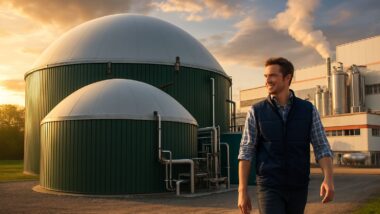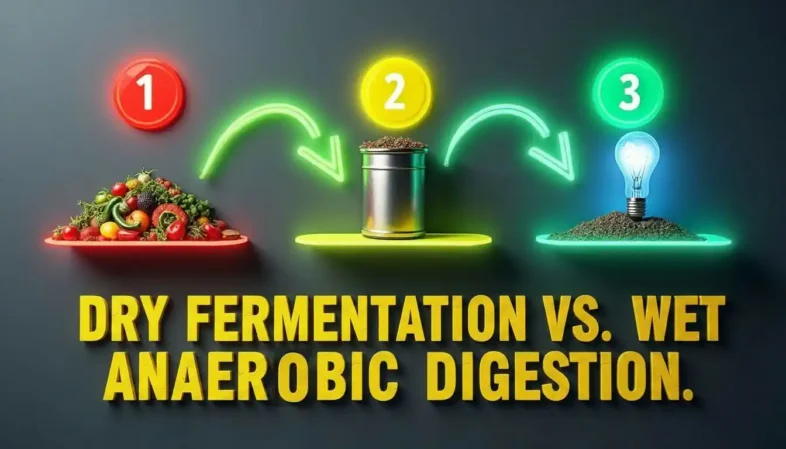
Dry fermentation (solid-state AD) and wet anaerobic digestion are both biochemical processes used to convert organic waste into biogas. The primary difference is the moisture content: wet systems process pumpable slurries (<15% dry matter), while dry systems handle stackable solids (20% – 40%+ dry matter).
Article-At-A-Glance – Dry Fermentation vs. Wet Anaerobic Digestion
- The total solids (TS) content of your feedstock is the single most important factor in choosing between wet and dry anaerobic digestion for municipal solid waste (MSW) treatment.
- Wet AD systems operate at under 10–20% TS and deliver stronger energy balance and economic performance, while dry fermentation handles 20–40%+ TS with far less water and greater feedstock flexibility.
- Dry anaerobic digestion (also called Solid-State Anaerobic Digestion or SSAD) is increasingly considered the most environmentally advanced option for large-scale MSW operations — but the tradeoffs are real and depend heavily on your specific waste stream.
- Most comparative research has focused on either wet or dry AD in isolation — the dilution factor and its direct impact on biogas yield across both systems is still an emerging area of study.
- Digestate management is one of the most overlooked operational challenges in MSW treatment — and it affects your bottom line more than most operators expect.
The process you choose for treating municipal solid waste doesn’t just affect your biogas yield — it shapes your entire operational footprint, cost structure, and long-term viability. Renergon Biogas, a specialist in anaerobic digestion technology, provides detailed technical comparisons that help operators make informed decisions between wet and dry systems.
At the centre of this debate are two competing technologies: wet anaerobic digestion (wet AD) and dry fermentation, also known as Solid-State Anaerobic Digestion (SSAD). Both convert biodegradable organic material into biogas and digestate, but they do it in fundamentally different ways. Understanding those differences — technically, operationally, and economically — is what separates a well-designed MSW facility from one that’s constantly fighting its own process.
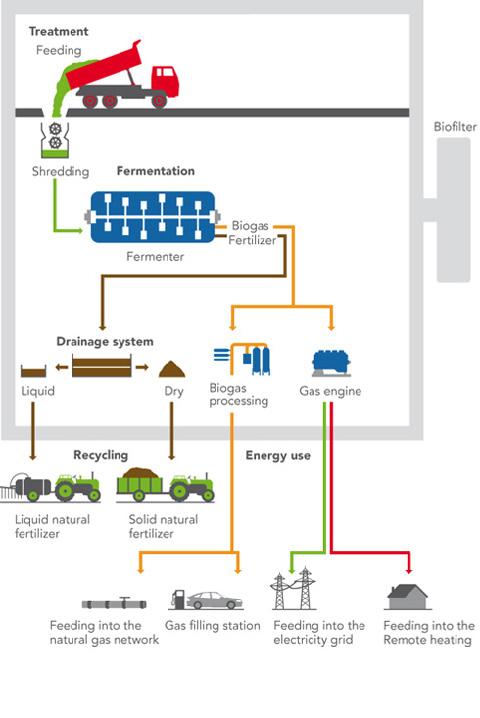
“Solid-State Anaerobic Digestion for …” from ohioline.osu.edu and used with no modifications.
Dry vs. Wet AD: The Core Difference Between Dry Fermentation vs. Wet Anaerobic Digestion That Changes Everything
The most fundamental distinction between these two technologies comes down to one number: total solids content. Everything else — reactor design, water usage, energy balance, feedstock tolerance — flows from that single variable.
Total Solids Content: The Defining Factor
Wet AD systems are designed to operate at low total solids content, typically below 10–20% TS. This means the feedstock is diluted — often significantly — before it enters the digester, creating a pumpable slurry that moves easily through the system. Dry fermentation, by contrast, operates at 20% TS and above, with some systems running at over 40% TS. No dilution is required. The material is loaded in its near-original solid state.
This difference in solids content isn’t just a technical detail — it’s the root cause of virtually every operational tradeoff between the two systems. Dilution in wet AD means larger reactor volumes to handle the same organic load. High solids in dry fermentation means lower degradation efficiency but dramatically reduced water demand and a smaller liquid handling burden.
Why Municipal Solid Waste Makes This Choice Critical
MSW is not a uniform feedstock. It arrives contaminated, variable in moisture content, and mixed with materials that can disrupt biological processes. Food waste, the primary biodegradable fraction, introduces high moisture naturally — which affects how it behaves in both wet and dry systems. Research has specifically identified the solids content of food waste entering the digester as a crucial balancing factor between the benefits and drawbacks of each AD approach. Getting this wrong at the design stage creates cascading problems that are expensive to fix after commissioning. For example, using specialized equipment can help mitigate some of these issues.
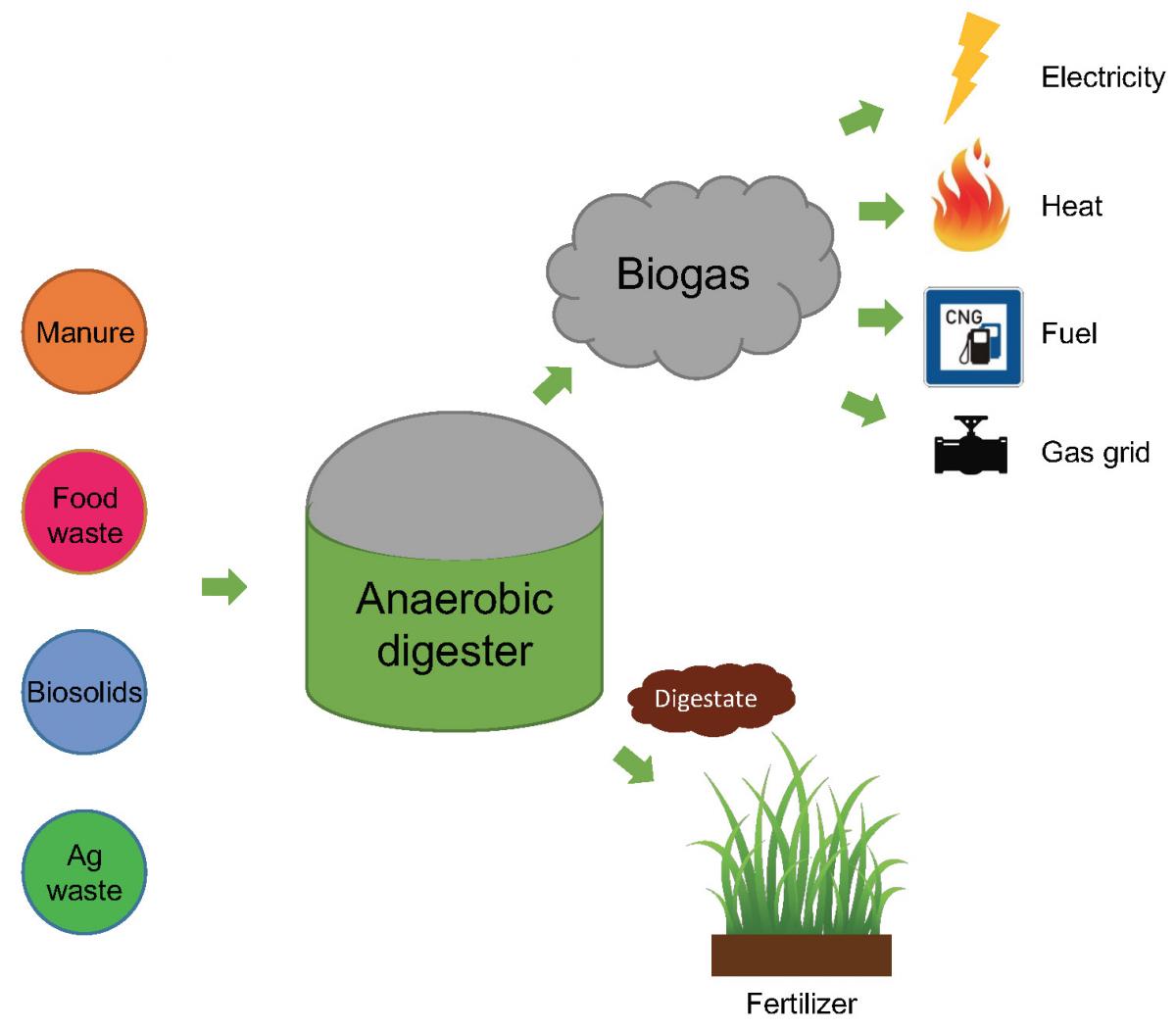
“Wet AD alternative choice: Dry Fermentation vs. Wet Anaerobic Digestion” from ohioline.osu.edu and used with no modifications.
How Wet Anaerobic Digestion Works
Wet AD is the older, more established of the two technologies. It has a longer operational track record and remains the dominant choice globally for both municipal and industrial biodegradable waste treatment.
The Dilution Process and Reactor Setup
In a wet AD system, incoming biomass — typically including food waste, animal dung, or organic fractions of MSW — is mixed with water in roughly equal proportions to produce a slurry with a total solids content of approximately 10–15% TS. This slurry is then fed into a sealed reactor vessel where anaerobic microorganisms break down the organic material and produce biogas (primarily methane and CO₂) along with a liquid digestate.
Because the material is pumpable, wet AD systems lend themselves well to continuous-flow reactor designs. The mixing is typically mechanical, and the process is generally well-understood from an engineering standpoint. However, that dilution requirement has a direct consequence: to process the same organic load as a dry system, a wet AD reactor needs significantly more volume. That translates directly into higher capital costs and a larger physical footprint. For a comparison of different digester types, check out the differences between covered lagoon and plug flow digesters.
Feedstock Requirements and Pretreatment
Wet AD systems are more selective about what they can accept. Contaminants like plastics, glass, and fibrous materials that are common in MSW streams can cause pump blockages, damage mechanical mixers, and reduce overall process efficiency. This means pretreatment — screening, sorting, and size reduction — is not optional. It’s a cost centre that must be factored into the total system economics from day one.
Energy Output and Economic Performance – Dry Fermentation vs. Wet Anaerobic Digestion
On a straight energy balance comparison, wet AD plants consistently outperform dry AD plants in biogas productivity per tonne of waste and per cubic meter of biogas produced. Research comparing wet and dry AD systems found that wet AD plants delivered improved energy balance and stronger economic performance overall. The continuous nature of the process, combined with more complete volatile solids (VS) removal under optimal conditions, gives wet AD a measurable efficiency edge — particularly when the incoming feedstock has a solids content that naturally suits the system. For more information on different types of digesters, you can explore the differences between covered lagoon and plug flow digesters.
That said, “better energy balance” only holds when the system is well-matched to its feedstock. A wet AD plant receiving high-solids MSW fractions requires more dilution water, more mixing energy, and more pretreatment — all of which erode that efficiency advantage quickly.
How Dry Fermentation Works
Dry fermentation takes a fundamentally different approach to the same biological process. Instead of creating a liquid slurry, the organic material is processed in its solid state — stacked, inoculated, and left to ferment in sealed batch containers.
Batch-Mode Fermenter Boxes Explained
The most common dry fermentation configuration uses large, sealed fermenter boxes — sometimes called garage-style digesters — where solid waste is loaded in batches. The material typically has a total solids content of 20–40% TS or higher. Inoculation is achieved by mixing fresh feedstock with already-digested material (digestate), which seeds the new batch with active microbial communities. Once loaded and sealed, the fermentation process proceeds without the continuous mechanical mixing that wet AD requires.
Percolate Recirculation and Process Stability
One of the defining features of dry fermentation is the use of percolate recirculation. Liquid leachate — called percolate — is collected from the base of the fermenter box, heated if necessary, and sprayed back over the solid waste mass from above. This serves two critical functions: it distributes moisture and microbial activity evenly through the solid mass, and it maintains the temperature stability needed for consistent methane production. Without mechanical mixing, percolate recirculation is what keeps the biology working.
Retention Time and Water Usage Advantages
Dry fermentation systems offer shorter hydraulic retention times compared to some wet AD configurations, and the water demand is dramatically lower. Because no dilution is required to make the feedstock processable, the system avoids the large volumes of process water that wet AD depends on. For facilities operating in water-stressed regions, or those facing strict effluent discharge limits, this is a significant operational advantage — not just an environmental one.
Head-to-Head: Wet AD vs. Dry Fermentation for MSW
Comparing these two technologies requires looking beyond a single performance metric. Biogas yield matters, but so does footprint, water consumption, feedstock tolerance, capital investment, and what you do with the output. The right answer changes depending on the scale of the operation, the nature of the incoming waste, and the infrastructure available at the site.
The table below summarises the key performance differences across the factors that matter most in MSW treatment decisions.
Fig. 1: Dry Fermentation vs. Wet Anaerobic Digestion Compared
| Performance Factor | Wet Anaerobic Digestion | Dry Fermentation (SSAD) |
|---|---|---|
| Operating Solids Content | <10–20% TS | 20–40%+ TS |
| Water Requirement | High (dilution required) | Low (no dilution needed) |
| Reactor Volume | Larger | Smaller per organic load |
| Biogas Productivity | Higher per tonne of waste | Lower degradation efficiency |
| Feedstock Flexibility | Lower (pretreatment required) | Higher (tolerates contaminants) |
| Mechanical Mixing | Required (continuous) | Not required |
| Capital Cost | Higher (larger vessels) | Lower per installation |
| Operational Complexity | Moderate to High | Lower |
| Energy Balance | Stronger | Moderate |
| Best Fit | Homogeneous, high-moisture waste | Mixed, high-solids MSW streams |
Footprint, Capacity, and Reactor Volume
Wet AD’s need for dilution creates a compounding volume problem. When you add water to bring a high-solids MSW fraction down to a processable slurry, you’re not just adding liquid — you’re multiplying the total volume that needs to be held, heated, mixed, and eventually processed as digestate. For large-scale MSW operations processing hundreds of tonnes per day, this translates into substantial civil engineering costs and land requirements. Dry fermentation’s batch-box configuration is more modular by design, allowing capacity to be scaled by adding additional fermenter units without redesigning the core infrastructure.
Biogas Productivity and Methane Content
Wet AD consistently produces more biogas per tonne of input waste under comparable conditions. The higher degree of volatile solids (VS) removal in a well-operated continuous wet AD system means more organic material is converted to methane rather than remaining locked in the digestate. Research comparing both systems specifically quantified biogas productivity per tonne of waste and per cubic meter of biogas produced, with wet AD coming out ahead on both metrics.
However, dry fermentation systems are not far behind when the feedstock is well-matched to the process. Studies on anaerobic digestion of food waste under conditions switching from wet to dry AD demonstrated high methane production potential even without mechanical mixing — suggesting that the efficiency gap narrows significantly when operating parameters are optimised for the specific waste stream being processed.
Feedstock Flexibility and Tolerance to Contaminants
This is where dry fermentation holds a clear and practically significant advantage for MSW applications. Municipal solid waste is inherently heterogeneous. Even after source separation and sorting, the organic fraction arriving at a treatment facility typically contains residual plastics, paper fibers, woody material, and other contaminants that would cause serious problems in a wet AD system’s pump and mixing infrastructure.
Dry fermentation systems don’t pump their feedstock — they load it. That means the mechanical vulnerabilities that make contamination so costly in wet AD simply don’t apply in the same way. Operators report substantially lower pretreatment requirements for dry systems handling mixed MSW, which reduces both the capital cost of pretreatment equipment and the ongoing labor and maintenance burden associated with running it.
Research has confirmed that dry AD plants offer greater flexibility in the type of feedstock accepted. For waste management authorities dealing with variable waste compositions across different collection zones or seasons, that flexibility has real operational value. It reduces the risk of process disruption and lowers the cost of feedstock conditioning before digestion.
Capital Costs vs. Operational Costs
The capital vs. operational cost tradeoff between wet and dry AD is nuanced and often misrepresented in high-level comparisons. Wet AD plants tend to require higher capital investment per installation due to the larger reactor vessels, more complex liquid handling systems, and the mechanical mixing infrastructure needed for continuous operation. However, wet AD’s stronger energy balance can generate higher revenue from biogas-to-energy conversion over the operational life of the plant.
Dry fermentation installations are generally less capital-intensive per unit of installed capacity. The modular batch-box design lowers construction complexity, and the absence of mechanical mixing systems reduces both initial equipment cost and long-term maintenance expenditure. But the lower biogas yield per tonne of waste means the revenue side of the equation is weaker unless the facility is optimized to process very high volumes.
The economic comparison ultimately depends on local energy prices, gate fees, water costs, and the cost of pretreatment. No single answer applies universally — which is why site-specific techno-economic analysis is essential before committing to either technology at scale.
Digestate Management: A Factor Most People Overlook
Digestate — the solid and liquid residue left after anaerobic digestion — is treated as an afterthought in many facility planning processes. It shouldn’t be. The volume, composition, and handling requirements of digestate differ significantly between wet and dry AD systems, and those differences have direct implications for operational cost, regulatory compliance, and whether the facility can be considered genuinely sustainable.
Wet AD produces large volumes of liquid digestate that must be stored, treated, and either land-applied or discharged in compliance with local effluent regulations. Dry fermentation produces a more solid digestate fraction that is easier to handle, transport, and market as a soil amendment. For facilities without access to large land areas for liquid digestate application — which describes most urban MSW operations — the more manageable output from dry fermentation is a meaningful advantage that should be weighted heavily in the technology selection process.
Which Method Works Best for Municipal Solid Waste
There is no single universally correct answer — but there are clear patterns that point toward the right choice for specific operational contexts. The decision framework should always start with the waste stream itself: its solids content, contamination level, moisture, and seasonal variability. Everything else follows from that characterisation.
When Wet AD Makes More Sense
Wet AD is the stronger choice when the incoming organic fraction is relatively homogeneous, high in moisture, and low in physical contaminants. Source-separated food waste collected through dedicated organics programs — where quality control at the household level keeps contamination low — is the ideal feedstock for wet AD. Under these conditions, the dilution requirement is minimised, pretreatment costs are manageable, and the superior energy balance of wet AD translates directly into better economics.
Facilities with access to abundant process water, existing liquid waste handling infrastructure, and strong biogas-to-grid or combined heat and power (CHP) revenue streams will also find that wet AD’s higher biogas productivity justifies the additional capital and operational complexity. It remains the dominant technology globally for good reason — when conditions are right, it performs exceptionally well.
When Dry Fermentation Is the Better Choice
Dry fermentation becomes the superior option when the incoming MSW stream is heterogeneous, high in solids, and carries significant contamination risk. Large-scale municipal operations collecting mixed organic waste — where source separation is incomplete and contamination with plastics, paper, and fibrous material is routine — are precisely the environments where dry fermentation’s tolerance for difficult feedstocks delivers the most value. The ability to load material without pumping it, and to operate without mechanical mixing, removes the two biggest mechanical failure points that plague wet AD systems in contaminated waste scenarios.
The Role of Water Availability and Scale
Water scarcity is an increasingly important variable in facility planning, and it’s one that strongly favors dry fermentation. Wet AD’s dilution requirement creates a continuous demand for process water that can become operationally and financially unsustainable in water-stressed regions or during drought periods. Dry fermentation’s percolate recirculation system is largely self-contained — the liquid produced by the waste itself is captured, heated, and reused within the process, dramatically reducing net water consumption.
At the scale of a major municipal solid waste facility — processing hundreds of tonnes per day across a large service area — this water independence is not just an environmental credential. It’s a practical operational resilience factor. Facilities that depend heavily on external water supply for dilution face vulnerability to supply disruptions, cost volatility, and increasingly stringent water use regulations. Dry fermentation systems, by design, sidestep most of that exposure entirely.
The Verdict: Dry Fermentation vs. Wet Anaerobic Digestion as a MSW Treatment Technology
Dry fermentation and wet anaerobic digestion are both proven, commercially mature technologies — but they are not interchangeable.
Wet AD delivers stronger biogas productivity and better energy economics when feedstock quality is high, and water is abundant. Dry fermentation wins on feedstock flexibility, lower water demand, simpler mechanical requirements, and more manageable digestate output when the waste stream is mixed, high-solids, or contaminated.
For most large-scale municipal solid waste operations dealing with the real-world variability of collected MSW, dry fermentation represents the more robust and operationally resilient long-term choice. If you’re evaluating AD technology for an MSW facility, reach out to Renergon Biogas — their engineering team specialises in matching the right digestion technology to your specific waste stream and operational context.
Additionally, understanding digestate disposal costs is crucial for optimising operational efficiency.
Frequently Asked Questions Related to Dry Fermentation vs. Wet Anaerobic Digestion
Below are answers to the most common technical questions waste management professionals ask when evaluating anaerobic digestion options for municipal solid waste treatment.
What is the main difference between wet and dry anaerobic digestion?
The main difference is total solids (TS) content. Wet AD operates at below 10–20% TS, meaning feedstock must be diluted with water to create a pumpable slurry. Dry fermentation operates at 20–40%+ TS, processing waste in its near-original solid state with no dilution required. This single difference drives nearly every other operational and economic distinction between the two systems, including reactor volume, water demand, mechanical complexity, and digestate characteristics.
Which method produces more biogas for municipal solid waste?
Wet AD produces more biogas per tonne of input waste under comparable conditions. The continuous process and higher volatile solids (VS) removal rate give wet AD a measurable advantage in biogas productivity — both per tonne of waste processed and per cubic meter of biogas generated. However, research on food waste digestion under switching conditions from wet to dry AD has shown that dry systems can achieve high methane production potential without mechanical mixing when operating parameters are properly optimised, narrowing the gap significantly for well-designed dry fermentation facilities.
Does dry fermentation work with contaminated waste streams?
Yes — and this is one of dry fermentation’s strongest practical advantages for MSW applications. Because dry fermentation systems load material rather than pump it, they avoid the mechanical vulnerabilities that make contamination so damaging in wet AD systems. Residual plastics, fibrous materials, and other common MSW contaminants that would block pumps or damage mechanical mixers in a wet AD plant can be tolerated far more effectively in a dry fermentation setup. Research has confirmed that dry AD plants offer greater feedstock flexibility, including higher tolerance for the types of contamination commonly found in mixed municipal waste streams.
How much water does wet anaerobic digestion require compared to dry fermentation?
Wet AD requires substantial volumes of process water to dilute incoming feedstock down to the 10–15% TS range needed for the system to operate. In practice, this means biomass and water are mixed in roughly equal proportions — a significant and continuous water demand that must be factored into both operating costs and infrastructure planning.
Dry fermentation, by contrast, uses a percolate recirculation system that captures liquid leachate produced by the waste itself, heats it, and redistributes it back through the solid mass. This closed-loop approach makes dry fermentation largely self-sufficient in terms of water, with net consumption dramatically lower than wet AD. For facilities in water-constrained environments or those subject to strict effluent discharge regulations, this difference alone can be decisive in technology selection.
What are the typical retention times for dry vs. wet AD systems?
Retention times vary by system design, feedstock characteristics, and operating temperature, but dry fermentation systems generally offer shorter hydraulic retention times compared to many wet AD configurations. The batch-mode operation of typical dry fermentation systems allows operators to manage retention time per batch independently, which provides operational flexibility that continuous-flow wet AD systems cannot easily replicate.
Wet AD systems operating in continuous or semi-continuous mode typically require longer retention times to achieve adequate volatile solids destruction, particularly when dealing with complex or fibrous organic materials. The mechanical mixing in wet AD helps maintain contact between microorganisms and substrate, but it also means the entire reactor volume must be maintained at process conditions for the full retention period — increasing the energy cost of operation.