Digestate disposal costs can determine whether an anaerobic digestion plant operates profitably or becomes burdened by an expensive liquid by-product.
For many plants, particularly food-waste AD facilities, the problem is not producing digestate. The challenge is finding sufficient suitable land, storing the material until it can be used, transporting a predominantly liquid product and demonstrating that every application provides an agricultural benefit without causing pollution.
Concern about per- and polyfluoroalkyl substances, normally abbreviated to PFAS, adds another potential risk. These persistent chemicals have been found in numerous products and waste streams. UK regulatory requirements.
Our view on UK regulatory requirements for PFAs and related substances is that:
- as of June 2026, the UK government has published a national PFAS Plan,
- but the Environment Agency has not published a generally applicable numerical PFAS limit specifically for digestate spread on agricultural land.
- Operators must check this when reading this, and nevertheless comply with existing waste, environmental permitting, water-protection and duty-of-care requirements.
Key Takeaways
- There is no single standard UK digestate disposal price. Costs depend heavily on volume, water content, storage, transport distance, spreading method, land availability and regulatory status.
- Transporting water is normally the largest avoidable expense because whole digestate is predominantly liquid.
- PAS 110 certification alone is not sufficient in England. Digestate made from waste must also comply with the Environment Agency’s Anaerobic Digestate Resource Framework before it can cease to be waste.
- There must be a genuine soil or crop need for the digestate. Where no such need exists, the Environment Agency states that the material is waste and waste-management controls apply.
- The UK PFAS Plan does not currently establish a universal PFAS limit for digestate applied to land.
- A digestate batch suspected of harmful contamination should not be spread merely because it has nutrient value or has previously been marketed as a fertiliser.
What Is Digestate?
Digestate is the residual material produced when biodegradable feedstocks are treated by anaerobic digestion. Depending on the process, it may leave the plant as a whole liquid digestate or be separated into a liquid fraction and a fibrous solid fraction.
Digestate generally contains nitrogen, phosphorus, potassium, organic matter and other plant nutrients. Food-based digestate can contain a high proportion of readily available nitrogen. The Environment Agency cites research indicating that approximately 80% of the total nitrogen in food-based digestate may be readily available.
That nutrient content gives digestate potential value, but it also creates pollution risks. Applying more nitrogen or phosphorus than a crop and soil require can result in nutrient loss to groundwater, rivers and the atmosphere.
Environment Agency guidance on the benefits and risks of anaerobic digestate
Why Digestate Disposal Can Be Expensive
The phrase “digestate disposal cost” can be misleading because compliant digestate is often used beneficially rather than disposed of. Nevertheless, the AD operator normally incurs substantial costs in getting it from the digester to suitable land.
The main cost components are described below.
1. Transporting Whole Digestate
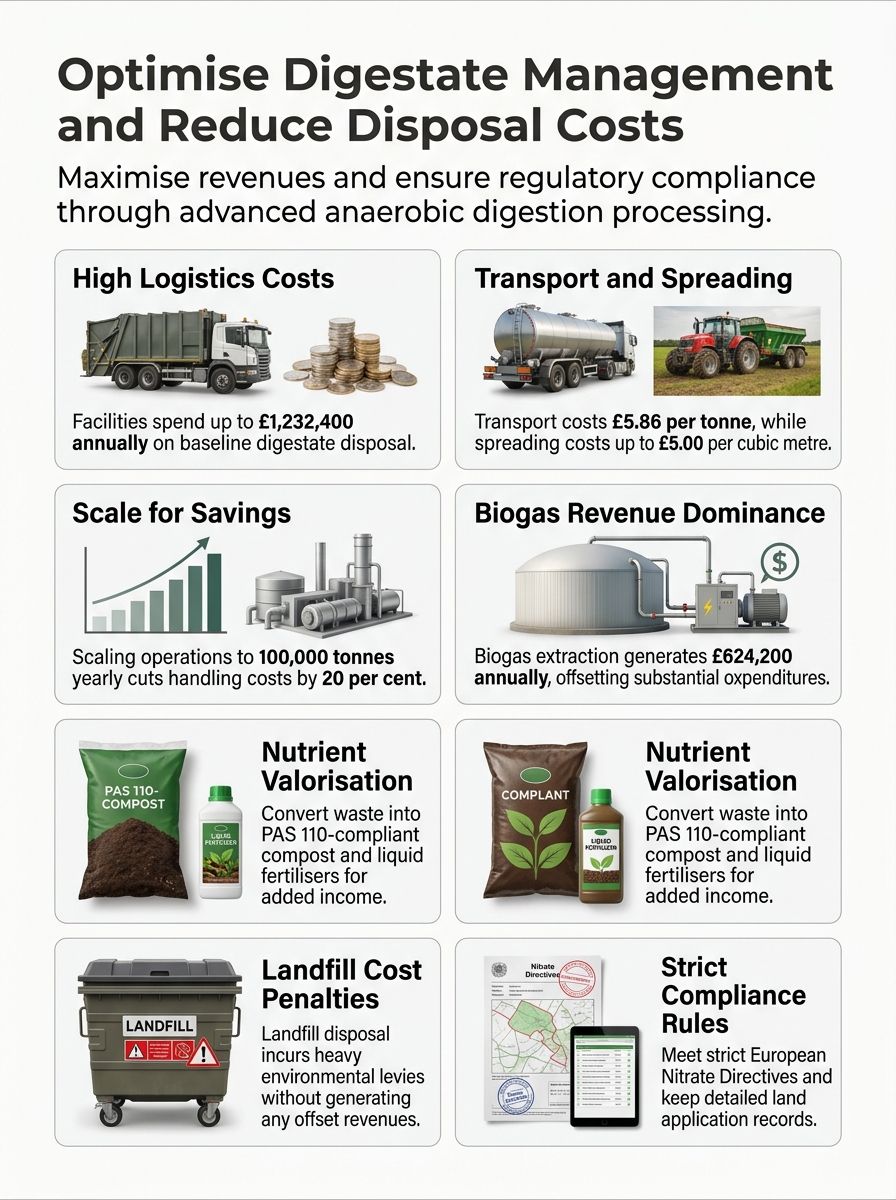
Whole digestate usually contains a large amount of water. Every additional mile between the AD plant, satellite store and receiving field, therefore, adds tanker time, fuel, labour and vehicle costs without increasing the quantity of nutrients delivered.
This makes the size and location of the available land bank extremely important. A plant surrounded by suitable farmland may have manageable costs. A plant that must send digestate over long distances may face a much higher annual bill.
No reliable national “cost per tonne” should be applied to every plant. Commercial rates change with:
- Journey distance and return mileage;
- Tanker capacity;
- Road access and loading time;
- Fuel and labour prices;
- Seasonal demand for contractors;
- Whether the vehicle returns empty;
- Whether intermediate storage is required; and
- The digestate’s dry-solids concentration.
An operator preparing a business plan should obtain current written quotations based on the actual routes, volumes, loading arrangements and spreading periods involved.
2. Field Application
Spreading costs depend on the type of equipment used and the condition of the fields. Possible methods include trailing hose, trailing shoe, injection and other low-emission application systems.
Published commercial case studies sometimes assume spreading costs in the region of several pounds per cubic metre. For example, an Esmil economic case study used an assumed whole-digestate spreading cost of £5 per cubic metre. That figure is an assumption within one particular model, not a universal market price.
Esmil case study on AD plant waste-management economics
Current local contractor quotations are more reliable than historic national averages. Prices may increase where fields are small, awkwardly shaped, steep, wet or distant from storage.
3. Digestate Storage
Digestate cannot always be spread when it is produced. The operator therefore needs adequate storage for periods when:
- Crop nutrient demand is low;
- Land is waterlogged, frozen or snow-covered;
- Heavy rain creates a risk of run-off;
- NVZ closed periods prevent the application of high readily available nitrogen manure;
- Crops or soil conditions are unsuitable; or
- Contractors and receiving land are unavailable.
Storage costs can include tank or lagoon construction, covers, mixers, pumps, inspection, maintenance, secondary containment and the financing cost of the infrastructure.
Current Environment Agency standard rules for certain permitted AD facilities require digestate to be stored in covered containers or covered lagoons.
Environment Agency standard rules for anaerobic digestion facilities
4. Sampling, Analysis and Certification
Operators may incur costs for digestate sampling, laboratory analysis, certification, audits, record-keeping and quality-management systems.
Where digestate is to be supplied as a product rather than controlled as waste, the producer must meet all applicable end-of-waste conditions. In England, these are set out in the Environment Agency’s Anaerobic Digestate Resource Framework.
Environment Agency Anaerobic Digestate Resource Framework
5. Contamination and Rejected Loads
Digestate that does not comply with the relevant product specification or resource framework may remain waste. This can restrict its market, require additional permitting and increase storage, transport, treatment or disposal costs.
Possible problems include:
- Excessive physical contaminants such as plastic;
- Unsuitable or unauthorised feedstocks;
- Failure to meet pathogen requirements;
- Potentially toxic elements;
- Persistent organic contaminants;
- Mixing compliant digestate with waste or non-compliant material; and
- Failure to demonstrate a legitimate market and beneficial use.
The Environment Agency states that if compliant digestate is mixed with other waste, the entire mixture becomes waste and must be managed under waste controls.
When Does Digestate Stop Being Waste?
In England, digestate produced from waste does not automatically become a product simply because it contains plant nutrients.
To comply with the Anaerobic Digestate Resource Framework, the producer must meet conditions covering matters including:
- Permitted input materials;
- Production in accordance with an approved standard and certification scheme;
- Quality requirements;
- Storage and handling;
- Contracts and records;
- A defined market;
- Suitability for the intended use; and
- Protection of human health and the environment.
The framework is used alongside PAS 110. Certification to PAS 110 is therefore an important requirement, but it should not be described as the only legal test.
Most importantly, the Environment Agency states that where there is no soil or crop need for digestate, the material is considered waste and waste-management controls must be followed.
This rule has a direct effect on cost. An operator cannot lawfully solve a storage problem by applying digestate to land that does not need its nutrients.
Farming Rules for Water and Digestate Application
In England, the Farming Rules for Water require organic manure and manufactured fertiliser applications to be planned so they do not exceed soil and crop need at the time of application.
Farmers and land managers must take account of factors including:
- Soil nutrient status;
- Crop requirements;
- Application timing;
- Weather forecasts;
- Soil conditions;
- Slope;
- Proximity to water; and
- The risk of run-off or leaching.
Government guidance on the Farming Rules for Water
These requirements can increase the land area and storage capacity needed by an AD plant. They can also reduce the number of days each year on which digestate can safely and lawfully be applied.
Additional Restrictions in Nitrate Vulnerable Zones
Anaerobic digestate is treated as a liquid organic manure for the purposes of England’s Nitrate Vulnerable Zone rules. Liquid organic manures with high readily available nitrogen are subject to closed spreading periods.
The applicable dates depend on the soil type and the crop. Operators and receiving farmers must check the current rules rather than assume that one national closed period applies everywhere.
Before applying digestate to a crop subject to an N-max limit, the crop-available nitrogen supplied by the material must be calculated using an accepted method.
Government guidance on using nitrogen fertilisers in Nitrate Vulnerable Zones
Government guidance on storing organic manures in Nitrate Vulnerable Zones
PFAS Explaining the Terminology
PFAS are a large group of synthetic chemicals used for properties such as resistance to heat, oil, grease and water.
They have been used in products including:
- Firefighting foams;
- Waterproof and stain-resistant textiles;
- Some food-contact materials;
- Industrial coatings;
- Paints;
- Medical devices; and
- Numerous specialist industrial applications.
PFAS are an environmental concern because many are highly persistent. Their behaviour, toxicity and mobility differ, however, and it is inaccurate to treat every PFAS compound as if it has identical properties or risks.
UK government PFAS Plan: Building a Safer Future Together
Are There Specific UK PFAS Limits for Digestate?
As of June 2026, no generally applicable Environment Agency concentration limit specifically for PFAS in digestate spread on agricultural land has been identified in the published Anaerobic Digestate Resource Framework or the government’s PFAS Plan.
It would therefore be incorrect to state that every digestate batch must currently undergo mandatory PFAS testing against a published national digestate threshold.
The UK government is developing its wider approach to PFAS. The 2026 PFAS Plan describes current monitoring, research, source control and possible future regulatory work. It also refers to investigations of PFAS in sewage sludge intended for land application.
Sewage sludge and anaerobic digestate made from source-separated food or agricultural materials are not necessarily the same material and should not be treated as interchangeable. Nevertheless, research into sludge demonstrates why operators should pay close attention to any feedstock that could introduce persistent chemicals into an AD plant.
Does the Absence of a Digestate-Specific PFAS Limit Remove Liability?
No. The absence of a published numerical PFAS limit for digestate does not give an operator permission to spread known or suspected contamination.
Depending on the circumstances, legal obligations may arise through:
- Environmental permit conditions;
- Waste duty-of-care requirements;
- The Environmental Permitting Regulations;
- The Farming Rules for Water;
- Water-pollution legislation;
- The conditions of the Anaerobic Digestate Resource Framework;
- Contractual product specifications; and
- The general requirement not to cause harm to human health or the environment.
If feedstock history, an incident or analytical evidence gives reasonable grounds to suspect PFAS contamination, the operator should undertake a documented risk assessment and obtain specialist regulatory and laboratory advice before releasing or spreading the material.
How PFAS Contamination Could Increase Digestate Disposal Costs
The financial consequences would depend on the type and concentration of PFAS, the volume affected, the regulatory classification and the available treatment or disposal routes.
Potential costs could include:
- Sampling and specialist laboratory analysis;
- Extended storage while results are obtained;
- Segregation of affected batches;
- Loss of end-of-waste or product status;
- Suspension of land spreading;
- Alternative treatment;
- Transport to an appropriately authorised facility;
- Disposal charges;
- Investigation of the contamination source;
- Regulatory and legal advice;
- Remediation or monitoring; and
- Loss of customer or landowner confidence.
There is no defensible standard UK cost per tonne for “PFAS-contaminated digestate.” Any figure would depend on case-specific analytical results and the disposal or treatment route accepted by the regulator and receiving facility.

Reducing Digestate Management Costs
Secure the Land Bank Before Accepting Feedstock
The available land should be assessed against nutrient demand, spreading restrictions, cropping patterns, soil conditions and practical transport distance. A nominal agreement covering a large acreage is not enough if the land cannot regularly receive the nutrients produced.
Prepare a Nutrient and Mass Balance
Operators should estimate digestate production and nutrient output throughout the year, rather than relying only on the annual feedstock tonnage. The assessment should consider nitrogen, phosphorus and potassium as well as total liquid volume.
Obtain Real Quotations
Transport and spreading costs should be based on written quotations for actual routes and application methods. Historic figures from reports can assist preliminary comparisons but should not be presented as current prices.
Provide Adequate Covered Storage
Sufficient storage allows applications to be timed according to crop need and suitable field conditions. Covers can also reduce rainwater entering a store and therefore reduce the volume that must later be transported and spread.
Control Feedstock Quality
A feedstock acceptance system should identify materials that could introduce plastic, chemicals or other contaminants. Prevention at the reception stage is generally less costly than managing a contaminated digestate batch.
Consider Separation Carefully
Mechanical separation can produce a liquid fraction and a fibrous fraction. This may improve handling and allow the fractions to be directed to different uses, but it does not make nutrients or contaminants disappear.
A separation or concentration system should therefore be assessed using a complete mass balance, including capital cost, energy, polymers, maintenance, labour, storage, reject streams and the final destination of every fraction.
Review Contracts and Responsibilities
Agreements should state who pays for storage, transport, analysis and application, and who is responsible if a field becomes unavailable or a batch fails specification.
A Practical Digestate Costing Checklist
A credible annual digestate budget should include:
- Expected annual digestate volume;
- Seasonal production profile;
- Existing and required storage capacity;
- Tank, lagoon and cover maintenance;
- Pumping, mixing and loading energy;
- Sampling and laboratory analysis;
- PAS 110 certification and audit costs, where applicable;
- Transport cost for each destination;
- Any satellite storage costs;
- Contractor spreading charges;
- Nutrient-management planning;
- Contingency land and storage;
- Contamination contingency;
- Insurance and contractual liabilities; and
- The fertiliser value credited to the digestate.
The calculation should include a realistic adverse scenario in which weather, cropping changes or loss of a receiving farm substantially increases the average transport distance.
Conclusion
Digestate can provide genuine fertiliser and soil-conditioning benefits, but its value should not be confused with guaranteed income. In many commercial AD projects, digestate remains a significant operating cost because large volumes must be stored, transported, analysed and applied within limited agricultural windows.
No single disposal price can reliably represent every plant. The most important cost variables are the volume of liquid produced, transport distance, storage provision, land-bank security, nutrient demand and whether the digestate qualifies as a product or remains waste.
PFAS introduces a developing area of risk. The UK now has a national PFAS Plan, yet there is not currently a universal Environment Agency PFAS limit specifically for digestate spread to land. That does not remove an operator’s wider obligation to prevent pollution and avoid supplying contaminated material.
The safest commercial approach is therefore to control feedstocks, maintain traceability, protect product status, secure an adequate local land bank and include realistic storage, transport, spreading and contamination contingencies in the plant’s financial model.
Frequently Asked Questions
What is the average digestate disposal cost per tonne?
There is no authoritative national average that can safely be applied to every UK AD plant. Local transport distance, digestate consistency, storage arrangements, spreading method and contractor availability can alter the cost substantially.
Can an AD plant sell digestate as fertiliser?
Potentially, but digestate made from waste must meet all relevant end-of-waste requirements. In England, this includes compliance with the Anaerobic Digestate Resource Framework and its certification, quality, market and use conditions.
Is PAS 110 digestate automatically no longer waste?
No. PAS 110 certification is an important component of the system, but compliance with the applicable resource framework and intended-use conditions is also required.
Can digestate be spread whenever storage is full?
No. Applications must comply with nutrient need, water-protection requirements, weather and soil conditions and, where relevant, NVZ closed periods. Lack of storage does not justify a polluting or agronomically unnecessary application.
Must every digestate batch be tested for PFAS?
No generally applicable national requirement for routine PFAS testing of every digestate batch has been identified in the published England resource framework as of June 2026. Risk-based testing may nevertheless be appropriate where the feedstock or an incident creates a credible contamination concern.
What should an operator do if PFAS contamination is suspected?
The affected material should be segregated where practicable and should not be dispatched or spread until the risk has been assessed. The operator should consult its environmental regulator, environmental consultant and a suitably accredited laboratory.
Sources and Further Verification
- Environment Agency: Anaerobic Digestate Resource Framework
- Defra and Environment Agency: How to Comply with the Farming Rules for Water
- Defra: Using Nitrogen Fertilisers in Nitrate Vulnerable Zones
- Defra: Storing Organic Manures in Nitrate Vulnerable Zones
- UK Government: PFAS Plan – Building a Safer Future Together
- Environment Agency: Developing PFAS Thresholds for the Water Environment
- Environment Agency: Standard Rules for Anaerobic Digestion Facilities
- Environment Agency: Landspreading Benefits and Risks of Biological Treatment Wastes
- Environment Agency: Waste and Receiving-Soil Analysis for Landspreading
- Esmil: AD Plant Waste-Management Economics Case Study
Regulatory note: The principal regulatory references above apply to England. Operators in Wales, Scotland and Northern Ireland should consult Natural Resources Wales, SEPA or DAERA respectively before relying on the regulatory sections of this article.