By maximising organic recovery, avoiding contaminant inhibition, and preserving high feedstock concentration, depackaging equipment increases biogas yield. Using the latest depackaging technology, high-energy food waste can be safely unlocked for anaerobic decomposition, without risking heavy metal contamination or microplastic build-up in soils.
Overview of the Article
- Food waste from grocery stores, restaurants, and food processors is one of the fastest-growing feedstock sources for anaerobic digestion, but the packaging must be removed first, or it will disrupt the entire digestion process.
- Depackaging equipment uses mechanical and hydraulic techniques to break open containers and cleanly separate organic material from metal, plastic, glass, and coated paper.
- Cleaner feedstock directly translates to higher volatile solids content, more stable microbial activity, and better biogas output — the numbers back this up.
- Real facilities like Bio-En Power in Woolwich, Ontario are processing up to 77,000 tons per year of packaged food waste using depackaging systems — and there’s a key detail about how they chose their equipment that most operators overlook.
- Depackaging machines are high-volume tools — understanding the minimum throughput threshold that justifies the investment is critical before committing to one.
Packaging contamination is one of the most underestimated threats to biogas yield in anaerobic digestion — and depackaging equipment is the solution most North American operators are still catching up to. In Europe, the continued use of early versions of depackaging technology is an elephant in the cupboard due to the high rate of particle size reduction from milling and shredding. Still, the US and other nations are introducing more modern technology from manufacturers such as Drycake Twister and Mavitech that overcome this problem.
Biogas producers are seeing a significant increase in available feedstock, thanks to the growing trend of banning organic waste from landfills and the adoption of zero-waste policies by corporations. Food waste from processors, retailers, and institutions is now being delivered to digester facilities in quantities that would have been unimaginable just ten years ago. However, there is a major caveat to this opportunity: most of the waste is still in its packaging. Operators of renewable energy plants who want to maximise digester efficiency need to understand what happens when packaging enters the system and how depackaging technology can help.
Why Packaging May Be Silently Sabotaging Your Biogas Yield
The issue is not just a nuisance — it is actively harmful. When packaged food waste is delivered to a facility and put into the digester without prior processing, the packaging material itself acts as a pollutant that disrupts microbial activity, blocks equipment, and diminishes the effective volatile solids content of your feedstock. The organic material that you actually need for gas production is trapped inside containers that the digester is unable to decompose.
Why Packaged Food Waste Is Now a Primary Feedstock Source
Corporate zero-waste commitments and organic waste landfill bans are not just regulatory pressures — they are creating a reliable, high-energy feedstock pipeline for anaerobic digestion facilities. Food processing plants, grocery chains, restaurants, and municipal Green Bin programs are all generating consistent volumes of packaged organic material that needs somewhere to go. Facilities that can accept and process this material have a significant competitive and operational advantage over those that cannot.
Compared to other feedstocks, packaged food waste has a high energy content. However, the energy can only be accessed if the organic material is cleanly separated from its packaging. A can of expired soup, a sealed bag of rotten produce, or a glass jar of sauce all have significant biogas potential. However, if left in place, the materials will actively harm your digester.
How Packaging Pollution Decreases Biogas Production
Materials used for packaging — such as metal, plastic, coated paper, and glass — do not decompose in an anaerobic setting. They take up space in the digester, reduce the quality of the feedstock, and can even cause physical harm to the mixing equipment and pumps. Plastic film is particularly known for wrapping around mechanical parts and causing expensive delays. Glass pieces can damage equipment and create safety risks downstream.
Aside from the physical harm, gas production is directly affected. Whenever non-organic packaging material is present, the volatile solids content of your feedstock, which is the portion that microorganisms convert into biogas, is reduced. From the moment that material enters the tank, a digester that is fed contaminated, unprocessed packaged waste is operating below its designed efficiency.

“Packaging waste – Wikipedia” from en.wikipedia.org and used with no modifications.
Understanding the Function of Depackaging Equipment
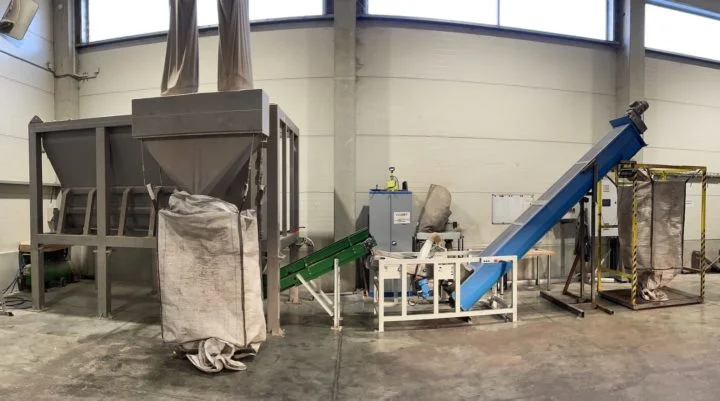
As the name implies, depackaging equipment is a type of industrial machinery that is used to open and separate packaged food waste on a large scale. This is achieved through a combination of mechanical force and hydraulic pressure, which enables the equipment to break open virtually any type of packaging, extract the organic material contained within, and then route the packaging to be recycled, incinerated, or sent to a landfill. The end result is a slurry or paste of organic material that is ready to be digested or further preprocessed.
Comparing Mechanical and Hydraulic Separation Methods
There are two main methods used in depackaging systems, and each has its own set of benefits depending on the type and amount of feedstock. Mechanical systems use devices like rotating drums, shredders, or press screws to physically break open packaging and force the organic content through a screen or perforated surface, leaving the packaging behind. Hydraulic systems use pressurised water or force to wash organic material out of containers. This leaves the packaging structure mostly intact, which makes the separation process easier later on.
There are three main types of depackaging equipment, each with its own strengths and weaknesses.
The first type, mechanical depackaging, uses a drum or shredder to separate the organic material from the packaging. This method is most effective for mixed rigid and flexible packaging, and it has a high throughput capacity. However, it can sometimes fragment the packaging into smaller pieces, which can be difficult to separate from the organic material.
The second type of depackaging equipment uses a hydraulic press or screw to separate the organic material from the packaging. This method is most effective for soft packaging, such as pouches and bags, and it produces a cleaner organic slurry output. However, it is less effective on hard, rigid containers.
The third type of depackaging equipment combines mechanical and hydraulic methods. This method is most effective for mixed municipal and commercial streams, and it can handle the widest variety of feedstock. However, it has a higher capital and maintenance cost than the other two methods.
The fourth type of depackaging equipment combines mechanical, hydraulic, pneumatic, and ballistic treatment all in one device, not incurring additional CAPEX or OPEX costs. An example is the Drycake Twister Depackager and Separation System.
Many high-volume facilities choose systems that combine both mechanical and hydraulic methods, especially when they accept mixed feedstock streams from both commercial sources and municipal Green Bin programs. For example, the Bio-En Power facility in Woolwich, Ontario, which processes up to 77,000 tons per year of packaged food waste, had to evaluate many different systems from European manufacturers before they found one that could handle both predictable commercial waste and highly variable municipal organics.
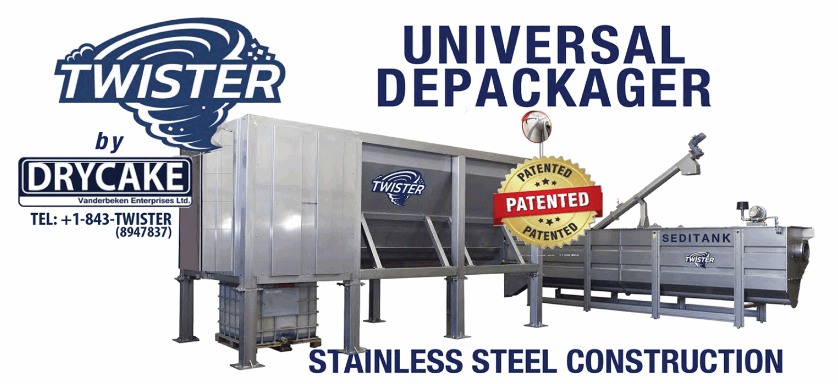
How to Separate Organic Material from Metal, Plastic, and Glass
Following the initial mechanical or hydraulic separation, the organic slurry is subjected to a series of secondary separation stages. Ferrous metal fragments, such as can lids, staples, and foil layers, are extracted using magnets. Lightweight plastics and film are removed using air blowers or cyclonic separators. Any glass and rigid plastic pieces that survived the primary separation stage are captured by screens or trommels. The result is a relatively clean organic fraction that is ready for anaerobic digestion.
The packaging waste that is expelled from the system is guided into containers for suitable disposal — recycling when it’s possible, incineration or landfill when it’s not. The aim isn’t to recycle all of the packaging perfectly; it’s to have organic material that’s free of contaminants on the digester end of the process.
The Unique Challenge Glass Packaging Poses for Digesters
When it comes to anaerobic digestion, glass presents a unique set of challenges. It doesn’t break down, it doesn’t compress, and it shatters into sharp fragments that can wreak havoc on pumps, impellers, and heat exchangers. Even tiny glass particles that manage to slip through the primary separation process can gradually build up in digester tanks over time. This not only reduces the effective tank volume but also creates a maintenance nightmare.
For facilities that handle large amounts of food waste packaged in glass, depackaging systems with dedicated glass separation stages are a must. These typically rely on density-based separation or specific screen sizes. To learn more about maintaining and optimising your digester, you can read about biogas plant crashes and how to prevent them.
The Impact of Depackaging on Biogas Yield
Depackaging directly influences the increase in biogas production by enhancing the quality of the feedstock. The productivity of a digester is determined by the quality of the material it processes. If the material is free from inert contaminants, consistent, and clean, the microbes in the digester can function at their optimal efficiency. This allows them to convert the highest possible amount of organic matter into methane.
Plant owners who have invested in recently developed depackaging equipment have reported more stable digester operations, fewer equipment failures, and more predictable gas production curves compared to those who try to run contaminated or partially processed packaged waste through their systems. While the initial cost of depackaging equipment may be high, it is offset by lower maintenance costs, higher gas yields, the ability to recycle high-value contaminant materials, and the ability to accept a wider and less consistent supply of feedstock.
Higher Volatile Solids Content Through Cleaner Feedstock
When it comes to predicting biogas yield from a particular feedstock, the volatile solids (VS) content is the most crucial measure. This figure shows the amount of organic matter that can be broken down by microorganisms and converted into methane. When the feedstock contains packaging contaminants, the VS content is diluted because the contaminants add mass that does not contribute to gas production.
If a depackaging system cleanly separates the organic material from its container before digestion, the VS content of each ton of feedstock that enters the digester is effectively increased. That’s just obvious, because losing any organic content in the rejected material means it ain’t going to be there to create biogas!
Decreasing Contaminants Safeguards Microbial Activity in the Digester
The microbial community in an anaerobic digester is vulnerable to disturbances. Plastic films, metal fragments, and glass particles don’t just sit idly in the tank – they interfere with the physical environment that the microorganisms rely on. Plastic film builds up on the mixing equipment, reducing the efficiency of agitation and creating dead zones where the organic material isn’t properly mixed with the active microbial population. This directly reduces conversion rates and biogas production.
Another risk comes from metal contaminants. If there are too many of certain metals, they can be toxic to the methanogenic archaea that produce methane. A small amount of trace metals is actually necessary for microbial health, but if there are too many metal fragments from packaging, it can suppress the microbial activity needed for gas production. Removing all the packaging before digestion can completely eliminate this risk.
Depackaging Equipment Helps Stabilise Gas Production Rates
Depackaging equipment is often overlooked for its ability to stabilize feedstock. Without preprocessing, the organic fraction of packaged food waste can vary greatly. This is due to the type of packaging it arrived in, the condition of the packaging, and the amount of contamination that was present. This inconsistency can lead to unstable gas production. This means that operators may see unpredictable increases and decreases in biogas output. This can make it difficult to manage energy planning and grid supply commitments.
When a depackaging system is set up correctly, it standardises the output. The organic slurry that comes out of the depackager has a predictable moisture content, VS concentration, and particle size distribution. If you feed that consistent material into your digester, the microbial community responds with stable, predictable methane production. For facilities that sell electricity or biomethane to the grid — like Bio-En Power’s 2.85-MW generator operation in Ontario — that consistency is not just a nice-to-have, it is operationally essential. Learn more about biogas digester design to optimize your operations.
Actual Plants Utilizing Depackaging Equipment
The most convincing proof for depackaging equipment comes from plants that have already incorporated it into their operations. Both in North America and throughout Europe, high-capacity anaerobic digestion plants processing commercial and municipal food waste have made depackaging a fundamental part of their feedstock management infrastructure. The size of these operations shows just how seriously the industry takes the contamination issue — and how much volume is now achievable when you solve it correctly.
It’s worth noting that the facilities at the forefront of this industry didn’t treat depackaging as an afterthought. They carefully evaluated the equipment, often after extensive research across various manufacturers and operating environments. The investment in getting the right system paid off in terms of operational stability and feedstock volume capacity that would have been impossible to achieve otherwise.
Ontario’s Bio-En Power: 77,000 Tons Per Year
One of the most successful examples of depackaging on a large scale can be seen at Bio-En Power’s facility in Woolwich, Ontario. This plant produces enough biogas to power a 2.85-MW generator, and the electricity is sold directly to the provincial grid. Earl Brubacher, the facility manager, spent a considerable amount of time and money travelling around Europe to assess depackaging equipment from various manufacturers before choosing a system. This system now processes up to 77,000 tons of packaged food waste per year. This includes relatively consistent food industry waste and highly variable municipal Green Bin organics. The depackager has survived two severe contamination events: a trailer hitch and an automotive flywheel that entered the system through the municipal waste stream.
Biogas Energy Partners in Exeter, Maine: A 150 Tons Per Day Capacity Plant
Biogas Energy Partners in Exeter, Maine is a good example of the increasing efforts in North America to ramp up the processing of packaged food waste for biogas production. The plant installed a depackaging unit in July that was designed to process up to 150 tons per day, primarily processing packaged organics from grocery stores. The feedstock mix is a combination of food industry waste and residential source-separated organics that are collected through municipal programs. Approximately 40% of the incoming material is liquid that arrives in tanker trucks. All other materials are processed through the depackager before they are introduced into the digestion system.
Which Facilities Require a Depackager?
Depackaging equipment isn’t a one-size-fits-all solution for every biogas plant. These machines are big, require significant capital investment, and are designed for high-volume throughput — they’re most efficient and financially viable when a facility consistently has a large volume of packaged food waste as a key part of its feedstock mix. Facilities that primarily rely on liquid waste streams, agricultural manure, or source-separated organics that arrive without packaging won’t reap the same benefits from a depackager.
Depackaging equipment is most beneficial in facilities that have a few specific traits. These facilities usually receive feedstock from a variety of commercial and municipal sources, leading to a wide range of packaging types and contamination levels. They have the necessary physical infrastructure to accommodate large preprocessing equipment. Additionally, they have enough feedstock volume commitments, whether from food processors, retailers, or municipal contracts, to justify the capital expenditure.
There are several sources of packaged food waste that are ideal for depackaging and anaerobic digestion:
- Municipal and Commercial Source Separated Food Waste (often called SSO (Source Separated Organics)) that, contrary to its name, invariably includes not only large numbers of the plastic bags used to line kitchen waste caddies but carelessly discarded other waste items
- Food processing facilities that generate large amounts of packaged products that are off-spec or expired
- Grocery chains and retail distributors that have made zero-waste commitments and have consistent streams of packaged food waste
- Municipal Green Bin programs where residents can deposit green garden waste and many allow domestic food/ kitchen waste along with grass trimmings and prunings
- Restaurants and food service operations on an institutional scale that generate mixed packaged waste
- Regional food banks and distribution centres that need to dispose of packaged goods that have been recalled or have expired
Each of these source categories has different types of packaging, contamination profiles, and volume consistency. A facility that draws from multiple source categories at the same time, like Bio-En Power and Biogas Energy Partners do, faces the widest range of packaging challenges and benefits the most from a robust, high-capacity depackaging system that is designed to handle mixed streams.
Feedstock Sources That Warrant the Investment
The feedstock sources that validate the investment in depackaging equipment are those that deliver high volumes of packaged organic material on a regular, contractual basis. A single grocery chain producing 10 tons of packaged food waste per week is not sufficient on its own. But when you combine that with a regional food processor, a municipal Green Bin contract, and a food distribution centre managing recalled product — you have the feedstock density that makes a depackager economically viable. The facilities that are successful in this area are often the ones that have secured multiple feedstock agreements before the equipment is even installed.
Depackager: The Key to Converting Waste into Biogas Fuel
Here’s the deal: packaged food waste is a massive, expanding, energy-dense feedstock opportunity — but only if you can handle it correctly. Depackaging equipment is the link between what shows up at your facility gate and what your digester actually requires. The Bio-En Power facility in Ontario and Biogas Energy Partners in Maine are not anomalies; they are pioneers in a trend that is gaining momentum as landfill bans become stricter and corporate zero-waste commitments increase.
Bakers and biscuit manufacturers are the best placed to use depackagers like the Drycake Twister that can run “dry” (without any water addition), allowing a premium quality of animal feed to be processed and sold as a product.
Facilities that invest in the right depackaging infrastructure now are positioning themselves to secure feedstock volumes and biogas yields that will be unattainable for operations that overlook this step.
Common Questions
These are the most common questions that operators and renewable energy professionals have when they are considering depackaging equipment for anaerobic digestion applications.
What kind of packaging can depackaging equipment manage?
Depackaging equipment is built to manage a broad spectrum of packaging materials like metal cans, rigid and pliable plastic containers, glass jars and bottles, coated paper and cardboard packaging, foil pouches, and multi-layer composite packaging. The key variable is not packaging type so much as packaging volume and consistency of the incoming stream.
What is the cost of running depackaging equipment?
The cost of running depackaging equipment can change depending on the volume of throughput, the mix of feedstock, and the specific configuration of the system. The main cost factors include the energy used for hydraulic and mechanical separation processes, maintaining components that wear, such as screens, blades, and press screws that are under high mechanical stress from rigid packaging, and labour for monitoring equipment and logistics for disposing of packaging downstream. While the exact figures are heavily dependent on the scale of the facility and the cost of energy in the region, operators have consistently reported that the reduction in maintenance costs for the digester, damage to equipment from contaminants, and improved yields of biogas offset a significant portion of the operational expenditure over time.
Can depackaging equipment handle liquid food waste delivered in tankers?
Usually, liquid food and drinks industry waste is processed separately from solid waste and pumped directly into the digester tank. The depackager is used for solid and semi-solid material.
How does packaging contamination affect the efficiency of anaerobic digestion?
There are several ways in which packaging contamination can reduce the efficiency of anaerobic digestion. Physically, the presence of inert packaging materials dilutes the volatile solids content of the feedstock. This means that a larger mass of material needs to be processed in order to deliver the same amount of digestible organic content to the microbial community. Mechanically, plastic films can wrap around mixing equipment and reduce the effectiveness of agitation, creating dead zones inside the digester where organic material is not properly exposed to the active microbial population.
Over time, glass and metal fragments can accumulate in the tank, reducing the effective volume of the digester and causing damage to pumps, heat exchangers, and other process equipment. Certain metals can reach inhibitory levels for the methanogenic archaea responsible for methane production when they are present at elevated concentrations from packaging fragments. This can directly suppress biogas output at the biological level.
Can small-scale biogas plants use depackaging equipment?
As it stands, depackaging equipment is designed for large-scale operations and is not economically viable for small-scale biogas plants. Small-scale plants that only process a few tons of food waste per day would not generate enough throughput to recover the investment via improved biogas yields and lower maintenance costs.
Operators of small-scale facilities that handle packaged food waste usually have two practical choices. The first is manual or semi-automated depackaging at low volumes. This is labour-intensive and limited in scale, but it works for very small feedstock streams. The second is to partner with or deliver packaged food waste to a centralised preprocessing facility that already has depackaging infrastructure in place. Then, they receive the processed organic slurry for digestion.
For anyone considering depackaging equipment, the first step is to conduct a thorough feedstock audit. This means understanding exactly what types of packaging are coming in, how much, and from how many sources. This information will determine whether a depackager is a worthwhile investment or a premature one. First, secure the feedstock contracts, then size the depackaging system to match the committed volume. This is the approach that the most successful biogas facilities have followed, and it is the one that delivers results.