Our sponsor Börger sent us this press release under the headline “‘Fines’ reduced at biogas plants by Börger’s FlowSep” – and yes, before anything else, it’s worth being upfront about the headline itself. It’s a deliberate play on words. In everyday English, “fine” tends to mean a financial penalty, and we suspect more than a few readers will click through expecting a story about regulatory enforcement.
That’s exactly the point: it’s a bit of clickbait, done knowingly, on a genuinely technical term that most people outside engineering and construction simply haven’t encountered. So before we get to the release itself, it’s worth explaining what “fines” actually means in this context, because once that’s clear, the story underneath is a solid, practical one for anyone running or specifying a biogas plant.
Key takeaways
“Fines” is an established engineering and construction term for very small, finely graded inert particles – sand, grit, small stones, glass fragments – not a reference to financial penalties.
Börger’s new FlowSep is a mechanical separator designed to strip these abrasive fines out of slurry and digestate before they wear out pumps, valves and other plant components.
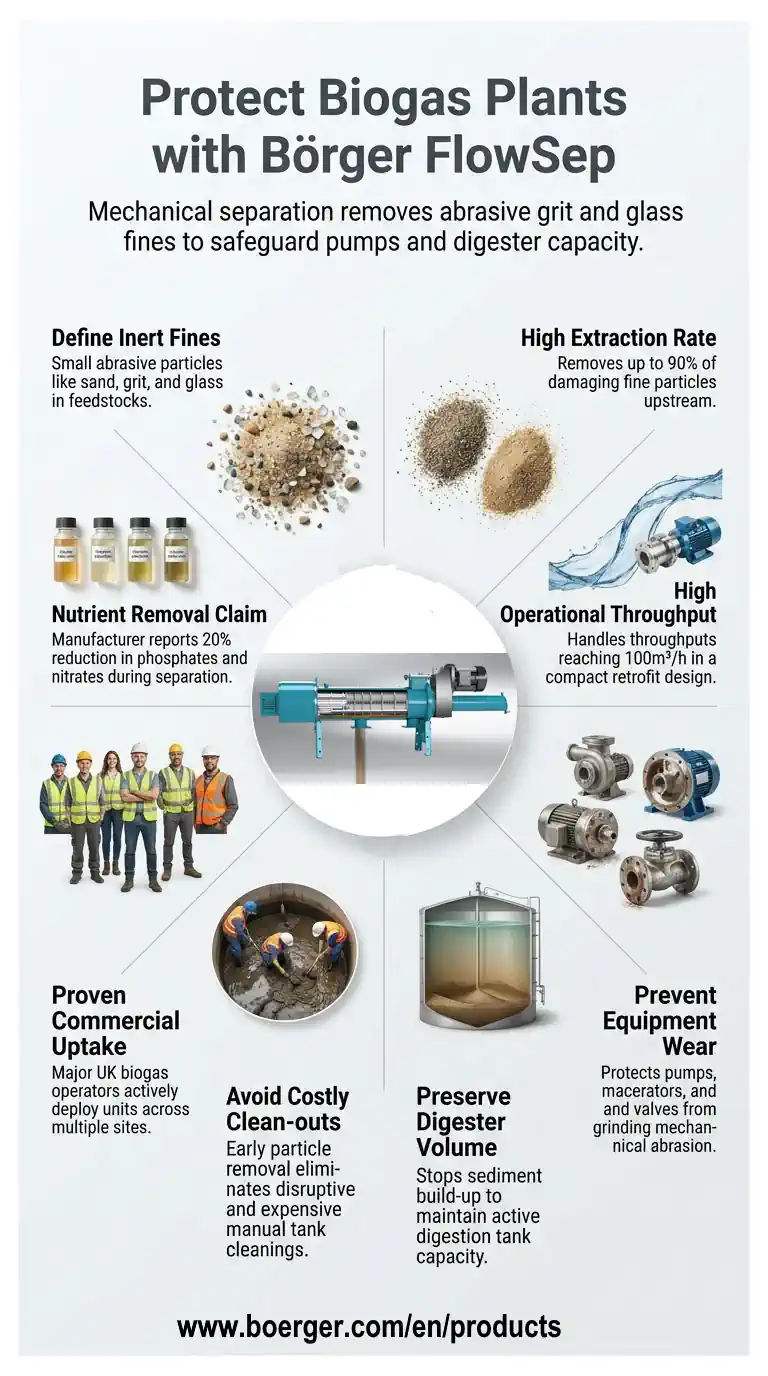
It works alongside Börger’s existing BioSelect Separator, and independent trade coverage confirms it can extract up to 90% of unwanted fine particles, at throughputs up to 100m³/h.
A major UK biogas operator, already a long-standing Börger customer, has placed its first FlowSep orders – a sign the technology is moving from launch interest into real-world uptake.
For AD operators, unmanaged grit and glass fines are a genuine, if often under-discussed, cause of reduced digester volume, mixing problems and expensive pump/valve wear – which is why this kind of pre-treatment technology matters operationally, not just as a cost-saving nicety.
What does “fines” actually mean?
In construction, quarrying and mineral processing, “fines” is the standard term for the smallest, most finely graded fraction of an inert material – think sand, grit, crushed stone dust, or in this case, tiny fragments of glass that end up in food waste and slurry streams. It has nothing to do with financial fines or penalties; it’s simply the sector’s word for “small hard particles.” Börger’s press release is using the word in this correct, technical sense – but the headline is clearly written to catch the eye of anyone who reads “fines” and assumes it means something else entirely. Once you know that, the release makes a lot more sense.
For those of you who prefer to refer to this abrasive material in digester feedstocks and output digestate in more general terms, you may like to read our earlier piece,Could Börger FlowSep Transform Food Waste Anaerobic Digestion?, which looks at the same technology from a grit-and-inerts-removal angle.
The press release:
‘Fines’ reduced at biogas plants by Börger’s FlowSep
One of the UK’s leading players in biogas has placed its first orders for Borger’s new FlowSep, which protects pumps and associated equipment from the damaging effects of sand, grit and fine glass particles in slurry handling/food waste applications.
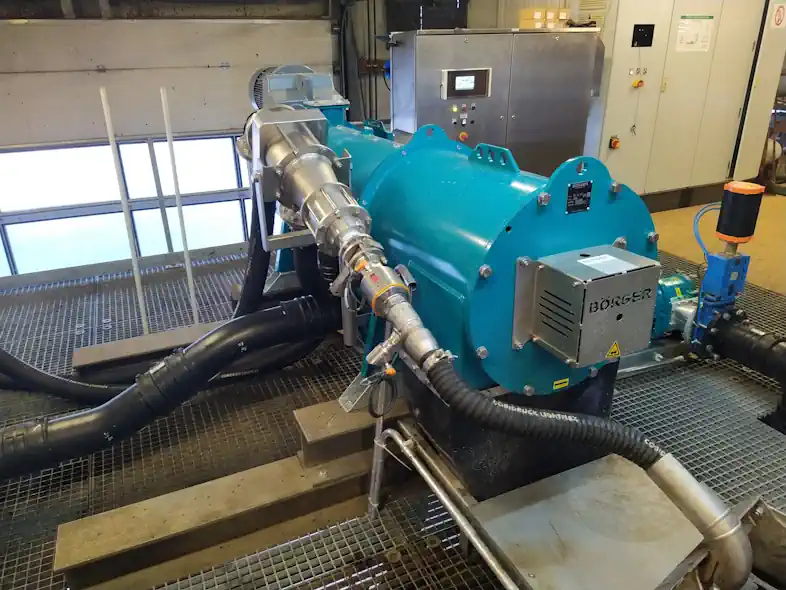
The Borger Flowsep speator with added grit removal greatly decreases the accumulation of sediment.
Since purchasing its first Borger equipment (a separator with feed and discharge pump) almost 10 years ago, the major biogas operator has since invested in numerous pumps, macerators, liquid feed systems and separators from Borger for numerous different sites.
David Brown, Managing Director of Borger UK, said:
“With FlowSep, which created huge interest at the World Biogas Expo, an increasing number of biogas plant operators are benefitting from a very cost-effective, mechanical method of preventing ‘fines’ (PM 2.5) from harming equipment.
“Importantly, whilst it stops unwanted ‘fines’ from later settling out in digesters and lagoons, FlowSep also removes phosphates and nitrates by 20%.”
Flowsep protects valuable pumps, valves and system components from heavy wear.
He added: “Since supplying our key biogas customer with their first separator and pump almost a decade ago, all of our equipment, including our rotary lobe pumps and macerators, have conclusively proved their reliability and performance in what are always challenging applications with food and agricultural feedstocks.”
Why grit and glass fines are a real problem in biogas plants
What FlowSep actually does
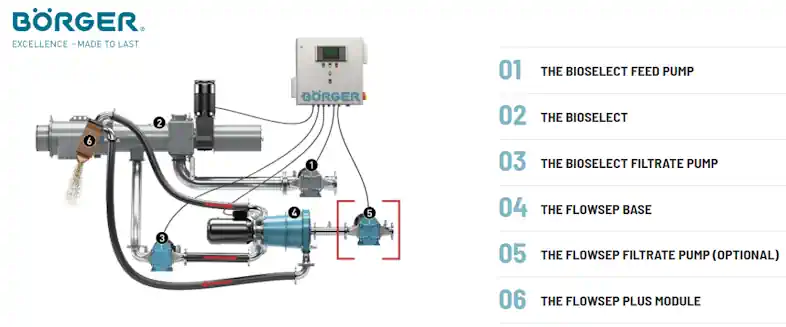
Trade press coverage of FlowSep’s launch confirms the substance behind the release. FlowSep is designed to work alongside Börger’s established BioSelect Separator as part of a closed, odourless system, and independent reporting puts its extraction rate at up to 90% of unwanted fine particles, with throughput rates of up to 100m³/h in a compact, retrofit-friendly unit. It’s aimed specifically at removing the sand, grit and small glass fragments that routinely turn up in liquid manure, food waste digestate, pipework and tankers – material that doesn’t contribute anything to biogas production but causes real, ongoing wear on the equipment handling it.
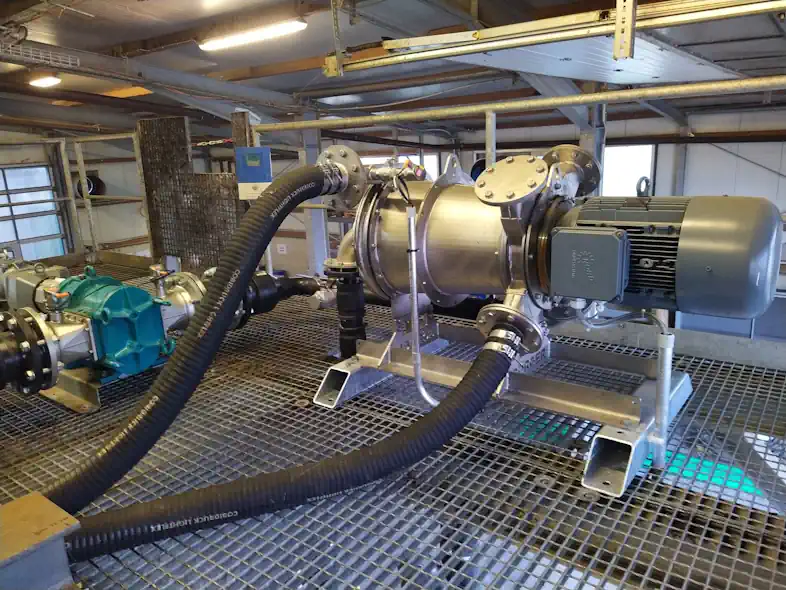
The Borger BioSelect with Flowsep combination with labelled components.
Why this matters for digester performance, not just equipment cost
This isn’t only a maintenance-budget story. Fine inert material that isn’t removed before it reaches the digester settles out over time, gradually occupying tank volume that should be available for active digestion, interfering with mixing, and building up sediment that eventually forces a costly and disruptive tank clean-out. Removing it upstream, before it accumulates, protects both the mechanical plant and the digester’s effective working capacity – which is why pre-treatment technology like this earns its place in a well-run AD facility’s feedstock handling line, not just its maintenance schedule.
One technical point worth flagging
The release describes fines as “(PM 2.5). PM2.5 refers to airborne particulate matter under 2.5 microns across, and government and research bodies have identified agricultural ammonia as a major contributor: ammonia released during slurry storage and spreading reacts in the atmosphere with industrial and vehicle pollutants (sulphur dioxide, nitrogen oxides) to form what’s known as “secondary” PM2.5.FlowSep won’t reduce ammonia volatilisation or downstream secondary PM2.5 formation; it’s protecting equipment from abrasive solids.
So while PM2.5 absolutely deserves the attention it gets in farming circles, the parenthetical “(PM 2.5)” in the release is best read as a shorthand for “very fine particles” rather than a claim that FlowSep is doing anything to address the ammonia-driven air-quality issue.
The phosphate and nitrate figure
The release states FlowSep also removes phosphates and nitrates by 20%. We haven’t been able to independently verify this specific figure against Börger’s own technical literature or third-party test data at time of writing, so we’d treat it as a manufacturer’s claim worth asking Börger to substantiate with data if it’s a factor in your own specification decisions, rather than an independently confirmed figure.
A track record with real customers
The press release notes that the unnamed major UK biogas operator behind these first FlowSep orders has been a Börger customer for almost a decade, having built up a wider installed base of Börger separators, pumps and macerators across multiple sites in that time. That’s a meaningful detail: FlowSep isn’t a new company’s unproven debut product; it’s a new addition from a supplier with an established operational track record in demanding food and agricultural feedstock applications, being adopted by a customer who already has direct experience of how Börger’s other equipment performs in the field.
FAQ
Is “fines” really just an ordinary engineering term, or is the headline misleading?
It’s a genuine, correctly used technical term for small inert particles like sand, grit and glass fragments. The headline is deliberately playing on the more familiar meaning of “fine” as a penalty to draw readers in, but the substance of the release uses the word accurately throughout.
What’s the difference between FlowSep and Börger’s existing BioSelect Separator?
BioSelect is Börger’s established separator for splitting liquid and solid fractions of slurry or digestate. FlowSep works downstream of, or alongside, that process specifically to strip out the remaining hard, abrasive fine particles – sand, grit, glass – that a standard separator isn’t designed to catch.
Does this replace the need for a grit trap or sand separator elsewhere in the plant?
Not necessarily – it depends on your existing feedstock handling line and where fines are entering the process. FlowSep is best thought of as an additional protective step for pumps, valves and digesters, not automatically a wholesale replacement for other grit-management equipment already in place.
Can FlowSep be retrofitted to an existing plant?
Yes – trade press coverage describes it as a compact, retrofit-friendly unit, including its control system, designed to work with an existing BioSelect installation rather than requiring a full process redesign.
Is this only relevant to farm-fed AD plants, or food waste plants too?
Both. Grit, sand and glass fines are a particular headache for food waste AD plants, where packaging residues and food-processing by-products routinely introduce hard inert material, but the same wear problems apply wherever slurry or digestate carries abrasive solids.
Conclusion
Strip away the pun in the headline, and Börger’s FlowSep is a straightforward, well-evidenced piece of engineering aimed at a real and often underappreciated problem: the slow, grinding damage that sand, grit and glass fines do to pumps, valves and digester capacity over time. Independent trade coverage backs up the core performance claims, and the fact that an established, long-standing Börger customer has placed the first orders is a good practical signal that this isn’t just launch-day enthusiasm.
As ever, it’s worth asking your supplier to back up the more specific figures – particularly the phosphate and nitrate removal claim – with data relevant to your own plant before you rely on them in your own specification decisions.
We use cookies on our website to give you the most relevant experience by remembering your preferences and repeat visits. By clicking “Accept”, you consent to the use of ALL the cookies.
This website uses cookies to improve your experience while you navigate through the website. Out of these, the cookies that are categorized as necessary are stored on your browser as they are essential for the working of basic functionalities of the website. We also use third-party cookies that help us analyze and understand how you use this website. These cookies will be stored in your browser only with your consent. You also have the option to opt-out of these cookies. But opting out of some of these cookies may affect your browsing experience.
Necessary cookies are absolutely essential for the website to function properly. These cookies ensure basic functionalities and security features of the website, anonymously.
Cookie
Duration
Description
__stripe_mid
1 year
Stripe sets this cookie to process payments.
__stripe_sid
1 hour
Stripe sets this cookie to process payments.
ci_session
2 hours
This cookie is set as default session Cookie name in config.php in config folder in CodeIgniter.
cookielawinfo-checkbox-advertisement
1 year
Set by the GDPR Cookie Consent plugin, this cookie records the user consent for the cookies in the "Advertisement" category.
cookielawinfo-checkbox-analytics
11 months
This cookie is set by GDPR Cookie Consent plugin. The cookie is used to store the user consent for the cookies in the category "Analytics".
cookielawinfo-checkbox-functional
11 months
The cookie is set by GDPR cookie consent to record the user consent for the cookies in the category "Functional".
cookielawinfo-checkbox-necessary
11 months
This cookie is set by GDPR Cookie Consent plugin. The cookies is used to store the user consent for the cookies in the category "Necessary".
cookielawinfo-checkbox-others
11 months
This cookie is set by GDPR Cookie Consent plugin. The cookie is used to store the user consent for the cookies in the category "Other.
cookielawinfo-checkbox-performance
11 months
This cookie is set by GDPR Cookie Consent plugin. The cookie is used to store the user consent for the cookies in the category "Performance".
CookieLawInfoConsent
1 year
CookieYes sets this cookie to record the default button state of the corresponding category and the status of CCPA. It works only in coordination with the primary cookie.
enforce_policy
1 year
PayPal sets this cookie for secure transactions.
m
1 year 1 month 4 days
Stripe sets this cookie for fraud prevention purposes. It identifies the device used to access the website, allowing the website to be formatted accordingly.
ts
1 year 1 month 4 days
PayPal sets this cookie to enable secure transactions through PayPal.
ts_c
1 year 1 month 4 days
PayPal sets this cookie to make safe payments through PayPal.
viewed_cookie_policy
11 months
The cookie is set by the GDPR Cookie Consent plugin and is used to store whether or not user has consented to the use of cookies. It does not store any personal data.
Functional cookies help to perform certain functionalities like sharing the content of the website on social media platforms, collect feedbacks, and other third-party features.
Cookie
Duration
Description
_lscache_vary
2 days
Litespeed sets this cookie to provide the prevention of cached pages.
LANG
9 hours
Linkedin set this cookie to set user's preferred language.
nsid
session
PayPal sets this cookie to enable the PayPal payment service on the website.
tsrce
3 days
PayPal sets this cookie to enable the PayPal payment service on the website.
x-pp-s
session
PayPal sets this cookie to process payments on the site.
yt-player-headers-readable
never
The yt-player-headers-readable cookie is used by YouTube to store user preferences related to video playback and interface, enhancing the user's viewing experience.
yt-remote-cast-installed
session
The yt-remote-cast-installed cookie is used to store the user's video player preferences using embedded YouTube video.
yt-remote-connected-devices
never
YouTube sets this cookie to store the user's video preferences using embedded YouTube videos.
yt-remote-device-id
never
YouTube sets this cookie to store the user's video preferences using embedded YouTube videos.
yt-remote-fast-check-period
session
The yt-remote-fast-check-period cookie is used by YouTube to store the user's video player preferences for embedded YouTube videos.
yt-remote-session-app
session
The yt-remote-session-app cookie is used by YouTube to store user preferences and information about the interface of the embedded YouTube video player.
yt-remote-session-name
session
The yt-remote-session-name cookie is used by YouTube to store the user's video player preferences using embedded YouTube video.
ytidb::LAST_RESULT_ENTRY_KEY
never
The cookie ytidb::LAST_RESULT_ENTRY_KEY is used by YouTube to store the last search result entry that was clicked by the user. This information is used to improve the user experience by providing more relevant search results in the future.
Performance cookies are used to understand and analyze the key performance indexes of the website which helps in delivering a better user experience for the visitors.
Cookie
Duration
Description
l7_az
1 hour
This cookie is necessary for the PayPal login function on the website.
Analytical cookies are used to understand how visitors interact with the website. These cookies help provide information on metrics the number of visitors, bounce rate, traffic source, etc.
Cookie
Duration
Description
_ga
1 year 1 month 4 days
Google Analytics sets this cookie to calculate visitor, session and campaign data and track site usage for the site's analytics report. The cookie stores information anonymously and assigns a randomly generated number to recognise unique visitors.
_ga_*
1 year 1 month 4 days
Google Analytics sets this cookie to store and count page views.
_gat_gtag_UA_*
1 minute
Google Analytics sets this cookie to store a unique user ID.
_gid
1 day
Google Analytics sets this cookie to store information on how visitors use a website while also creating an analytics report of the website's performance. Some of the collected data includes the number of visitors, their source, and the pages they visit anonymously.
browser_id
5 years
This cookie is used for identifying the visitor browser on re-visit to the website.
sbjs_current
session
Sourcebuster sets this cookie to identify the source of a visit and stores user action information in cookies. This analytical and behavioural cookie is used to enhance the visitor experience on the website.
sbjs_current_add
session
Sourcebuster sets this cookie to identify the source of a visit and stores user action information in cookies. This analytical and behavioural cookie is used to enhance the visitor experience on the website.
sbjs_first
session
Sourcebuster sets this cookie to identify the source of a visit and stores user action information in cookies. This analytical and behavioural cookie is used to enhance the visitor experience on the website.
sbjs_first_add
session
Sourcebuster sets this cookie to identify the source of a visit and stores user action information in cookies. This analytical and behavioural cookie is used to enhance the visitor experience on the website.
sbjs_migrations
session
Sourcebuster sets this cookie to identify the source of a visit and stores user action information in cookies. This analytical and behavioural cookie is used to enhance the visitor experience on the website.
sbjs_session
1 hour
Sourcebuster sets this cookie to identify the source of a visit and stores user action information in cookies. This analytical and behavioural cookie is used to enhance the visitor experience on the website.
sbjs_udata
session
Sourcebuster sets this cookie to identify the source of a visit and stores user action information in cookies. This analytical and behavioural cookie is used to enhance the visitor experience on the website.
tk_ai
1 year 1 month 4 days
JetPack sets this cookie to store a randomly-generated anonymous ID used only within the admin area and for general analytics tracking.
tk_lr
1 year
JetPack plugin sets this referral cookie on sites using WooCommerce, which analyzes referrer behaviour for Jetpack.
tk_or
1 year 1 month 4 days
JetPack plugin sets this referral cookie on sites using WooCommerce, which analyzes referrer behaviour for Jetpack.
tk_qs
1 hour
JetPack sets this cookie to store a randomly-generated anonymous ID used only within the admin area and for general analytics tracking.
tk_r3d
3 days
JetPack installs this cookie to collect internal metrics for user activity and improve user experience.
tk_tc
session
JetPack sets this cookie to record details on how users use the website.
Advertisement cookies are used to provide visitors with relevant ads and marketing campaigns. These cookies track visitors across websites and collect information to provide customized ads.
Cookie
Duration
Description
NID
6 months
Google sets the cookie for advertising purposes; to limit the number of times the user sees an ad, to unwanted mute ads, and to measure the effectiveness of ads.
scribd_ubtc
10 years
Scribd sets this cookie to gather data on user behaviour across several websites and maximise the relevancy of the advertisements on the website.
test_cookie
15 minutes
doubleclick.net sets this cookie to determine if the user's browser supports cookies.
VISITOR_INFO1_LIVE
6 months
YouTube sets this cookie to measure bandwidth, determining whether the user gets the new or old player interface.
VISITOR_PRIVACY_METADATA
6 months
YouTube sets this cookie to store the user's cookie consent state for the current domain.
YSC
session
Youtube sets this cookie to track the views of embedded videos on Youtube pages.