



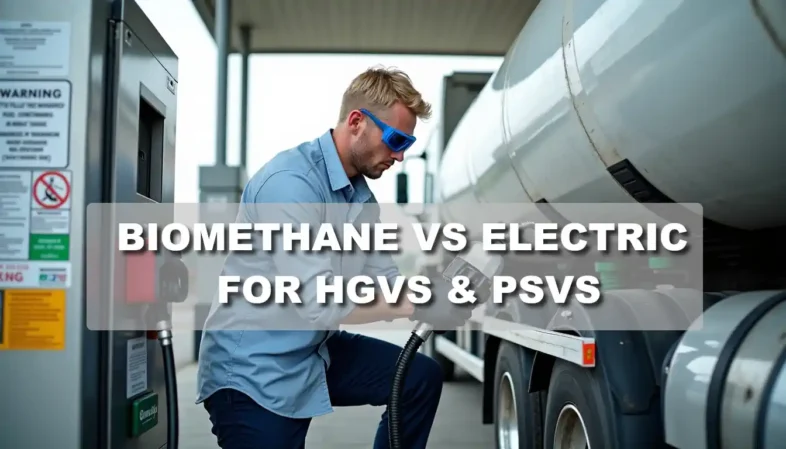
Biomethane and battery-electric trucks are often presented as competing solutions for decarbonising heavy road transport. That comparison is too simple.
The most appropriate technology depends on the work the vehicle must perform, the distance it travels, where it returns at the end of a shift, the available energy infrastructure and the source of the renewable energy.
A battery-electric truck making predictable regional deliveries has a very different duty cycle from an articulated lorry travelling hundreds of miles across national borders. A farm tractor working close to an anaerobic digestion plant presents another entirely different opportunity.
The more useful question is therefore not simply:
Is biomethane better than electricity?
It is:
How should each available unit of renewable energy be matched to the transport task where it delivers the greatest practical benefit?
This article follows biomethane from the anaerobic digester to the vehicle fuel tank. It explains why Bio-CNG and Bio-LNG exist, what is actually dispensed at modern gas filling stations, and where battery-electric HGVs are likely to be the stronger choice.
Why Heavy Road Transport Is Difficult to Decarbonise
Heavy goods vehicles perform an exceptionally wide range of duties.
Some operate entirely within a city. Others return to the same distribution centre every evening. Long-haul vehicles may cross several countries, operate for extended periods and carry loads for which vehicle weight, range and refuelling time are commercially critical.
This matters because no single low-carbon technology is presently ideal for every application.
Battery-electric powertrains are highly energy-efficient and produce no exhaust emissions during operation. They are increasingly practical for urban distribution, depot-based fleets and a growing range of regional transport duties.
However, heavy electric trucks also require:
- adequate electricity network capacity at depots and public charging sites;
- high-power charging equipment;
- sufficient charging time within vehicle schedules;
- route planning around available charging facilities; and
- careful consideration of battery weight, range and payload.
The European Commission expects battery-electric drivetrains to account for most zero-emission heavy-duty vehicles entering service by 2030. At the same time, it has acknowledged continuing obstacles including grid capacity, site availability, planning delays and the need for substantially more truck-charging infrastructure.
Biomethane offers a different set of advantages. It can be stored, transported and dispensed rapidly, and it can replace fossil natural gas in compatible engines. Its strongest role may therefore be in applications where high daily mileage, rapid refuelling, existing gas-vehicle fleets or limited charging capacity make full electrification more difficult.
From Organic Waste to Vehicle Fuel
Raw biogas is normally produced by anaerobic digestion of materials such as food waste, manure, sewage sludge, crops and other biodegradable feedstocks.
It commonly contains methane, carbon dioxide, water vapour and smaller quantities of contaminants. Depending on the feedstock and plant, these may include hydrogen sulphide, ammonia, siloxanes and other trace compounds.
Raw biogas is not the same product as transport-grade biomethane.
Before it can be used as a high-quality vehicle fuel or injected into a natural gas network, the gas must be upgraded. This principally involves removing carbon dioxide and reducing moisture and contaminants to the required specification.
The resulting biomethane can then follow several routes:
- use directly as a compressed vehicle fuel;
- injection into the natural gas network;
- compression and transport to a remote grid-injection point;
- compression as Bio-CNG;
- liquefaction as Bio-LNG; or
- use as an industrial or process fuel.
The Biomethane Value Ladder
It is tempting to assume that every additional processing stage automatically creates a more valuable product. That is not necessarily true.
Liquefaction adds cost, energy consumption, refrigeration equipment and operational complexity. Grid injection requires a suitable connection and compliance with network specifications. Compression requires storage and dispensing infrastructure.
The best route is the one that matches local production to a reliable market.
| Energy product | Typical processing | Potential applications |
|---|---|---|
| Raw or cleaned biogas | Moisture and contaminant removal as required | CHP, boilers and on-site process heat |
| Upgraded biomethane | Carbon dioxide and contaminant removal | Industrial fuel, vehicle fuel or further processing |
| Bio-CNG | Biomethane compressed and stored as a gas | Tractors, refuse vehicles, buses and regional fleets |
| Grid-injected biomethane | Upgraded to network entry requirements | Distributed through the natural gas network |
| Bio-LNG | High-quality biomethane further purified and cryogenically liquefied | Long-haul HGVs, shipping and other high-energy-demand uses |
The value ladder is therefore not a ranking from inferior to superior. It is a method of matching processing effort, fuel quality and energy density to the end use.
Why Bio-CNG Exists
Bio-CNG is biomethane stored and dispensed in compressed gaseous form.
It is particularly attractive for vehicles that return regularly to a base, travel predictable routes or do not require the maximum possible range from each tank.
Potential applications include:
- farm tractors and suitable agricultural machinery;
- refuse collection vehicles;
- local authority fleets;
- buses;
- local delivery vehicles;
- regional distribution trucks; and
- HGVs operating from fixed depots.
For a farm-based anaerobic digestion plant, this creates an especially interesting circular-economy opportunity.
Manure, crop residues or other organic materials can be digested. The resulting gas can be upgraded and compressed, then used in suitable farm vehicles or supplied to nearby agricultural contractors, delivery fleets and regional hauliers.
The fuel is produced close to where it is consumed. This may avoid the need for cryogenic liquefaction and can reduce dependence on imported diesel.
Does Bio-CNG Always Have a Lower Methane Purity?
Not necessarily.
The term Bio-CNG describes the physical form in which the biomethane is stored: compressed gas. It does not by itself prescribe one universal methane concentration.
A small direct-use project could theoretically upgrade its gas to a specification suitable for the intended engine and local fuel system without preparing it for entry into a national gas network.
However, much of the Bio-CNG dispensed by large public filling-station networks is associated with biomethane injected into the gas grid. In that case, the renewable gas entering the network must first meet the applicable grid-entry requirements.
The physical gas withdrawn at the filling station is then compressed from the local network, while the renewable origin is accounted for through a recognised chain-of-custody, mass-balance or certificate system.
What Is Actually Sold at Biomethane Filling Stations?
There is no single European model. Several different supply arrangements are in use.
1. Grid-Connected Bio-CNG Stations
At a grid-connected CNG station, gas is drawn from the natural gas network and compressed into vehicle storage cylinders.
The individual methane molecules entering the truck will normally be part of the mixed gas flowing through the network. They cannot be physically traced back through the pipelines to one particular anaerobic digestion plant.
Instead, an equivalent quantity of verified biomethane is injected elsewhere into the interconnected system. Certificates or transport-fuel sustainability records are transferred and retired so that the renewable attribute is not sold twice.
The UK Green Gas Certification Scheme describes this clearly: its Renewable Gas Guarantees of Origin track the contractual and environmental attributes of renewable gas rather than attempting to trace its precise physical flow through the network.
CNG Fuels uses this type of grid-connected model at its UK public-access Bio-CNG stations. The gas grid provides physical continuity of supply, while biomethane procurement and Renewable Transport Fuel Certificates support the renewable-fuel claim.
2. Direct or Local Bio-CNG Supply
A station may also be located at, or supplied directly from, a biomethane plant.
In this arrangement, upgraded gas can be compressed and dispensed locally without first travelling through the national gas grid.
This may be attractive for farms, municipal fleets, bus depots, waste companies or other captive fleets operating close to the production plant.
Where no suitable gas connection exists, biomethane can also be compressed into transport containers and taken by road to a filling station or remote grid-injection site. The additional transport emissions and costs must then be included in the project assessment.
3. LNG and Bio-LNG Stations
European heavy-vehicle stations may dispense fossil LNG, Bio-LNG or a changing mixture of the two, depending on supply arrangements and customer contracts.
Some operators offer both compressed and liquefied gas at the same site. Others specialise in one fuel.
Gasum, for example, operates a Nordic network supplying compressed and liquefied gas and states that many of its stations offer both renewable biogas and natural gas.
As with grid-supplied Bio-CNG, the environmental claim may depend on whether renewable fuel is physically delivered to the station or allocated through an accepted mass-balance and certification arrangement.
Fleet operators must therefore look beyond the pump label and establish:
- whether the product is fossil LNG, Bio-LNG or a blend;
- whether the renewable gas is physically supplied or mass-balanced;
- which sustainability certification applies;
- the feedstock used to produce the biomethane;
- the quoted greenhouse-gas intensity; and
- whether methane leakage has been included in the emissions calculation.
Why Bio-LNG Exists
If Bio-CNG can already power trucks, buses and tractors, why incur the extra expense of liquefying biomethane?
The answer is volumetric energy density.
Compressed biomethane remains a gas. Even at high pressure, it occupies considerably more storage volume than liquefied methane containing an equivalent quantity of energy.
Bio-LNG is cooled until the methane becomes a cryogenic liquid. This substantially increases the quantity of energy that can be carried within the available vehicle tank volume.
That matters for long-haul transport because the vehicle operator wants:
- long range between refuelling stops;
- rapid refuelling;
- acceptable tank size and weight;
- minimal loss of payload;
- access to fuel along international transport corridors; and
- operating patterns resembling those of conventional long-distance trucks.
Liquefaction also places demanding requirements on the gas-cleaning process.
Water, carbon dioxide and certain contaminants must be reduced to very low concentrations because they can freeze or cause operational problems within cryogenic equipment. Bio-LNG production therefore begins with thoroughly upgraded and conditioned biomethane.
It is reasonable to describe Bio-LNG as the biologically produced renewable equivalent of LNG, provided it meets the required fuel and liquefaction specifications.
Bio-CNG vs Bio-LNG
| Criterion | Bio-CNG | Bio-LNG |
|---|---|---|
| Physical state | Compressed gas | Cryogenic liquid |
| Processing requirement | Upgrading and compression | Intensive upgrading, polishing and liquefaction |
| Infrastructure cost | Generally lower | Generally higher |
| Volumetric energy density | Lower | Higher |
| Typical vehicle range | Suitable for local and regional duties, although modern HGV ranges can be substantial | Particularly suited to long-haul and high-mileage operation |
| Likely refuelling model | Depot, local production site or grid-connected public station | Specialist cryogenic storage and public or depot LNG station |
| Strong applications | Tractors, buses, refuse vehicles and regional fleets | Long-haul HGVs and shipping |
Biomethane vs Battery-Electric HGVs
Battery-electric trucks are likely to take a growing share of road freight. Their high drivetrain efficiency, absence of tailpipe emissions and ability to use renewable electricity make them particularly strong in applications where charging can be planned around predictable vehicle downtime.
Good early applications include:
- urban deliveries;
- fixed daily routes;
- short and medium-distance distribution;
- vehicles returning to a depot overnight; and
- operations where depot charging capacity can be installed economically.
Biomethane may remain attractive where:
- vehicles cover high daily mileages;
- refuelling time is commercially important;
- public charging infrastructure is insufficient;
- grid reinforcement would be costly or slow;
- gas trucks are already available to the operator;
- local biomethane production creates a secure fuel source; or
- long-distance routes favour the higher energy density of Bio-LNG.
The answer will also change over time. Battery technology, vehicle range and megawatt-scale charging are advancing rapidly. A route that favours biomethane today may become straightforward to electrify later.
Conversely, limited supplies of sustainable biomethane should not be consumed indiscriminately in applications that can be electrified easily and more efficiently.
Which Technology Will Decarbonise Heavy Transport First?
The most credible answer is that both will contribute, but in different parts of the market.
Battery-electric HGVs are likely to grow rapidly in urban, depot-based and regional operations as vehicle availability improves and charging infrastructure expands.
Bio-CNG offers an immediately deployable option for compatible local and regional fleets, particularly where vehicles return to base or where biomethane is produced locally.
Bio-LNG addresses the specific challenge of storing enough renewable energy onboard a vehicle for intensive long-haul operation while retaining rapid refuelling.
It may therefore be more helpful to divide freight applications as follows:
| Transport duty | Potentially strong solution |
|---|---|
| Urban deliveries | Battery-electric |
| Depot-based regional distribution | Battery-electric or Bio-CNG |
| Refuse collection | Battery-electric or Bio-CNG, depending on route and infrastructure |
| Farm machinery and rural fleets | Locally produced Bio-CNG where suitable vehicles and infrastructure exist |
| High-mileage regional HGVs | Bio-CNG, Bio-LNG or battery-electric according to duty cycle |
| International long-haul freight | Bio-LNG currently offers important operational advantages, while battery-electric capability is developing |
A Circular Rural Energy Opportunity
One of the most overlooked biomethane opportunities lies in agriculture.
Farm AD plants are often discussed principally as electricity generators or as sources of gas for grid injection. But local Bio-CNG could allow agricultural businesses to retain more of the energy value within the rural economy.
A suitable plant could potentially:
- process manure and local organic residues;
- produce biogas through anaerobic digestion;
- upgrade part of that gas to biomethane;
- compress it for suitable tractors or farm vehicles;
- supply neighbouring farmers or agricultural contractors; and
- provide fuel for local delivery and haulage fleets.
This would not be appropriate everywhere. Vehicle availability, planning permission, gas-cleaning requirements, fuel taxation, safety regulations, storage, metering and demand would all need careful assessment.
Nevertheless, it demonstrates an important principle: not every biomethane project needs to pursue maximum processing complexity or serve a national market.
Sometimes the most efficient use of a renewable fuel is to produce it close to where it is needed and consume it within a local circular economy.
The Gas Grid as a Biomethane Transport Network
Where a suitable connection exists, the natural gas grid performs another valuable function.
It connects geographically dispersed biomethane plants with consumers and filling stations without requiring each producer to build a dedicated pipeline to each customer.
A plant injects an independently measured quantity of compliant biomethane. A consumer elsewhere withdraws gas from the network. The renewable attributes are transferred through an approved accounting and certification arrangement.
Under the UK Renewable Transport Fuel Obligation, biomethane suppliers must maintain evidence covering sustainability and chain of custody, including circumstances where pipeline systems are used to transport the fuel.
This model means that a truck can be supplied contractually with renewable biomethane even though the physical gas at the filling nozzle comes from the mixed local network.
It is a practical use of existing national infrastructure, but transparent certification is essential to prevent double counting and ensure that environmental claims are credible.
Environmental Claims Must Include Methane Leakage
Biomethane should not automatically be described as carbon neutral.
Its greenhouse-gas performance depends on:
- the feedstock;
- avoided emissions from manure or waste management;
- energy used in digestion and upgrading;
- methane leakage from the AD plant;
- methane slip during upgrading, storage and vehicle use;
- compression or liquefaction energy;
- transport distances; and
- the accounting methodology used.
Capturing methane that would otherwise escape from manure or decomposing organic waste can produce particularly substantial climate benefits. Poorly managed plants with significant fugitive methane emissions can undermine those benefits.
Fleet buyers should therefore ask for independently verified well-to-wheel or lifecycle greenhouse-gas figures rather than relying solely on broad claims about renewable gas.
Conclusion: Match the Fuel to the Transport Task
The future of heavy transport is unlikely to be dominated by one universal technology.
Battery-electric trucks are an increasingly strong solution for urban deliveries, fixed routes and depot-based fleets. Their role will expand as charging infrastructure, vehicle range and electricity-network capacity improve.
Bio-CNG can provide a practical route for tractors, refuse vehicles, buses, regional distribution fleets and other vehicles that return regularly to a known refuelling point. Farm-produced Bio-CNG may be especially valuable when it is used by the same farm or sold within a local rural economy.
Bio-LNG exists for a different reason. Liquefying high-quality biomethane provides the much greater volumetric energy density required for long-distance freight and other high-mileage applications where tank capacity and refuelling time are critical.
The strategic objective should not be to force every transport activity onto the same energy carrier.
It should be to reserve finite supplies of sustainable biomethane for applications where its storage, range and refuelling advantages provide the greatest value, while using renewable electricity directly wherever electrification is technically and economically preferable.
Biomethane and electric HGVs are not simply rivals. Used intelligently, they are complementary tools for reducing diesel consumption and accelerating the decarbonisation of road freight.
References and Further Reading
- International Energy Agency: Outlook for Biogas and Biomethane to 2040
- European Commission: Market Readiness of Zero-Emission Heavy-Duty Vehicles
- European Commission: Clean Transport Corridor Initiative for Truck Charging
- UK Department for Transport: Strategic Charging Infrastructure Scheme
- UK Department for Transport: RTFO Biomethane Guidance
- Green Gas Certification Scheme: Renewable Gas Guarantees of Origin
- Ofgem: Green Gas Support Scheme Guidance
- CNG Fuels: How Grid-Connected Bio-CNG Is Supplied
- CNG Fuels: UK Public Bio-CNG Station Data, May 2026
- Gasum: Compressed Gas, LNG and Bio-LNG Supply Chain
[First published June 2018. Updated April 2022 with a new video. Rewritten July 2026.]




Very interesting. Thanks for sharing.
I once used to send my motor in for a decarb after 50k miles. Now the globe needs a decarb! So much for the march of progress. Bloody marvelous. Nice job. Keep it up.
This post is so interesting. Thanks for sharing!
Thanks for taking the time and sharing such an interesting post with us.
Thanks for sharing your thoughts. Farmers are at the forefront of climate change. We want our UK government to value soil not oil.
Yes. Decarbonise, but read the International Transport Forum’s (ITF’s) conclusion: “ITF’s modelling results suggest that 70% of global CO2 emissions reduction could come from technological development, such as electric vehicles and fuel technologies, with 30% requiring behavioural change. If we continue to transport more goods and use our cars more that 30% behavioural change action will not materialise. But, no-one is talking about that.