
Did you know that fixed, continuously-wired biogas analysers now account for well over half of all biogas monitoring equipment sold, as more plants move from spot-checks to permanent, SCADA-integrated process control? Having spent years following how biogas plants are instrumented, I’ve seen how a permanently installed analyser, wired straight into the control system, changes the way an operator actually runs a digester – rather than reacting to readings during the working day and only reacting to emergencies out of office hours, they can see gas quality drift in real time and act on it immediately.
Whether you’re running an agricultural digester, a food-waste AD plant, a biomethane upgrading facility or a landfill gas site, choosing the right fixed biogas analyser that talks reliably to your SCADA system can make or break your process control strategy. In this guide I’ll walk you through everything you need to know about fixed, continuous biogas analysers as opposed to the handheld devices used by previous biogas generations – from the underlying measurement technologies to the manufacturers worth shortlisting in 2026.
A quick note before we start: although this article covers only fixed analysers that are permanently plumbed into the gas stream and hard-wired into a SCADA or PLC system for continuous, unattended monitoring. Each manufacturer, in this developing market, describes their products very differently and for each sub-sector we found just one manufacturer.
Portable, handheld biogas analysers are a different category of instrument entirely, used for spot-checks and walk-round readings rather than permanent installation, and we don’t cover them here beyond this mention. If that’s what you’re looking for, we’ve reviewed the top handheld biogas analysers in a separate article.
Top 7 Fixed Biogas Analysers Reviewed – Key Takeaways
- Fixed biogas analysis requires robust, low-maintenance sensor technology because the instrument has to run unattended, continuously, for months between service visits
- NDIR (infrared), electrochemical, paramagnetic and laser-based (TDLAS/CEAS) technologies each lead in different parts of the 2026 fixed-analyser market, depending on the gases and accuracy needed
- A fixed analyser is only as useful as its SCADA integration – check Modbus RTU, 4–20mA, Profibus, Profinet and Ethernet/IP support before anything else
- Always confirm ATEX and/or IECEx Zone 1 or Zone 2 certification for installation in or near the hazardous areas of a biogas plant. If you don’t know where ATEX zones are present in your plant, you need to do an ATEX Explosion Risk Assessment within which your zone locations and extent which each zone applies outward from the gas source shall be provided.
- Multi-point sampling (sequencing gas from several digesters or process locations through one analyser) is a major cost and maintenance saving over installing a separate unit at every point
- Consider total cost of ownership, including calibration gas, filter and sensor replacement, not just the purchase price
Understanding Fixed, Continuous Biogas Analysis Basics
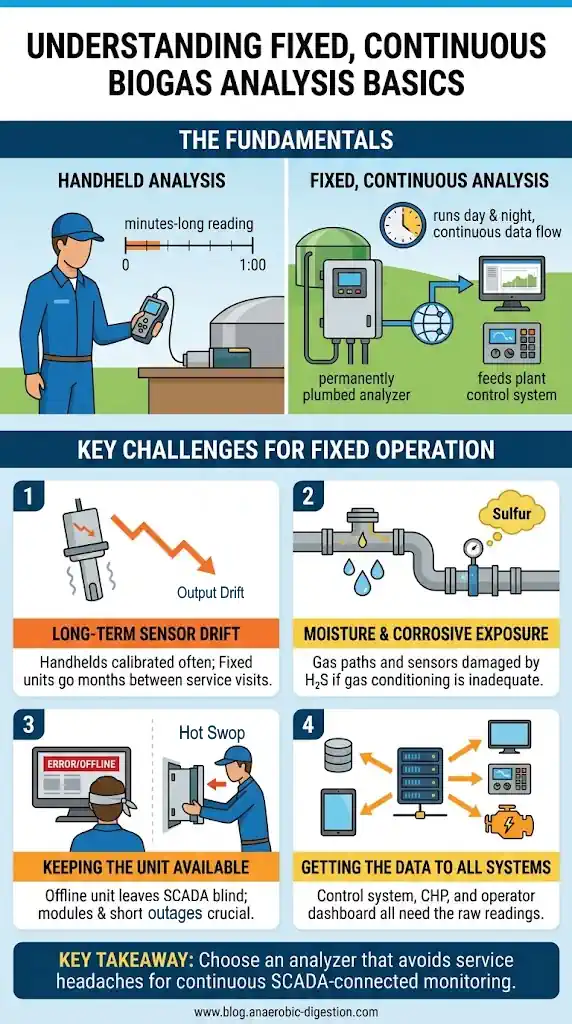
Let’s start with the fundamentals of fixed biogas analysis. Unlike a handheld unit that a technician carries round the site and uses for a reading lasting a minute or two, a fixed analyser is plumbed permanently into one or more sample points and left running, day and night, feeding data continuously back to the plant’s control system.
Key challenges that are specific to fixed, continuous operation include:
- Long-term sensor drift – a handheld unit is recalibrated before every outing; a fixed unit may run for months between visits
- Continuous exposure to moisture and corrosive hydrogen sulphide, which will damage sensors and gas paths if conditioning is inadequate
- Keeping the unit available – a fixed analyser that’s offline for calibration or sensor replacement leaves the SCADA system blind, so hot-swappable modules and short service windows matter
- Getting the data where it’s needed – raw readings on a local display are of limited use if the control system, the CHP engine controller and the operator’s dashboard can’t all see them
When selecting a fixed analyser for continuous SCADA-connected monitoring, understanding these basics will help you avoid a device that looks good on a datasheet but is a headache in service. Continuous gas analysis works hand in hand with other digestate and process monitoring to give a complete real-time picture of plant performance.
A note on spelling: you will see this type of instrument called a biogas “analyser” by UK, European and most international manufacturers (Awite, Union Instruments, SICK, QED’s UK operation), and a biogas “analyzer” by US manufacturers (Siemens’ US literature, Nova Gas Analyzers, DURAG’s US arm). This is simply British versus American English spelling – it is not a sign that a product is non-English, lower quality, or aimed at a different market. We use “analyser” throughout this article as our house style, but you’ll find both spellings used interchangeably across manufacturer datasheets, and either term will find the right equipment in a search engine.
List of the Top 7 Fixed Biogas Analysers of 2026
Let’s dive into the equipment worth shortlisting in 2026! We’ve tried to group our picks by the measurement technology at their core, since this is usually the biggest factor in accuracy, maintenance burden and price. We may have done no more than follow each manufacturer’s named benefits, judge that yourself. Here are our top picks:
- NDIR (Non-Dispersive Infrared) Multi-Component Analysers
- Best for: Continuous CH4/CO2 process monitoring with O2 and H2S add-ons
- Typical accuracy: ±1–2% of measuring range
- Highlight: Field-proven, self-validating with ambient air
- Modular Extractive Gas Analyser Platforms
- Best for: Sites needing 20+ measurable gases or future-proofed sensor modules
- Typical accuracy: ±1% of reading (module dependent)
- Highlight: Up to six analyser modules in one cabinet
- Hot-Swap Modular Fixed Biogas Analysers
- Best for: Sites prioritising zero monitoring downtime during service
- Typical accuracy: ±1% after calibration
- Highlight: Field-replaceable modules, no lost SCADA data
- Continuous Multi-Point Digester Analysers
- Best for: Agricultural and industrial plants with several fermenters to sequence through one unit
- Typical measuring points: Up to 5 per analyser
- Highlight: Integrates with automated desulphurisation control
- Modular Multi-Point Platforms with Mixed Sensor Technology
- Best for: Larger sites with up to ten sample points feeding one cabinet
- Typical sensors: NDIR, electrochemical, paramagnetic and acoustic density cells
- Highlight: Build the exact sensor combination your process needs
- Maintenance-Free Combined Online Sensors
- Best for: Simpler plants wanting a low-maintenance, direct in-line sensor
- Typical gases: CO2/O2 or CH4/CO2 combined in one housing
- Highlight: No moving parts, PAT-conforming continuous output
- Laser-Based (TDLAS/CEAS) Trace & Grid-Quality Analysers
- Best for: Biomethane upgrading plants and grid-injection quality control
- Typical measurement: Trace contaminants down to ppb level
- Highlight: Non-consumable laser measurement, very low drift
List of Fixed Biogas Analyser Manufacturers & Models
We’ve researched the following manufacturers and models of fixed, continuously-wired biogas analysers. As with any specialist equipment purchase, treat this as a starting point for your enquiries and check thoroughly with each manufacturer that a specific model suits your gas composition, hazardous area classification and SCADA protocol before committing to a purchase.
1. NDIR Multi-Component Analysers
SIEMENS
The Siemens ULTRAMAT 23 is a long-established continuous gas analyser widely used on biogas and landfill gas sites. It measures up to four components simultaneously – typically the two infrared-active gases CH4 and CO2, plus O2 (via a paramagnetic cell) and H2S (via an electrochemical sensor) – in a single 19″ rack-mount or desktop unit. Siemens also offers the Set BGA, a preconfigured, cabinet-mounted version of the ULTRAMAT 23 built specifically as a standardised, stationary system for landfill, sewage and biogas applications, complete with its own gas-conditioning components for heating or drying the sample. It self-validates using ambient air for zero and span checks on the IR and O2 channels, and is rated for use with flammable gas concentrations up to around 70% CH4.
2. Modular Extractive Gas Analyser Platforms
SICK (MAIHAK)
The SICK GMS800 family (including the GMS810, GMS811, GMS815 and GMS840 variants) is a modular extractive analyser system built around six interchangeable analyser modules, capable between them of measuring more than 60 different gas compounds, including CH4, CO2, O2, H2S, CO and NH3. Because the platform is modular – gas module, analyser modules, I/O modules and operating unit – it can be specified tightly for a biogas digester’s gas mix and then adapted later if monitoring requirements change, making it a flexible choice where a site expects to add measurement points or gases over time.
3. Hot-Swap Modular Fixed Biogas Analysers
QED ENVIRONMENTAL SYSTEMS (LANDTEC / GEOTECH)
The QED LANDTEC BIOGAS 3000 (marketed in some regions under the Geotech name, and the successor to the earlier GA3000 PLUS) is a compact, self-contained fixed analyser built specifically for continuous biogas and landfill gas monitoring. It uses up to four sample ports to measure CH4, CO2 and O2 as standard, with H2S, H2 and CO available as options, so a plant can monitor the gas before and after desulphurisation from the same unit. Its standout feature is a modular, hot-swappable design: individual sensor modules can be replaced on site in minutes, and the supplier can provide a temporary loan unit during servicing, so the SCADA feed is never left blank for long. It’s ATEX and IECEx certified for Zone 2, IP65 rated, and offers six configurable 4–20mA outputs plus Modbus RTU as standard, with Profibus and Profinet available as options – making it one of the more straightforwardly SCADA-ready units on this list.
4. Continuous Multi-Point Digester Analysers
AWITE BIOENERGIE
Germany’s Awite has supplied over 1,700 gas analysis systems worldwide, and its AwiFLEX range is built specifically for continuous, multi-point monitoring of agricultural and industrial biogas plants. AwiFLEX provides continuous measurement of CH4, CO2, O2, H2S and H2, sequencing between up to five measuring points – useful where a plant runs several fermenters from one control room. Beyond gas analysis, the system can take flow, temperature and pressure inputs and drive automated desulphurisation control, and integrates with Awite’s own AwiCONTROL automation and visualisation software for full-plant process control, as well as third-party SCADA systems.
5. Modular Multi-Point Platforms with Mixed Sensor Technology
UNION INSTRUMENTS
The Union Instruments INCA platform takes a building-block approach: modules for active gas sampling, gas processing, sensing, control, data processing and communication are combined to create a system tailored to the site. When specified with its sequential sampling option, INCA can switch between up to ten measuring points – for example, sampling from multiple fermenters in a single agricultural biogas plant. Its sensor options span NDIR (for CH4 and CO2), electrochemical (O2, H2S, H2), paramagnetic (O2) and acoustic cells (for gas density), letting an integrator mix and match the right technology for each measured gas rather than compromising with a single fixed sensor set.
6. Maintenance-Free Combined Online Sensors
BLUESENS GAS SENSOR
German manufacturer BlueSens takes a different approach, offering maintenance-free combined sensors rather than cabinet-based multi-gas systems. Its BlueInOne and BlueVary units combine two gas measurements – CO2/O2 or CH4/CO2 – in a single, space-saving in-line housing with no moving parts, delivering continuous, PAT-conforming (process analytical technology) real-time data. BlueSens’ own BlueVIS software can calculate derived process values such as CER, OUR and RQ automatically from the live gas data, which is useful where an operator wants process insight rather than just raw concentrations. The company’s single-gas BCP-series sensors (CO2, O2, H2, CH4) can also be deployed individually where only one gas needs continuous tracking.
7. Laser-Based (TDLAS/CEAS) Trace & Grid-Quality Analysers
DURAG GROUP
Where a plant is upgrading biogas to biomethane for injection into the natural gas grid, trace-level accuracy matters more than it does for digester process control. DURAG’s ProCeas is a laser-based (cavity-enhanced absorption spectroscopy) continuous analyser built for exactly this: it delivers continuous, real-time, multi-parameter measurement of methane, moisture, ammonia, hydrogen sulphide and other trace contaminants down to parts-per-billion level, even in the highly moisture-saturated gas streams typical of biogas purification. For an operator who needs to prove gas quality continuously at the point of grid injection, rather than simply monitor digester health, this category of instrument fills a gap the digester-focused analysers above aren’t designed for.
Key Features to Consider When Choosing a Fixed Biogas Analyser for SCADA Integration
When we researched the fixed analysers reviewed here, a clear set of selection criteria emerged – distinct in several ways from choosing a portable unit. We’d suggest considering the following factors before you commit:
Measurement Technology and Accuracy
NDIR sensing suits CH4 and CO2 well and is the most common core technology; electrochemical cells typically handle O2, H2S and H2; paramagnetic cells offer stable long-term O2 accuracy; and laser-based (TDLAS/CEAS) technology is reserved for trace-level and grid-quality work. Match the technology to the gases and accuracy your process actually needs – paying for trace-level laser accuracy on a simple digester process loop is rarely good value.
SCADA and Communication Protocols
This is the feature that most separates a fixed analyser from a portable one. Confirm the unit supports your plant’s existing protocol – commonly Modbus RTU, 4–20mA analogue outputs, Profibus, Profinet or Ethernet/IP – before you specify it, and check whether additional protocols are a factory option or require a third-party gateway.
Multi-Point Sampling
If your plant has more than one fermenter, digester or sample location, a single analyser that sequences between several sample points via a solenoid-switched sampling system can be considerably cheaper to buy and maintain than installing a dedicated unit at every point – several of the manufacturers above offer this as standard.
Certifications and Hazardous Area Rating
Confirm ATEX and/or IECEx certification appropriate to the zone the analyser (and its sample lines) will sit in, and check whether the certification covers the full installed system or only the analyser cabinet itself.
Gas Conditioning and Moisture Management
Continuous operation means continuous exposure to a wet, corrosive gas stream. Look for built-in condensate handling, filtration and, where relevant, sample gas heating or drying – this has a direct effect on both measurement accuracy and sensor lifespan.
Serviceability and Downtime
Hot-swappable modules, on-site field calibration and loan units during servicing all reduce the amount of time your SCADA system is left without live gas data – a factor worth weighing alongside the headline accuracy specification.
Installation and Maintenance Best Practices
Getting a fixed analyser installed and maintained correctly protects both the accuracy of your readings and the life of the instrument.
Installation Requirements
- Site the analyser as close as practical to the sample point(s) to minimise sample line length and lag time
- Follow the manufacturer’s requirements for sample line heat tracing or insulation where moisture dropout is a risk
- Confirm the hazardous area classification of the installation point and select ATEX/IECEx-rated equipment accordingly
- Agree the SCADA protocol, addressing and data tag mapping with your controls integrator before the unit arrives on site
Maintenance Schedule
- Weekly to monthly: visual inspection, filter and condensate trap check
- Quarterly: calibration verification against certified span gas
- Annually: full calibration, sensor condition check and certification renewal where applicable
- As needed: sensor or module replacement, following manufacturer-stated service life
Industry-Specific Applications
Agricultural and Industrial Digesters
Focus on: CH4 yield optimisation and feed management. Key feature: multi-point sampling across several fermenters. Typical choice: NDIR or modular platform analysers such as AwiFLEX or INCA.
Biomethane Upgrading and Grid Injection
Focus on: Trace contaminant and moisture control at the point of grid injection. Key feature: ppb-level accuracy. Typical choice: laser-based (TDLAS/CEAS) analysers such as ProCeas.
CHP Engine Protection
Focus on: Continuous H2S and CH4 monitoring to protect engine life. Key feature: fast response and reliable alarming. Typical choice: NDIR/electrochemical combined analysers such as the Ultramat 23 or BIOGAS 3000.
Landfill Gas Collection
Focus on: Durability and wide measurement range across a variable, often diluted gas stream. Key feature: robust, field-serviceable modules. Typical choice: modular hot-swap analysers such as the BIOGAS 3000 or SICK GMS800 series.
Expert Tips for Optimal SCADA Integration
- Agree data tag names and alarm thresholds with your SCADA integrator before the analyser is commissioned, not after
- Build in a loan or spare module arrangement wherever the manufacturer offers one, so a service visit never leaves the control system blind
- Log raw gas readings as well as any derived values (such as CER/OUR/RQ) so you can re-check calculations later without re-running the plant
- Keep a calibration and maintenance record for every analyser on site – this matters for both accuracy and any regulatory reporting
- Review your SCADA alarm limits periodically against actual plant performance, rather than leaving factory defaults in place indefinitely
Conclusion to “Top 7 Fixed Biogas Analysers”
Selecting the right fixed, SCADA-connected biogas analyser is a decision that affects your plant’s process control for years, not just its monitoring budget for this quarter. Consider your specific gas composition, the number of sample points you need to cover, your SCADA protocol, and the hazardous area classification of the installation site. As with any specialist instrumentation, the cheapest unit on the datasheet isn’t always the most cost-effective once you factor in calibration gas, sensor replacement and the cost of any downtime.
Need help making your final decision? We’d recommend:
- Define your gas list, number of sample points, and required SCADA protocol before requesting quotes
- Get proposals from more than one manufacturer in each technology category
- Ask specifically about hot-swap or loan-unit arrangements for servicing
- Check the ATEX/IECEx certification covers your actual installation, not just the analyser cabinet
Feel free to reach out in the comments with any questions about fixed biogas analysers and SCADA integration – we’re always happy to help fellow industry professionals make informed decisions.
Note: Specifications mentioned are based on publicly available manufacturer literature and may vary by model, region and configuration. Always request current specifications and quotes from manufacturers or authorised distributors before purchase.
CC BY-NC by ENVIRODATA-ERYRI
Frequently Asked Questions (FAQs)
Q: What’s the difference between a fixed biogas analyser and a portable one?
A: A fixed analyser is permanently plumbed into the gas stream and hard-wired into a SCADA or PLC system for continuous, unattended monitoring, whereas a portable analyser is a handheld instrument carried around a site for periodic spot-checks. We’ve covered portable units separately in our handheld biogas analyser review.
Q: Is “analyser” or “analyzer” the correct spelling?
A: Both are correct – “analyser” is the British and international English spelling, while “analyzer” is American English. Manufacturers use whichever spelling matches their home market’s convention, and both terms refer to the same equipment.
Q: What SCADA communication protocols should I look for?
A: Most fixed biogas analysers offer at least 4–20mA analogue outputs and Modbus RTU as standard, with Profibus, Profinet or Ethernet/IP available as factory options on many models. Confirm your plant’s existing protocol before specifying a unit.
Q: Do I need special certifications for a fixed biogas analyser installation?
A: Yes, in most regions a fixed biogas analyser and its sample lines must carry ATEX and/or IECEx certification appropriate to the hazardous area zone it’s installed in. Installation should be carried out by technicians familiar with hazardous area requirements.
Q: Can one fixed analyser monitor more than one digester?
A: Yes – several of the systems reviewed here, including AwiFLEX and the Union Instruments INCA platform, can sequence sample gas from multiple sample points (up to five or ten points respectively, depending on configuration) through a single analyser cabinet.
Q: How often should a fixed biogas analyser be calibrated?
A: Most manufacturers recommend quarterly calibration verification with a full annual calibration, though harsh gas conditions or critical applications may call for more frequent checks. Several units also self-validate zero and span using ambient air between full calibrations.
Q: What’s the typical lifespan of a fixed biogas analyser?
A: With proper maintenance, the analyser cabinet and electronics typically last 10–15 years, though individual sensor modules (especially electrochemical cells) usually need periodic replacement well before that, depending on gas exposure and duty cycle.
Q: Are there ongoing maintenance costs I should budget for?
A: Yes, typical ongoing costs include:
- Calibration gas and annual calibration services
- Replacement sensor modules, filters and seals
- Routine cleaning, condensate trap servicing and inspection
- SCADA integration or software updates
- Occasional service call-outs
Q: Why would I need a laser-based (TDLAS/CEAS) analyser instead of a standard NDIR unit?
A: Standard NDIR/electrochemical analysers are well suited to digester process control, but laser-based analysers offer trace-level accuracy down to parts-per-billion, which matters where biogas is being upgraded to biomethane and gas quality has to be proven continuously at the point of grid injection.
Q: What are the common causes of fixed analyser failure or drift in biogas applications?
A: Common causes include:
- Moisture or condensate entering the sensor or sample line
- Corrosion from hydrogen sulphide in poorly conditioned gas
- Sensor exhaustion (particularly electrochemical cells) without timely replacement
- Missed or infrequent calibration
- SCADA communication faults from incorrect protocol configuration rather than analyser failure itself