Biomethane is being introduced into Northern Ireland's gas network to help decarbonize its energy supply, with the first injection into the grid occurring in November 2023. The potential exists for the province to develop a lead, but is the government doing enough?
Produced from agricultural and food waste through anaerobic digestion, biomethane can be used in place of natural gas without needing to change existing appliances. The government is working on a policy framework and support mechanisms to develop the industry, which has the potential to meet a significant portion of the region's gas demand.
ADBA PRESS RELEASE – 20 October 2025:
Biomethane is key to Northern Ireland’s Net Zero Future, say industry leaders at 2025 ADBA Conference
Industry leaders, policymakers, and investors gathered at the (ADBA) Northern Ireland Conference at the ICC Belfast last month to explore how to unlock Northern Ireland’s vast biomethane potential and cement its role in delivering the region’s net zero and circular economy goals.
Opening the conference on 23 September, Chris Huhne, ADBA Chair, emphasised Northern Ireland’s unique position:
“No other region in the UK has such abundant agricultural and livestock resources. Northern Ireland has the greatest potential to lead the biomethane revolution — the question is no longer how, but why it needs biomethane?”
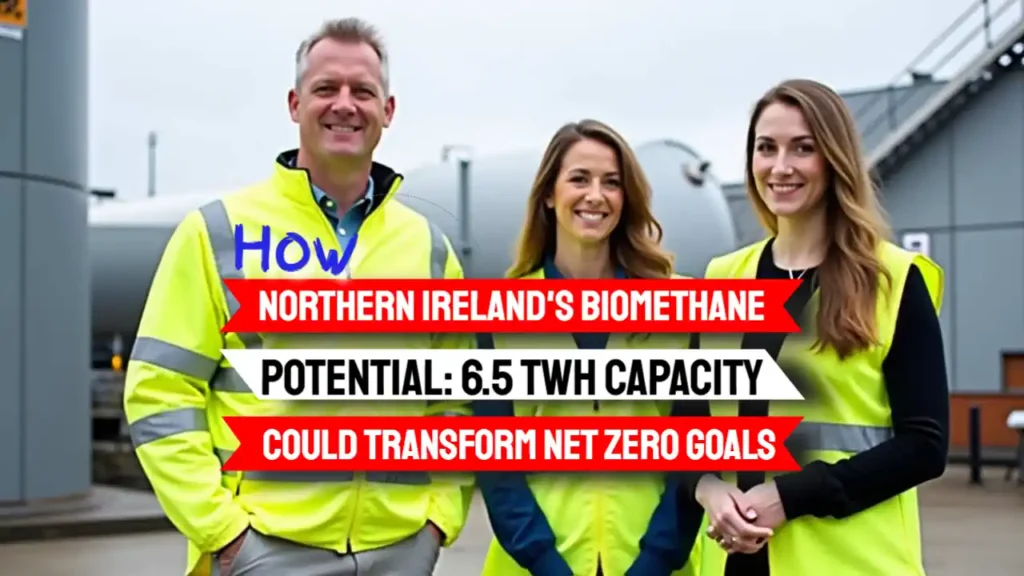
In a policy and market update, Dr Gareth Mottram, ADBA’s Policy Lead, highlighted that Northern Ireland could produce up to 6.5 TWh of biogas — exceeding the Republic of Ireland’s 2030 target — and reduce emissions by around 1 million tonnes of CO₂ annually. He urged policymakers to include Northern Ireland in the forthcoming successor to the Green Gas Support Scheme (GGSS) and to clarify the rules for the Republic of Ireland’s Renewable Heat Obligation (RHO).
“Biogas can support both Northern Ireland and the Republic of Ireland’s energy needs,” said Dr Mottram. With the right framework, we can save households money, support farming, and strengthen energy security. Biogas also represents a huge opportunity for export towards Great Britain.”
Government Commitment and Collaboration
Delivering the keynote address, Andrew Muir MLA, Minister for Agriculture, Environment and Rural Affairs, reaffirmed the NI government’s commitment to biomethane as part of the energy transition, explaining how it plays a clear role in tackling climate change while supporting resilient agricultural communities.
The Minister also highlighted new funding, including £50,000 for proof-of-concept projects and £9 million for shared bioeconomy projects announced earlier this month, as well as efforts to promote cross-departmental collaboration within the Northern Ireland government, notably with the Department for Economy.
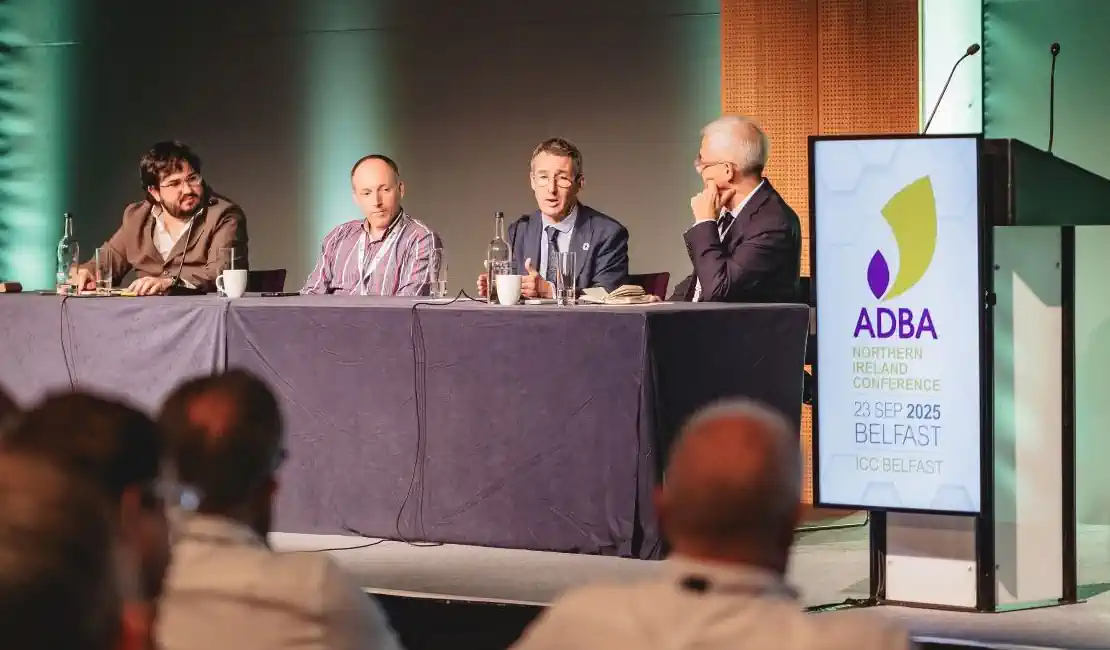 Andrew Muir MLA (second from right) takes questions from Chris Huhne (on the right) and the audience.
Investment, Regulation, and “Joined-Up Thinking” Needed
Throughout the day, speakers from Kinecx, A&L Goodbody, Green Gas Task Force, Manby BGE, Firmus Energy, SGS, Ulster Farmers’ Union, BH Estates, Encirc, SGN Green Gas Solutions, Verdant Analytix, Vogelsang, AFBI and Anaergia called for clarity, stability, and collaboration across departments and regulators. They noted that the absence of a clear policy framework has stalled momentum since 2021.
Mark Stevenson of Kinecx noted that policy gaps and fragmented regulation were holding back investment, calling Northern Ireland to adopt a joined-up approach between the Department for the Economy and DAERA to realise its biomethane potential.
Charles McAllister of the Green Gas Task Force added that biomethane could offset up to 13% of the UK’s net zero target, urging the creation of a national biomethane target and a UK-wide case study to showcase best practice.
Circular Economy and Nutrient Management Solutions
A recurring theme across sessions was that anaerobic digestion (AD) is more than an energy solution — it’s a cornerstone of nutrient management, waste reduction, and agricultural resilience. Dr James Young of the Centre for Competitiveness presented the Mid-Ulster Eco-Cycling Centre as a model for linking agriculture, renewable energy, and local economic development.
Speakers also discussed how AD can help address the Lough Neagh nutrient pollution crisis, with calls for targeted action on the 20% of sites responsible for 80% of phosphorus runoff — creating both environmental gains and feedstock continuity for AD plants.
Making AD Investable
Investors and developers stressed the need for clear market access and financial certainty. James Dorman of Manby BGE, which employs 150 people in a £300 million biorefinery project, explained that investors needed confidence — in the feedstock, in the planning, and in the policy.
Given the right signals, Northern Ireland could attract large-scale green investment and export renewable gas across the island.
Next Steps for ADBA in Northern Ireland
The conference concluded with a call from the attendees for ADBA to appoint a full-time policy and public affairs representative in Northern Ireland, to strengthen collaboration with the agri-food industry and policymakers, and to ensure the sector’s voice is heard in the development of future support schemes.
Reflecting on the day’s proceedings, Chris Huhne said:
“This ADBA Northern Ireland conference was the most focussed yet on how we finally begin to exploit the region’s massive potential for biogas. Minister Muir showed that he understood the importance of anaerobic digestion in staunching the nutrient overload that is wrecking Lough Neagh, and it is surely just a matter of time before such a visible environmental problem is addressed.
Northern Ireland has the resources, the expertise, and the urgency to lead the UK in biomethane production. What’s needed now is policy certainty and partnership — to turn potential into progress.
I came away optimistic that the northern Irish sector, which has been marking time for so long, can succeed in another big push forward. In particular, it is not hyperbole to say that the future of the northern Irish livestock sector, the biggest protein producer in the UK, depends on our success. There will be no net zero in agriculture without AD, biogas and bio-fertiliser”.
– ADBA Press Release ENDS –
The IPPTS Associates View:
Northern Ireland's Biomethane Moment: Why the Region Can't Afford to Wait
A perspective on unlocking the region's green gas potential
Northern Ireland stands at a crossroads. Blessed with more agricultural and livestock resources per capita than anywhere else in the UK, the region has the raw ingredients to become a biomethane powerhouse. The potential is staggering: 6.5 TWh of biogas production that could slash emissions by a million tonnes of CO₂ annually, support farmers, strengthen energy security, and even export renewable gas to Great Britain and the Republic of Ireland.
Yet for all this promise, the industry has been treading water since 2021. The September 2025 ADBA Conference in Belfast laid bare a troubling reality: Northern Ireland's biomethane sector isn't suffering from a lack of ambition, expertise, or resources. It's being held back by something far more mundane—policy paralysis.
The Cost of Standing Still
While other regions forge ahead with clear renewable energy frameworks, Northern Ireland remains caught in a holding pattern of consultations, fragmented regulations, and departmental silos. The Green Gas Support Scheme successor remains undefined for the region. Rules around the Republic of Ireland's Renewable Heat Obligation lack clarity. Grid connection costs remain a barrier. And crucially, there's no joined-up thinking between the Department for the Economy and the Department of Agriculture, Environment and Rural Affairs.
This isn't just an administrative inconvenience. Every month of delay means missed investment, stalled projects, and opportunities flowing elsewhere. Investors need certainty. Developers need long-term security. Farmers need confidence that the infrastructure will be there when they're ready to participate. Right now, Northern Ireland is offering none of these things.
The human cost is equally stark. With 4,800 people currently employed across the UK's AD sector and projections of 60,000 jobs by 2050 if fully deployed, Northern Ireland is leaving economic opportunity on the table. More pressingly, the region's livestock sector—the biggest protein producer in the UK—faces an existential challenge in reaching net zero. Without anaerobic digestion and bio-fertiliser, that goal simply isn't achievable.
More Than Just Energy
Perhaps the most frustrating aspect of Northern Ireland's stalled progress is that the conversation remains stuck on biomethane as merely an energy play. This fundamentally misunderstands what AD can deliver.
The Lough Neagh crisis should be a wake-up call. Northern Ireland's largest lake, once a jewel of natural heritage, is choking on nutrient pollution. Research suggests that 20% of sites are responsible for 80% of phosphorus runoff. Anaerobic digestion offers a proven solution to this nutrient management nightmare, processing agricultural waste into controlled, valuable digestate while generating renewable energy as a co-benefit.
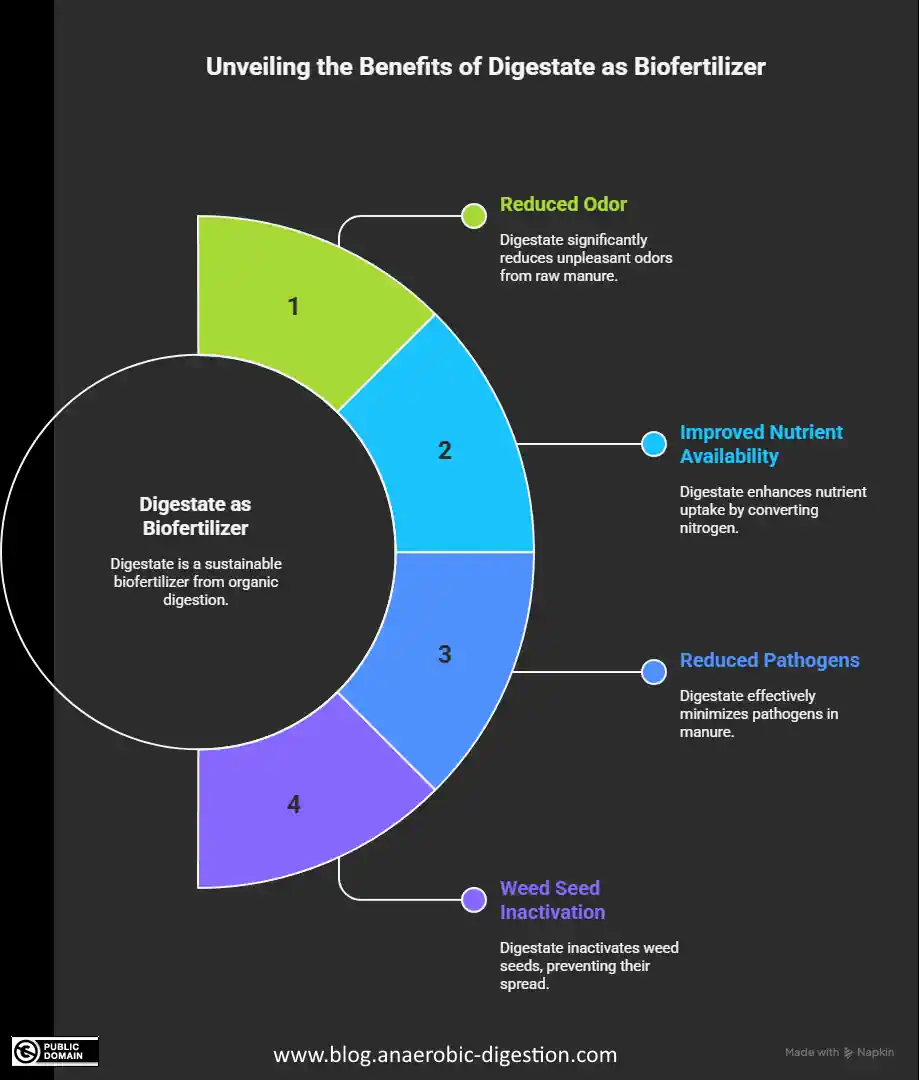
This is what a circular economy looks like in practice. Livestock manure and food waste become feedstock. AD plants process it, capturing methane that would otherwise escape into the atmosphere. The energy produced powers homes and businesses. The digestate returns to fields as bio-fertiliser, closing the nutrient loop while reducing dependence on imported synthetic fertilisers. Everyone wins: farmers, energy consumers, the environment, and the public purse.
Yet this integrated vision struggles to gain traction when government departments work in isolation, when planners focus narrowly on energy metrics, and when public understanding of AD remains superficial. The sector has failed to build the social licence it needs, and policymakers haven't grasped the full value proposition.
What Success Looks Like
The building blocks are already visible. The Mid-Ulster Eco-Cycling Centre demonstrates how AD can anchor local economic development, linking agriculture with renewable energy and job creation. Manby BGE's £300 million biorefinery project employs 150 people and proves that with the right signals, large-scale green investment will come. Across the UK, over 750 operational AD plants digest 36 million tonnes of organic material annually, delivering 1% of the nation's total greenhouse gas savings.
Minister Andrew Muir's September announcement of £50,000 for proof-of-concept projects and £9 million for shared bioeconomy initiatives shows political recognition of AD's importance. Cross-departmental working groups signal intent. But intent isn't infrastructure. Good intentions don't connect plants to the gas grid or give investors the 20-year certainty they need to commit capital.
What Northern Ireland requires now is action, not more debate. That means:
Policy harmonisation across departments and with the Republic of Ireland, creating a coherent framework rather than competing priorities. The region's unique position spanning two jurisdictions should be an advantage, not an administrative nightmare.
Financial clarity including subsidies and socialised grid connection costs to de-risk investment. If the UK is serious about biomethane providing 20-50% of gas demand by 2050, it must back that ambition with targeted support in regions with the greatest potential.
Strategic communication that showcases operational successes, brings politicians and planners to working AD facilities, and builds public understanding of the wider benefits beyond energy production. Northern Ireland's strengths in agriculture, engineering, and environmental innovation deserve to be celebrated and leveraged.
Cross-sector partnerships that bring together food and drink, agriculture, waste management, and energy sectors around a common vision. The circular economy doesn't respect departmental boundaries, and neither should policy.
The Stakes Are Clear
Charles McAllister of the Green Gas Task Force noted that biomethane could offset up to 13% of the UK's net zero target. For Northern Ireland specifically, the numbers are even more compelling given the region's agricultural profile. This isn't peripheral to climate action—it's central.
More fundamentally, Northern Ireland's livestock sector has no viable path to net zero without AD and bio-fertiliser. The alternative is managed decline of a cornerstone industry, with devastating consequences for rural communities, food security, and the regional economy.
The infrastructure being discussed today won't be built overnight. AD plants require years of planning, financing, and construction. The policy frameworks need to be in place now if Northern Ireland is to meet its 2030 milestones, let alone its 2050 ambitions. Every delay compounds the challenge.
A Call to Action
Northern Ireland's biomethane sector has marked time for too long. The technical expertise exists. The feedstock is abundant. The environmental need is urgent. The economic case is proven. What's missing is political courage and bureaucratic coordination.
The September ADBA Conference made clear that industry leaders, investors, and farmers are ready to move. They're waiting for government to do its part: create the stable, supportive policy environment that transforms potential into progress.
Northern Ireland could lead the UK in biomethane production and demonstrate how rural regions can drive the renewable energy transition while solving environmental challenges and supporting traditional industries. Or it can remain a cautionary tale of squandered opportunity.
The region has the resources, the expertise, and the urgency. What it needs now is action. Because the cost of standing still is measured not just in missed megawatt hours, but in degraded water quality, agricultural uncertainty, and a climate crisis that won't wait for bureaucratic coordination.
The question, as Chris Huhne put it, is no longer how Northern Ireland can develop biomethane. It's why the region can't afford not to.
In this second section of this page the author draws on insights from the ADBA Northern Ireland Conference held in Belfast in September 2025, where industry leaders, policymakers, and investors gathered to discuss unlocking the region's biomethane potential.