




Food vs Fuel and Anaerobic Digestion: Do Energy Crops Compete With Food?
Food vs Fuel and Anaerobic Digestion: Do Energy Crops Compete With Food? The food vs fuel debate asks a deceptively simple question: should productive agricultural land be used to grow crops for people and livestock, or should some of that land be used to produce renewable energy? For anaerobic digestion, the answer is sometimes presented […]
Anaerobic Digester Mixing Systems: Lowest Cost, Reliability and Better Performance
Anaerobic digester mixing systems are easy to underestimate. A mixer may represent only one part of an anaerobic digestion plant, but poor mixing can affect effective digester volume, energy consumption, maintenance costs, biological performance and ultimately the reliability of the whole biogas process. This becomes particularly important when digesters process agricultural feedstocks such as cattle […]

Renewable Heat Incentive (RHI): What It Was, Why It Closed and Lessons for Biogas CHP
The Renewable Heat Incentive (RHI) was a UK government support scheme designed to encourage the production and use of renewable heat. For the anaerobic digestion and biogas sector, it became particularly important because it could support the use of biogas for heat and, under qualifying arrangements, the useful heat recovered from combined heat and power […]

Is Biogas Sustainable? Benefits, Limitations and Its Role in Renewable Energy
Biogas can be one of the most useful forms of renewable energy because it does something that wind turbines and solar panels cannot do: it can produce renewable energy while treating organic wastes that society must deal with anyway. Food waste, manure, sewage sludge, agricultural residues and other biodegradable materials naturally decompose. When that decomposition […]

Plan the Digestate Outlet Before You Accept the Feedstock: A Message to All Biogas Plant Operators
We say “Plan the Digestate Outlet Before You Accept the Feedstock”, because an anaerobic digestion plant can have a reliable digester, attractive feedstock contracts and a convincing gas-production forecast but still encounter serious operational problems if nobody has properly planned what happens to its digestate. Digestate is not a minor residue that can be considered […]

Does Every Biogas Plant Need H₂S Removal? Biogas Desulfurization Explained
Biogas systems face corrosion threats from hydrogen sulfide (H₂S), drastically cutting equipment life. With removal efficiencies over 99%, methods like iron oxide media, chemical scrubbing, and biological techniques combat this issue. Choosing the right system depends on multiple factors, ensuring sustained efficiency while minimizing costs…
Anaerobic Digestion Project Success: The Digester Is Only One Link in the Failure Chain
A well-designed anaerobic digester is essential, but it doesn’t guarantee a successful anaerobic digestion plant, and many great AD projects have sadly failed to achieve Anaerobic Digestion Project Success. Every AD plant relies on a connected chain of feedstock supply, reception, pre-treatment, pumping, biological treatment, gas handling, energy export, digestate management and operational control. If […]

What is Methane Stripping of Landfill Leachate?
Methane Stripping of Landfill Leachate refers to the removal of dissolved methane from landfill leachate before it is directly pumped into a public sewer. If the methane dissolved in leachate were allowed to enter the sewers, it may be present in sufficient concentrations to cause an explosion and/or asphyxiation risk within the sewer into which […]
Combined Heat and Power Advantages and Disadvantages
Combined heat and power advantages and disadvantages need to be considered together before deciding whether CHP, also known as cogeneration, is the right energy solution for a site. The main advantage of combined heat and power (CHP) is straightforward: electricity is generated on-site while heat that would otherwise be wasted is recovered for a useful […]
Biogas CHP Emissions: SCR Systems for NOx Control in Gas Engines
Biogas combined heat and power (CHP) engines are an established way to convert biogas from anaerobic digestion into useful electricity and heat. However, burning biogas in a reciprocating gas engine also produces exhaust emissions, including nitrogen oxides (NOx), carbon monoxide (CO) and other combustion products. As emission standards have tightened, controlling these pollutants has become […]

3 Anaerobic Sludge Digestion Case Studies: Biogas to RNG
These three anaerobic sludge digestion case studies explain how water utility companies are embracing the anaerobic digestion process as their method of choice for the treatment of the vast quantities of solid sludge materials which they aerate and settle out of the sewage entering their sewage works every day. While doing that they produce a […]
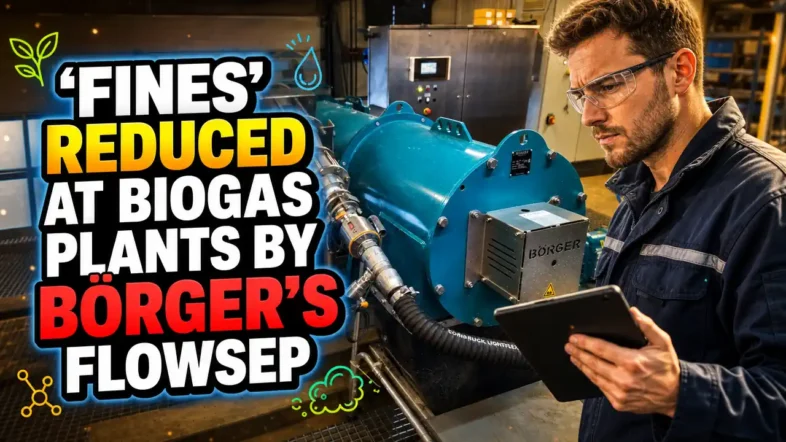
Borger’s FlowSep: Cutting the Fines That Damage Biogas Plants
Our sponsor Börger sent us this press release under the headline “‘Fines’ reduced at biogas plants by Börger’s FlowSep” – and yes, before anything else, it’s worth being upfront about the headline itself. It’s a deliberate play on words. In everyday English, “fine” tends to mean a financial penalty, and we suspect more than a […]
