Hydrogen sulphide (H₂S) removal (biogas scrubbing) is one of the less glamorous parts of anaerobic digestion, but it can be one of the most important. Raw biogas normally contains hydrogen sulphide alongside methane, carbon dioxide, water vapour and other trace gases. Leave too much H₂S in the gas, and it can contribute to corrosion, damage downstream equipment, increase maintenance requirements and prevent upgraded biomethane from meeting the required gas-quality specification.
But does that mean every biogas plant needs a dedicated H₂S removal system?
Not necessarily.
The more useful engineering question is:
How much hydrogen sulphide must be removed for the intended use of the biogas, and what is the most economical way of achieving that throughout the life of the plant?
This distinction has become increasingly important as anaerobic digestion has moved beyond relatively simple biogas combustion towards CHP, biomethane upgrading, renewable natural gas (RNG), vehicle fuel and gas-grid injection.
Key Takeaways
- Hydrogen sulphide is a normal contaminant of biogas, although concentrations vary substantially with feedstock and operating conditions.
- Not every AD plant necessarily needs a stand-alone H₂S removal unit. The treatment requirement depends on raw gas quality, end use and equipment specifications.
- Biomethane and RNG applications normally demand much deeper gas cleaning than relatively tolerant direct-combustion applications.
- H₂S can be controlled inside the digestion process, after the digester, or by combining both approaches.
- Common technologies include iron dosing, activated carbon, iron-oxide media, biological desulphurisation, micro-aeration and wet chemical scrubbing.
- Sacrificial media can be attractive because of its simplicity, particularly at relatively low sulphur loads, but replacement costs can become significant as H₂S loading increases.
- Regenerative processes are increasingly interesting for higher sulphur loads because the active treatment medium is continuously regenerated rather than routinely discarded.
- The lowest-cost solution should be assessed on whole-life cost rather than purchase price alone.

What Is Hydrogen Sulphide in Biogas?
Hydrogen sulphide is formed during anaerobic digestion when sulphur-containing material is biologically degraded and sulphate and other sulphur compounds are reduced under anaerobic conditions.
The resulting H₂S partitions between the liquid phase and the biogas.
Its concentration can vary enormously. Feedstock composition is particularly important. Materials containing relatively large quantities of sulphur-containing proteins or sulphates may produce considerably more H₂S than other feedstocks.
This is why an H₂S treatment system should not simply be selected from a generic plant flow rate.
The sulphur load matters.
A plant producing a large volume of relatively low-H₂S biogas presents a very different treatment problem from a smaller digester producing sulphur-rich gas.
Why Does H₂S Need to Be Removed from Biogas?
There are several reasons.
1. Corrosion
Hydrogen sulphide is associated with serious corrosion problems, particularly where moisture is present.
Raw biogas leaving a digester is normally saturated or close to saturated with water vapour. As the gas cools, condensate forms. The combination of moisture and sulphur compounds can create highly corrosive conditions in pipework, compressors, heat exchangers, engines and other equipment.
Combustion can create additional sulphur-containing products that affect downstream equipment and emissions.
Good condensate management and good H₂S control therefore belong together.
2. Engine and Equipment Protection
CHP engines, boilers, compressors, upgrading equipment, membranes, catalysts and other downstream equipment all have their own gas-quality requirements.
There is no single universal H₂S concentration that is acceptable to every item of equipment.
The equipment manufacturer’s gas specification should therefore be treated as the design requirement rather than relying on a generic internet figure for an allegedly acceptable H₂S concentration.
3. Biomethane Quality
Turning biogas into biomethane introduces much tighter gas-quality requirements.
Carbon dioxide removal alone is not enough. Water, H₂S and other contaminants must also be reduced sufficiently for the intended application.
For example, the Environment Agency’s current framework for biomethane produced from waste specifies a maximum hydrogen sulphide concentration of 5 mg/m³ for biomethane intended for grid injection and appliance use.
This illustrates an important principle:
The closer raw biogas gets to becoming a natural-gas substitute, the more demanding gas cleaning normally becomes.
4. Health and Safety
Hydrogen sulphide is also a highly toxic gas.
This makes leak prevention, ventilation, gas detection, safe maintenance procedures and suitable risk assessment important wherever H₂S-containing biogas is produced or handled.
H₂S treatment equipment should never be regarded solely as a process-efficiency issue. The properties of the untreated gas must also be incorporated into the plant’s overall health and safety arrangements.

Never forget the health hazards when considering biogas desulfurization.
“Symptoms of H2S Exposure Illustrated …” from www.pringlelaw.net and used with no modifications.
So, Does Every Anaerobic Digestion Plant Need H₂S Removal?
Almost every AD operator needs to consider and manage H₂S, but that does not mean every plant needs a separate desulphurisation installation.
A small installation burning relatively low-sulphur biogas in suitable equipment may require substantially less treatment than a plant producing grid-quality biomethane.
At another plant, sulphide precipitation within the digester may reduce the load sufficiently for a relatively small polishing system downstream.
At a high-H₂S biomethane installation, substantial bulk removal followed by final polishing may be preferable.
The correct question is therefore not simply:
“Do we need H₂S removal?”
It is:
“What untreated H₂S load do we have, what outlet concentration must we achieve, and which treatment train delivers that reliably at the lowest acceptable whole-life cost?”
H₂S Control Inside the Digester Versus Gas Treatment
An important distinction is often missed when discussing biogas desulphurisation.
There are two fundamentally different approaches:
- reduce the amount of H₂S entering the biogas in the first place; or
- remove H₂S from the biogas after it has been produced.
Many successful plants use both.
Iron Salt Dosing
Iron salts can be dosed into the anaerobic digestion process so that dissolved sulphide reacts with iron and is retained largely as an insoluble iron sulphide rather than passing into the gas phase as H₂S.
This can reduce the sulphur load reaching downstream gas-treatment equipment.
However, iron dosing is not “free desulphurisation”. Chemical consumption is continuous, dosing must be controlled, and the added material ultimately enters the digestate or sludge stream.
The economics therefore depend upon the cost of chemical dosing compared with the avoided cost of downstream H₂S treatment.
Micro-Aeration
Controlled introduction of small quantities of air or oxygen can encourage sulphide-oxidising microorganisms to convert H₂S into elemental sulphur or other oxidised sulphur compounds.
This can provide comparatively inexpensive bulk H₂S reduction.
However, oxygen addition must be carefully engineered and controlled. It changes the gas composition and may be undesirable where stringent oxygen limits apply downstream.
This is particularly relevant to biomethane and RNG production.
Activated Carbon for H₂S Removal
Activated carbon is widely used for polishing biogas because it can remove relatively low residual concentrations of H₂S very effectively.
Special impregnated carbons can increase sulphur-removal capacity.
The attraction is simplicity. A correctly designed vessel contains the adsorbent, gas passes through it, and H₂S is captured until the media approaches exhaustion.
But this simplicity creates an important economic issue:
activated carbon is normally a consumable.
As the total sulphur load rises, media consumption, change-out labour, transport and disposal or regeneration requirements become increasingly important.
Activated carbon is consequently often particularly attractive as a polishing stage after another process has removed the bulk of the H₂S.

“Activated carbon » Rayeneh Group” from rayeneh.com and used with no modifications.
Iron-Oxide and Other Sacrificial Media
Iron-based solid media are another established approach.
H₂S reacts with the active iron compounds and is retained within the media.
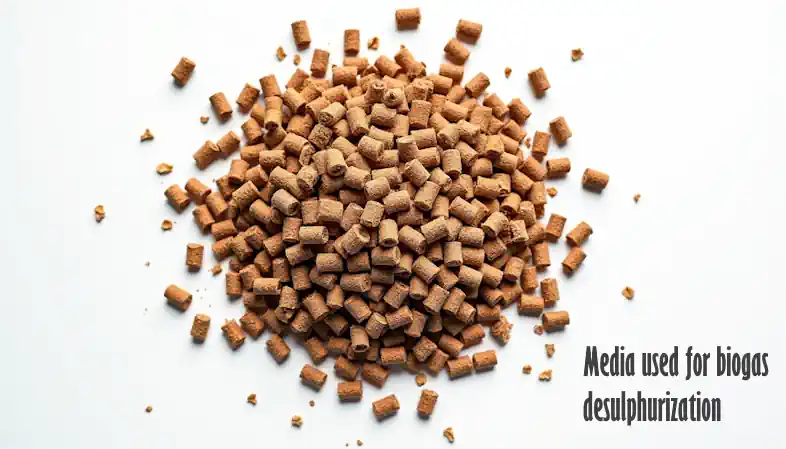
“Iron Oxide Iron Hydroxide H2s Adsorbent” from mingshuo.en.made-in-china.com and used with no modifications.
Such systems can be mechanically simple and attractive where gas flow and sulphur loading make replacement intervals reasonable.
The disadvantage is inherent in the term sacrificial media.
Eventually the available reactive capacity is consumed.
The operator must then deal with:
- replacement media;
- spent media handling;
- labour;
- possible process interruption;
- transport;
- appropriate disposal or regeneration arrangements; and
- protection against H₂S breakthrough while the media approaches exhaustion.
None of these factors necessarily makes sacrificial media a poor choice.
For many installations it may remain the simplest and most economical solution.
But media replacement frequency becomes a crucial lifecycle-cost variable as the sulphur load increases.

“Hydrogen sulphide removal from natural gas using a membrane.” from pubs.rsc.org and used with no modifications.
Biological H₂S Removal
Biological desulphurisation uses sulphur-oxidising microorganisms to convert H₂S into elemental sulphur and/or sulphate.
External systems include biofilters, biotrickling filters and bioscrubbers.

“H2S in biogas using biotrickling filter …” from www.sciencedirect.com and used with no modifications.
Biological treatment can offer high removal efficiency with comparatively modest chemical consumption. Recent scientific reviews continue to identify biological treatment as an important commercial option for biogas desulphurisation.
However, biological systems are biological reactors.
The microbial population requires appropriate environmental conditions, nutrients and process control. Rapid changes in loading or operating conditions must be accommodated by the system design.
Aerobic biological oxidation also requires oxygen, which must be considered where very low oxygen concentrations are required in the final gas.
Anoxic biological processes offer another possibility by using electron acceptors such as nitrate rather than oxygen, although these introduce their own reagent and process requirements.
Chemical Scrubbing and Regenerative H₂S Removal
Wet chemical processes transfer H₂S from the biogas into a liquid phase where it reacts chemically.
There is an important distinction between once-through chemical consumption and a regenerative process.
In a regenerative system, the treatment solution is restored and recirculated rather than simply discarded after reacting with H₂S.
This can fundamentally change the operating economics at sufficiently high sulphur loads.

“Troubleshooting a Caustic Scrubber for biogas desulfurization| AIChE” from www.aiche.org and used with no modifications.
Greenlane Cascade H₂S: A Current Example of Regenerative Desulphurisation
A useful current commercial example is the Greenlane Renewables Cascade H₂S process.
Greenlane announced in August 2026 that it had received equipment and service orders worth approximately US$2.5 million from an existing US renewable natural gas customer, including another Cascade H₂S installation.
The announcement is interesting beyond the value of the contract because it highlights the growing economic importance of regenerative H₂S treatment at RNG plants.
According to Greenlane’s published process information, raw biogas enters a scrubbing tower and flows counter-currently against a regenerative chemical solution.
The H₂S-rich solution then passes to a separate regeneration stage. Elemental sulphur is separated and the regenerated solution is returned to the scrubber.
The treatment loop therefore continuously reuses its active solution rather than depending upon routine replacement of an entire bed of sacrificial solid media.
Greenlane states that the process does not require oxygen addition to the biogas and does not add oxygen to the treated gas.
Its published 2026 product information gives an operating range of up to approximately 10,000 ppm H₂S at the inlet, with bulk removal to approximately 100 ppm and an optional polishing stage for much lower residual concentrations.
These figures are manufacturer-stated performance data and should be considered as such rather than universal figures applicable to every installation.
Why Oxygen-Free H₂S Removal Can Matter
Oxygen is useful in several biological H₂S removal processes because sulphur-oxidising microorganisms require an electron acceptor.
But adding air also adds nitrogen and oxygen to the gas stream.
That may be acceptable for some biogas applications.
It becomes more important when producing biomethane to a tightly controlled final specification.
A process that removes H₂S without deliberately adding oxygen to the treated biogas can therefore offer a process-integration advantage for some RNG and biomethane plants.
This does not automatically make an oxygen-free process the best solution. It simply removes one potential gas-quality constraint from the treatment train.
The Hidden Cost of Sacrificial H₂S Media
This is perhaps the most interesting issue raised by the recent Greenlane announcement.
A conventional media vessel may have relatively modest capital cost and very simple controls.
But evaluating the system solely on purchase price can be misleading.
The real calculation should include:
- annual H₂S mass loading;
- usable sulphur capacity of the selected media under actual gas conditions;
- replacement-media cost;
- delivery;
- spent-media handling;
- labour;
- downtime or operational disruption;
- standby vessel requirements;
- monitoring for breakthrough; and
- disposal or regeneration cost.
This is why H₂S concentration alone is not enough when comparing technologies.
Gas flow must also be considered.
A useful first engineering parameter is the mass of sulphur that must be removed per day or per year.
Once that figure is known, the lifetime consumption of sacrificial media can be compared much more meaningfully with the capital and operating cost of biological or regenerative treatment.
Can Replacing H₂S Media Really Pay Back in Less Than a Year?
Greenlane states that existing projects using sacrificial media may achieve a payback of less than one year after changing to its regenerative Cascade H₂S technology. It also states that Cascade H₂S has similar capital expenditure to a sacrificial-media approach while operating at 15–30% of the OPEX.
These are Greenlane’s commercial claims, not general industry performance guarantees.
Nevertheless, the underlying economic principle is sound.
If a plant has sufficiently high and continuous sulphur loading, the annual cost of replacing consumable media can become substantial. At some point, investing more capital in a regenerative process can become cheaper over the remaining life of the facility.
The crossover point will be site-specific.
Operators considering such a conversion should therefore compare actual historic expenditure against a properly developed lifecycle model rather than assuming either technology will automatically be cheaper.
Bulk H₂S Removal Followed by Polishing
One of the most useful ways to think about biogas desulphurisation is to separate bulk removal from polishing.
Trying to make one treatment stage economically remove everything from a high inlet concentration to a very low final concentration is not always optimal.
Instead, the first process can remove most of the sulphur load economically.
A second, smaller polishing stage then deals with the residual H₂S and provides assurance that the final specification is met.
This approach can combine technologies such as:
- iron dosing plus activated carbon;
- biological treatment plus activated carbon;
- regenerative chemical scrubbing plus polishing media; or
- another bulk-removal process followed by a suitable final adsorbent.
The polishing media then sees only a small fraction of the original sulphur load, potentially extending its useful life considerably.
Comparing the Main Biogas H₂S Removal Methods
| Method | Main Strength | Main Limitation | Typical Role |
|---|---|---|---|
| Iron salt dosing | Reduces sulphide entering the gas phase | Continuous chemical use; affects digestate/sludge chemistry | In-digester H₂S control |
| Micro-aeration | Relatively simple biological sulphide oxidation | Requires careful oxygen control | Bulk H₂S reduction |
| Activated carbon | Excellent final polishing capability | Media becomes exhausted | Low-load removal and polishing |
| Iron-based solid media | Simple and robust | Media replacement and handling | Small to moderate sulphur loads |
| Biotrickling filter/bioscrubber | Can handle substantial H₂S loads with relatively low consumable use | Biological process requires suitable operating conditions | Bulk removal |
| Regenerative chemical scrubbing | Regenerates treatment solution and can reduce consumable-media demand | More process equipment and capital complexity | Continuous bulk removal, particularly where sulphur loading justifies it |
| Hybrid/two-stage system | Optimises bulk removal and final polishing separately | More equipment and interfaces | High-specification gas and variable H₂S loads |
How Should an AD Plant Choose an H₂S Removal System?
There is no universally best H₂S removal technology.
The selection should begin with actual process data.
At minimum, consider:
- normal H₂S concentration;
- maximum and transient H₂S concentrations;
- biogas flow rate and variability;
- total sulphur mass loading;
- moisture and other contaminants;
- required outlet H₂S concentration;
- oxygen and nitrogen constraints;
- downstream equipment requirements;
- operator skill and maintenance resources;
- availability of chemicals and replacement media;
- waste/by-product management;
- planned plant life; and
- whole-life cost.
A technology that is inexpensive for a small digester may become expensive when multiplied across the sulphur loading of a large RNG plant.
Conversely, a sophisticated regenerative system that makes economic sense at high continuous H₂S loading may be unnecessary for a small installation with modest treatment requirements.

“Wet scrubber for Biogas Desulfurization – Energy Education” from energyeducation.ca and used with no modifications.
Measure Sulphur Loading, Not Just H₂S Concentration
This deserves particular emphasis.
Operators commonly talk about H₂S in parts per million.
That tells only part of the story.
For treatment economics, the mass of sulphur arriving at the treatment system is often more useful.
A relatively modest H₂S concentration combined with a very large continuous biogas flow can consume substantial quantities of sacrificial media.
Conversely, a high ppm reading at a very small gas flow may represent a much smaller annual sulphur load.
When reviewing an existing H₂S treatment system, therefore, calculate the approximate annual sulphur load and compare it with actual annual media, chemical, maintenance and disposal expenditure.
That calculation can reveal whether an apparently inexpensive treatment process is genuinely inexpensive.
Fig. Gas chromatograhy can be used to monitor for hydrogen sulphide.

“Gas Chromatography | GeeksforGeeks” from www.geeksforgeeks.org and used with no modifications.
Existing Biogas Plants May Have the Greatest Opportunity
New AD and biomethane plants can select H₂S treatment as part of the original process design.
Existing plants present a different opportunity.
An operator may already have several years of records showing:
- actual H₂S concentrations;
- biogas production;
- media consumption;
- chemical expenditure;
- maintenance labour;
- breakthrough events; and
- downtime.
This means the economics of an upgrade can often be assessed against real operating expenditure rather than design assumptions.
The August 2026 Greenlane announcement is significant in this respect because the company specifically identifies existing RNG facilities using granular media as potential candidates for conversion to regenerative H₂S treatment.
Conclusion: H₂S Removal Is a Lifecycle-Cost Decision
Hydrogen sulphide management should be considered from the earliest stages of anaerobic digestion plant design.
But the statement that “every biogas plant needs H₂S removal” requires qualification.
Every plant needs to understand its H₂S risk and ensure that the gas is suitable for its intended use. The amount and method of treatment required can vary dramatically.
For relatively modest sulphur loads, simple in-digester control or sacrificial media may be entirely appropriate.
For higher continuous loads, biological or regenerative processes may offer better lifecycle economics.
For biomethane and RNG, a combination of bulk removal and final polishing can provide both economic treatment and reliable compliance with the final gas specification.
The important lesson is not that one H₂S technology has suddenly replaced all the others.
It is that biogas desulphurisation should be evaluated as an integrated process and a whole-life operating cost—not simply as a vessel of media that needs changing whenever H₂S breaks through.

Frequently Asked Questions
Does all biogas contain hydrogen sulphide?
Hydrogen sulphide is a common constituent of raw biogas, but its concentration varies substantially according to feedstock composition and digestion conditions. Gas analysis is therefore necessary rather than assuming a standard concentration.
Does every biogas plant need an H₂S scrubber?
No. Every plant should assess and control H₂S sufficiently for safe operation and its intended gas use, but this does not necessarily require a dedicated external scrubber. Some installations can use in-digester control or require relatively limited gas treatment, whereas biomethane and RNG projects normally require much deeper purification.
What is the best H₂S removal method for biogas?
There is no single best method. Activated carbon, iron media, iron dosing, biological systems, micro-aeration and chemical scrubbers all have applications. Selection depends particularly on gas flow, H₂S concentration, total sulphur loading, final gas specification and lifecycle cost.
Is activated carbon suitable for H₂S removal?
Yes. Activated carbon is widely used and can be particularly effective as a polishing stage. Its economics depend on the contaminant loading and useful media capacity because exhausted carbon must ultimately be replaced or regenerated.
Why use two stages of H₂S treatment?
A bulk-removal stage can economically remove most of the incoming sulphur while a smaller polishing stage achieves the low final concentration required by downstream equipment or biomethane specifications. This can substantially reduce the contaminant load placed on expensive polishing media.
What is regenerative H₂S removal?
In a regenerative process, H₂S is captured by a treatment medium that is subsequently regenerated and reused rather than continually discarded after becoming loaded with sulphur. This can reduce consumable requirements and may improve lifecycle economics where sulphur loading is sufficiently high.
Why is oxygen important when choosing an H₂S treatment system?
Some biological desulphurisation processes use air or oxygen to support sulphide oxidation. This can be effective, but oxygen and nitrogen entering the biogas must be considered where downstream upgrading or final biomethane specifications impose limits on gas composition. Oxygen-free processes avoid deliberately introducing this additional gas-quality consideration.
How should the cost of H₂S treatment be compared?
Compare whole-life costs rather than equipment purchase prices alone. Include capital expenditure, media or chemical consumption, electricity, labour, maintenance, waste handling, downtime, monitoring and the expected operating life of the installation.
References and Further Reading
- US Environmental Protection Agency (EPA), AgSTAR – Anaerobic System Design and Technology.
- US Environmental Protection Agency (EPA), AgSTAR – Anaerobic Digester/Biogas Operator Guidebook.
- Environment Agency – Biomethane from Waste: Resource Framework, specification for biomethane for injection into the gas grid and use in appliances.
- Health and Safety Executive (HSE) – EH40 Workplace Exposure Limits.
- Recent peer-reviewed reviews of physical, chemical and biological biogas desulphurisation technologies published in Renewable and Sustainable Energy Reviews and Science of the Total Environment.
- Greenlane Renewables – Cascade H₂S product information and fact sheet. Manufacturer performance and cost claims quoted in this article are identified as such.
- Greenlane Renewables, 19 August 2026 – announcement of Cascade H₂S equipment and service orders from an existing US RNG customer.
[Published June 2025. Article updated August 2026. Technology performance and gas-quality requirements are application-specific. Plant designers and operators should confirm current regulatory, gas-network and equipment-manufacturer requirements for their installation.]
“`