A well-designed anaerobic digester is essential, but it doesn’t guarantee a successful anaerobic digestion plant, and many great AD projects have sadly failed to achieve Anaerobic Digestion Project Success.
Every AD plant relies on a connected chain of feedstock supply, reception, pre-treatment, pumping, biological treatment, gas handling, energy export, digestate management and operational control. If one essential link lacks capacity, reliability or a credible contingency, it can restrict the performance of the entire plant.
This matters when evaluating a proposed project, investigating an operating problem or reviewing an investment. Focusing too narrowly on the digester can lead people to treat symptoms inside the tank while overlooking the commercial, mechanical or operational constraint that is actually causing them.
The practical approach is to follow the material through the complete plant, test every interface and identify the least dependable essential link before it becomes the plant’s real operating limit.
Key Takeaways
- A technically sound digester can sit at the centre of an unsuccessful AD project.
- The plant’s true capacity is controlled by its least dependable essential link, not simply by digester volume or nameplate throughput.
- Feedstock supply, reception, pre-treatment, pumping, gas use and digestate outlets must be assessed as one connected working system.
- Annual averages can conceal hourly, daily and seasonal bottlenecks.
- The weakest points often occur at the interfaces between equipment packages, even when each component meets its own specification.
- Every important interface should be tested for quantity, quality, timing and recovery.
- Storage, redundancy and alternative outlets only provide protection when they have sufficient capacity and can be activated in practice.
- Operator knowledge, authority and decision-making are essential process links, not merely staffing considerations.
- Before relying on any contingency, ask for evidence that the recovery route is real and usable.
- The most important question is: If this link fails tomorrow, what specifically prevents it from becoming a whole-plant failure?
Anaerobic digestion projects are often evaluated as if the digester were the project.
People examine the tank volume, retention time, operating temperature, mixer arrangement and expected gas yield. If the biology appears credible and the digester supplier has suitable experience, the proposal begins to feel technically sound.
But a technically sound digester can sit at the centre of an unsuccessful AD plant.
The reason is simple: the digester doesn’t operate independently. It sits inside a chain that begins before the feedstock reaches the site and continues until the energy and digestate have found dependable outlets.
A failure anywhere in that chain can reduce throughput, destabilise biology, interrupt energy production or increase costs. The digester may be performing exactly as designed while the project around it fails commercially or operationally.
The most useful way to evaluate an AD project is therefore not to ask, “Will this digester work?”
Ask instead:
Can the entire material, energy and operating chain keep working under real conditions?
That change of question exposes weaknesses that equipment specifications alone rarely reveal.
Follow the Material Through the Whole Plant
Think of an AD project as a sequence of linked promises.
The feedstock supplier promises to deliver suitable material. The reception system promises to accept it. Pre-treatment promises to remove packaging and contaminants. Pumps and pipework promise to move it. The digester promises to convert part of it into biogas. Gas-handling equipment promises to condition and use that gas. The digestate system promises to store, treat and dispatch everything that remains. Operators promise to keep all these systems within a workable operating envelope.
Each promise depends on the previous one being kept.
This creates what might be called the failure chain test:
- What must enter this link?
- What must the link do reliably?
- What leaves it?
- Where does that output go next?
- What happens to the whole plant if this link is unavailable, overloaded or underperforming?
This test matters because the most serious constraint isn’t necessarily the most expensive item or the most technically sophisticated process. It is often the link with the least spare capacity, the weakest evidence or no practical alternative.
A project may have two digesters but only one critical feed pump. It may have ample gas production capacity but an unconfirmed grid connection. It may have excellent mixing but insufficient reception capacity during peak deliveries. It may have a secure feedstock contract but no dependable contingency outlet for digestate.
In each case, the project’s effective capacity is determined by something outside the biological vessel.
That leads to a repeatable rule:
An AD plant’s real capacity is set by its least dependable essential link, not by the nameplate capacity of its digester.
This is why annual averages can be misleading. A proposal may state that 40,000 tonnes of feedstock will be processed each year, but the plant doesn’t receive an average day every day. Deliveries may arrive in peaks. Seasonal feedstocks may appear within short windows. Food waste may contain variable packaging, grit or contaminants. Digestate may be easier to move at some times of year than others.
A yearly tonnage can fit neatly into a spreadsheet while the actual plant repeatedly encounters hourly, daily or seasonal bottlenecks.
Suppose a food-waste AD plant is designed around a dependable digester and a plausible annual feedstock quantity. The financial model assumes steady throughput and steady gas production.
Once operating, delivery vehicles frequently arrive during the same part of the day. The reception area can’t unload them quickly enough, so some vehicles wait and others are diverted. The depackaging equipment performs well on softer packaged foods but struggles when loads contain more rigid packaging and contamination than expected. Cleaning takes longer, organic material is lost with the rejects, and the feedstock balance becomes less predictable.
The digester itself hasn’t failed. But it now receives less usable organic material than forecast, delivered in a less consistent form.
Operators try to recover lost throughput by feeding more heavily when processed material becomes available. The biological loading pattern becomes uneven. Gas production fluctuates. More grit and fragments enter downstream equipment. Pumps require attention more frequently, and planned maintenance becomes reactive.
Meanwhile, the digestate store approaches its working limit because the expected land outlet isn’t available when assumed. Feed rates must then be reduced, not because the digester lacks capacity, but because the plant has nowhere dependable to put its output.
Looking only at the tank might produce the diagnosis “underperforming digester.” Following the chain produces a more accurate diagnosis: reception variability, pre-treatment limitations and digestate constraints are controlling biological and financial performance.
This distinction changes the response. More biological additives, a different laboratory test or pressure on operators to increase gas output won’t remove a reception bottleneck or create additional digestate storage. Treating the visible symptom inside the digester can distract management from the failing link outside it.
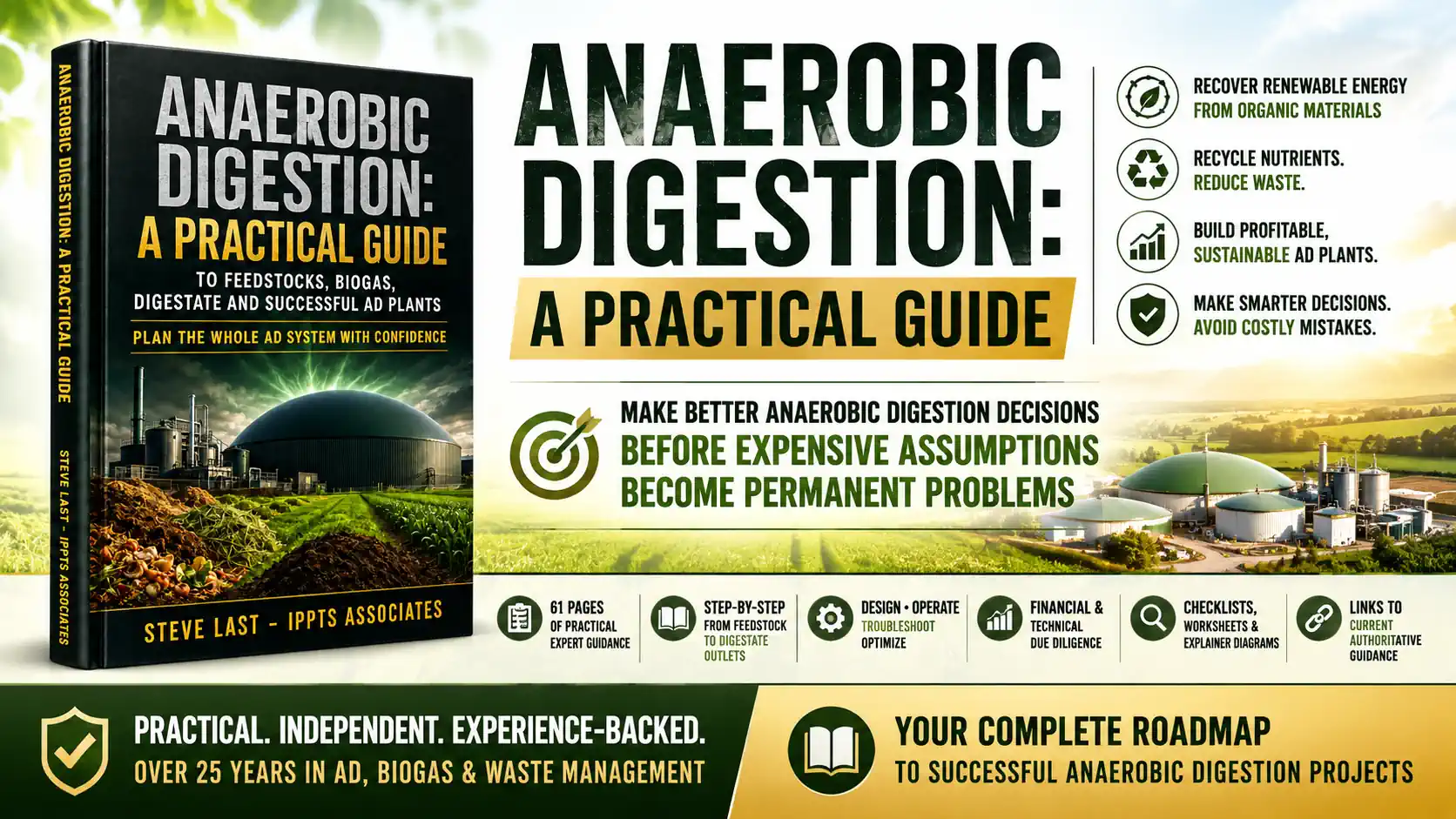
Anaerobic Digestion Practical Guide
We used our experience to create our latest ebook to help you make better decisions before expensive assumptions become permanent problems. See below:
Test Interfaces, Not Just Equipment
The weakest points in AD projects often occur at interfaces.
A feedstock contract may specify tonnage without adequately controlling composition. A depackager may demonstrate impressive separation under trial conditions, but the pump after it must handle the pulp actually produced from the plant’s changing feedstock. A gas-upgrading package may meet its own performance requirements, but saleable output still depends on gas quality, storage, compression, connection availability and downstream acceptance.
Every package can meet its individual specification while the combined system underperforms.
This is the difference between component success and system success.
Component success asks whether each item does what its supplier promised. System success asks whether the outputs from one stage are suitable, timely and dependable inputs for the next.
That is a much harder test, but it is the one that matters.
For each interface, examine four things:
- Quantity: Can the next stage accept the maximum realistic flow, not merely the annual average?
- Quality: Is the output genuinely suitable for the equipment or process receiving it?
- Timing: Can storage and control systems absorb peaks, interruptions and seasonal restrictions?
- Recovery: If the next link stops, can the plant continue safely, reduce production in a controlled way or use an alternative route?
These questions reveal why storage and redundancy aren’t merely additional costs. They can act as shock absorbers between links.
A reception buffer can separate vehicle delivery patterns from digester feeding. Gas storage can separate short-term biological production from energy-equipment demand. Digestate storage can separate continuous production from seasonal land application. Standby pumps, isolation arrangements and accessible maintenance routes can prevent a single equipment problem from stopping the complete process.
But buffers must be evaluated honestly. A storage tank that provides only a few hours of capacity may help during a brief interruption but does little during a multi-day outage. A standby pump is of limited value if it shares the same vulnerable power supply, suction blockage or inaccessible pipework. A contingency digestate outlet isn’t real merely because someone believes another farmer might accept the material.
A useful test is to ask for evidence of the recovery route before relying on it.
Who has agreed to receive the material? Under what quality conditions? How quickly can the alternative be activated? What equipment, transport or permissions are required? What will it cost? What happens while those arrangements are being made?
The same reasoning applies to operators.
Operator capability is often described as a staffing matter, but it is an essential process link. Operators detect changes in feedstock, notice abnormal pump behaviour, interpret biological trends, coordinate maintenance and decide when to reduce loading. They need suitable information and enough authority to protect the process.
A competent operator who is pressured to maintain throughput despite clear warning signs can’t protect the biology effectively. Likewise, a dashboard full of data doesn’t create control if responsibilities are unclear or nobody can stop an unsuitable load from entering reception.
The operating system therefore includes decision rights, handovers, alarms, sampling routines, maintenance planning and management response. These are not administrative extras. They determine how quickly a deviation is recognised and whether it is corrected before it travels along the chain.
Before approving, funding or modifying an AD project, draw the complete route from feedstock commitment to final energy and digestate outlets. Mark every essential link, every interface, every buffer and every credible alternative.
Then ask one final question at each point:
If this link fails tomorrow, what specifically prevents it from becoming a whole-plant failure?
If the answer is only optimism, an annual average, an untested supplier assumption or an informal contingency, the project hasn’t yet demonstrated a complete working system. The next decision should not be to improve the digester specification. It should be to strengthen the weakest essential link before it quietly becomes the plant’s real operating limit.
Frequently Asked Questions
Can a well-designed anaerobic digester still underperform?
Yes. The biological vessel may be correctly designed while problems elsewhere reduce the quantity, consistency or quality of the material reaching it. Reception bottlenecks, variable feedstock, poor pre-treatment, pump failures and digestate storage restrictions can all reduce effective throughput or disturb stable feeding.
What is the failure chain test?
The failure chain test examines every essential stage of an AD project by asking what enters it, what it must do reliably, what leaves it, where that output goes and what happens if the stage becomes unavailable or underperforms. It helps identify problems that may not appear in the digester specification.
What is the difference between component success and system success?
Component success means an individual item of equipment performs according to its specification. System success means all the components work together, with each stage providing a suitable and dependable input to the next. An AD plant can achieve component success while failing to achieve system success.
Why are annual feedstock tonnages potentially misleading?
Annual tonnages don’t show when material will arrive, how variable it will be or whether the plant can handle peak deliveries. Reception, storage, depackaging, pumping and digestate systems must cope with real hourly, daily and seasonal conditions, not just an annual average.
Why should digestate outlets be considered during project development?
Digestate is produced continuously while land application and other outlets may be seasonal or restricted. If storage fills or an expected outlet becomes unavailable, feed rates may have to be reduced even when the digester has unused biological capacity. A credible project therefore needs dependable primary and contingency digestate arrangements.
Does equipment redundancy remove the risk of plant stoppages?
Not automatically. A standby item must be capable of operating when required and should not depend on the same vulnerable systems as the primary equipment. Shared power supplies, blocked suction lines, inaccessible valves or inadequate controls can defeat apparent redundancy.
How can storage improve AD plant reliability?
Storage can provide a buffer between stages that operate on different schedules. Reception storage can separate delivery peaks from controlled digester feeding, gas storage can help balance production and use, and digestate storage can separate continuous production from seasonal outlets. Its protective value depends on its usable capacity and the likely duration of an interruption.
Why is operator authority part of the process?
Operators may recognise unsuitable loads, changing biological conditions or developing mechanical problems before management does. If they lack the authority to quarantine material, reduce loading or arrange corrective action, an avoidable disturbance can spread through the plant. Operational authority is therefore part of process control.
What should be checked before relying on a contingency outlet?
Confirm who will accept the material, the required quality, available capacity, transport arrangements, applicable permissions, activation time and likely cost. An informal possibility isn’t the same as a credible recovery route.
What is the most important question to ask during an AD project review?
At every essential link, ask:
If this link fails tomorrow, what specifically prevents it from becoming a whole-plant failure?
If there is no evidence-based answer, that link requires attention before additional confidence is placed in the project’s overall capacity or financial forecast.