The REGOs (Renewable Energy Guarantees of Origin) scheme and RGGOs (Renewable Gas Guarantees of Origin) are certificate schemes used in the UK to verify renewable energy, with REGOs for electricity and RGGOs for green gas/biomethane. They allow consumers to prove renewable sourcing.
Important Points of Distinction Between RGGOs and REGOs
- REGOs (Renewable Energy Guarantees of Origin) are certificates issued for electricity — one per megawatt hour (MWh) of renewable electricity generated.
- RGGOs (Renewable Gas Guarantees of Origin) are certificates issued for green gas — one per kilowatt hour (kWh) of green gas produced.
- Both certificates track the environmental attributes of energy, not the physical flow of electricity or gas to your home or business.
- Since January 2021, the EU no longer recognises UK REGOs — a post-Brexit change that has real implications for energy suppliers and businesses making green claims.
- Understanding the difference between REGOs and RGGOs could change how you evaluate your energy supplier's green credentials.
Two Certificates, Two Very Different Jobs
If you've ever tried to tell the difference between a REGO and an RGGO and ended up more confused than when you started, you're not alone — the names are almost deliberately awkward. These two certificate types sit at the heart of how the UK tracks and communicates renewable energy claims, yet they operate in completely separate worlds: one for electricity, one for gas. The Green Gas Certification Scheme (GGCS), which issues RGGOs, and Ofgem, which administers REGOs, are two distinct bodies managing two distinct systems, and mixing them up can lead to some serious misunderstandings about what your energy supplier is actually telling you.
Getting clarity on both is genuinely useful — whether you're a business making sustainability claims, a domestic consumer choosing a green tariff, or simply someone who wants to understand how the UK's renewable energy tracking actually functions.
What Is a REGO Certificate?
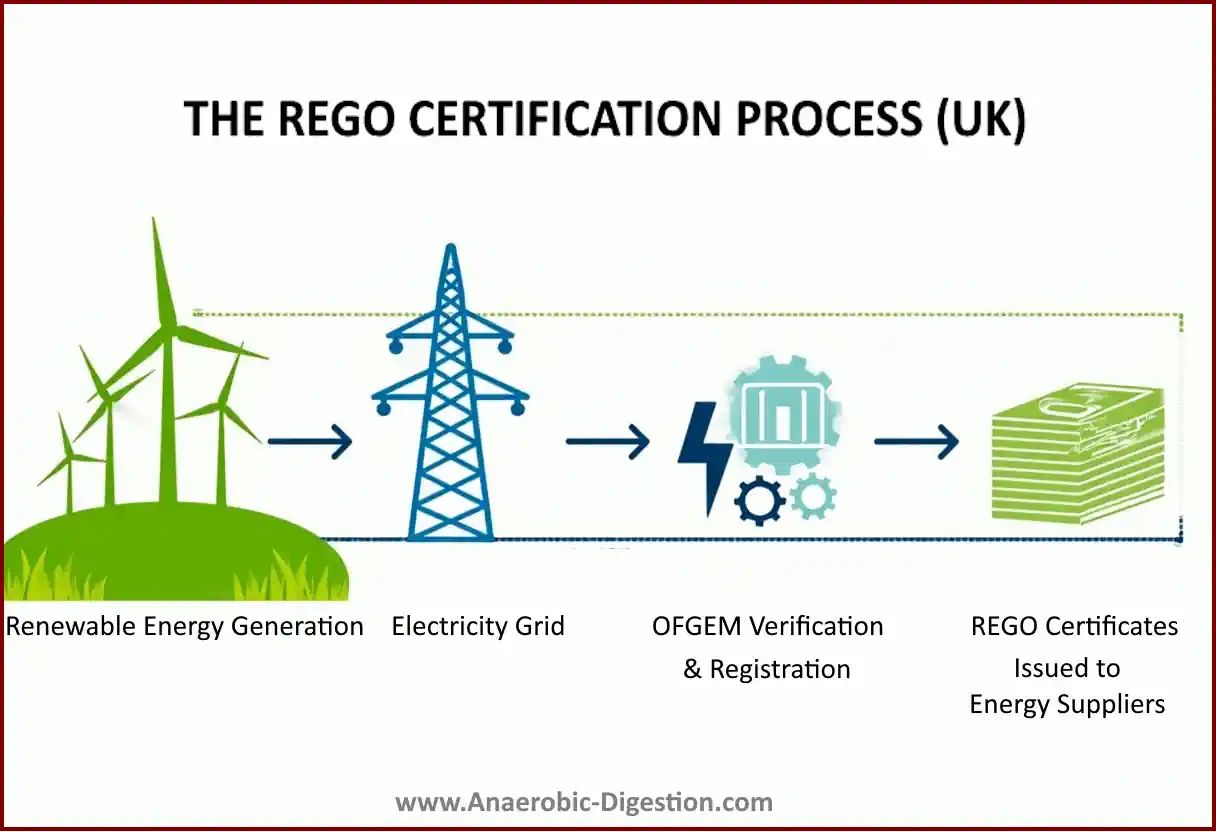
A Renewable Energy Guarantee of Origin (REGO) is a certificate issued to generators of renewable electricity in Great Britain and Northern Ireland. The scheme is administered by Ofgem on behalf of the Department for Energy Security and Net Zero in Great Britain, and the Northern Ireland Utility Regulator (UR) in Northern Ireland. Its primary purpose is to provide transparency to consumers about the proportion of electricity that suppliers source from renewable sources.
- REGOs apply to electricity only, not gas.
- Eligible sources include wind, solar, hydro, for wind, solar, hydro, tidal, geothermal, landfill gas, sewage gas, and biomass.
- Generating stations in both Great Britain and Northern Ireland can apply.
- The scheme is directly tied to Fuel Mix Disclosure (FMD) requirements for licensed electricity suppliers.
One REGO Per MWh of Renewable Electricity Generated
The unit measurement here is important. One REGO certificate is issued for every megawatt hour (MWh) of eligible renewable electricity output. This means a large wind farm generating hundreds of thousands of MWh annually will receive an equivalent number of REGO certificates. Each certificate individually represents that one MWh of renewable electricity was produced and fed into the grid. Learn more about renewable technologies and their impact on energy production.
Who Can Apply for REGOs
Any generating station in Great Britain or Northern Ireland that produces electricity from eligible renewable energy sources can apply for REGOs through Ofgem. The application process and account management are handled through Ofgem's online register. Generators must meet scheme eligibility criteria, and full guidance is available through Ofgem's applicant-facing pages.
How REGOs Are Used for Fuel Mix Disclosure (FMD)
The primary use of REGOs in Great Britain and Northern Ireland is for Fuel Mix Disclosure. Licensed electricity suppliers are legally required to disclose to potential and existing customers the mix of fuels used to generate the electricity they supply. REGOs are the mechanism that allows suppliers to make renewable claims as part of that disclosure. To understand more about renewable energy, explore the biogas digesters market trends.
How the REGO Scheme Actually Works
Once issued, REGOs can be traded separately from the physical electricity itself. A supplier does not have to be the original generator to hold REGOs — they can be bought and sold on the open market. This is a critical point that often surprises people when they first learn about it.
The Role of Ofgem in Issuing REGOs
Ofgem sits at the centre of the REGO scheme as its administrator. It issues certificates to eligible generators, maintains the central register, and oversees the rules governing how REGOs are used for FMD purposes. Its dual role — covering both Great Britain on behalf of DESNZ and Northern Ireland on behalf of the UR — means it operates across the full UK generation landscape.
How Electricity Suppliers Use REGOs
Electricity suppliers collect REGOs and use them to back their renewable electricity claims when publishing their Fuel Mix Disclosure data. By holding and cancelling REGOs, a supplier can demonstrate to customers and regulators that a portion of their electricity supply is matched to renewable generation. The volume of REGOs a supplier cancels directly informs the renewable percentage shown on their FMD label.
What Happens When a REGO Is Cancelled
Cancellation is the final step in a REGO's lifecycle. Once cancelled, the certificate can no longer be traded or reused — it has been “spent” against a specific supply claim. This prevents double-counting, ensuring that the same MWh of renewable electricity cannot be claimed by two different suppliers simultaneously.
What Is an RGGO Certificate?
Switching lanes entirely — an RGGO, or Renewable Gas Guarantee of Origin, is the green gas equivalent of a REGO, but it is issued by an entirely different body under an entirely different scheme. RGGOs are issued by the Green Gas Certification Scheme (GGCS), and where REGOs deal in electricity measured in MWh, RGGOs deal in green gas measured in kilowatt hours (kWh). One RGGO is issued for each kWh of green gas produced.
To date, the GGCS has issued almost all of its RGGOs for biomethane injected into the UK Gas Distribution Network — though the scheme can issue RGGOs for any type of green gas that meets its Scheme Rules, including biopropane and gas produced under the GreenPower Renewable Gas Scheme.
One RGGO Per kWh of Green Gas Produced
The unit difference between REGOs and RGGOs is one of the first things that trips people up. REGOs are measured in megawatt hours (MWh), while RGGOs are measured in kilowatt hours (kWh). That means one RGGO represents a much smaller unit of energy than one REGO — 1,000 RGGOs would be equivalent in energy terms to just one REGO. This distinction matters when comparing the scale of green electricity versus green gas certification in the UK.
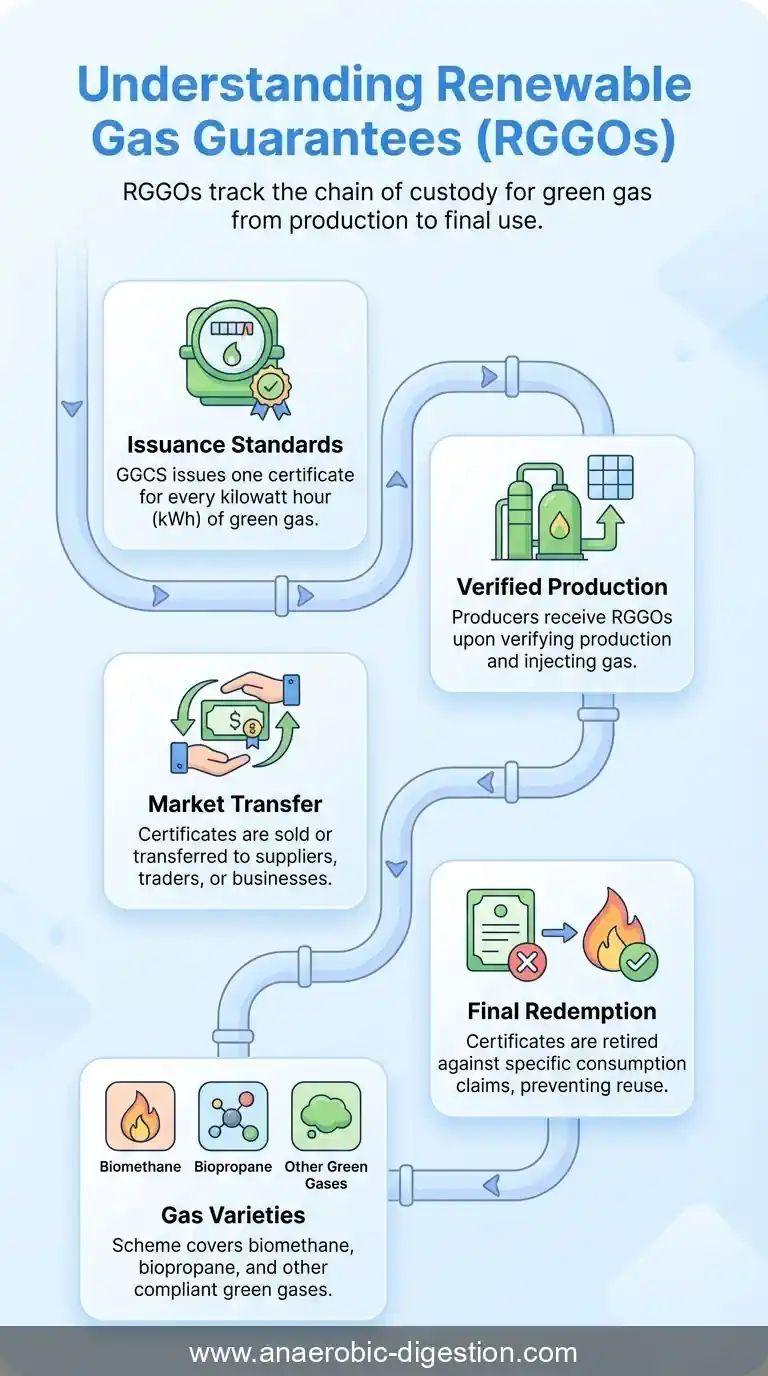
Each RGGO captures specific information about the environmental attributes of the green gas it represents, allowing that information and its associated value to travel along a chain of custody — from the gas producer all the way to the end consumer. This traceability is central to the whole point of the scheme.
RGGOs are traded separately from wholesale gas. In practice, almost all claims of green gas use are made on the basis of generic gas supplied from the wholesale market, which is then matched to RGGOs that link the customer back to actual green gas production and injection. The gas you burn and the certificate proving it was green are two separate things moving through two separate systems.
- One RGGO = one kWh of green gas produced
- Almost all RGGOs issued to date represent biomethane injected into the UK Gas Distribution Network
- RGGOs can also be issued for biopropane and gas from GreenPower Renewable Gas Scheme participants
- RGGOs are issued by the Green Gas Certification Scheme (GGCS), not Ofgem
- They are traded separately from wholesale gas — physical gas and its certificate are decoupled
What Information an RGGO Contains
Each RGGO captures detailed information about the green gas it represents — including the type of green gas, the production method, the source of the feedstock, and where and when it was injected into the network. This level of detail is what allows the certificate to carry meaningful environmental value as it moves through the supply chain, giving end consumers and businesses a traceable link back to actual green gas production.
How RGGOs Move Through the Chain of Custody
The chain of custody model is what makes RGGOs functional as a market instrument. A green gas producer receives RGGOs upon verified production and injection of green gas. Those certificates can then be sold or transferred to suppliers, traders, or directly to large business consumers. At the end of the chain, the certificate is redeemed — retired against a specific consumption claim — ensuring it cannot be used again. This model mirrors the REGO cancellation process for electricity, just operating in the gas sector under GGCS rules.
REGOs and the EU: What Changed After Brexit
Brexit introduced a significant break in how UK renewable energy certificates are recognised internationally. Before January 2021, UK REGOs operated within a framework that had meaningful alignment with EU standards. That alignment no longer exists, and the consequences are still being felt by UK energy suppliers, generators, and businesses trying to make credible cross-border green claims.
Why the EU No Longer Recognises UK REGOs as of January 2021
As of 1 January 2021, the EU no longer recognises UK REGOs. This is a direct consequence of the UK leaving the EU's regulatory framework. Without a mutual recognition agreement on Guarantees of Origin between the UK and the EU, UK-issued REGOs simply carry no weight for EU compliance or disclosure purposes. For businesses operating across both markets, this created an immediate gap in their renewable energy verification toolkit.
GoOs vs REGOs: The EU's Parallel System
EU Member States use a system called Guarantees of Origin (GoOs), which are issued under the framework of the EU's Renewable Energy Directive. GoOs and REGOs are conceptually similar — both certify that a unit of energy was produced from a renewable source — but they are not interchangeable. The EU's system follows the EN 16325 standard for Guarantees of Origin, which UK REGOs do not exactly conform to, making direct equivalence impossible without a formal mutual recognition agreement.
The April 2023 Rule Change That Affected GB Fuel Mix Disclosure
The post-Brexit landscape for REGOs continued to evolve beyond January 2021. Changes to GB Fuel Mix Disclosure rules have progressively tightened how REGOs from certain sources can be used, reflecting the UK's need to develop its own robust standards now that EU alignment is no longer automatic.
For electricity suppliers and generators operating in Great Britain, staying up to date with Ofgem's evolving FMD guidance is essential. The rules around which REGOs can be used for disclosure purposes, and in what circumstances, have been subject to ongoing review — and the April 2023 changes marked a notable shift in how GB suppliers must approach their annual FMD reporting obligations.
RGGOs and the EU: A Similar but Separate Problem
Just as REGOs face EU recognition issues post-Brexit, RGGOs have their own set of limitations when it comes to alignment with EU standards. The GGCS has been transparent about this, and understanding exactly why RGGOs fall outside the EU's GoO framework is important for any business with cross-border green gas ambitions.
Why RGGOs Are Not Classified as EU Guarantees of Origin
RGGOs are not considered Guarantees of Origin under the EU Renewable Energy Directive framework for two specific reasons. First, there is no mutual recognition agreement on GoOs between the UK and the EU — the same structural issue that affects REGOs. Second, the format of an RGGO does not exactly follow the EN 16325 standard for GoOs referenced within the Renewable Energy Directive.
These are not minor technicalities. They mean that a UK business holding RGGOs cannot use them to make renewable gas claims that are recognised under EU regulatory or disclosure frameworks.
Businesses with operations or reporting obligations in both the UK and the EU need to be aware that separate certification may be required for each jurisdiction. For those in the biogas industry, understanding the importance of CO2 separation membrane technology can be crucial for compliance and efficiency.
RGGOs Within UK Government Policy and the Green Gas Levy
Within the UK, RGGOs are firmly embedded in government energy policy. The Green Gas Levy, introduced to fund the Green Gas Support Scheme (GGSS), is designed to drive increased biomethane production and injection into the grid — which directly increases the pool of green gas against which RGGOs can be issued. The GGCS operates as the certification backbone of this policy intent, ensuring that every kWh of supported green gas production is tracked and verifiable. For more insights into the process, learn about biogas production and its role in green energy.
For businesses making green gas claims under UK frameworks — whether for corporate sustainability reporting, supply chain disclosures, or customer-facing green tariff marketing — RGGOs issued by the GGCS are the recognised mechanism. The scheme's validation tools, including the ability to validate individual certificates through the GGCS platform, provide an additional layer of credibility to green gas claims made in the UK market.
The Clearest Differences Between REGOs and RGGOs
If you've made it this far and still want a side-by-side comparison to anchor everything, here it is. The two schemes share a philosophical purpose — tracking and certifying the environmental attributes of renewable energy — but they differ in almost every practical detail.
| Feature | REGO | RGGO |
|---|---|---|
| Energy type | Electricity | Green gas (biomethane, biopropane) |
| Issuing body | Ofgem | Green Gas Certification Scheme (GGCS) |
| Unit of issue | 1 per MWh | 1 per kWh |
| Primary use | Fuel Mix Disclosure (FMD) | Green gas supply chain claims |
| EU recognition | Not recognised post-January 2021 | Not classified as EU GoO |
| Physical energy tracked | No — certificates are decoupled | No — certificates are decoupled |
Do REGOs and RGGOs Prove the Energy Is Physically Renewable?
This is probably the most important question anyone can ask about these certificates — and the answer is no, not in the way most people assume. Both REGOs and RGGOs are attribute certificates. They certify that a unit of renewable energy was produced and fed into the respective network, but they do not guarantee that the specific electrons or gas molecules that reached your meter came from a renewable source. The physical energy and the certificate travel separately.
Why REGOs Don't Guarantee Your Electricity Came From Renewables
The UK electricity grid is a shared network. When renewable electricity is generated by a wind farm and fed into the grid, it mixes instantly with electricity from gas plants, nuclear stations, and every other generation source. There is no technical mechanism to route specific electrons from a specific source to a specific consumer — it is physically impossible on a shared grid.
What REGOs do instead is provide a paper trail of environmental attributes. A supplier holds REGOs equivalent to the amount of renewable electricity they want to claim, cancels those REGOs against their supply, and can then disclose that proportion as renewable in their Fuel Mix Disclosure. The certificate and the electricity are entirely decoupled in terms of physical flow.
This is not a flaw in the system — it is the system working exactly as designed. REGOs are an accounting tool, not a physical routing mechanism. The important thing is that for every MWh a supplier claims as renewable, a corresponding MWh of renewable electricity was genuinely generated somewhere in the UK and a REGO was issued to prove it.
Why RGGOs Don't Track the Physical Flow of Green Gas
The same logic applies to RGGOs. Biomethane injected into the UK Gas Distribution Network immediately blends with natural gas from other sources. The GGCS acknowledges this directly — almost all green gas claims in the UK are made on the basis of generic gas from the wholesale market, matched to RGGOs that link the customer back to verified green gas production. Your boiler burns a mixture of gases; the RGGO is what connects your consumption claim to a real green gas production event somewhere upstream in the network. For more insights, explore methanogens in anaerobic digestion and their role in biogas production.
REGOs and RGGOs Are Different Tools for the Same Goal
Strip everything back and both schemes exist for the same fundamental reason: to make renewable energy claims credible, traceable, and standardised.
Without certificate schemes like REGO and RGGO, any supplier could call their product “green” with nothing to back it up. These certificates create an auditable chain from production to claim, administered by recognised bodies — Ofgem for REGOs and the GGCS for RGGOs — that give the market a shared language for what “renewable” actually means. They are different tools, operating in different energy sectors, solving the same verification problem.
Frequently Asked Questions
The confusion between REGOs and RGGOs is completely understandable — the names are almost identical, the underlying logic is similar, and yet the details that matter are quite different. The questions below address the most common points of confusion that come up when people start digging into how these schemes actually work.
If you are working through these questions in the context of a business sustainability strategy or a green energy procurement decision, it is worth bookmarking the Ofgem REGO pages and the GGCS platform directly, as both bodies publish scheme-specific guidance that is updated regularly.
Can a business hold both REGO and RGGO certificates at the same time?
Yes. REGOs relate to electricity and RGGOs relate to green gas — they operate in completely separate schemes under separate administrators. A business that consumes both electricity and gas could, in principle, hold REGOs matched to its electricity consumption and RGGOs matched to its gas consumption simultaneously. There is no conflict between the two certificate types because they cover entirely different energy vectors.
Are REGOs the same as Renewable Energy Certificates (RECs) used in other countries?
REGOs and RECs serve a similar conceptual purpose — both certify that a unit of electricity was generated from a renewable source — but they are not the same instrument and are not mutually recognised. RECs are used primarily in the United States, while REGOs are a UK-specific scheme administered by Ofgem. The EU equivalent is a Guarantee of Origin (GoO), issued under the Renewable Energy Directive framework.
Since January 2021, UK REGOs are not recognised by the EU as GoOs, and US RECs carry no standing in the UK or EU markets. Each jurisdiction operates its own certificate framework, and cross-border renewable energy claims typically require certificates issued under the relevant jurisdiction's recognised scheme — or a formal mutual recognition agreement between the issuing bodies, which currently does not exist between the UK and EU for REGOs.
Can UK REGOs still be used for any EU-related purposes after Brexit?
No. As of 1 January 2021, the EU no longer recognises UK REGOs within the EU's Guarantee of Origin framework. Without a mutual recognition agreement between the UK and EU on GoOs, UK REGOs have no standing for EU Fuel Mix Disclosure, EU corporate renewable electricity claims, or any other EU regulatory purpose. Businesses with reporting obligations that span both the UK and EU need to source separate GoOs for their EU-facing claims.
What is the Green Gas Certification Scheme (GGCS) and how does it relate to RGGOs?
The Green Gas Certification Scheme (GGCS) is the body responsible for issuing, administering, and overseeing RGGOs in the UK. It operates the register through which green gas producers receive certificates upon verified injection of green gas into the network, and it provides tools including certificate validation and trader information to support the market. The GGCS also participates in the European Renewable Gas Registry (ERGaR), which works toward broader European recognition of green gas certificates — though RGGOs are not currently classified as EU Guarantees of Origin under the Renewable Energy Directive. For more insights on the market, check out the latest biogas digesters market trends.
Can RGGOs be used for carbon emissions reporting frameworks like GHGP or SBTi?
This is an area where guidance is still developing, and businesses should not assume that holding RGGOs automatically satisfies the requirements of specific carbon accounting frameworks. The Greenhouse Gas Protocol (GHGP) and Science Based Targets initiative (SBTi) each have their own criteria for what constitutes a credible renewable energy or emissions reduction claim, and those criteria do not always align neatly with national certificate schemes.
For Scope 1 gas emissions specifically, the use of RGGOs as a basis for claiming reduced emissions intensity is not universally accepted across all reporting frameworks. Some frameworks require certificates that meet specific criteria — such as additionality, temporal matching, or geographic proximity — that standard RGGOs may not automatically fulfil.
If your organisation is using RGGOs to support carbon reporting under GHGP, SBTi, or similar frameworks, it is strongly recommended to verify acceptability with your framework guidance documentation or sustainability reporting adviser before making formal claims. The GGCS provides validation tools and scheme documentation that can support this process, but the final determination of acceptability sits with the framework itself. For organisations navigating this space, staying close to updated guidance from both the GGCS and your chosen reporting framework will be essential as standards continue to evolve.