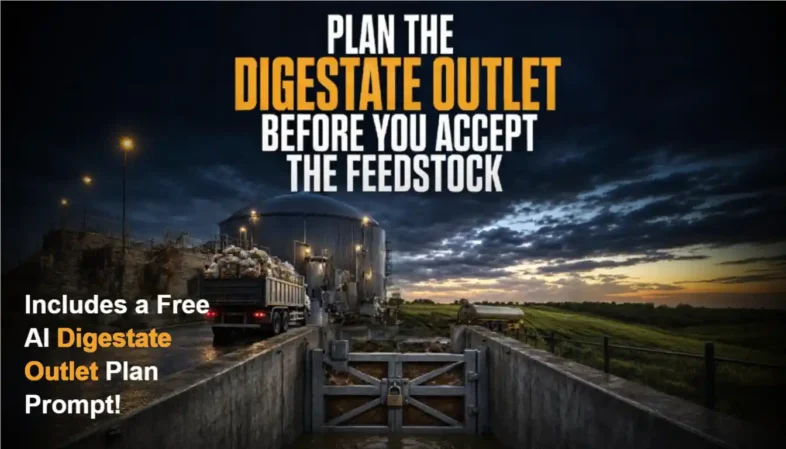
We say “Plan the Digestate Outlet Before You Accept the Feedstock”, because an anaerobic digestion plant can have a reliable digester, attractive feedstock contracts and a convincing gas-production forecast but still encounter serious operational problems if nobody has properly planned what happens to its digestate.
Digestate is not a minor residue that can be considered after the main project decisions have been made. It is a continuous material output that needs suitable storage, handling, transport and a lawful, dependable destination.
The quantity and characteristics of that output depend on the materials entering the plant. Feedstock decisions can affect digestate volume, nutrient content, contamination, agricultural suitability, transport costs and the conditions under which the material can be used.
That connection changes the order in which an AD project should be planned.
Instead of asking what feedstocks are available and then hoping a digestate outlet can be found, begin with the outlet the project can genuinely support. Work backwards through digestate quality, storage, seasonal restrictions, land availability and contingency arrangements before deciding which feedstocks to accept.
A useful rule is:
If you cannot explain where the digestate will go, you have not finished assessing the feedstock.
Key Takeaways
- Digestate management planning should begin before feedstock contracts are accepted, not after the plant has been designed.
- The suitability of an outlet depends on digestate quantity, composition, contamination, nutrient content and applicable requirements.
- Anaerobic digestion converts part of the feedstock into biogas, but a substantial material stream remains and must be managed.
- A landbank measured only in hectares does not demonstrate that sufficient usable outlet capacity exists.
- Seasonal restrictions, cropping plans, weather, ground conditions and storage availability can all affect when digestate can be removed.
- Feedstocks that appear profitable may create additional digestate handling, transport or disposal costs.
- Contamination introduced at reception can reduce digestate quality and make agricultural use more difficult.
- Separation into liquid and fibre can help in some circumstances, but it does not eliminate the need for outlets.
- Contingency arrangements must be specific, credible and available when the primary outlet is interrupted.
- The safest development approach is to start with the outlet and work backwards to the acceptable feedstock.
The Outlet Determines What the Plant Can Afford to Accept
Feedstock discussions usually begin with availability, gate fees and potential gas production.
A food manufacturer has material to remove. A waste contractor can offer a long-term supply agreement. A farmer has slurry, manure or crop residues. A developer calculates the annual tonnage, estimates the methane yield and starts assessing the revenue.
Those are necessary considerations, but they are incomplete.
Every incoming material affects what leaves the plant after digestion. Some of its organic content is converted into biogas, but digestion does not make the remaining water, nutrients, grit, packaging fragments or other non-converted constituents disappear.
The resulting digestate has to be stored, moved and directed to an appropriate outlet.
That creates a direct relationship between feedstock acceptance and digestate management:
The inlet decides what the outlet must handle. The outlet decides what the inlet can responsibly accept.
A plant accepting clean agricultural materials may produce digestate with a relatively predictable use within an established farming system. A plant taking variable packaged food waste, industrial residues or mixed organic materials may face more demanding questions about contamination, composition, quality assurance and the suitability of agricultural outlets.
The point is not that one feedstock category is always preferable. The point is that the real value of a feedstock cannot be established without understanding its digestate consequences.
A feedstock with an attractive gate fee can become less valuable once additional storage, separation, transport, sampling or specialist management are considered.
A material with a respectable theoretical gas yield may still be unsuitable if it introduces contaminants that compromise an existing digestate outlet.
An apparently modest change to the accepted feedstock mix can alter the nutrient balance of the digestate and place additional pressure on the available landbank.
In practical terms, feedstock selection is also digestate specification by another name.
Work Backwards From the Digestate Destination
The most useful planning method is to reverse the usual project sequence.
Instead of starting with the tonnes that might enter the plant, start with the material that will need to leave it.
The reverse-planning sequence has five stages:
- Identify the credible final outlet.
- Define the quality and handling conditions that outlet requires.
- Establish how much material can be accepted and when.
- Determine the storage, treatment and contingency arrangements needed between production and use.
- Accept only feedstocks that remain compatible with those conditions.
This sequence sounds straightforward, but each stage exposes assumptions that are easily missed.

Start With a Real Outlet, Not a Theoretical One
An outlet is not established simply because agricultural land exists near the site.
The relevant question is whether identifiable farms, land managers or other recipients are willing and able to take the expected quantity and type of digestate under realistic conditions.
That requires attention to the receiving land, nutrient requirements, crop rotation, access, transport distance, storage arrangements and applicable rules.
An agreement that works for one type of digestate may not work for another. A farmer willing to receive material from a relatively consistent agricultural feedstock mix may be less comfortable accepting digestate containing visible plastic fragments or material derived from a different waste stream.
The plant should therefore define the outlet using actual acceptance conditions, not general expressions of interest.
Ask:
- Who is expected to take the digestate?
- What material will they accept?
- What quality standards or contractual conditions apply?
- What quantities can they realistically use?
- At what times of year can they receive it?
- Who provides transport and application equipment?
- What happens if their circumstances change?
These questions make the difference between a plausible market and an operationally usable outlet.
Treat Quality as an Outlet Requirement
Digestate quality is not just a laboratory matter. It determines whether the receiving outlet remains available.
Depending on the feedstocks, process and intended use, relevant considerations may include physical contamination, nutrient content, stability, odour, trace contaminants and the material’s regulatory status.
The exact requirements depend on the jurisdiction, the feedstock and the destination. They should be verified for the specific project.
For a plant accepting packaged food waste, depackaging performance becomes a digestate issue as much as a reception issue.
If a separation system removes most packaging but allows small fragments to pass into the organic fraction, the consequences may not become obvious until digestate is inspected or an agricultural recipient raises concerns.
At that point, the problem is no longer confined to the front end of the plant. It has travelled through the complete process and affected the final outlet.
The practical lesson is:
Anything that compromises the digestate outlet can also compromise the value of the feedstock that introduced it.
This is why feedstock acceptance criteria, delivery inspections and pre-treatment performance should be considered alongside digestate quality requirements.
Calculate Capacity by Nutrients and Timing, Not Hectares Alone
A proposed landbank may look reassuring when presented as a large number of hectares.
However, the usable outlet capacity depends on more than land area.
Digestate contains nutrients that must be considered in relation to crop needs, existing nutrient applications, soil conditions and relevant requirements. Land already receiving slurry, manure or other organic materials may have less additional capacity than its total area suggests.
The practical question is not simply, “How much land is available?”
It is:
How much of this particular digestate can this land receive, at the times it is available for application, without exceeding the relevant agronomic or regulatory limits?
Timing is equally important.
A digester generally continues producing digestate while opportunities for land application may vary with season, rainfall, soil condition, crop establishment and operational restrictions.
If application is delayed, the material must still go somewhere.
That is where seasonal storage becomes a central project constraint.
A site may have enough theoretical landbank capacity over a full year but insufficient storage to bridge the periods when that land cannot receive digestate.
The project then faces a mismatch between continuous production and intermittent outlet availability.
Evaluate Storage as a Working Buffer
Digestate storage is often treated as a supporting item in the plant layout. In reality, it is the buffer that keeps a temporary outlet interruption from becoming a feedstock and gas-production problem.
Storage should be assessed against realistic operating conditions, not just ideal collection schedules.
Consider:
- The expected rate of digestate production.
- Periods when agricultural application may be unavailable.
- Delays caused by weather or unsuitable ground conditions.
- The time needed to arrange haulage or alternative outlets.
- Whether existing storage is genuinely accessible when needed.
- Additional capacity required during maintenance or treatment interruptions.
The useful capacity is the amount that can be operated safely and lawfully under real conditions. A tank that appears adequate on paper may offer less practical resilience if part of its volume is unavailable or if the plant produces more material than forecast.
If storage fills, the consequence can extend directly into the digester.
Operators may need to reduce or suspend incoming feedstock because there is insufficient space for the material leaving the process.
At that point, the digestate outlet has become the plant’s effective throughput limit.
Confirm Contingencies Before They Are Needed
A contingency outlet should be treated as part of the project design, not an emergency improvisation.
It is not enough to assume that another local farm, contractor or treatment facility will be available if the primary route fails.
A credible contingency should have a defined recipient, acceptance conditions, transport arrangements, likely cost and activation timescale.
It should also be compatible with the digestate actually produced.
If the alternative outlet only accepts cleaner material than the plant can provide, it is not a contingency. If it requires transport equipment that cannot be obtained when needed, it is not a contingency. If its cost would make continued operation uneconomic, that needs to be understood before the situation arises.
The relevant question is:
Can this alternative outlet handle the actual digestate, in the actual quantities required, within the time available?
A Feedstock Decision Viewed From the Wrong End
Consider a proposed food-waste AD plant that has secured an attractive supply of packaged supermarket food.
The feedstock offers a gate fee, and the developer expects it to make a useful contribution to biogas production. The financial model assumes the resulting digestate will be applied to nearby farmland.
At first, the proposal appears sound.
But the receiving farms expect a digestate that is consistent, manageable and free from troublesome visible contamination. The depackaging system has been assessed using relatively clean sample loads, while the contracted material may vary significantly between deliveries.
Some loads contain heavier packaging, composite materials or items that are more difficult to separate. Additional washing or dilution is introduced to improve processing, increasing the volume of material passing through the plant.
That change creates several consequences.
More liquid requires additional storage. Increased transport volumes raise haulage costs. Packaging fragments that pass through pre-treatment create concern among agricultural recipients. The farms that were expected to take the digestate become less certain about accepting it.
The plant still has access to the feedstock. The digester may still produce gas. Yet the commercial value of the arrangement has changed because the outlet assumptions no longer match the digestate being produced.
Now apply the reverse-planning method.
Start with the farms’ acceptance conditions. Establish the quality they require, the quantity they can use, the seasonal application periods and the available storage.
Then ask whether the proposed packaged food waste can be processed to meet those conditions consistently.
If the answer depends on unproven separation performance, excessive water use or informal assurances, the feedstock should not be treated as fully secured simply because a supply contract exists.
Possible responses might include tightening acceptance specifications, changing pre-treatment, rejecting unsuitable loads, securing additional storage or finding a different outlet.
Which response is appropriate depends on the project. The important point is that the digestate destination determines whether the feedstock opportunity is genuinely usable.
Separation Does Not Make the Outlet Problem Disappear
Mechanical separation can divide digestate into a liquid fraction and a more solid fibre fraction.
That may help with handling, transport, storage or matching different materials to different outlets. In some projects, it can provide useful operational flexibility.
But separation does not remove the need for a complete outlet strategy.
Both fractions still require suitable destinations. Nutrients and contaminants do not disappear merely because the material has been divided into two streams.
A project that proposes separation should therefore ask:
- Where will the liquid fraction go?
- Where will the fibre fraction go?
- How will each fraction be stored?
- What quality conditions apply to each outlet?
- What happens if the separator stops?
- Does the proposed arrangement reduce total cost or simply relocate it?
These questions prevent a common planning mistake: treating a processing technology as though it were an outlet.
Treatment changes the form of the material. It does not, by itself, guarantee a destination.
The Decision Rule That Protects the Project
Before accepting a feedstock, follow its consequences through to the final digestate destination.
Ask whether the material will alter the digestate’s quantity, quality, nutrient content, contamination risk or seasonal storage requirement.
Then establish whether the existing landbank, storage and contingency arrangements can absorb those changes.
If they cannot, the feedstock’s apparent value is incomplete.
A gate fee, a contract or a promising methane yield does not make a material suitable if the resulting digestate cannot be managed dependably.
The practical rule is:
Do not accept a feedstock until you can explain where its digestate will go, when it can move, what quality the outlet requires and what happens if that outlet becomes unavailable.
Try This With AI
So, you’ve read this article but it all sound too difficult to do. Try the following AI prompt and be guided by AI!
Use the AI you’re already using: ChatGPT, Claude, Gemini, Grok, Meta AI, Copilot, or another general-purpose AI assistant. Replace the example information inside the brackets with your own information, then copy and paste the complete prompt (in blue text below) into your AI:
AI Prompt
Act as an independent anaerobic digestion feedstock and digestate management reviewer. Apply reverse planning to this proposed feedstock, existing feedstock mix or AD project:
[Paste or describe the available information. Example:
“Our food-waste AD plant is considering 8,000 tonnes a year of packaged supermarket food. It offers a good gate fee but has variable packaging. Digestate is separated into liquid and fibre, stored on site and transported to nearby farms, although winter capacity and alternative outlets haven’t been confirmed.”]
Start with the final digestate destinations and work backwards to decide whether the feedstock should be accepted. Assess how it could affect digestate quantity, physical contamination, nutrient loading, consistency, storage demand, transport, treatment and outlet acceptance. Test the primary and contingency outlets for usable capacity, required quality, seasonal availability, activation time and likely practical constraints.
Distinguish confirmed facts from assumptions, label reasonable inferences clearly and identify information that must be verified under the applicable local requirements. Do not invent feedstock properties, methane yields, laboratory results, regulations, contracts or outlet capacity.
Present the result as a concise decision report containing the proposed material route, the five most serious outlet risks ranked by consequence, the evidence needed to resolve each risk, and any acceptance conditions or safeguards required.
Finish with one of four provisional decisions: accept, accept only with stated conditions, pause pending evidence, or reject, followed by a precise explanation of what would have to be true for that decision to change.
— End of AI prompt —
Frequently Asked Questions
What is digestate management planning?
Digestate management planning establishes how digestate will be stored, handled, transported and directed to a suitable outlet. It considers expected quantity, composition, nutrient content, contamination risk, seasonal constraints and contingency arrangements.
Why should the digestate outlet be considered before the feedstock?
Feedstocks influence the characteristics and quantity of digestate produced. Planning the outlet first helps determine whether a proposed feedstock is compatible with available land, storage, quality requirements and alternative destinations.
Does anaerobic digestion eliminate the original feedstock?
No. Anaerobic digestion converts part of the biodegradable material into biogas, but a remaining digestate stream still requires management. Its quantity and composition depend on the feedstocks, process conditions and any additional water or treatment stages.
Is a large landbank enough to guarantee a digestate outlet?
No. The practical capacity of a landbank depends on factors such as nutrient requirements, cropping patterns, existing manure or slurry applications, access, seasonal conditions and applicable rules. Land area alone does not show how much digestate can actually be used.
How can feedstock contamination affect digestate use?
Physical contamination, such as packaging fragments, can reduce digestate quality and make agricultural recipients less willing to accept it. Depending on the feedstock and intended outlet, other quality concerns may also require assessment.
Why is digestate storage so important?
Digestate may be produced continuously while opportunities for land application or collection are intermittent. Storage provides a buffer when outlets are unavailable because of seasonal conditions, transport delays, weather or operational interruptions.
Can a high-gate-fee feedstock still be a poor commercial choice?
Yes. A feedstock may introduce additional depackaging, contamination, storage, transport or digestate management costs. Its true commercial value can only be assessed after these downstream consequences are considered.
Does separating digestate into liquid and fibre solve the outlet problem?
Not by itself. Separation creates two material streams, and each still requires suitable storage, handling and an appropriate destination. The value of separation depends on whether reliable outlets exist for both fractions.
What makes a contingency digestate outlet credible?
A credible contingency identifies a specific recipient, confirms the material they can accept, establishes available capacity and defines the transport arrangements, expected cost and activation timescale. General assumptions that another outlet might be found are not sufficient.
What should be included in feedstock acceptance criteria?
Feedstock acceptance criteria should address the characteristics that affect both plant operation and digestate use. Depending on the project, these may include material type, contamination, packaging, composition, consistency and compatibility with the intended digestate outlet.
What is the most important question to ask before accepting a new feedstock?
Where will the resulting digestate go, when can it be moved, what quality must it meet and what happens if the intended outlet becomes unavailable?