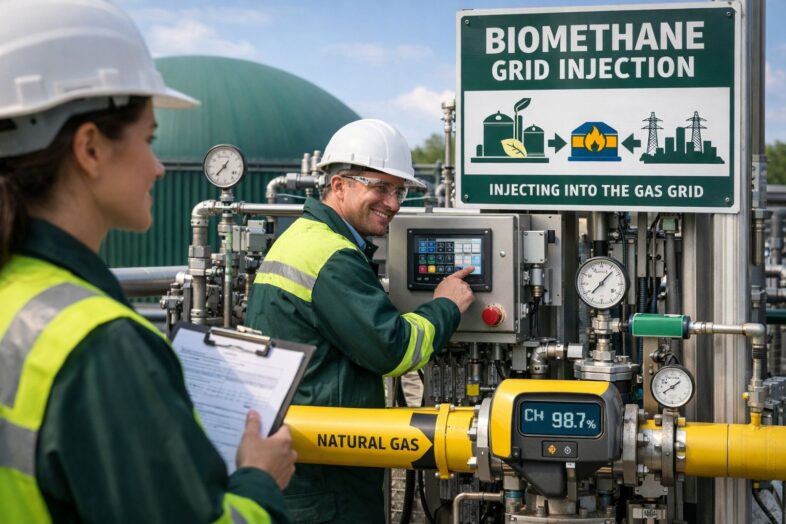
Meeting strict biomethane grid injection requirements is the single factor that shapes every decision a biogas producer makes before injection day, because grid operators will not accept gas that falls short of purity thresholds.
Getting gas onto the grid isn’t just a technical formality—it’s the difference between a profitable renewable energy project and a stalled one.
Producers across Europe have learned this the hard way, discovering that methane content, water dew point, and pressure specifications aren’t suggestions but gatekeepers.
Key Takeaways
- EN 16723 Part 1 sets the gas quality specifications biomethane must meet before entering the natural gas network, while Part 2 governs automotive fuel use
- Grid injection standards cover methane concentration, water content, oxygen levels, and pressure matching to protect pipeline infrastructure and downstream equipment
- Europe moved to unify these standards after discovering that country-by-country rules were blocking cross-border biomethane trade
- CEN Technical Committee 408 built these standards with input from industry groups, balancing safety with practical market needs
- Later sections break down exact technical thresholds and explain, as a case study, how the Biosurf project accelerated harmonisation across member states
- It’s not just Europe where grid injection developments are rising, but Europe is leading the world, so we decided to write this article about Europe
Why EN 16723 Changed the Game for Biomethane Across Europe
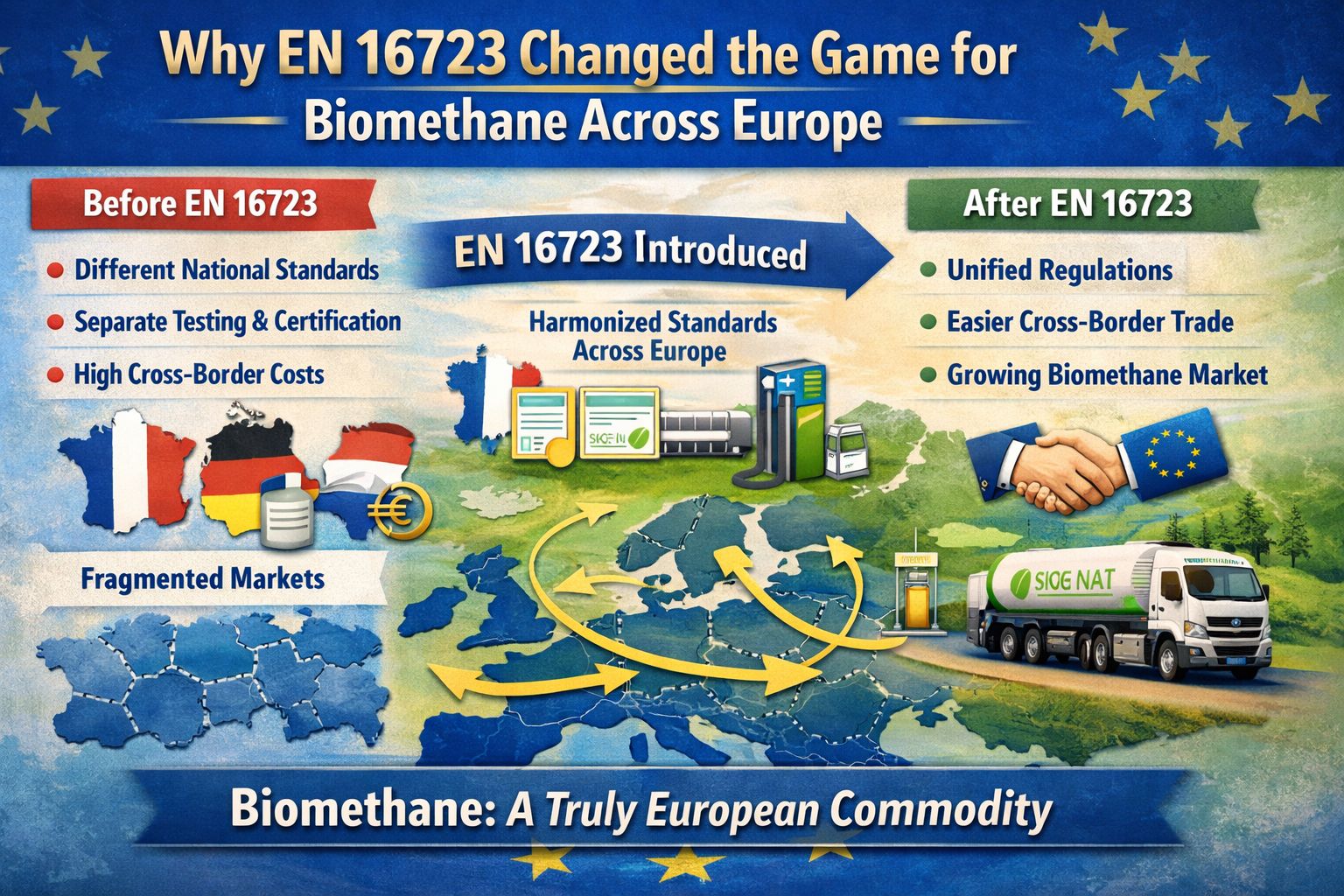
Before EN 16723 existed, a biomethane producer in France faced entirely different biomethane grid injection requirements than one in Germany or the Netherlands. That meant separate testing, separate certification, and separate compliance costs for anyone hoping to sell gas beyond their home market. That meant separate testing, separate certification, and separate compliance costs for anyone hoping to sell gas beyond their home market. The lack of a shared rulebook didn’t just slow things down—it actively discouraged cross-border investment in renewable gas infrastructure.
EN 16723 fixed that fragmentation by giving every country a common technical language. Grid operators, equipment manufacturers, and biomethane producers could finally work from the same playbook, whether the gas was headed into a transmission pipeline or a vehicle fuel tank. This shift mattered because it turned biomethane from a collection of isolated national projects into a genuinely tradable European commodity.
EN 16723: The Two-Part Standard Powering Biomethane Trade
EN 16723 isn’t a single document—it’s split into two distinct parts, each addressing a different end use for biomethane. Understanding which part applies to your project determines everything from the testing equipment you’ll need to the contracts you’ll sign with grid operators.
Part 1 Covers Specifications for Grid Injection
EN 16723 Part 1 lays out the exact biomethane grid injection requirements upgraded biogas must meet before it touches the natural gas network. This is the rulebook that matters most for producers aiming to inject directly into transmission or distribution pipelines. This is the rulebook that matters most for producers aiming to inject upgraded biogas directly into transmission or distribution pipelines. It addresses compatibility with existing natural gas infrastructure, ensuring that biomethane behaves predictably alongside conventional gas already flowing through the system.
Part 2 Covers Automotive Fuel Specifications
Part 2 shifts focus entirely to biomethane used as a vehicle fuel. The specifications here reflect the realities of compressed natural gas (CNG) and liquefied natural gas (LNG) engines, which demand tighter tolerances in some respects than pipeline injection does. Producers supplying fueling stations need to meet this separate set of criteria, even if their gas originated from the same upgrading facility.
How CEN Technical Committee 408 Built These Standards
Neither part of EN 16723 appeared overnight. CEN Technical Committee 408 was formed specifically to draft standards covering natural gas and biomethane for transport, as well as biomethane destined for grid injection. The committee pulled together technical experts, industry stakeholders, and national standards bodies to hammer out specifications that would work across vastly different national gas infrastructures.
The Timeline Behind Europe’s Biomethane Standards
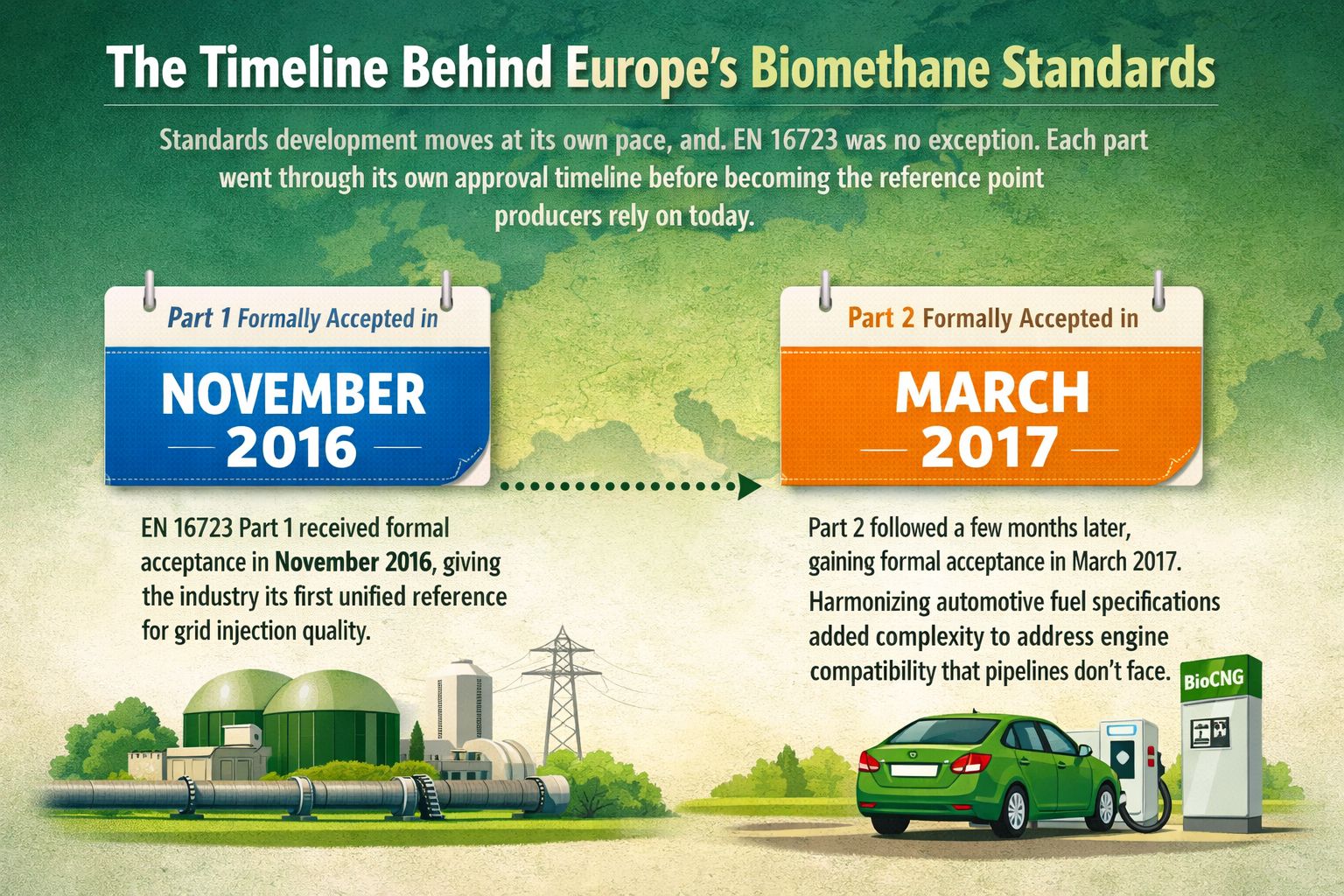
Standards development moves at its own pace, and EN 16723 was no exception. Each part went through its own approval timeline before becoming the reference point producers rely on today.
Part 1 Formally Accepted in November 2016
EN 16723 Part 1 received formal acceptance in November 2016, giving the industry its first unified reference for grid injection quality. This milestone gave producers, grid operators, and equipment suppliers a fixed target to design around, rather than guessing which national variant might apply.
Part 2 Formally Accepted in March 2017
Part 2 followed a few months later, gaining formal acceptance in March 2017. The gap between the two approvals reflects the added complexity of harmonizing automotive fuel specifications, which had to account for engine compatibility issues that pipeline injection simply doesn’t face.
Why Europe Needed Unified Biomethane Grid Injection Requirements
Standardization doesn’t happen just because it sounds tidy on paper—it happens because the old system was actively costing the industry money and slowing growth. Several converging pressures made EN 16723 not just useful but necessary.
The Rapid Rise of Natural Gas Vehicles
The number of natural gas vehicles on European roads kept climbing, and fuel suppliers needed confidence that biomethane would perform identically to conventional CNG regardless of where it was produced. Without a shared fuel standard, scaling up biomethane refueling infrastructure would have meant negotiating separate specifications in every market.
A Patchwork of Conflicting National Rules
Every biomethane-producing country had already established its own injection standards before EN 16723 arrived. That patchwork created friction at every border crossing, forcing producers to either limit sales to domestic markets or absorb the cost of meeting multiple, sometimes contradictory, specifications.
Legal and Technical Security for Producers
A unified European standard gives producers something national rules alone couldn’t: legal and technical certainty that holds up across jurisdictions. That certainty matters enormously when a biomethane project requires significant upfront capital and long-term offtake agreements.
Faster Market Access Across Borders
With one technical specification to meet, producers gained a much faster path into new markets. There’s no need to redesign upgrading equipment or renegotiate certification processes every time a producer wants to sell gas across a national border.
Free Trade as a Foundation for Growth
Ultimately, standardization became the precondition for genuine free trade in biomethane. Without EN 16723, the renewable gas sector would have remained a collection of disconnected national markets rather than the integrated European industry it’s becoming.
Who Shaped These Technical Standards
Standards don’t write themselves, and EN 16723 reflects years of coordinated input from the organizations closest to Europe’s biomethane sector. Industry associations, national gas regulators, and technical experts all had a seat at the table, which is partly why the final specifications strike a workable balance between safety and commercial practicality.
The Role of the European Biogas Association
The European Biogas Association played an active part in shaping these standards, participating in CEN Technical Committee 408 through the Biosurf project framework. Their involvement ensured that the people producing and injecting biomethane day-to-day had a voice in specifications that would directly affect their operations. That kind of direct industry input tends to produce standards that work in practice, not just on paper. For more on this topic, explore the debate on biomethane vs. green hydrogen for industrial decarbonisation.
How CEN Technical Committee 408 Coordinates Member States
CEN Technical Committee 408 serves as the coordinating body pulling together national standards organisations from across Europe. Rather than imposing a single country’s approach onto everyone else, the committee works through consensus, reconciling differing technical traditions into one workable framework.
This coordination role matters because gas grids weren’t built with harmonisation in mind. Pipeline materials, metering equipment, and safety protocols developed independently in each country over decades. Getting dozens of national technical bodies to agree on shared thresholds for methane content, oxygen limits, and water dew point required patience and genuine technical negotiation.
The committee’s structure allows member states to contribute expertise specific to their own infrastructure challenges while still moving toward a single European standard. Countries with extensive natural gas vehicle fleets, for example, brought different priorities to the table than countries focused primarily on harmonising biomethane grid injection requirements. Balancing those priorities is exactly what CEN TC 408 was built to do. It also comprises a significant step in implementing pipeline injection within the REPowerEU Plan.
- National standards bodies from biomethane-producing countries contributed technical expertise
- Industry associations like the European Biogas Association represented producer interests
- Grid operators provided input on infrastructure compatibility requirements
- Automotive and fuel industry representatives shaped Part 2’s vehicle fuel specifications
What emerged from this process wasn’t a compromise that satisfied no one—it was a functional standard that most stakeholders could actually implement. That outcome isn’t guaranteed in standards development, and it speaks to how seriously CEN TC 408 approached the technical challenges involved.
Getting that level of cooperation across so many national interests took more than committee meetings. It required a dedicated project structure with funding and a clear mandate, which is exactly what came next. For instance, the REPowerEU plan exemplifies such structured efforts to align diverse interests towards a common energy goal.
Inside the Biosurf Project That Supported Harmonization
Behind the scenes of EN 16723’s development sat a research initiative specifically designed to accelerate biomethane standardization across Europe. The Biosurf project gave the European Biogas Association and other stakeholders the resources and framework needed to engage meaningfully with CEN Technical Committee 408’s work, turning what could have been a slow, fragmented process into a coordinated push toward harmonized standards.
Horizon 2020 Funding and Grant Agreement No. 646533
The Biosurf project received its backing through the European Union’s Horizon 2020 research and innovation programme, operating under grant agreement no. 646533. That funding structure gave the project real staying power, allowing researchers and industry representatives to engage in the kind of sustained technical work that standards harmonization demands. Without dedicated funding behind it, the push to align EN 16723 across member states would have relied on goodwill alone—rarely enough to move a multi-year technical process forward.
The Biosurf Final Conference in Brussels, November 2017
Biosurf’s work culminated in a final conference held in Brussels on 24 November 2017, bringing together the stakeholders who had spent years shaping biomethane’s regulatory future. The timing wasn’t accidental—it landed just months after EN 16723 Part 2 received formal acceptance, allowing the conference to serve as both a wrap-up and a forward-looking checkpoint for the industry.
Conferences like this one matter more than they might seem to on the surface. They give producers, grid operators, and policymakers a shared moment to assess what’s working, what still needs refinement, and where the next regulatory gaps might emerge. For an industry built on cross-border infrastructure, that kind of collective check-in keeps everyone moving in the same direction.
The Brussels gathering also reinforced something the entire Biosurf project had been built around from the start: harmonized standards only work if the people implementing them stay connected. Technical documents alone don’t create a functioning market—ongoing dialogue between producers, regulators, and equipment manufacturers does.
- Brought together industry stakeholders who contributed to EN 16723 development
- Marked the formal conclusion of Horizon 2020 grant-funded harmonization work
- Provided a venue for discussing implementation challenges across member states
- Reinforced the European Biogas Association’s ongoing role in standards advocacy
What Harmonized Standards Mean for the Future of Biomethane
EN 16723 isn’t the finish line—it’s the foundation European biomethane producers now build on. As more countries expand renewable gas infrastructure, having a shared technical reference point means new entrants to the market don’t have to reinvent compliance processes from scratch. That head start matters for an industry still scaling up its share of Europe’s overall gas supply.
Producers who understand these standards thoroughly gain a real competitive edge, since compliance stops being a guessing game and becomes a predictable part of project planning. The groundwork laid by CEN Technical Committee 408 and projects like Biosurf gives the sector a technical vocabulary that will likely shape whatever updates or expansions to biomethane standards come next.
Frequently Asked Questions
Questions about biomethane grid injection standards tend to circle back to a handful of core topics—what the standards actually require, how they differ by application, and who’s responsible for setting them. Here’s a quick reference covering the essentials.
| Standard | Covers | Formally Accepted |
|---|---|---|
| EN 16723 Part 1 | Grid injection specifications | November 2016 |
| EN 16723 Part 2 | Automotive fuel specifications | March 2017 |
That side-by-side view makes it easier to see why the two parts developed on slightly different timelines—automotive applications simply carried additional technical considerations that took extra time to resolve. For more information on biomethane production, you can refer to this biomethane production by anaerobic digestion.
What is EN 16723 and why does it matter?
EN 16723 is the European standard governing biomethane quality, split between grid injection and automotive fuel use. It matters because it replaced a fragmented set of national rules with one shared technical reference, making cross-border biomethane trade practical for the first time. This aligns with initiatives like the REPowerEU Plan, which aims to boost renewable energy use across Europe.
What’s the difference between EN 16723 Part 1 and Part 2?
Part 1 sets specifications for biomethane entering the natural gas network, focused on compatibility with pipeline infrastructure. Part 2 covers biomethane used as automotive fuel, addressing the different tolerances required by CNG and LNG vehicle engines.
When were these biomethane standards formally accepted?
Part 1 gained formal acceptance in November 2016, establishing the grid injection framework first. Part 2 followed in March 2017, completing the automotive fuel specifications a few months later.
Who developed the EN 16723 standards?
CEN Technical Committee 408 developed these standards, drawing on input from national standards bodies, industry associations, and technical experts across Europe. The European Biogas Association contributed directly through its participation in the Biosurf project.
What was the Biosurf project and why was it created?
Biosurf was a research initiative funded through the European Union’s Horizon 2020 programme under grant agreement no. 646533, created to support biomethane standards harmonization across Europe. It gave organizations like the European Biogas Association a structured way to engage with CEN Technical Committee 408’s standards development work, culminating in a final conference held in Brussels in November 2017.
Navigating biomethane grid injection requirements demands close attention to gas quality, pressure matching, and technical standards to ensure network safety and efficiency. The process involves upgrading raw biogas by removing impurities and adjusting the calorific value so it can safely enter the natural gas grid as a reliable, low-carbon energy source. importance of renewable energy in today’s energy landscape is crucial for promoting sustainable practices and reducing reliance on fossil fuels.