



The REPowerEU plan is the European Commission’s strategy to make Europe independent of Russian fossil fuels, launched in response to Russia’s invasion of Ukraine and the energy-market disruption that followed. When we first covered it in 2022, it was an ambitious set of proposals. Today it is binding law — and that changes how its headline promises, including the 35 billion cubic metre (bcm) biomethane target for 2030, should be read.
This article brings our original coverage up to date: what the plan set out to do, what has actually been enacted, where the Russian gas phase-out now stands, and whether the ambitious biomethane target is realistic.
What is the REPowerEU plan?
The European Commission published the REPowerEU plan on 18 May 2022, setting out how the European Union could eliminate its dependency on Russian fossil fuels. It proposed a series of measures to rapidly reduce that dependence, accelerate the green transition, and increase the resilience of the EU-wide energy system.
The logic was straightforward. By acting as a Union rather than as 27 separate buyers, Europe could diversify supply faster, invest at scale, and keep more of its energy spending inside the bloc. In the short term the member states needed alternative gas, oil and coal; looking further ahead, they would also need renewable hydrogen and home-grown renewable gas.
What has changed since 2022 is that REPowerEU is no longer just a plan. Its gas measures are now enforceable legislation, with firm dates and real penalties, which we cover below.
The REPowerEU biomethane action plan
From the start, the biomethane element of REPowerEU implied a greatly expanded role for the anaerobic digestion process across Europe.
The Biomethane Action Plan set out tools including a Biomethane Industrial Partnership and financial support — partly through the Common Agricultural Policy — to lift sustainable biomethane production to 35 bcm a year by 2030. At launch, the Commission pointed to around €37 billion of targeted investment to build the capacity and grid connections the sector would need (European Commission press release, May 2022).
Delivering that scale-up requires adapting existing gas networks to carry biomethane and, over time, renewable hydrogen — the infrastructure side of the challenge that is often underestimated.
Is the 35 bcm biomethane target on track?
Here is the honest update. The 35 bcm target still stands, and the Commission and industry continue to treat it as the goal for 2030. But the sector is running behind the trajectory it needs.
According to figures presented at European Biomethane Week in October 2026, biogas and biomethane together supplied roughly 22 bcm of gaseous energy in 2024 — about 7% of European gas demand — with dedicated biomethane production capacity having passed 8 bcm. Europe now hosts more than 20,000 biogas plants and nearly 1,700 biomethane upgrading facilities, backed by around €36 billion of announced investment (Bioenergy Insight, October 2026).
The European Biogas Association (EBA) has been candid that growth remains well below potential. Its leadership has pointed to several brakes on the sector:
- the absence of a binding EU biomethane target, which weakens the investment signal;
- slow and fragmented permitting across member states;
- a lack of stable, long-term demand signals and investment certainty;
- the failure to value digestate — the nutrient-rich by-product of anaerobic digestion — as an organic fertiliser, which a clear end-of-waste framework could change.
EBA chief executive Harmen Dekker has noted that around 98% of digestate already returns to agricultural soils, yet often carries little market value — a missed opportunity for Europe’s fertiliser self-sufficiency as well as for farm incomes. In our view, that point deserves far more policy attention than it gets.
Why aim for such a large increase in biogas-to-biomethane output?
It is not hard to see why the EU leaned so heavily on renewables, and on biogas-to-biomethane in particular:
- renewables are among the cheapest and cleanest energy available, and can be produced domestically;
- they reduce the need for imported energy;
- the money spent stays in the country, supporting local economies and rural jobs.
REPowerEU was designed to speed up the green transition and trigger large-scale investment in renewable energy. It also stressed the need to help industry and transport substitute fossil fuels with renewables faster, driven by the parallel goals of cutting emissions and cutting dependency.
REPowerEU Plan includes faster electrification, plus quicker adoption of renewable heat and process fuels
Ending reliance on Russian fossil fuels was never going to come from a scale-up of renewable electricity alone. It also requires faster electrification and the replacement of fossil-based heat and fuel across industry — including construction and the transport sector. The payoff the Commission points to is that, over time, the clean-energy transition should help lower energy costs and reduce import dependency.
This is precisely where biomethane earns its place. As EU Energy Commissioner Dan Jørgensen put it at European Biomethane Week in 2026, renewables will do much of the work on electricity, “but we will still need molecules, and biogas and biomethane are a part of those solutions.” Hard-to-electrify sectors — high-temperature industrial heat, shipping and heavy transport — are exactly where a renewable gas is most valuable.
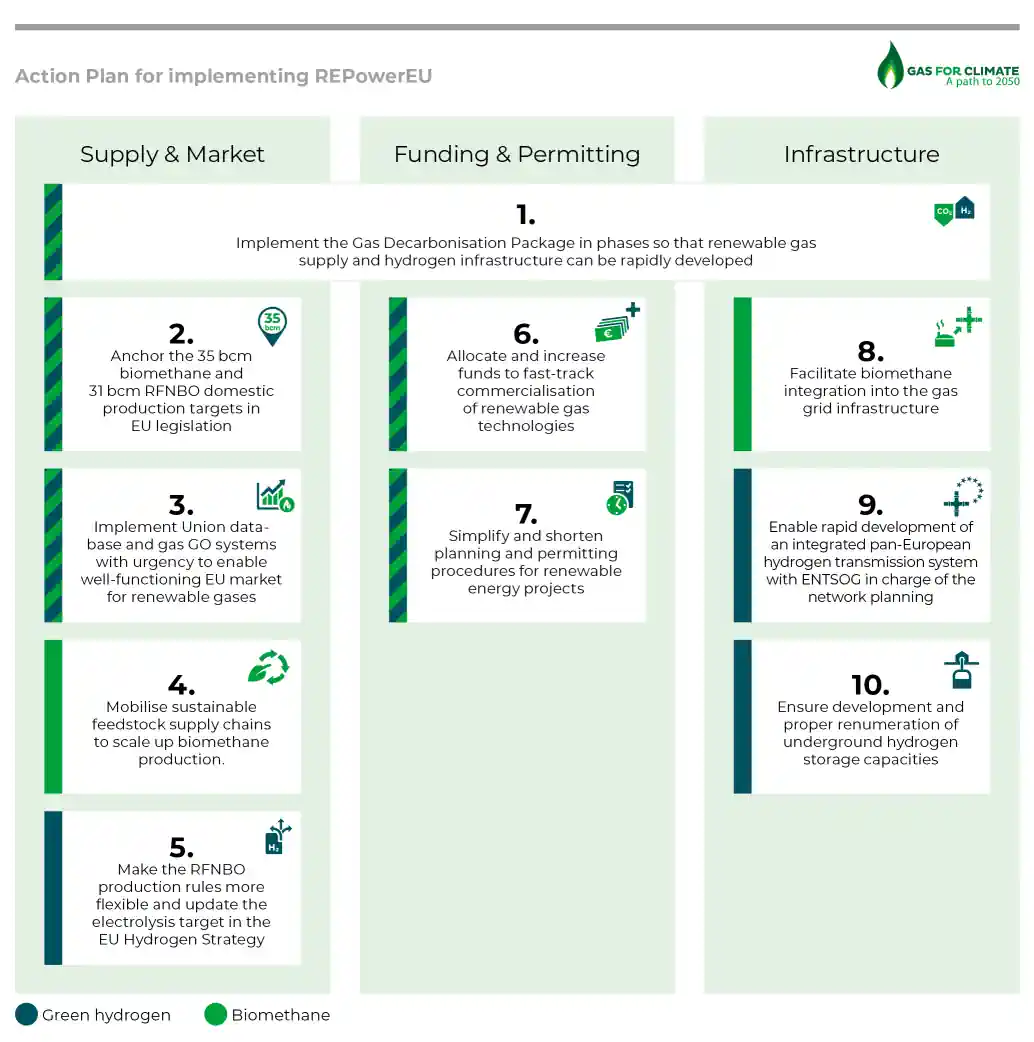
The image below, from the “Gas for Climate” consortium, illustrates how the action plan was envisaged to build up step by step.
The Russian gas phase-out: from target to binding law
This is the single biggest change since our original article. In 2022, cutting dependency on Russian energy “by 2027” was a political ambition. It is now binding EU law with firm dates and real penalties.
The sequence ran like this:
- 6 May 2025 — the Commission presented its Roadmap towards ending Russian energy imports.
- 2 December 2025 — the Council and Parliament reached political agreement on the rules.
- 26 January 2026 — the Council gave the final green light to a stepwise ban (Council of the EU).
- 3 February 2026 — the REPowerEU Regulation (EU) 2026/261 entered into force.
Under the regulation, importing Russian pipeline gas and LNG into the EU is prohibited, with a stepwise approach to limit the impact on prices and markets:
- a full ban on Russian LNG imports from the start of 2027;
- a ban on Russian pipeline gas from autumn 2027, with transition periods for pre-existing contracts.
Before gas enters the Union, member states must verify the country in which it was produced, and all gas imports are subject to prior authorisation unless they come from exempt third countries. Enforcement has teeth: for companies, maximum penalties of at least €40 million, or 3.5% of worldwide annual turnover, or 300% of the transaction turnover; for individuals, no less than €2.5 million. EU countries were also required to submit national plans by 1 March 2026 to diversify gas supplies — and, where relevant, Russian oil.
How far has the EU already cut Russian energy?
The progress has been real, and faster than many expected in 2022:
- Russian gas has fallen from around 45% of EU imports to roughly 12% by 2025;
- Russian oil has dropped from 27% at the start of 2022 to about 2–3%, imported by only a couple of member states;
- all imports of Russian coal have been banned under sanctions.
The Commission estimates the remaining Russian gas — the volumes the new ban is designed to remove — is worth on the order of €10–15 billion a year, money that will no longer flow to Moscow once the phase-out completes (European Commission).
What if Russia had cut supplies first?
When REPowerEU was drafted, a central worry was a sudden interruption of Russian gas — a risk made vivid by the early cut-offs to Poland and Bulgaria. The plan therefore proposed EU-level backstop options for such a scenario.
The 2026 regulation carries that thinking forward: in a declared emergency under the Gas Security of Supply rules, the Commission can temporarily suspend the obligation to prove a shipment’s country of production, for a strictly limited period. The underlying point from 2022 still holds — an abrupt shock would have been painful, which is exactly why an orderly, legislated phase-out was preferable.
What does the REPowerEU plan include?
The plan was built around four main areas:
- energy efficiency and savings;
- diversification of energy supply;
- acceleration of the clean-energy transition;
- investment and reform.
At launch in 2022, the Commission estimated that delivering REPowerEU’s objectives would need an additional €210 billion of investment by 2027, while saving close to €100 billion a year in reduced fossil-fuel imports. To finance it, the Commission proposed mobilising around €300 billion, largely from the existing Recovery and Resilience Facility. (These were the Commission’s 2022 estimates; they frame the scale of ambition rather than describe current spending.)
Achieving the goals was always going to rest on three pillars:
- demand reduction;
- diversifying suppliers for conventional fuel imports while future-proofing the related infrastructure;
- accelerating the switch to renewable energy sources.
The timeline meant the speed and scope of action had to go well beyond earlier proposals such as the “Fit for 55” package and the “Hydrogen and Decarbonised Gas Market” package. As Frans Timmermans, then the Commission’s climate chief, put it at the plan’s launch: “The cheapest energy is the energy you do not use.”
Short-term disruption, longer-term savings and a climate dividend
Avoided demand and energy efficiency were presented as not only the most cost-effective measures but also the most sustainable, secure and immediately actionable. That framing has aged well: the member states had been paying roughly €1 billion a day to Russia for fossil energy at the exceptionally high prices of 2022, so every unit of avoided demand delivered an outsized return.
All efforts to cut fossil-fuel use remain welcome, and the plan contained many good proposals on efficiency and renewables. Even so, some details drew legitimate criticism — chiefly the risk of locking in new fossil-gas infrastructure and leaning on optimistic hydrogen assumptions, which we turn to next.
Fossil fuels still needed from non-Russian partners
Even with aggressive demand reduction now and a near-fully decarbonised system later, the EU still needs fossil fuels from non-Russian partners during the transition. That reality is visible in the regulation itself, which allows for emergency flexibility and a stepwise, rather than overnight, exit.
The EU’s drive to import renewable hydrogen also raised concerns for countries in the global South. At least one expert has warned they may face pressure to dedicate scarce renewable capacity to producing hydrogen for export to meet European climate goals, rather than to meet their own clean-development needs — a fairness question that has not gone away.
Potential environmental and economic trade-offs
Critics flagged several ways the plan risked undercutting its own aims, by:
- investing in additional non-renewable gas infrastructure;
- counting on unrealistic levels of hydrogen;
- increasing bioenergy use without firm limits on feedstocks, such as food crops.
Each of these risks prolonging fossil-fuel dependence and, as a consequence, jeopardising climate and nature targets. Part of the original financing debate also centred on the small slice of genuinely “new money” raised by selling additional emission allowances — a move critics argued would sit awkwardly alongside the EU’s own emissions-reduction effort. For biomethane specifically, the answer to the feedstock worry is well established: prioritise wastes, residues, manures and sequential crops rather than displacing food production.
The REPowerEU Plan – Our view
As long-standing supporters of the anaerobic digestion process, our position is unchanged: greater investment in biogas production, upgraded to biomethane and used to displace Russian natural gas, would have been a sound move even without the war. The crisis simply made the case urgent.
We also still agree with this assessment from WWF, even if we never quite understood the reluctance to put bioenergy on the welcome list:
“The Commission’s plan to accelerate the EU’s shift to clean energy solutions such as energy efficiency, wind and solar power is very welcome,” said Ester Asin, Director of the WWF European Policy Office. “But financing this by selling pollution permits is misguided, as is building more fossil gas infrastructure or relying on increased biomass use. That will just prolong our dependence on fossil fuel imports and jeopardise climate goals.”
The plan rightly emphasised a huge expansion of solar and wind alongside rising biomethane output, and it has since been reinforced through the revised EU Renewable Energy Directive.
Four years on, the verdict is nuanced. REPowerEU has delivered a faster-than-expected cut in Russian gas, oil and coal, and it has turned a political promise into binding law with real enforcement. On biomethane, the ambition survives but the delivery lags: the 35 bcm target for 2030 remains official policy, yet without a binding sub-target, faster permitting and proper value for digestate, it will be hard to reach.
In short, the plan set out to:
- drive energy efficiency;
- diversify supplies;
- accelerate the EU’s clean-energy transition, including a major rise in anaerobic digestion and biogas-to-biomethane production.
On balance, it remains a positive development for Europe’s biogas industry — provided the policy follow-through now matches the headline ambition.
[Published July 2022. Updated 5 November 2026.]




Hats off to the research. How does the EU justify the high cost of even the biomethane energy? Why is it?
REPowerEU’s ambitious plan to increase biogas to biomethane output is a smart move for the EU’s energy future. Not only does it promote renewable energy, but it also reduces dependency on foreign fossil fuels. Investing in clean, domestic energy sources will benefit both the environment and the local economy.