Digestate vs Compost: Is digestate better than compost as an agricultural biofertiliser?
That apparently simple question hides an important complication: digestate is not one single agricultural product.
Fresh digestate leaving an anaerobic digester can be used as whole digestate, containing both its liquid and suspended solid fractions. Alternatively, it can be mechanically separated into:
- liquid digestate, or separated liquor; and
- solid digestate, usually called separated digestate fibre.
Those three forms of digestate behave differently in storage, transport, spreading and, importantly, in the soil.
That means a useful comparison is not simply:
digestate versus compost.
It is really:
whole digestate versus separated liquid digestate versus separated digestate fibre versus compost.
Once that distinction is made, the apparent competition between digestate and compost becomes much easier to understand.
Liquid digestate can behave primarily as a rapidly available nutrient fertiliser. Separated fibre shifts more of the value towards organic matter and phosphorus. Whole digestate retains both fractions and therefore offers a broader nutrient and organic-matter package, but at the cost of moving and applying a relatively large volume of slurry-like material.
Compost is different again. It is an aerobically stabilised organic amendment in which much of the agricultural value lies in relatively stable organic matter and its effects on soil structure and longer-term soil health.
So the question is not simply which material is best. It is which material best fits the crop, soil, nutrient requirement, logistics and farming system.
Key Takeaways for Digestate vs Compost
- Digestate is not a single product. It may be used as whole digestate or separated into liquid digestate and solid digestate fibre, and each has different agronomic and handling characteristics.
- Whole digestate can be a very practical option where sufficient land is close to the AD plant and the material can be pumped and spread efficiently, including by umbilical systems.
- Separating digestate changes how nutrients can be managed. More readily available nitrogen tends to remain in the liquor, while more solids, organic matter and phosphorus are associated with the fibre.
- Digestate fibre is not the same as compost. Fibre has undergone anaerobic digestion and mechanical separation, whereas mature compost has undergone aerobic stabilisation. Digestate fibre is often composted for several weeks after which it is usually referred to as compost. That can cause confusion with compost derived commercially from green waste which is what most people would think of as compost.
- Compost generally has the stronger role in building stable soil organic matter, while liquid digestate has the stronger role as a readily available nutrient fertiliser.
- There is no universally best option. The correct choice depends on crop nutrient requirements, soil condition, phosphorus status, storage, transport distances and spreading infrastructure.
Digestate and Compost: The Essential Difference
Digestate is the material remaining after anaerobic microorganisms have converted part of an organic feedstock into biogas.
The process conserves most of the mineral nutrients that entered the digester while changing their chemical form. In particular, digestion tends to increase the proportion of nitrogen present as plant-available ammonium.
Composting takes a different route. Organic material is decomposed aerobically, producing a relatively stable, humified material that normally releases nutrients more slowly but provides a substantial source of organic matter.
That gives us the first useful distinction:
- Digestate tends to be valued strongly for nutrients.
- Compost tends to be valued strongly for stable organic matter and soil conditioning.
But that statement still oversimplifies digestate, because separating it substantially changes where those nutrients and solids end up.
The Three Main Forms of Digestate
1. Whole Digestate
Whole digestate is the material discharged from the AD process before solid-liquid separation.
It contains the suspended and dissolved nutrients, water and residual organic solids in one mixed material.
This gives whole digestate a potentially important advantage: nothing has been deliberately divided into separate nutrient streams.
The farmer receives the nitrogen-rich liquid component together with the more fibrous material carrying additional organic matter and a proportion of the phosphorus and other nutrients.
It can therefore provide:
- readily available nitrogen;
- potassium and other soluble nutrients;
- phosphorus;
- residual organic matter;
- sulphur and micronutrients, depending on feedstock; and
- some soil-conditioning value.
Its disadvantage is largely physical rather than agronomic.
Whole digestate contains a great deal of water. That water has to be stored, pumped, transported and spread.
Where the land bank lies close to the digester, this may not be a serious disadvantage. Where digestate has to travel appreciable distances by road, moving water becomes expensive.
Storage also needs to accommodate the full digestate volume, and may need a mixing pump system to resuspend the fibrous material before spreading on land.
Nevertheless, avoiding separation can save the capital, energy, maintenance and operating costs associated with mechanical separators and avoids creating two separate materials that then require their own storage and management systems.
2. Separated Liquid Digestate
Mechanical separation using equipment such as a screw press, centrifuge or other separator divides whole digestate into a liquid fraction and a solids-rich fibre fraction. This is becoming more common with time as more farms install digestate screw separators.
The liquid fraction normally retains much of the ammonium nitrogen and potassium and therefore behaves primarily as a liquid renewable fertiliser.
It usually contains fewer suspended solids than whole digestate and can consequently be easier to pump and apply through precision spreading equipment.
Its major agricultural attraction is the ability to target readily available nutrients at a growing crop.
However, separating digestate does not make the liquid disappear. A substantial volume of nutrient-containing water remains and still has to be stored and spread.
The liquid fraction therefore has both advantages and disadvantages.
Advantages include:
- high proportion of readily available nitrogen;
- more precise nutrient application;
- easier pumping than solids-rich whole digestate;
- good compatibility with trailing hose, trailing shoe and injection equipment;
- less fibrous residue left on a growing crop; and
- the possibility of applying nitrogen while retaining more phosphorus in the separated fibre.
Disadvantages include:
- a large liquid volume still requiring storage and handling;
- ammonia-loss risk if poorly applied;
- pollution risk if over-applied or spread in unsuitable conditions;
- less organic matter than whole digestate or fibre; and
- separation equipment introduces additional capital and operating costs.
3. Separated Digestate Fibre

“Digestate [Fibre] – Wikipedia” from en.wikipedia.org and used with no modifications.
The other product from separation is the solids-rich fraction, usually called digestate fibre.
This is where the simple statement such as “digestate is a liquid fertiliser” can be seriously misleading unless it is made clear whether the writer means “whole digestate” or just the liquid fraction.
Separated fibre can be stackable and can contain considerably more dry matter and organic material than the liquor fraction. Phosphorus also tends to partition preferentially into the solids.
UK government guidance recognises this nutrient redistribution: the liquid fraction may contain more readily available nitrogen, while the stackable fraction contains more organic matter and may contain a larger share of the phosphate.
Digestate fibre therefore begins to resemble compost much more closely than liquid digestate does.
But it is important not to make the opposite mistake and call digestate fibre “compost”.
It isn’t.
Digestate fibre has undergone anaerobic biological treatment. Compost has undergone aerobic stabilisation. Their organic matter, biological condition, moisture content and stability can consequently differ considerably.
Separated fibre may subsequently be composted, and that additional aerobic treatment can produce a more stable material. UK government technical work explicitly identifies composting of separated digestate fibre as a recognised downstream processing route.
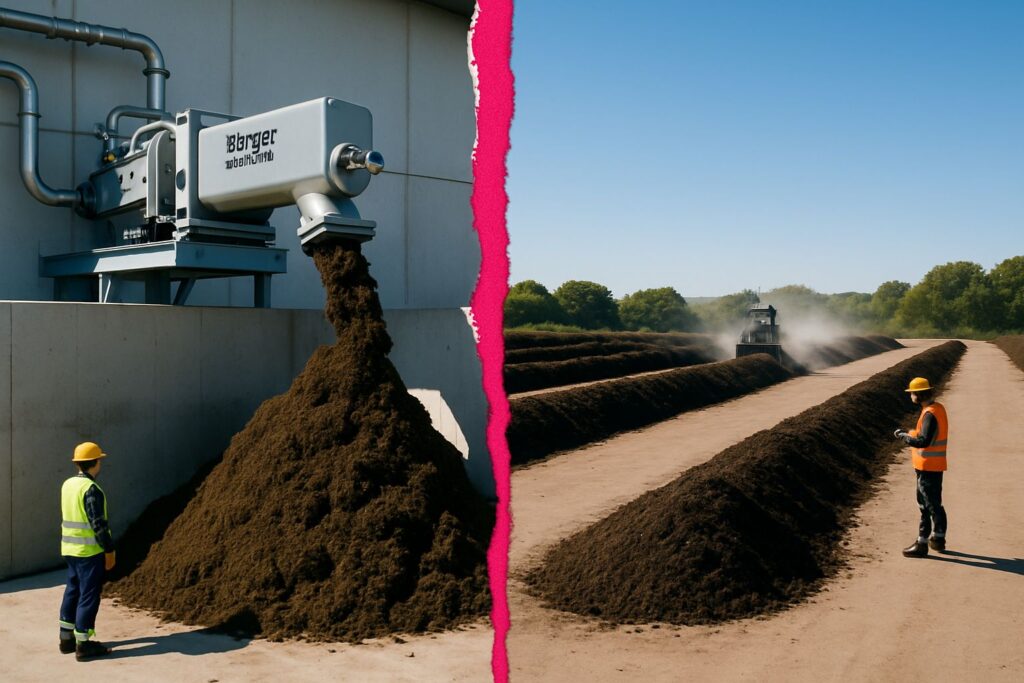
Whole Digestate or Separation: Is Separation Always Better?
No.
Separating digestate can be very useful, but separation should solve a problem. It should not automatically be treated as an upgrade.
One of the advantages of whole digestate is its simplicity.
The AD plant produces one material. That material is stored, mixed as necessary, pumped and spread.
There is no separator to operate, no separate fibre storage system to manage and no need to organise two different land-application streams.
Where the farm has sufficient nearby land and suitable spreading equipment, whole digestate can therefore be entirely rational.
WRAP’s UK industry work has shown that both approaches are commonplace: digestate is widely used on agricultural land in whole, fibre and liquor forms, and separation is a management choice rather than an inherent requirement of AD.
Reasons to Keep Digestate Whole
Keeping the material whole may make sense where:
- there is a substantial land bank close to the AD plant;
- whole digestate can be pumped directly from storage to nearby fields;
- both crop nutrients and residual organic matter are wanted;
- phosphorus levels in receiving soils permit continued application;
- there is no economic reason to export a concentrated solids fraction;
- the existing storage system is designed for whole digestate; and
- the cost and complication of separation would provide little additional benefit.
Reasons to Separate Digestate
Separation becomes more attractive when there is a practical reason to put nutrients into different physical forms.
For example:
- liquid nitrogen needs to be applied to growing crops;
- phosphorus needs to be moved away from land with high soil-P indices;
- solid material needs to be transported farther than would be economic for whole digestate;
- liquid handling equipment performs better with reduced solids;
- storage configuration favours separate liquid and solid streams;
- the fibre has an alternative agricultural, horticultural or soil-conditioning market; or
- further nutrient recovery or digestate processing is planned.
This last point can be particularly important.
Separating out a phosphorus-rich solid fraction can make it economically more realistic to transport that phosphorus farther from the AD plant, because far less water needs to travel with it.
Whole Digestate and Umbilical Spreading
One important reason not to dismiss whole digestate is the development of high-capacity pumping and umbilical spreading systems.
Instead of repeatedly driving loaded tankers across the field, digestate can be pumped from a store, reception point or temporary nurse tank through flexible pipework to the spreading tractor.
The tractor then applies the digestate through equipment such as a dribble bar, trailing hose, trailing shoe or injector.
This changes the logistics considerably.
The vehicle travelling across the field no longer has to carry a large tanker full of digestate.
That can reduce repeated heavy tanker traffic and associated compaction or rutting risks, particularly where digestate is supplied from a suitable field-edge or remote pumping location.
Environment Agency guidance includes umbilically supplied shallow injection as an application system and notes that it can place material into the upper soil while reducing volatilisation, nutrient loss and odour.
Advantages of Umbilical Application of Whole Digestate
- High application capacity: large volumes can be transferred without repeatedly filling a field-going tanker.
- Lower field weight: the spreading tractor is not carrying the entire digestate load.
- Potentially less compaction: especially compared with repeated movement of heavily loaded tankers.
- Suitable for low-emission application: the umbilical can feed trailing hose, trailing shoe or injection systems.
- Whole digestate can remain whole: avoiding separation purely to make land application possible.
- Good fit where land is concentrated around the AD plant: pumping can replace a significant amount of tanker transport.
Disadvantages and Limitations of Umbilical Systems
Umbilical spreading is not universally appropriate either.
Practical limitations include:
- the cost of pumps, hose, reels and specialist applicators;
- the need for sufficient pumping capacity;
- wear and risk of hose damage;
- management of road crossings, gateways and field boundaries;
- limitations imposed by distance and topography;
- the need to keep digestate sufficiently homogeneous and pumpable;
- weather and soil conditions still determining when spreading is acceptable; and
- greater organisational complexity when moving between disconnected land parcels.
Where fields are dispersed many kilometres from the plant, road tankers or separate transport arrangements may still be necessary.
So again there is no universally correct solution.
The economics of whole digestate are heavily influenced by the relationship between the AD plant, storage location, land bank and spreading equipment.
Digestate Separation Changes Nutrient Geography
This may be the most important practical consequence of separation.
It does not merely produce a thinner liquid and a thicker solid.
It allows the operator to manage different nutrients differently.
After separation:
- much of the readily available nitrogen remains with the liquid;
- much of the potassium also remains soluble and therefore stays largely with the liquid;
- a greater proportion of phosphorus is associated with the solids; and
- more of the residual dry matter and organic material is concentrated in the fibre.
This can be extremely valuable on farms where phosphorus distribution is becoming a constraint.
A nitrogen-rich liquor can potentially be used on fields that need nitrogen without applying exactly the same nutrient ratio contained in whole digestate.
Meanwhile, the more transportable phosphorus-rich fibre can be directed to lower-P soils or exported farther from the AD plant.
This is one reason why separation can improve nutrient management even though it does not create any new nutrients.
It changes their physical distribution and therefore the farmer’s ability to put them where they are actually needed.
How Does Whole Digestate Compare With Compost?

“Compost – Wikipedia” from en.wikipedia.org and used with no modifications.
Whole digestate is the digestate form that makes a simple digestate-versus-compost comparison particularly difficult.
Unlike separated liquor, it contains both nutrient-rich liquid and residual fibrous matter.
It therefore supplies readily available nutrients while also returning organic material to soil.
That makes whole digestate a broader amendment than liquid digestate alone.
Nevertheless, the organic fraction in digestate has already undergone anaerobic decomposition. Some of the readily degradable carbon has been converted into methane and carbon dioxide during digestion.
Mature compost, in contrast, has been deliberately aerobically stabilised.
So although both add organic matter, equal fresh-weight applications should not be assumed to have equal effects on long-term soil organic matter.
Compost will normally have the stronger role where the primary objective is building stable soil organic matter.
Whole digestate will normally have the stronger role where the objective is to combine available nutrient supply with some return of residual organic material.
How Does Liquid Digestate Compare With Compost?
This is the easiest comparison because the two materials occupy quite different positions.
Separated liquor is predominantly a fertiliser.
Mature compost is predominantly a soil amendment with fertiliser value.
If the crop requires readily available nitrogen during active growth, liquid digestate can provide substantial value.
If the soil needs stable organic carbon, better aggregation, improved water-holding characteristics or long-term structural improvement, compost is usually the more appropriate material.
UK field trials have repeatedly demonstrated this distinction. WRAP’s DC-Agri programme found food-based digestate to be a valuable nitrogen fertiliser, while repeated compost applications increased soil organic matter particularly effectively.
How Does Digestate Fibre Compare With Compost?
This is the most interesting comparison of all.
Separated fibre and compost can look superficially similar because both are solids-rich organic amendments.
Both can add organic material and nutrients. Both can be spread using solid-manure handling equipment. Both may have soil-conditioning value.
But their histories are fundamentally different.
Digestate fibre has been anaerobically digested and mechanically separated.
Compost has undergone an aerobic stabilisation process.
As a result, compost will normally be the more stabilised material.
Digestate fibre may still contain readily biodegradable organic matter and ammoniacal nitrogen. This helps explain why UK ammonia guidance treats separated digestate fibre as a material requiring careful incorporation after spreading rather than simply assuming it behaves like mature green compost.
Fibre can, however, be composted after separation. That produces an interesting hybrid route:
AD first extracts renewable energy; subsequent composting then further stabilises the fibre for use as an organic soil amendment.
A More Useful Four-Way Comparison
| Characteristic | Whole Digestate | Separated Liquor | Digestate Fibre | Mature Compost |
|---|---|---|---|---|
| Main role | Combined nutrient fertiliser and organic amendment | Liquid nutrient fertiliser | Organic amendment plus nutrients | Stable soil amendment plus nutrients |
| Readily available N | High to moderate | Usually highest relative importance | Lower proportion than liquor | Usually relatively low |
| Organic matter | Present | Relatively low | Concentrated relative to liquor | High and relatively stable |
| Phosphorus | Retained in complete nutrient mix | Reduced relative to whole digestate after separation | Often concentrated relative to liquor | Variable; must be included in nutrient planning |
| Physical form | Pumpable slurry | Liquid | Solid/semi-solid, potentially stackable | Stackable solid |
| Transport efficiency | Poorer over long distances because much water is moved | Poor over long distances unless nutrients justify it | Better than whole digestate for nutrient export | Better than liquid materials, although still bulky |
| Typical spreading | Tankers or umbilical systems with low-emission applicator | Tankers or umbilical systems with trailing hose/shoe or injection | Solid manure spreader | Solid manure/compost spreader |
| Best fit | Nearby land requiring both nutrients and organic matter | Targeted crop nutrient supply | Organic matter/P redistribution and export | Long-term soil condition and organic matter building |
What Does Long-Term Research Say About Soil Health?
The comparison becomes particularly important when we move beyond fertiliser value and look at the soil itself.
Long-term trials are much more valuable here than short pot studies because changes in soil carbon, aggregation, porosity and biological activity develop over many years.
The CRUCIAL field experiment in Denmark, which we have discussed previously on this site, provides more than two decades of evidence on repeated applications of recycled organic amendments.
The experiment has included composted household organic material, cattle slurry, degassed sewage sludge, mineral fertilisers and other nutrient sources.
The latest published work reported substantial improvements from several carbon-rich recycled amendments in indicators including:
- soil organic carbon;
- cation exchange capacity;
- porosity;
- water content at field capacity;
- microbial activity;
- bulk density; and
- clay dispersibility.
There is an important lesson here for any digestate-versus-compost comparison.
A material can be an excellent fertiliser without necessarily being the best material for building soil organic matter.
Likewise, an amendment that produces a slower immediate crop response may still be extremely valuable because it changes the soil itself.
We should therefore avoid ranking digestate and compost by crop yield alone.
Digestate Nutrients: Timing Matters
The high plant availability of digestate nitrogen is both an advantage and a management responsibility.
If applied while a crop can use the nitrogen, digestate can replace manufactured fertiliser.
If applied at the wrong time, nitrogen can instead be lost through ammonia emissions, nitrate leaching or run-off.
WRAP’s UK field research found a major difference between well-timed spring applications and poorly timed autumn applications of food-based digestate. This is why nutrient availability should be treated as an asset to manage rather than a licence to apply digestate whenever storage space needs freeing.
Spreading Method Matters Almost as Much as Digestate Type
For liquid and whole digestate, the value reaching the crop depends heavily on application technique.
Low-emission techniques such as:
- trailing hose;
- trailing shoe;
- shallow injection; and
- appropriate direct injection
reduce the surface area exposed to the air and can reduce ammonia loss compared with high-emission broadcast application. UK agricultural guidance specifically recommends these approaches for slurry and digestate. citeturn835058search3
That point also reinforces the importance of the whole-digestate option.
A farm with a suitable pump, umbilical distribution system and low-emission applicator may be able to use whole digestate efficiently without first separating it.
Conversely, separation may allow a farm to use lighter liquor through precision spreading systems while handling the fibre separately.
Storage Is Part of the Digestate Decision
The choice between whole and separated digestate cannot be made solely by looking at nutrient analyses.
Storage matters.
Whole digestate requires liquid storage for the entire digestate volume.
After separation, much of the volume remains as liquor and still requires liquid storage, but a portion becomes stackable fibre.
That may ease pressure on liquid storage and provide more flexibility, but it creates another storage stream that also needs appropriate management.
The fibre must remain sufficiently dry and stackable; if it takes on enough water to behave as a slurry again, the handling advantage is lost. UK guidance emphasises the need to protect separated stackable material from rainfall.
Transport Economics Can Determine the Best Option
Digestate is bulky.
That sounds obvious, but it has major consequences for how AD plants are designed and operated.
If the receiving farmland surrounds the plant, pumping whole digestate may be entirely sensible.
If suitable land is farther away, the economics change.
Hauling whole digestate means hauling water.
Separating out fibre can make nutrients associated with those solids substantially easier to move economically.
This is particularly useful when phosphorus needs to leave the immediate land bank.
The liquid can then be used locally where nitrogen and potassium are required while the fibre travels farther.
In that situation the separator is performing a nutrient-logistics function as much as a mechanical one.
What About Soil Biology?
It is tempting to create neat statements such as:
“digestate feeds bacteria while compost feeds fungi.”
Reality is more complicated.
Microbial responses depend on feedstock, treatment, application rate, soil type, cropping system and the form of digestate used.
Separated liquor, whole digestate and digestate fibre should certainly not be expected to produce identical biological responses.
A liquid dominated by soluble nutrients is fundamentally different from a solids-rich fibre carrying more residual organic material.
Compost differs again because its organic matter has undergone aerobic stabilisation.
For an authority article, it is therefore safer and more useful to say:
the greater the quantity and persistence of usable organic carbon being returned to soil, the greater the potential for an amendment to influence soil biological and physical properties beyond simple nutrient supply.
What About Contaminants and Plastics?
Neither “digestate” nor “compost” guarantees quality.
The feedstock matters.
So do source segregation, depackaging, process control and product quality assurance.
This is particularly relevant to food-waste digestate because fragments of plastic packaging can partition preferentially into the solid fraction during processing.
That means separation can sometimes concentrate an unwanted physical contaminant at the same time as it concentrates useful solids and phosphorus.
This is one reason good food-waste depackaging and removal of physical contaminants before or during AD is so important.
Quality-assured UK digestate can be produced to PAS 110 requirements, which explicitly recognise whole digestate, separated liquor and separated fibre as digestate products.
Digestate and Compost Under UK Nutrient Rules
Regardless of physical form, digestate should not be treated as something that merely needs disposal.
It is an organic manure and nutrient source.
The same principle applies to compost.
Applications need to fit crop requirement, soil nutrient status and the relevant pollution-prevention and NVZ requirements.
That becomes particularly important after separation because the nutrient ratios of the resulting fractions are no longer the same as the starting whole digestate.
The separated liquor and fibre should therefore be analysed and managed as separate agricultural materials.
The Environment Agency specifically recommends testing separated materials and soils so application rates and timing can be calculated to match need.
When Whole Digestate May Be the Best Choice
Whole digestate may be the logical choice when:
- the receiving land is close to the AD plant;
- there is sufficient storage;
- soil phosphorus status allows the complete nutrient mixture to be applied;
- the farm needs both available nutrients and residual organic matter;
- the material can be pumped efficiently;
- an umbilical application system is available; and
- there is no clear financial or agronomic benefit from separation.
When Liquid Digestate May Be the Best Choice
Separated liquor may be preferable when:
- nitrogen supply is the primary objective;
- precision application to growing crops is required;
- soil phosphorus levels make whole-digestate applications less desirable;
- reduced solids improve pumping and spreading;
- a trailing hose, trailing shoe or injector is being used; and
- the separated fibre has a useful destination elsewhere.
When Digestate Fibre May Be the Best Choice
Fibre may be particularly useful when:
- organic matter addition is wanted;
- phosphorus needs to be moved away from the immediate AD plant area;
- a stackable product is easier to store or transport;
- liquid storage capacity is constrained;
- the fibre is destined for further composting; or
- a suitable agricultural, horticultural or land-restoration outlet exists.
When Compost May Be the Best Choice
Mature compost normally becomes particularly attractive where:
- increasing stable soil organic matter is the main objective;
- soil structure is degraded;
- water-holding characteristics need improvement;
- long-term rather than immediately available nutrient supply is wanted;
- the land does not require the readily available nitrogen loading associated with digestate; or
- a stable, readily handled soil conditioner is preferred.
Can Digestate and Compost Be Used Together?
Yes, and in many farming systems that may make more sense than viewing them as competitors.
A farm might use digestate strategically to meet crop nutrient demand while applying compost within a longer-term soil organic matter programme.
But the same could apply to whole digestate and compost, or separated liquor and compost, or fibre and compost.
There is no single prescription because the starting materials and soil requirements are different.
The important principle is that all nutrient inputs must be counted together.
Applying compost for its soil-conditioning value does not make its phosphorus disappear from the nutrient budget.
Likewise, applying fibre because it is a convenient way of exporting organic matter and phosphorus does not mean its remaining nitrogen can be ignored.
Digestate vs Compost: Which Should a Farmer Choose?
| Primary requirement | Material to consider first |
|---|---|
| Maximum flexibility without installing separation | Whole digestate |
| Pumpable nutrient supply to nearby land | Whole digestate |
| Targeted readily available nitrogen | Separated liquor |
| Low-solids application to growing crop | Separated liquor |
| Move phosphorus farther from AD plant | Separated fibre |
| Transport organic solids economically | Separated fibre |
| Build stable soil organic matter | Mature compost |
| Improve soil structure over the long term | Mature compost |
| Supply nutrients and some organic matter in one operation | Whole digestate |
| Fine-tune N and P distribution separately | Separated liquor + fibre |
The Bottom Line
Digestate versus compost is not a two-product comparison.
That is the central point.
Whole digestate, separated liquor and separated fibre can each have distinctly different roles in agriculture.
Whole digestate retains the complete nutrient and solids mixture and can be particularly effective where there is nearby land, sufficient storage and efficient pumping or umbilical spreading infrastructure.
Separated liquid digestate concentrates the management focus on readily available nutrients, particularly nitrogen, and can be well suited to precision application to growing crops.
Separated digestate fibre concentrates more of the solids, organic matter and phosphorus into a material that is easier to store and transport than whole digestate and is much closer to compost in agricultural function — although it is not the same thing as mature compost.
Compost remains the more obvious choice when the primary purpose is adding stable organic matter and improving soil condition over the longer term.
Separation therefore should not be regarded automatically as “processing digestate into something better”.
It is a management tool.
Where nutrients, land and storage requirements favour whole digestate, keeping it whole can be entirely sensible.
Where phosphorus needs to be exported, nitrogen needs to be targeted more precisely, or different outlets exist for solids and liquids, separation can create substantial value.
And where soil organic matter and long-term soil structure are the priority, mature compost may still outperform all three digestate options for that particular job.
The correct question is therefore not “digestate or compost?” It is: which form of recycled organic material supplies the nutrients and soil benefits this field actually needs, with the least avoidable cost and environmental loss?
Digestate vs Compost: Frequently Asked Questions
What are the three main forms of digestate?
The three main forms of digestate are whole digestate, separated liquid digestate or liquor, and separated solid digestate or fibre. Whole digestate contains both liquid and suspended solids. Mechanical separation divides it into a nutrient-rich liquid fraction and a solids-rich fibre fraction.
Is separated digestate fibre the same as compost?
No. Digestate fibre has undergone anaerobic digestion followed by mechanical separation. Compost has undergone aerobic stabilisation. Fibre can subsequently be composted, but fresh separated fibre should not automatically be treated as equivalent to mature compost.
Why separate digestate?
Separation allows different nutrients and physical fractions to be managed separately. Much of the readily available nitrogen remains in the liquor, while a greater proportion of solids, organic matter and phosphorus moves into the fibre. This can improve nutrient targeting, storage flexibility and transport economics.
Why would an AD plant not separate its digestate?
If adequate land lies close to the plant and whole digestate can be efficiently pumped and applied, separation may add cost and complexity without delivering sufficient benefit. Whole digestate retains the complete nutrient and organic-matter mixture and avoids operating separate fibre and liquor handling systems.
Can whole digestate be spread through an umbilical system?
Yes, provided the digestate is suitably pumpable and the equipment is designed for it. An umbilical system can pump digestate from storage or a remote supply point to a field applicator, avoiding repeated movement of heavily loaded tankers across the field. Trailing hose, trailing shoe or injection equipment can then be used for low-emission application.
Which is better for soil organic matter: digestate or compost?
Mature compost will normally be the stronger choice where increasing stable soil organic matter is the main goal. However, whole digestate and especially separated fibre also return organic material to soil and should not be treated as if digestate were simply a liquid mineral fertiliser.
Digestate vs Compost: References and Further Reading
The following sources provide further technical information on digestate quality, agricultural use, nutrient management, spreading methods and the long-term effects of recycled organic amendments on soils.
- Environment Agency – Anaerobic Digestate: Resource Framework.
Current guidance for England on when digestate produced from source-segregated biodegradable waste can achieve end-of-waste status, including requirements relating to PAS 110 certification and appropriate use.
Anaerobic Digestate Resource Framework. - WRAP – BSI PAS 110: Producing Quality Anaerobic Digestate.
Guidance on the quality specification for anaerobic digestate, including whole digestate, separated fibre and separated liquor.
BSI PAS 110: Producing Quality Anaerobic Digestate. - WRAP – Digestate and Compost in Agriculture (DC-Agri) Project Reports.
UK field-trial evidence on the fertiliser value, crop response, soil effects and safe agricultural use of quality digestate and compost.
Digestate and Compost in Agriculture – DC-Agri Project Reports. - Defra – Code of Good Agricultural Practice for Reducing Ammonia Emissions.
Guidance covering storage and application of digestate and other organic manures, including trailing hose, trailing shoe and injection systems and the reduction of ammonia losses.
Code of Good Agricultural Practice for Reducing Ammonia Emissions. - Environment Agency – Landspreading: Benefit Statement Completed Example.
An official worked example that includes umbilical-supplied shallow injection and discusses reduced nutrient losses, odour and field compaction.
Landspreading Benefit Statement – Completed Example. - WRAP – Anaerobic Digestion and Composting Industry Survey.
UK industry evidence on digestate processing and agricultural use, including whole digestate, separated fibre and liquor.
Anaerobic Digestion and Composting Industry Survey. - Long-term soil health effects of human urine and other bio-based fertilizers: A comprehensive field study.
Published in Agriculture, Ecosystems & Environment in 2026, this study reports results from more than 20 years of the Danish CRUCIAL field experiment, including compost, sewage sludge, cattle slurry and mineral fertiliser treatments.
Long-term Soil Health Effects of Bio-based Fertilisers – CRUCIAL Field Study.
Note: Agricultural performance and nutrient content vary according to feedstock, digestion process, separation method, storage, treatment and local soil conditions. Farmers and land managers should base application decisions on current analysis of both the material and the receiving soil and comply with the applicable national and local regulations.