I have a small confession to make.
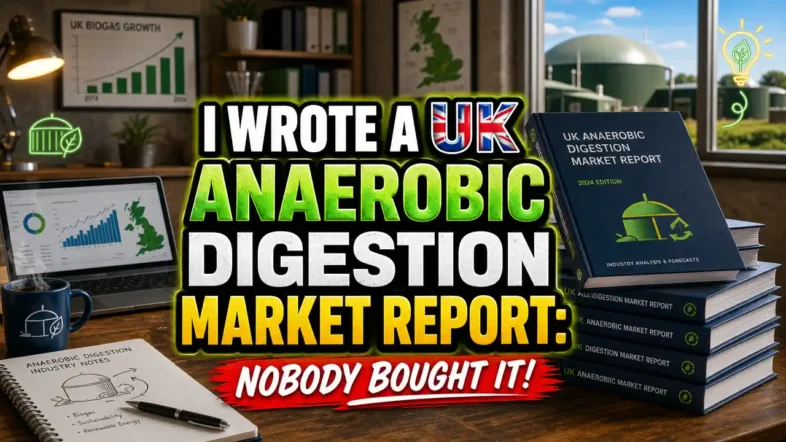
Earlier this summer, I spent the best part of three working days researching and writing a new UK Anaerobic Digestion Market Report 2026.
It runs to 65 pages. It is the first full UK AD market report I have produced since 2017, and the industry I found when I went back through the evidence was considerably more interesting – and in some respects more worrying – than I had expected.
I priced the finished report at $47.
Then I promoted it.
I issued a press release and distributed it through OpenPR. I submitted information about it to editors of online technical industry publications. I advertised it with banner ads on this blog and on anaerobic-digestion.com – something that has generated sales of my other technical publications in the past.
And the result?
Six Months, One Sale: Only one copy sold.
So rather than simply run another advertisement telling you why I think you should buy the report, I am going to try something rather different.
For September 2026 only, I am removing the fixed purchase price for readers of this blog. The normal recommended price remains $47, but you can choose what you wish to pay on Gumroad – including nothing at all.
There is something I would value more than the money at this stage: your feedback.
But before I explain that offer, I thought it might be more interesting to tell you how I actually produced the report, what surprised me while researching it, and why using AI has changed the way I can undertake this sort of independent industry research.
Can AI Really Help Write a Professional Market Report?
There is an obvious question whenever somebody says that AI was used to help produce something they are selling.
If AI helped write it, why should anyone pay for it?
I think that question misunderstands what these tools can do when they are used interactively by someone who already knows the subject.
I have worked in environmental engineering, waste management, landfill gas, biogas and anaerobic digestion for more than 30 years. That experience does not disappear when I open an AI chatbot.
Quite the opposite. AI gives me a remarkably powerful research assistant to interrogate.
The process of producing this report was not a matter of typing:
“Write me an 80-page report about the UK anaerobic digestion market.”
Had I done that, I doubt the result would have been something I would have been willing to put my name to.
Instead, I worked progressively. I supplied the subject areas and the questions I thought mattered. I asked the AI to investigate particular issues. I challenged answers that appeared weak or incomplete. I asked for sources and supporting evidence and read them. I introduced knowledge from my own experience of the industry.
One question led to another. Sections were rewritten. Conclusions were challenged. Subjects that initially looked peripheral became important enough to warrant much deeper investigation.
In other words, I used AI rather like a very fast research assistant.
But I remained the engineer and author sitting at the desk asking:
- Does that actually make sense?
- What evidence supports it?
- What are we missing?
- Does that accord with what I have seen happening in the industry?
- What does this mean for the future of UK anaerobic digestion?
That distinction matters.
AI Probably Cut the Research Time by More Than 75%
I did not keep a timesheet, but I estimate that I spent approximately 12 to 15 concentrated hours over three days researching, developing, challenging and rewriting the report.
Without AI assistance, I think the same exercise would probably have taken me at least four times as long.
That does not mean the report was somehow “written in 12 hours”. It means that many of the time-consuming mechanical parts of research – finding information, identifying sources, comparing material, organising evidence and creating drafts to interrogate – can now be accelerated enormously.
Twenty years ago, researching a report like this meant hours of web searches, opening dozens of documents, copying figures into notes, trying to remember where a particular statistic came from, and gradually constructing chapters from piles of source material.
AI changes that workflow.
What it does not change is the need for someone who understands the subject to decide which questions should be asked in the first place – and to recognise when an answer needs challenging.
There Is Another Important Lesson About AI Research
In preparing this article, I went back and independently checked every one of the more striking findings used in the report and in my original promotional material.
That exercise demonstrated something important.
AI can produce an answer that sounds convincing and is broadly based on something real, while still expressing the underlying fact too strongly or too imprecisely.
For example, figures concerning maize grown for AD needed to be distinguished carefully between England and the whole UK. Figures for the number of plants approaching the end of subsidy support needed to distinguish between different support mechanisms. And one previously quoted figure for total installed AD capacity appears to have become outdated and should no longer be used.
This is precisely why I do not regard AI as a substitute for professional judgement.
It is an extraordinarily useful research tool, but it still needs interrogating, checking and editing.
For me, that combination of AI-assisted research and decades of industry experience is much more useful than either on its own.
Three Things Surprised Me While Researching the Report
I thought I knew the UK AD industry pretty well. Nevertheless, three findings stood out.
1. The End-of-Support Problem Could Be Much Bigger Than It Looks
Hundreds of existing UK anaerobic digestion plants are moving towards the end of the financial support arrangements on which their original investment cases were based.
ADBA analysis has highlighted more than 160 plants reaching the end of support during one five-year period, followed by more than 400 during the following five years. At the same time, the UK Government has said that it does not plan to extend the Renewables Obligation as existing support begins to expire.
It is easy to describe this purely as a brownfield investment opportunity – and it certainly could become one.
But there is another side to it.
What happens to plants that are no longer economically attractive once their original subsidy support disappears?
Some will undoubtedly continue. Others may be refinanced, repowered, converted or acquired by better-capitalised operators.
But potentially losing a significant part of the UK’s existing AD infrastructure just as we need substantially more renewable gas would be an extraordinary own goal.
While researching the report, I became convinced that this end-of-support issue deserves far more attention than it currently receives.
It could become both one of the biggest threats and one of the biggest brownfield investment opportunities in British anaerobic digestion.
2. The Rise in Maize Grown for AD Surprised Me
The second finding was maize.
Official Defra statistics now available show that approximately 88,000 hectares of maize in England were being grown for anaerobic digestion in 2024, compared with about 57,000 hectares in 2018.
That is an increase of more than 50% in six years.
I find that significant because I have long supported anaerobic digestion primarily as a technology for recovering energy and nutrients from organic wastes and residues.
Growing crops principally to feed digesters becomes much harder to defend when those crops compete with food production or impose avoidable environmental impacts.
There is also an uncomfortable regulatory aspect to this.
The way waste regulations apply to purely agricultural farm digesters can make accepting food waste more complicated, due to Waste Permitting Regulations, than growing a crop specifically for the digester.
In other words, regulations intended to protect the environment can create incentives pointing in precisely the wrong direction.
The food-versus-fuel argument therefore is not something I think the AD industry should simply dismiss.
It needs confronting.
3. Moor Bioenergy Could Be Far More Important Than One New AD Plant
The most encouraging finding was the emergence of the UK’s first unsubsidised biomethane plant.
Future Biogas commissioned the Moor Bioenergy plant at Gonerby Moor in Lincolnshire in February 2025. It was developed to supply around 100 GWh of biomethane annually under a long-term commercial arrangement with AstraZeneca.
During its first year, the plant reportedly injected almost 100 GWh of renewable biomethane into the gas grid.
For me, the significance goes well beyond one plant.
If a long-term commercial offtake arrangement can make unsubsidised biomethane work in Britain, it raises an obvious question:
Where else could the model be replicated?
Britain is hardly the world’s most heavily subsidised market for anaerobic digestion. If commercially structured, subsidy-free biomethane can work here, the implications could ultimately extend well beyond the UK.
Instead of always asking:
“How much government subsidy will be required to build the next generation of biomethane plants?”
we may increasingly be able to ask:
“Under what conditions can biomethane compete commercially without subsidy?”
That is a much more exciting question.
And the UK Still Needs Much More Biomethane
This matters because the gap between today’s biomethane industry and some projections of what may ultimately be required is enormous.
NESO’s 2025 Holistic Transition pathway envisages at least 64 TWh of biomethane supply by 2050 – close to ten times current output.
That should not be confused with saying that UK law specifically requires 64 TWh of biomethane. It does not.
Net Zero is the legally binding destination. The precise mix of technologies used to reach it remains a matter of energy policy, economics and future technological development.
Nevertheless, the scale of biomethane envisaged in such a pathway demonstrates just how much further this industry could have to grow.
The Deeper I Went, the More Interesting the Questions Became
The deeper I went into the research, the less interested I became in producing another report simply predicting that the anaerobic digestion market would grow.
There are plenty of reports that will tell you that.
The interesting questions are the awkward ones.
- Can the UK realistically increase biomethane production sufficiently to make a major contribution to Net Zero?
- What happens to hundreds of existing plants as their original financial support expires?
- Why are regulatory structures making waste-fed farm AD unnecessarily difficult?
- How sustainable is increasing maize consumption by digesters?
- Could AD and nutrient recovery contribute to tackling serious nutrient problems such as those affecting Lough Neagh?
- What happens when persistent contaminants entering digestate today accumulate in agricultural soils over decades?
- Can biomethane move from being regarded as a subsidised renewable-energy niche to becoming an economically competitive part of national energy infrastructure?
Those became the questions I wanted the report to address.
So Why Has Nobody Bought It?
Well almost nobody! I did sell One copy. This is the question I cannot answer.
Perhaps $47 is too expensive.
Perhaps there are simply too many market reports competing for attention.
Perhaps people interested in anaerobic digestion have become accustomed to downloading industry reports free of charge.
Perhaps an 80-page report sounds like more information than most people have time to read.
Perhaps mentioning AI-assisted research reduces the perceived value, even though my experience is that it enables much broader investigation.
Perhaps my promotion concentrated too much on describing what was inside the report rather than explaining why I thought the findings mattered.
Or perhaps I simply have not put it in front of the right people.
I would genuinely like to know.
So rather than guessing, I have decided to run an experiment.
For September, You Decide What This Report Is Worth
The normal recommended price of the UK Anaerobic Digestion Market Report 2026 is $47.
For September 2026 only, I am removing the compulsory charge.
When you visit the Gumroad download page, you can choose what you wish to pay.
If you want to download it for $0, you may do so.
If you think it is worth $5, $10, $20, $47 or another amount, you can choose that instead.
There is no obligation to pay me anything during this September offer, and if you do, our normal full refund within 30 days promise still applies for anyone who finds that the report is not of value to them.
What I would much rather receive is something potentially more valuable:
your honest feedback after you have looked through the report.
Download the UK Anaerobic Digestion Market Report 2026 – Pay What You Wish During September
Why Am I Prepared to Give Away Something I Normally Sell for $47?
Because at the moment I have a sample size of precisely zero customers.
That tells me almost nothing.
If 50, 100 or more people download the report during September, however, I have an opportunity to learn.
I want to know which sections readers find valuable, which they find weak, what I have overlooked, what needs explaining better and whether there are subjects that deserve additional coverage.
And if the criticism is justified, I can do something about it.
One advantage of selling a digital report through Gumroad is that I can revise and improve the publication. If feedback reveals a weakness, I can amend the report, add material and issue an updated version. Existing readers can then be invited to return to the download page and obtain the improved edition.
That makes this September offer useful to me as well as to readers.
I would rather have a widely read report that becomes better through informed criticism than an $47 report sitting on a virtual shelf with nobody reading it.
What I Would Particularly Like You to Tell Me
If you download it, I would welcome comments on any aspect of the report, but particularly these questions:
- Is the report genuinely useful to somebody working in or studying the AD and biomethane sector?
- Which chapters provide the most value?
- Which sections are too general or need more evidence?
- Is there anything important that I have missed?
- Would you normally pay $47 for this type of independent specialist report?
- If not, what would prevent you from buying it?
- Does knowing that AI was extensively used as a research assistant increase or reduce your confidence in the publication?
- After reading it, what do you think a fair price would be?
Please do not feel obliged to be polite.
If something is wrong, weak or unconvincing, I would rather know.
AI Has Not Removed the Need for Expertise. It Has Made Expertise More Productive.
That, ultimately, may be the most interesting lesson I took from producing this report.
AI allows me to investigate more questions, compare more information, test more assumptions and explore subjects that I might previously have excluded simply because researching them would take too long.
But somebody still needs to recognise when an answer looks wrong.
Somebody still has to ask the next question.
And somebody ultimately has to decide what the evidence means.
After more than 30 years working around waste management, landfill gas, biogas and anaerobic digestion, I find the combination of professional experience and AI-assisted research enormously productive.
Now I would like you to judge the result.
During September 2026, download the report and pay whatever you think appropriate – including nothing.
Then, if you can spare a few minutes, please tell me what you think. Use the star rating on the GumRoad website, or reply here in the comments.
Get the UK Anaerobic Digestion Market Report 2026 – September Pay-What-You-Wish Offer

Normal recommended price: $47. For September 2026 only, the minimum payment has been reduced to $0. The UK Anaerobic Digestion Market Report 2026 is independently published by IPPTS Associates.