Food vs Fuel and Anaerobic Digestion: Do Energy Crops Compete With Food?
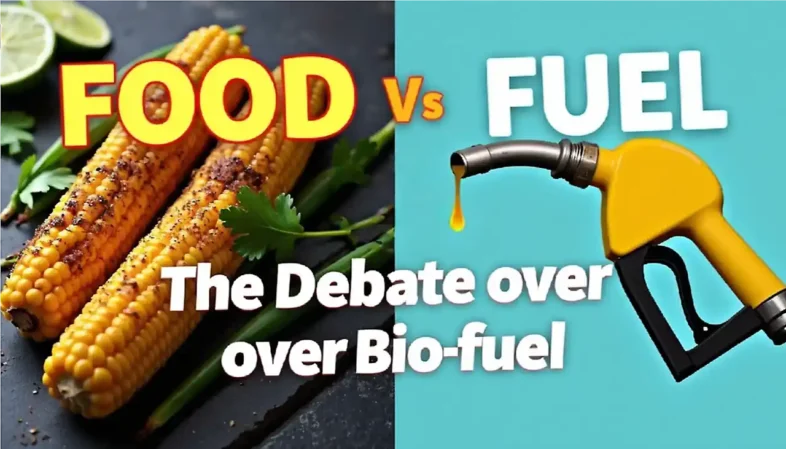
The food vs fuel debate asks a deceptively simple question: should productive agricultural land be used to grow crops for people and livestock, or should some of that land be used to produce renewable energy?
For anaerobic digestion, the answer is sometimes presented as equally simple.
Supporters of crop-fed biogas may argue that producing renewable gas from crops strengthens farm businesses, improves energy security and helps replace fossil fuels. Critics respond that growing maize, cereals or other crops for an anaerobic digester uses land, fertiliser, water and farming capacity that could have been used to produce food.
Both arguments contain some truth.
The mistake is treating every anaerobic digestion plant as if it were doing the same thing.
There is an enormous difference between making biogas from unavoidable food waste, cattle slurry or crop residues and deliberately growing a high-yielding crop on productive agricultural land primarily to feed an anaerobic digester.
Understanding that distinction is the key to making sense of food vs fuel and anaerobic digestion.
What Does “Food vs Fuel” Mean?
The food-versus-fuel debate developed largely around the rapid growth of first-generation biofuels made from crops such as maize, wheat, sugar cane and oilseeds. These were called biofuels, because they were chemically converted into ethanol and almost all was used as an additive to mineral based fuels for transport use.
Production of bioethanol has been reducing in recent years, while fuel (biogas) from the anaerobic digestion process has been rising.
The concern is not necessarily that every tonne of crop sent to energy production would otherwise have been eaten directly by a person.
Agricultural markets do not work quite that simply.
The more important question is one of opportunity cost and land use.
If productive farmland is occupied by a crop grown specifically for energy, what might otherwise have been grown there?
Could it have produced wheat, vegetables, animal feed or another food crop? Could greater demand for energy crops indirectly cause food production to move somewhere else? And could increased competition for agricultural commodities contribute to higher food or animal-feed prices?
Those are legitimate questions.
But applying them indiscriminately to all biogas production makes little sense.
Anaerobic Digestion Is Not Necessarily a Food vs Fuel Technology
Anaerobic digestion is a biological process, not a particular feedstock.
A digester can process many different organic materials. For a more detailed overview, see our guide to anaerobic digestion feedstocks and feed materials.
Typical feedstocks include:
- cattle and pig slurry;
- poultry manure;
- source-separated household food waste;
- commercial and catering food waste;
- food and drink manufacturing residues;
- crop residues;
- spoiled or rejected agricultural produce;
- sewage sludge;
- grass and other vegetation; and
- purpose-grown maize, rye, beet and other energy crops.
Those feedstocks have very different implications for food production.
A tonne of unavoidable food waste entering an AD plant is clearly not equivalent to a tonne of maize deliberately grown for that plant.
That distinction should be at the centre of the food-versus-fuel discussion.
Food Waste to Biogas: Food vs Fuel Does Not Really Apply
Once food has genuinely become unavoidable waste, the choice is no longer between eating it and turning it into energy.
The food has already been lost from the human food chain.
The relevant question becomes what we should do with the waste.
Where suitable food waste is collected separately and sent to anaerobic digestion, the process can recover renewable energy while retaining much of the nutrient value in digestate.
That is fundamentally different from growing food-quality crops specifically to make gas.
Of course, preventing food waste should come first. Edible surplus food should, wherever practical and safe, remain in the human food chain. Food that can no longer be used by people may sometimes have other beneficial uses before digestion.
But once material has genuinely become unavoidable organic waste, recovering energy and nutrients through AD can form part of a circular waste-management system.
Calling that “food versus fuel” misses the point.
Manure and Slurry Are Different Again
The same reasoning applies even more strongly to livestock manure and slurry.
Cows are not being reared to produce slurry for digesters. The slurry already exists as a consequence of food production.
Anaerobic digestion can capture some of the energy remaining in that material while providing controlled manure treatment. The resulting digestate can then return nutrients to agricultural land.
There can therefore be a particularly strong case for the anaerobic digestion of manure and farm slurries.
The difficulty is that slurry and manure generally have a relatively low energy density. A farm digester may consequently obtain considerably more gas by co-digesting them with higher-energy materials.
That is where the debate becomes more complicated.
If those additional materials are wastes or residues, there may be little conflict.
If they are purpose-grown crops, the land-use question returns.
Crop Residues Are Not the Same as Purpose-Grown Energy Crops
Another distinction often lost in the debate is that crop material does not necessarily mean food diverted to energy.
Agriculture produces residues and by-products as well as saleable food and feed.
Where genuinely surplus crop residues can be collected sustainably and digested, they may provide renewable energy without requiring a corresponding area of farmland to be taken out of food production.
There are practical limitations.
Fibrous materials such as straw can be difficult to digest because lignocellulose is relatively resistant to biological degradation. Handling, preprocessing and digester mixing can also become more demanding.
Nevertheless, making better use of agricultural residues is very different in principle from planting a field specifically to produce digester feedstock.
The Difficult Case: Maize Grown Specifically for Biogas
Maize illustrates why the food-versus-fuel criticism cannot simply be dismissed.
Maize silage is an excellent anaerobic digestion feedstock.
It can produce high biogas yields, it can be stored as silage, its characteristics are reasonably predictable and farmers understand how to grow and harvest it efficiently.
Those characteristics made maize particularly attractive during the expansion of agricultural biogas in countries such as Germany.
However, whole-crop maize silage grown for AD is an energy crop.
The grain (cob) is not normally harvested for human food first and the remainder then sent to the digester. The whole plant with the corn cobs is harvested as a crop for silage.
If that maize occupies productive agricultural land that could have produced food or animal feed, there is a genuine land-use trade-off.
That does not automatically make maize-fed AD environmentally unacceptable.
It does mean we should acknowledge what is happening rather than arguing that there is no food-versus-fuel issue at all.
For a more detailed comparison of crop performance, see our article on biogas yield from maize silage versus grass silage. That comparison also considers the environmental and agricultural disadvantages associated with intensive maize production.
Why Farmers Grow Energy Crops for AD
There are good operational reasons why farmers and biogas developers have used purpose-grown crops.
Waste feedstocks are unpredictable.
Their composition changes. Supplies can disappear. Contamination may occur. Competing AD plants may bid up gate fees or feedstock prices.
A crop grown under contract provides something extremely valuable to a biogas project: feedstock security.
The operator knows approximately how many tonnes will be available, when they will arrive, how they will behave in the digester and roughly how much gas they should produce.
That certainty can help make a project financeable.
This issue is considered in more detail in our article on finding the right feedstock for anaerobic digestion plants, including why predictable energy crops can be commercially attractive where waste-feedstock availability is uncertain.
Consequently, it is too simplistic to portray farmers growing energy crops as merely choosing fuel instead of feeding people. The crops may provide stability to a renewable-energy business and diversify farm income.
But economic usefulness does not remove the land-use consequences.
Both considerations need to be recognised.
What About Catch Crops and Crop Rotations?
This is where the binary phrase “food versus fuel” becomes particularly inadequate.
Not every energy crop necessarily replaces a food crop.
Some crops can potentially be incorporated into rotations, grown between principal food crops or used to improve the overall productivity and resilience of the farming system.
Advocates of these systems argue that properly integrated biogas cropping can coexist with food production rather than simply displacing it.
There is merit in that argument.
A field is not necessarily committed permanently to either food or energy. Agricultural land performs multiple functions, and thoughtful crop rotations can provide soil, agronomic and environmental benefits.
However, claims should be judged on the actual farming system.
Calling something a catch crop or rotational crop does not by itself prove that there has been no displacement of food production.
A catch crop is a fast-growing, short-term crop planted between successive main cash crops during periods when the soil would otherwise be bare, usually over autumn and winter.
The appropriate question remains:
What would have happened on this land, and to the farming system as a whole, if the crop had not been grown for AD?
Digestate Changes the Equation – But Does Not Eliminate the Debate
Anaerobic digestion also produces digestate.
That matters because AD is not simply an energy-extraction process.
Nitrogen, phosphorus, potassium and other plant nutrients entering a digester are largely retained in the digestate rather than disappearing with the biogas.
When digestate is properly managed and used as a fertiliser, it can displace some manufactured fertiliser and return nutrients and organic material to agricultural land.
For a mixed farming system, that recycling can be valuable.
It is one reason why analysing AD solely in terms of the crop entering the digester can give an incomplete picture.
But digestate does not make the original land requirement disappear.
A poorly conceived energy-crop system does not automatically become sustainable because its digestate is returned to land.
The whole agricultural and energy system needs to be considered.
The Environmental Question Goes Beyond Food
Food production is not the only consideration when deciding whether land should be used for energy crops.
Large areas of intensive monoculture can have consequences for:
- biodiversity;
- soil condition;
- erosion;
- pesticide use;
- fertiliser requirements;
- water quality;
- landscape character; and
- greenhouse gas emissions from cultivation and harvesting.
Conversely, well-designed rotations, cover crops and perennial energy crops may in some circumstances provide agronomic or environmental benefits.
That is why simply labelling a feedstock “renewable” tells us surprisingly little about whether its use is sustainable.
A Practical Hierarchy for AD Feedstocks
Rather than asking whether crops for anaerobic digestion are universally good or bad, it is more useful to think in terms of a feedstock hierarchy.
Where technically, economically and environmentally appropriate, the strongest case is generally for materials that already exist and need to be managed.
1. Unavoidable Organic Wastes
Food-processing residues, unavoidable food waste and other biodegradable wastes can provide energy without requiring crops to be grown specifically for the digester.
2. Manures and Slurries
These are unavoidable products of livestock agriculture and can benefit from controlled treatment and methane capture.
3. Agricultural Residues and By-products
Where removal is agronomically sustainable, residues can provide additional renewable energy without necessarily competing directly with food production.
4. Genuine Catch and Rotational Crops
These can have a role where they complement rather than materially displace food production.
5. Purpose-grown Energy Crops
These deserve the greatest scrutiny, particularly when grown on productive agricultural land that could otherwise contribute to food or animal-feed production.
This is not an absolute rule.
Local circumstances matter.
But it is a much more useful starting point than pretending that all biomass has the same sustainability credentials.
Should We Stop Using Crops in Anaerobic Digesters?
Not necessarily.
There are situations where a relatively small proportion of a consistent crop feedstock can make a manure- or waste-based digester considerably easier to operate.
There may also be farming systems where rotational or intermediate crops provide energy without significantly reducing food production.
What should be questioned is the assumption that maximising biogas production per hectare is automatically the best use of agricultural land.
Biogas yield is only one measure of performance.
Food production, biodiversity, soil health, nutrient management, greenhouse-gas reduction and farm resilience also matter.
Food First, Waste to Energy Next
A sensible long-term principle for anaerobic digestion is therefore neither “never use crops” nor “food versus fuel is a myth”.
Food-quality agricultural resources should primarily support food production, while anaerobic digestion should increasingly extract renewable energy from wastes, manures, residues and genuinely sustainable cropping systems.
That still leaves an important role for agricultural AD.
Indeed, it arguably gives anaerobic digestion a stronger environmental case.
The technology is exceptionally well suited to materials society already needs to manage: manure, food waste, agricultural residues and organic industrial wastes.
Using those resources to produce biogas or biomethane while recycling nutrients through digestate is fundamentally different from creating a large new demand for food-quality crops simply because they produce high methane yields.
The Food vs Fuel Debate Needs More Nuance
The original food-versus-fuel argument was powerful because it reduced a complicated question to four words.
Unfortunately, agricultural systems are not that simple.
Some biogas competes with food production.
Much of it does not.
A manure digester, a municipal food-waste AD plant and a large installation predominantly supplied by purpose-grown maize may all use anaerobic digestion, but their relationship with agriculture and food security is profoundly different.
The challenge for the biogas industry is therefore not to deny the food-versus-fuel issue.
It is to demonstrate that AD can increasingly operate without creating unnecessary competition with food production.
Waste-derived feedstocks, manure, agricultural residues, responsible crop rotations and careful use of digestate provide a route towards that objective.
Anaerobic digestion has an important role in renewable energy and sustainable organic-waste management.
But renewable energy should complement sustainable food production, not needlessly compete with it.
Frequently Asked Questions (FAQs)
What does the “food vs. fuel” debate mean in relation to anaerobic digestion?
The food vs. fuel debate centers on whether productive agricultural land should be used to grow crops for fuel rather than food or livestock feed. In anaerobic digestion (AD), it questions whether growing crops like maize exclusively to feed biogas plants competes with food production, increases land costs, or impacts food prices.
Does all anaerobic digestion contribute to the food vs. fuel issue?
No. Anaerobic digestion can process a wide variety of organic materials. Using unavoidable food waste, livestock manure, or sewage sludge does not compete with food production because those materials are already outside the human food chain or exist as by-products of farming. The debate primarily applies when high-yielding crops are grown on fertile land solely to feed digesters.
Why do farmers grow purpose-grown energy crops like maize for biogas?
Purpose-grown crops provide feedstock security and operational predictability. Unlike waste streams, which can fluctuate in availability and quality, silage crops like maize offer consistent, high-gas yields that help stabilize digester operations and satisfy financial backing requirements.
How do catch crops and crop rotations fit into the debate?
Not all energy cropping replaces food crops. Sequential or cover crops grown between main food crops can produce energy feedstock while helping prevent soil erosion, improving soil health, and diversifying farm income without displacing primary food production.
What role does digestate play in agricultural sustainability?
Digestate is the nutrient-rich organic byproduct of the AD process. When returned to farmland as a natural biofertilizer, it recycles essential plant nutrients (like nitrogen, phosphorus, and potassium) back into the soil, reducing the need for synthetic fertilizers.
What is the best hierarchy for selecting AD feedstocks?
To minimize land-use conflict, feedstock selection should prioritize materials in the following order:
- Unavoidable organic wastes (food processing, municipal food waste)
- Manures and slurries (livestock by-products)
- Agricultural residues (surplus stalks, straw, or by-products)
- Catch and rotational crops (grown between main harvests)
- Purpose-grown energy crops (should receive the highest sustainability scrutiny)
Related Reading
- Anaerobic Digestion Feedstock and List of Feed Materials
- Biogas Yield from Maize Silage vs Grass Silage: Pros and Cons
- Anaerobic Digestion of Manure
- Finding the Right Feedstock for Anaerobic Digestion Plants
About the author: Steve Last is a Chartered Civil and Environmental Engineer with more than 30 years’ experience in waste management, landfill gas, anaerobic digestion and biogas-related environmental engineering.