
By selling RGGOs, biogas plant owners can now get a higher price for biogas or biomethane made from waste organics (biowaste) than for biogas or biomethane which uses food crops in their feedstock.
You know, unless you make the most of RGGOs, the frustrating part of selling biomethane in the UK: the physical gas becomes “just gas” the moment it hits the network, so the value of the renewable story can get lost.
This is where guarantees of origin matter in practice. Renewable Gas Guarantees of Origin (RGGOs) let you separate the green attribute from the commodity gas price, so buyers can pay for verified sustainability rather than a promise.
In this page, I'll spell out what RGGOs are, how the scheme works end-to-end, and the commercial levers you can pull to improve biogas ROI without risking weak claims.
Read on.
Key Takeaways
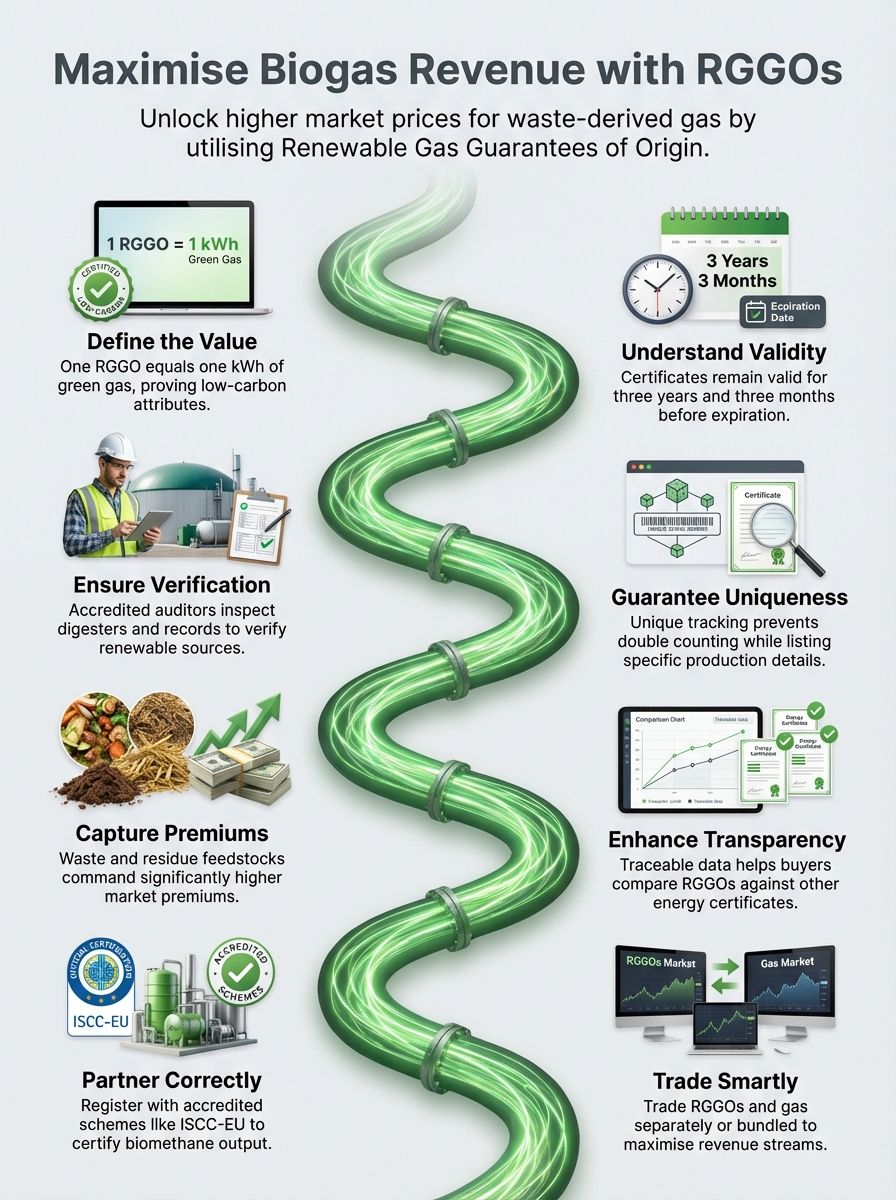
- One RGGO equals one kilowatt-hour (kWh) of biomethane produced and injected, issued under the Green Gas Certification Scheme (GGCS).
- RGGOs expire after 3 years and 3 months if they are not cancelled (retired) to an end-use consumer, so good certificate housekeeping protects revenue.
- Since 9 August 2024, biomethane RGGOs have used the G-REX registry, which supports more certificate data points that can influence buyer confidence and pricing.
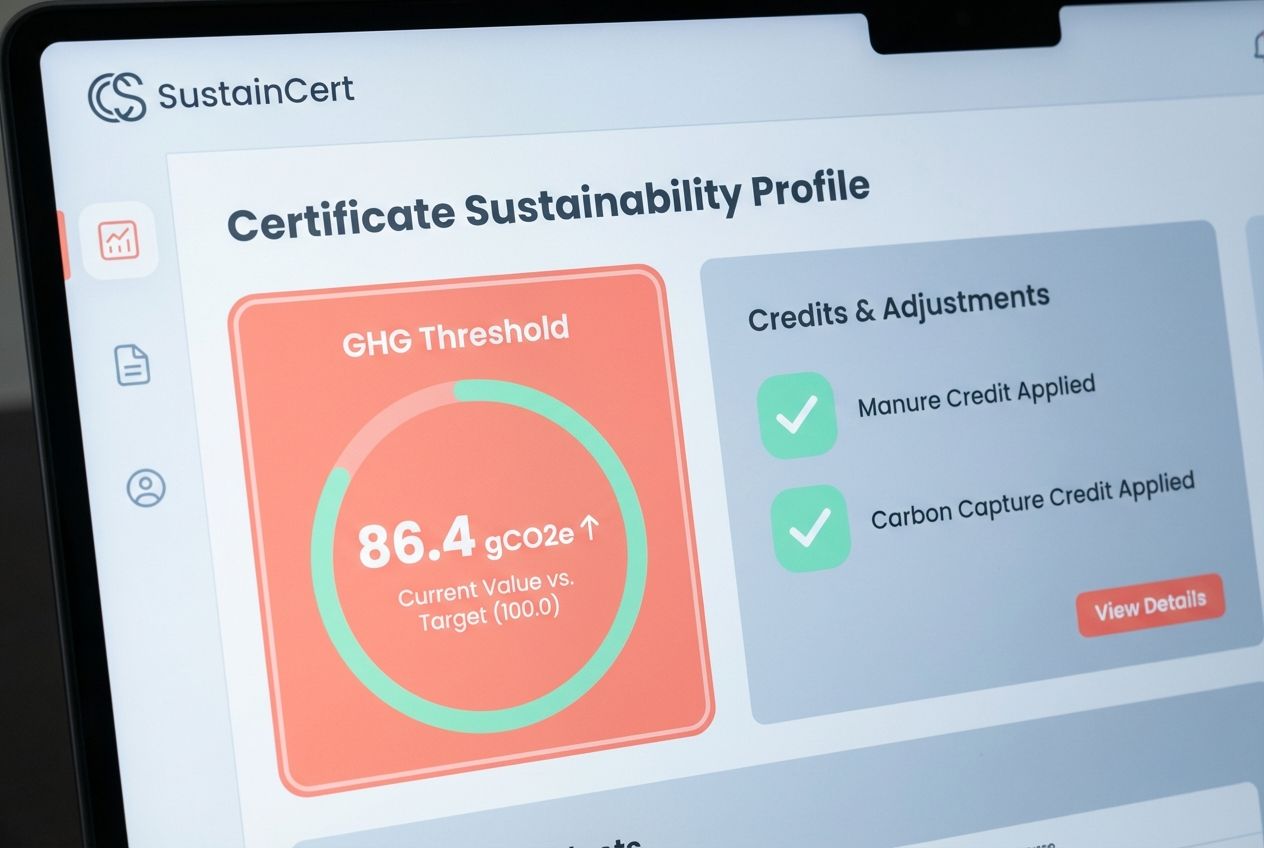
- From August 2024, RGGOs can show extra sustainability fields such as manure credit applied, carbon capture credit applied, and whether a GHG threshold was met.
- Buyers use RGGOs for sustainability reporting (including GHGP, SBTi and SECR), and it's best match the claim to what the certificate shows.

What are Renewable Gas Guarantees of Origin (RGGOs)?
One RGGO equals one kWh of green gas, and it lets a buyer claim the low-carbon attribute.
A Renewable Gas Guarantee of Origin (RGGO) is the certificate that carries the renewable and low-carbon attributes of biomethane and other “green gas” products. It is a bookkeeping instrument, not a molecule tracker.
Once you inject biomethane into the gas grid, it mixes with fossil natural gas. RGGOs solve that practical problem by letting the market trade the renewable source attribute separately from the physical gas production and supply.
That separation is also what stops double-counting. Each unit injected can only be matched to one RGGO, and once an end user cancels the certificate, it cannot be used again.
Expiry matters more than most operators expect. In the GGCS Scheme Rules (Version 4, in force from 2 July 2024), RGGOs expire three years and three months after the injection date if they have not been cancelled or withdrawn, which is why transfer and cancellation discipline is part of your revenue model, not admin.
RGGOs vs REGOs (and why the difference affects buyer expectations)
Procurement teams often mix up certificate types, especially if they already buy renewable electricity.
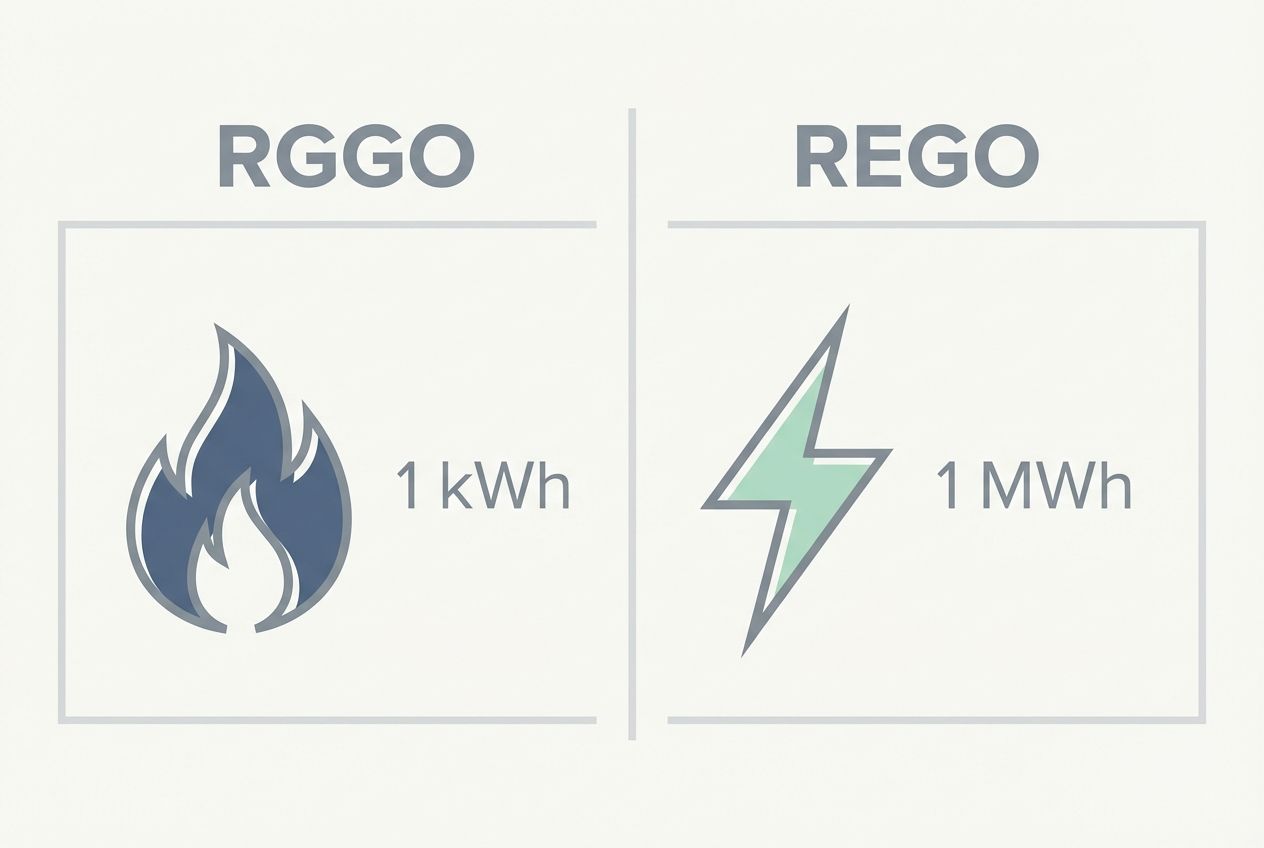
| Certificate | What it applies to | Unit size | Typical buyer use |
|---|---|---|---|
| RGGO | Renewable gas (mainly biomethane in the UK gas network) | 1 kWh | Green gas claims, supplier products, cancellation statements, sustainability evidence |
| REGO | Renewable electricity (Ofgem scheme) | 1 MWh | Electricity fuel mix disclosure and renewable electricity claims |
The practical takeaway: if a buyer's internal team is used to REGOs, they may expect the same wording, audit trail, and retirement evidence. You can speed up sales by explaining, early, what the RGGO cancellation statement proves and what it does not.
How RGGOs Work
RGGOs work because the scheme forces a tight chain of custody: production evidence creates certificates, registries record ownership, and cancellation locks the claim to one end user.
Since 9 August 2024, the GGCS has run biomethane RGGO activity through the G-REX registration database, and Ofgem's GGSS scheme information confirms that registered GGSS participants receive quarterly support payments over 15 years, with applications open until 31 March 2028.
- Prove production: you document biomethane volumes and feedstocks (for example, food waste, agricultural waste, or animal manure).
- Verify and issue: you get the metering and sustainability evidence checked, then certificates are issued per kWh.
- Transfer: you sell and transfer RGGOs through the registry to a trader, supplier, or corporate buyer.
- Cancel: the buyer (or their supplier) cancels the RGGOs to generate a cancellation statement for the reporting period they want to claim.
Certification process for biomethane producers
At the biogas plant level, your certification story is only as strong as your data. Buyers are paying for an audit trail, so the fastest way to lose value is missing, inconsistent, or late evidence.
Most producers lean on recognised sustainability frameworks or assurance approaches such as voluntary schemes (ISCC-EU, ISCC-Plus, REDCert, Better Biomass) and formal assurance processes (for example, ISAE 3000) to support claims around renewable energy sources and sustainability.
- Feedstock classification: keep your “product, residue, waste” categorisation clean, because it can change how buyers view additionality, carbon intensity, and reputational risk.
- Metering evidence: align internal logs with the injection and settlement evidence your counterparties rely on.
- GHG calculations: document your assumptions (including energy inputs and methane slip) so your numbers stand up in due diligence, not just in a sales deck.
- Remote injection: if you compress and transport biomethane for injection at a different site, build the transport emissions into your lifecycle evidence so you do not overstate “lower carbon” outcomes.
A common pitfall is treating sustainability reporting as a one-off, rather than a quarterly discipline. If you want repeatable premiums, you need repeatable evidence.
Issuance and transfer of RGGOs
Issuance is simple in concept: one RGGO per kWh injected. The commercial detail sits in how you define “eligible” output and how quickly you move certificates to a buyer who will cancel them before expiry.
In practice, you will see two measurement approaches used in certificate markets:
- Net measurement: the scheme can subtract fossil-based energy used in the production process from the eligible biomethane output for certificate issuance, which makes the certificate cleaner for buyers focused on true decarbonisation.
- Gross measurement: certificates track total output, while fossil inputs are reflected in lifecycle emissions calculations rather than subtracted from volumes.
The registry records key fields that affect buyer confidence, such as producer identity, production period dates, commissioning details, feedstock labels, and whether any production support applies to some or all output.
One RGGO equals one kWh, cancelled and logged on a Cancellation Statement.
If you sell into markets that care about “additionality” or “carbon-negative” claims, treat cancellation timing and certificate labels as commercial terms. Your buyer may pay more for tighter claims, but only if the paperwork supports it.
Benefits of RGGOs for Biogas Producers
RGGOs are valuable because they make your renewable energy attribute tradable. That helps you move from being a price taker in the commodity gas market to being paid for verified green energy.
They also give buyers a cleaner procurement workflow. Instead of trying to assess every anaerobic digestion plant in detail, a buyer can focus on cancellation statements, sustainability labels, and whether the certificate matches their risk and reporting needs.
Increased market value for green gas
The premium is not a fixed “RGGO price”. It is the result of buyer demand meeting certificate scarcity for certain attributes (for example, waste-based feedstocks, tight GHG thresholds, or clear cancellation statements).
Two practical examples you can use in sales conversations:
- Supplier-backed demand: some UK business gas products match a defined share of customer consumption with RGGOs (for example, part-matched or fully matched offerings). This creates steady certificate demand even when wholesale gas prices swing.
- Attribute-led procurement: buyers with net-zero or low-carbon energy targets often pay more for certificates that clearly show waste or residue feedstocks and a defensible carbon intensity story.
One more commercial detail that is easy to miss: the GGCS publishes scheme fees, and its fee schedule lists a RGGO cancellation fee on the party cancelling certificates to end users, plus annual participation fees for producer and trader accounts. If you are quoting prices to buyers, you will want to agree, in writing, who carries those costs and how they show up in the deal economics.
Enhanced transparency and credibility
RGGOs are more than a “green tick”. They carry structured data that lets a buyer compare options across renewable sources and make a clear choice.
Since August 2024, the GGCS has supported extra fields that can materially change how a buyer interprets the carbon story, including manure credit and carbon capture credit indicators.
GGCS emissions reporting guidance also uses decision-driving GHG thresholds that show up in the market, including 86.4 gCO2e per kWh for GGSS-aligned sustainability criteria and 125.28 gCO2e per kWh for NDRHI-aligned criteria, with RTFO-related thresholds shown in kgCO2e per MWh terms on certificates.
| Certificate field (common post-August 2024) | What it tells a buyer | How you can use it commercially |
|---|---|---|
| Manure credit applied (true/false/unspecified) | Whether manure-related negative values were applied in lifecycle GHG calculations | Helps buyers looking for stronger decarbonisation outcomes, while keeping claims precise |
| Carbon capture credit applied (true/false/unspecified) | Whether captured CO2 was counted as a negative value in lifecycle calculations | Supports carbon intensity narratives, but you must avoid implying permanent storage if it is not evidenced |
| GHG threshold met (numeric) | Whether a defined scheme threshold was met for the relevant criteria | Improves comparability across offers, which can lift close rates for procurement-led buyers |
The credibility win is simple: you give the buyer a traceable, cancellable instrument that reduces green procurement risk and helps them defend their reporting to auditors.
Steps to Maximise Biogas Revenue with RGGOs
If you want higher, repeatable prices, treat RGGOs like a product line with operations, QA, and sales enablement. The best performers do the basics relentlessly and make it easy for a buyer to cancel certificates cleanly.
- Sell the attribute, not the acronym: lead with what the buyer gets (verified renewable gas, cancellation evidence, clearer carbon footprint reporting), then explain the registry mechanics.
- Build a “claim pack”: standardise what you provide each quarter (feedstock summary, meter evidence, sustainability labels, cancellation statement format).
- Protect against expiry: plan transfers and cancellations so certificates do not sit idle while contracts and reporting cycles drift.
- Separate support from value: where production support applies to part of your output, make that split obvious so buyers do not over-claim additionality.
On-site energy optimisation can also lift biogas ROI. Many plants reduce unit costs by tightening parasitic load and using smart controls, and some sites also evaluate battery storage systems where they have CHP or grid-constrained electrical export.
Partnering with accredited schemes
Start with the scheme path that matches your buyer set.
- Corporate ESG and procurement buyers: prioritise the clarity of your RGGO labels, cancellation statements, and chain-of-custody story.
- Subsidy-aligned buyers: ensure your GGSS or legacy NDRHI evidence is complete, because those criteria can shape what appears on certificates and what buyers believe they are buying.
C-Zero can support you with GGCS process set-up, certificate management, and trading execution, including aligning voluntary scheme evidence with what the registry will actually display.
Trading, contracts, and risk management in the RGGO market
Think of RGGO monetisation as a contract design problem as much as a trading problem. You can sell the physical gas and the certificates together, or you can separate them, but either way you must define cancellation, timing, and claims.
| Deal lever | What you set | Why it affects price |
|---|---|---|
| Cancellation timing | Monthly, quarterly, or annual cancellation to match a buyer's reporting cycle | Reduces buyer admin risk, which often improves willingness to pay |
| Attribute tightness | Waste-only, manure content, carbon capture credit, GHG threshold labels | Stronger attributes often win better pricing and faster approvals |
| Claim guardrails | What the buyer can say in public claims and reporting, and what they cannot | Prevents disputes, protects renewals, and keeps you out of reputational fire drills |
If you supply biomethane for transport claims, keep the value logic clean. RTFC-driven deals are priced off RTFO obligations, and you should avoid implying that an RGGO premium is the driver when the commercial driver is the transport certificate market.
One more forward-looking point for manufacturers and exporters: the European Commission lists the EU Carbon Border Adjustment Mechanism (CBAM) as entering its definitive regime from 1 January 2026, which increases scrutiny on embedded emissions data across supply chains. If your buyers sell into CBAM-exposed sectors, clear “lower carbon” evidence can move from being a nice-to-have to being part of supplier qualification.
Contact C-Zero on 0203 778 2337 or info@c-zeromarkets (dot) com, St Georges House, 15 Hanover Square, London W1S 1HS, for help with market access, trading, and linking renewable power to renewable heat and renewable electricity goals.
RGGOs Conclusion
RGGOs are one of the most practical guarantees of origin tools available for UK biomethane producers who want better pricing and cleaner buyer confidence.
If you treat certificates as part of your core operation, with tight metering evidence, clear sustainability labels, and on-time cancellations, you give buyers something they can use for green procurement and credible reporting.
Work with accredited schemes, keep your chain of custody clean from anaerobic digestion to cancellation statement, and you can lift biogas ROI while supporting real-world decarbonisation goals.

RGGOs FAQs
1. What are Renewable Gas Guarantees of Origin (RGGOs) and how do they raise the price for biogas from waste?
RGGOs, short for renewable gas guarantees of origin, prove your gas production comes from waste and other renewable sources. Buyers pay more for that proof, because it helps your firm be seen as an environmentally friendly, sustainable business and aids the transition to renewable energy.
2. Do RGGOs make my gas carbon-negative, carbon neutral or zero carbon?
No, RGGOs show origin, they do not cut emissions by themselves. To claim carbon-negative, carbon neutral or zero carbon you need carbon removal, carbon capture, or verified carbon offsetting while decarbonising your process.
3. Will RGGOs help with scope 1 reporting and the carbon border adjustment mechanism (cbam)?
Yes, RGGOs can support scope 1 claims and help buyers check low carbon inputs in supply chains. That aids risk management as the carbon border adjustment mechanism, and its rollout, affects trade and pricing.
4. Will the market pay a higher price for gas backed by RGGOs?
Yes, many buyers prefer guarantees for a future-proof supply and will pay a premium over fossil fuel gas. The extra value links to clean technologies, lower risk in supply chains, and corporate plans to be environmentally friendly.
5. How do I get RGGOs for gas from waste and what steps matter?
Register with a recognised registry, track your gas production, and secure third-party verification, then issue the renewable gas guarantees of origin. Look for government subsidy, and pair the move with clean technology like solar power, wind power, hydropower, or biomass crops, to ease grid integration and speed the transition to renewable energy.
Argus launches biomethane guarantee of origin price assessments
NEWS PROVIDED BY Argus Media Jan 14, 2022:
LONDON, Jan. 14, 2022 /PRNewswire/ — Sustainable alternatives to fossil fuels are at the heart of many new products launched by leading global energy and commodity intelligence company Argus, the latest being prices for biomethane guarantees of origin. Biomethane can be used as an alternative or as a supplement to natural gas in industry, transport and heating.
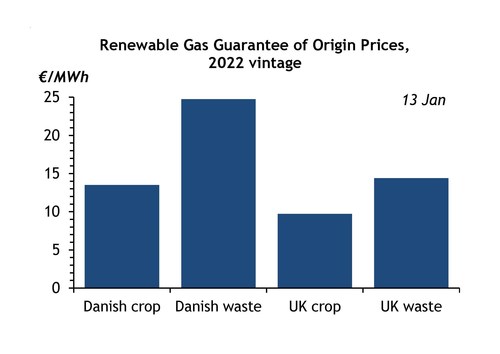
The new Argus Renewable Gas Guarantee of Origin (RGGO) pricing applies to biomethane produced from two types of feedstock:
- energy crops like maize, wheat, or sugar beet, and
- waste like manure, slurry, and straw, as well as municipal or solid waste.
The figures are for biomethane produced in the United Kingdom and Denmark, two of the world's most developed markets.
Biomethane created from waste is often more expensive than biomethane produced from energy crops, which is considered to be less environmentally benign because it requires land use, which excludes other uses like reforestation.
Making biomethane from agricultural, municipal, or food waste, on the other hand, utilises materials that would otherwise be thrown into landfills or incinerated, resulting in larger greenhouse gas savings over time.
RGGOs are purchased and sold as a proxy for biomethane production and consumption.
[Published January 2022. Updated February 2026.]