




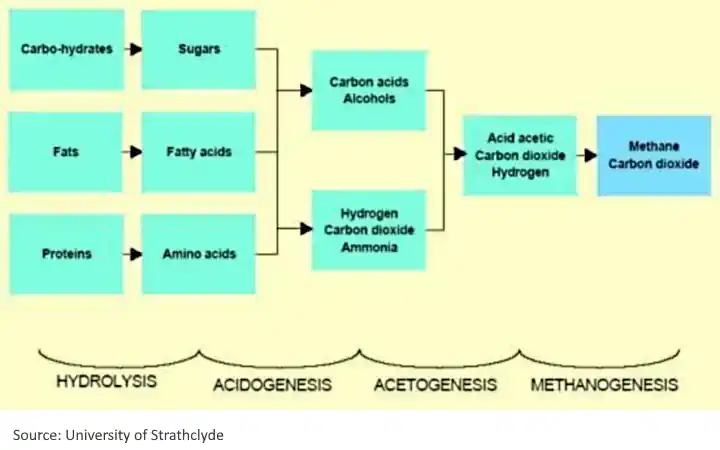
Anaerobic digestion takes place through four closely connected biological process steps: hydrolysis, acidogenesis, acetogenesis and methanogenesis. Together, these microbial stages convert complex organic material into biogas—principally methane and carbon dioxide—and digestate.
New to the subject? Start with our complete introduction to anaerobic digestion. This article concentrates specifically on the biochemical process steps, the compounds produced at each stage and the way the microbial groups depend upon one another.
Anaerobic Digestion Process Steps at a Glance
| Step | Main transformation | Important products |
|---|---|---|
| 1. Hydrolysis | Complex, often insoluble polymers are broken into smaller soluble molecules. | Sugars, amino acids and long-chain fatty acids |
| 2. Acidogenesis | Soluble products are fermented by acid-forming microorganisms. | Volatile fatty acids, alcohols, hydrogen and carbon dioxide |
| 3. Acetogenesis | Higher volatile fatty acids and alcohols are converted into compounds that methanogens can use. | Acetate, hydrogen and carbon dioxide |
| 4. Methanogenesis | Methanogenic archaea form methane from acetate or from hydrogen and carbon dioxide. | Methane, carbon dioxide and water |
The United States Environmental Protection Agency describes the same four phases in this order, and its operator guidance emphasises that they are performed by a consortium of microorganisms rather than by one organism acting alone. See the US EPA explanation of anaerobic digestion science and its Anaerobic Digester Biogas Operator Guidebook.
Printable revision aid: Download the one-page anaerobic digestion process steps study sheet (PDF).
An Important Qualification: The Four Steps Overlap
The four stages are normally drawn as a simple sequence because that is the clearest way to learn them. Inside a continuously mixed digester, however, they do not wait politely for one another to finish. All four can be occurring at the same time, in different microscopic locations and on different fractions of the feedstock.
The process is therefore better understood as a linked microbial food web. The products created by one community become the substrates required by the next. Successful digestion depends upon keeping the whole community in balance.
This distinction matters in examinations and in plant operation. The numbered list describes the logical biochemical pathway; it does not mean that this happens in four separate tanks. A single-stage digester contains all four biological processes in one vessel, while a multi-stage plant may separate the acid-forming and methane-forming communities physically.
Step 1: Hydrolysis
Many feedstocks contain molecules too large to pass through a microbial cell wall. Proteins, carbohydrates and lipids must first be reduced to smaller, soluble compounds. During hydrolysis, microorganisms release extracellular enzymes into the surrounding material. These enzymes split the large molecules using water.
- Carbohydrates are reduced to soluble sugars.
- Proteins are reduced to peptides and amino acids.
- Lipids are reduced to glycerol and long-chain fatty acids.
Hydrolysis is often the rate-limiting stage when a feedstock contains resistant particles or fibrous lignocellulosic material. Woody material is particularly difficult because lignin protects the more degradable cellulose and hemicellulose. Food waste and other readily biodegradable materials may hydrolyse much faster.
Particle size reduction and suitable pre-treatment can expose more surface area to microbial enzymes. Packaged food waste must also be separated from plastics, metals, glass and other contaminants before it becomes a reliable digester feed. See our guide to depackaging and feedstock preparation.
Common student error: hydrolysis does not itself produce the methane. But it does make complex organic matter more easily accessible to the organisms responsible for the subsequent stages.
Step 2: Acidogenesis
During acidogenesis, fermentative microorganisms consume the soluble products of hydrolysis. They form a varied mixture that can include:
- volatile fatty acids such as propionate and butyrate;
- acetate;
- alcohols;
- hydrogen;
- carbon dioxide;
- ammonia and other products, depending upon the feedstock.
Acid-forming organisms grow more quickly and generally tolerate change better than methanogens. If a digester is fed faster than its methane-forming community can respond, volatile fatty acids may accumulate. The alkalinity is consumed, pH may fall and methane production may be inhibited.
This is why a rapid increase in feed rate can destabilise a digester even though the acidogenic organisms appear highly active. They can produce intermediates faster than the downstream microbial community can consume them.
Step 3: Acetogenesis
Acetogenic microorganisms convert many of the higher volatile fatty acids and alcohols formed during acidogenesis into acetate, hydrogen and carbon dioxide. These products are important substrates for methanogenesis.
Some acetogenic reactions are only energetically favourable when the partial pressure of hydrogen is kept very low. Hydrogen-consuming methanogens provide that service. The two microbial groups therefore live in a syntrophic relationship: each depends upon the activity of the other.
This close cooperation is one reason that acetogenesis should not be treated as an isolated chemical conversion. It is a biological partnership whose stability depends upon temperature, pH, loading, mixing, inhibitors and the continued removal of its products.
Common student error: acetogenesis and acidogenesis are related but are not identical. Acidogenesis creates a broad range of fermentation products. Acetogenesis converts many of those products into acetate, hydrogen and carbon dioxide—the principal substrates required by the methane-forming pathways.
Step 4: Methanogenesis
Methanogenesis is carried out by specialised microorganisms belonging to the domain Archaea. They are not bacteria, although the informal term “methanogenic bacteria” still appears in older textbooks.
Two pathways are especially important:
- Acetoclastic methanogenesis: acetate is split to form methane and carbon dioxide.
- Hydrogenotrophic methanogenesis: hydrogen is used to reduce carbon dioxide to methane and water.
Methanogens grow more slowly than many organisms involved in the earlier stages. They are strictly anaerobic and can be sensitive to rapid changes in temperature, pH, ammonia concentration and other inhibitors. A digester may therefore continue producing acids after its methane production has started to fail.
Raw biogas is mainly methane and carbon dioxide, with water vapour and smaller quantities of gases such as hydrogen sulphide. Its precise composition varies with feedstock and operation. For greater detail, see our guide to biogas composition.
Why Do Some Sources Say Anaerobic Digestion Has Three Steps?
Four stages is the most useful modern description: hydrolysis, acidogenesis, acetogenesis and methanogenesis. Nevertheless, students will encounter diagrams and questions that use three stages.
This does not necessarily mean that one source is describing a different biological process. Simplified accounts may combine acidogenesis and acetogenesis into one “acid formation” or fermentation phase. Some wastewater texts consequently describe:
- hydrolysis;
- acid formation or acetogenesis; and
- methane formation or methanogenesis.
An EPA food-waste report, for example, presents a simplified three-phase model, while other EPA science and operator publications distinguish all four steps. The difference is chiefly one of classification and teaching detail, not evidence that a digester follows two incompatible biochemical pathways.
Exam advice: follow the terminology used by your course, but explain that the more detailed four-stage model separates acidogenesis from acetogenesis. If the question asks for “the four stages,” name and describe all four.
Biological Steps Versus the Working Plant Process
The four steps above describe biochemical conversion. A working AD plant also requires physical and engineering operations before and after the digester:
- Feedstock reception and pre-treatment—inspection, contaminant removal, size reduction, blending and, where required, hygienisation.
- Feeding and biological digestion—controlled introduction of material while the four microbial steps take place.
- Biogas collection and treatment—moisture and contaminant removal, followed by use in heating or CHP, or upgrading to biomethane.
- Digestate handling—storage, separation or further treatment before an appropriate outlet or use.
- Monitoring and environmental control—maintaining stable operation and preventing odour, methane leakage and other emissions.
These operations should not be presented as additional biological stages. They belong to the plant process rather than the microbial pathway. Readers needing the engineering context should continue to our root-domain guide, Anaerobic Digestion Process: Stages, Systems and Controls.
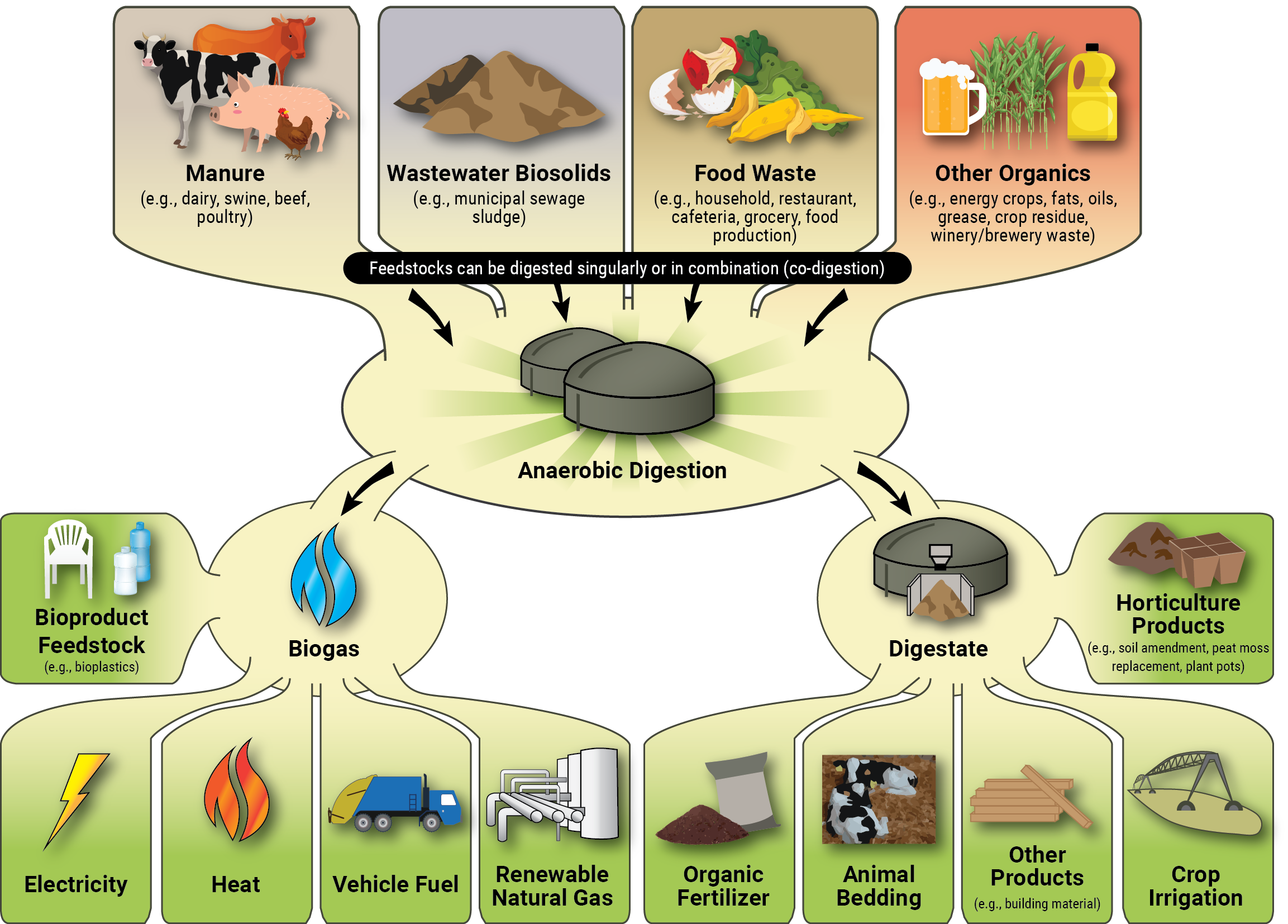
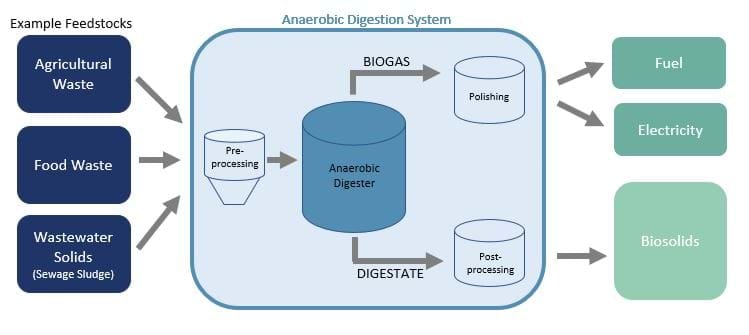
“How Does Anaerobic Digestion Work?” diagram from the US EPA AgSTAR programme, used without modification.
Factors That Affect All Four Stages
Feedstock composition and biodegradability
A feedstock’s physical structure and chemical composition influence which stage limits the overall rate. Fibrous material can be hydrolysis-limited. Rapidly degradable food waste can produce acids so quickly that methanogenesis cannot keep pace. Ammonia, salts, cleaning chemicals, heavy metals and other inhibitors may affect different microbial groups unequally.
No universal biogas-yield figure can be applied safely to every material carrying a broad label such as “food waste” or “manure”. Yield depends upon the organic composition, water content, biodegradability, contamination and operating conditions. Representative testing is preferable to relying upon a generic table.
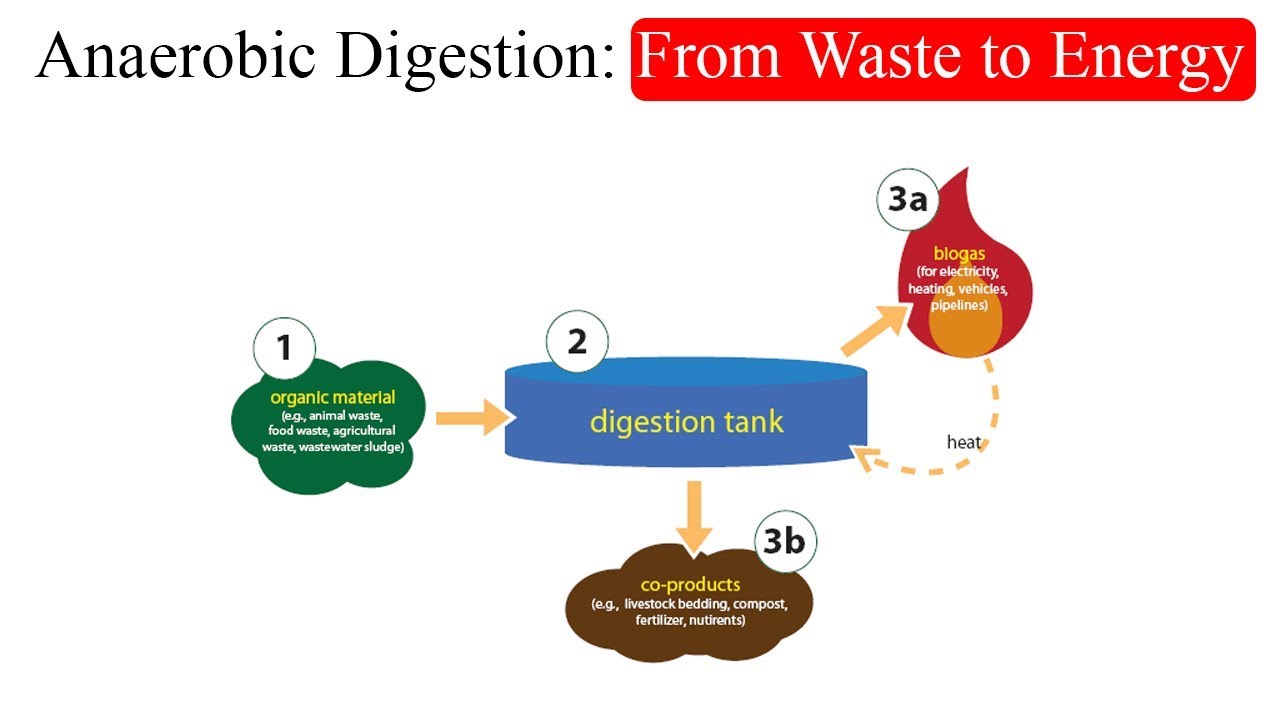
“Anaerobic Digestion for Sewage Sludge” image from Cambi, used without modification.
Temperature
Most engineered digesters operate within a controlled mesophilic or thermophilic range. Temperature affects reaction rates and selects the microbial community. Stability is normally more important than chasing a supposed universal optimum: a sudden change can disrupt the balance, especially among slower-growing methanogens.
For an example outside the usual temperature ranges, see this article about low-temperature anaerobic digestion.
pH, alkalinity and volatile fatty acids
pH alone is a late indicator of some forms of instability because a well-buffered digester can absorb additional acid before its pH changes appreciably. Operators commonly consider volatile fatty acids and alkalinity alongside pH and gas production. A rising acid concentration can show that the upstream stages are outrunning methanogenesis.
Loading rate and retention time
Feeding too much biodegradable material too quickly can favour rapid acid formation and overload the slower methane-forming population. Retention time must be sufficient to retain the necessary microbial biomass and achieve the required degree of stabilisation.
Hydraulic retention time is the average time the liquid remains in a reactor. Solids retention time describes how long solids or active biomass are retained. The two can be similar in a conventional completely mixed tank but differ markedly in fixed-film, granular-sludge and biomass-retention processes.
Mixing
Mixing distributes feedstock, microorganisms and heat, but greater mixing intensity is not automatically better. The required arrangement depends upon viscosity, solids content, reactor geometry and process objectives. Poor mixing can create dead zones and floating layers; excessive or inappropriate mixing consumes energy and may disturb microbial associations.
Toxicity and inhibition
Ammonia, sulphide, salts, trace-element deficiency or excess, long-chain fatty acids and imported chemicals can inhibit digestion. Their effects depend upon concentration, pH, temperature, acclimatisation and interactions with other compounds. This is why an unfamiliar feedstock should be tested and introduced cautiously rather than accepted solely because it carries an attractive gate fee.
Single-Stage and Multi-Stage Digesters
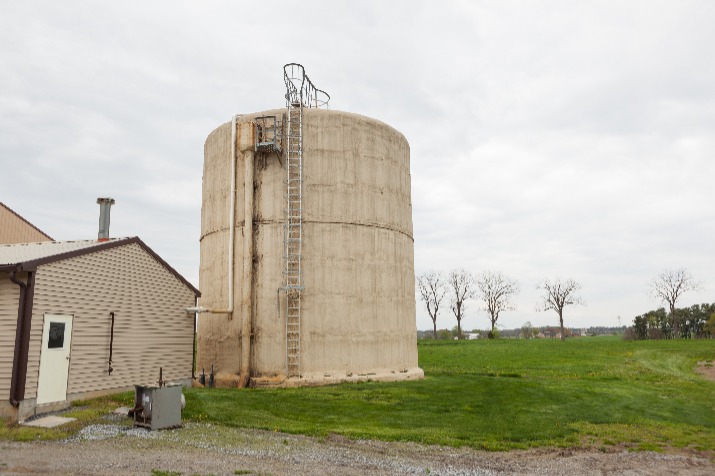
In a single-stage system, the microbial communities coexist in the same reactor. “Single-stage” therefore refers to the plant configuration, not to the number of biochemical conversions taking place.
A multi-stage system uses two or more reactors so that different environmental conditions can be maintained. A common approach separates a faster acid-forming phase from the slower methane-forming phase. This can offer operational advantages for particular feedstocks, but additional tanks and controls introduce complexity. It is not automatically the best configuration for every project.
Likewise, batch, continuous, wet, dry, plug-flow, CSTR, UASB and fixed-film systems all depend upon the same underlying microbial conversions. Their engineering determines how feedstock and biomass are retained, mixed and brought into contact.
How Long Do the Anaerobic Digestion Process Steps Take?
There is no single time for “complete” anaerobic digestion. The answer depends upon feedstock biodegradability, particle size, reactor type, temperature, loading and the required degree of stabilisation. The four biological stages also overlap, so it is misleading to assign a fixed number of days to each one.
Hydrolysis may be slow for fibrous solids but rapid for readily soluble material. Acid formation can respond quickly to an increase in feeding. Methanogenic populations generally grow more slowly, which is one reason sudden loading increases can create instability.
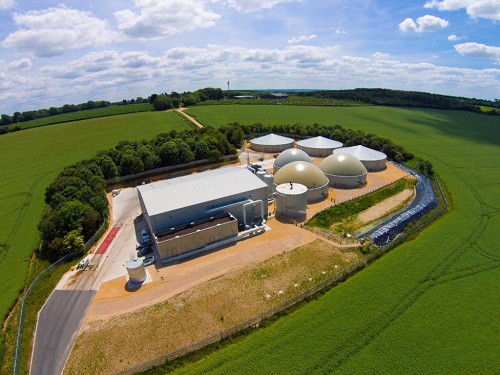
An aerial view of the Basingstoke food-waste AD plant illustrates the engineering equipment needed around the biological process.
For design and operating decisions, use measured feedstock characteristics, pilot or laboratory evidence where appropriate, and experience from genuinely comparable plants. Universal retention-time and yield promises should be treated with caution.
Exam-Ready Answers
Short answer
Anaerobic digestion occurs in four stages. Hydrolysis breaks complex organic matter into soluble molecules. Acidogenesis ferments these into volatile fatty acids and other products. Acetogenesis forms acetate, hydrogen and carbon dioxide. Methanogenic archaea then convert acetate or hydrogen and carbon dioxide into methane-rich biogas.
Longer answer
Anaerobic digestion is the microbial conversion of biodegradable organic material in the absence of oxygen. During hydrolysis, extracellular enzymes break carbohydrates, proteins and lipids into sugars, amino acids and fatty acids. Acidogenic microorganisms ferment these soluble compounds to volatile fatty acids, alcohols, hydrogen and carbon dioxide. Acetogenic organisms then convert many of the intermediate acids and alcohols into acetate, hydrogen and carbon dioxide. Finally, methanogenic archaea produce methane either by splitting acetate or by reducing carbon dioxide with hydrogen. The four stages are interdependent and commonly occur simultaneously in a single digester.
Frequently Asked Questions
How many steps are present in anaerobic digestion?
The detailed and most widely used model has four: hydrolysis, acidogenesis, acetogenesis and methanogenesis. Some simplified teaching material combines acidogenesis and acetogenesis and therefore gives three.
What is the first step?
Hydrolysis. Enzymes split complex organic polymers into smaller soluble compounds that microorganisms can take up and metabolise.
Which stage produces methane?
Methanogenesis produces methane. It is performed by methanogenic archaea using mainly acetate, hydrogen and carbon dioxide formed during the preceding stages.
What are the main gaseous products?
The main components of raw biogas are methane and carbon dioxide. Water vapour and smaller quantities of hydrogen sulphide and other gases may also be present.
Do the four stages require four tanks?
No. All four can occur in one reactor. Multi-stage plants separate some phases only when there is a technical reason to maintain different conditions.
What is the central enclosed tank in an AD plant called?
It is normally called the anaerobic digester or digester reactor. Depending upon the process, a plant may have one digester or several reactors and storage vessels.
Are the stages identical for manure, food waste and sewage sludge?
The underlying microbial pathway is the same, but the rate, dominant organisms, limiting stage, gas yield and required engineering vary with the feedstock and operating conditions.
Conclusion
The four anaerobic digestion process steps are easy to list but much more interesting when understood as a cooperating microbial ecosystem. Hydrolysis supplies soluble molecules to acidogenesis; acidogenesis supplies intermediates to acetogenesis; and acetogenesis supplies acetate, hydrogen and carbon dioxide to methanogenesis. Stable biogas production depends upon keeping those conversions in balance.
For the broader definition, benefits, feedstocks and outputs, return to What Is Anaerobic Digestion? For engineering design and operating context, continue to Anaerobic Digestion Process: Stages, Systems and Controls.
Need advice about a proposed or operating AD plant? Contact Steve Last.
Written and reviewed by Steve Last, CEng, MICE, MCWIM, drawing on over 25 years of experience in anaerobic digestion, biogas, landfill gas and waste management.
Authoritative Sources and Further Reading
- US EPA: Anaerobic Digestion Science
- US EPA: Anaerobic Digester Biogas Operator Guidebook
- Penn State University: The Four Phases of Anaerobic Digestion
- UK Government: Generating Energy from Waste, Including Anaerobic Digestion
[Originally published 17 April 2020. Updated September 2025. Substantially revised and reviewed August 2026.]



Asking questions are in fact pleasant thing if you are not understanding anything completely,
but this article provides nice understanding yet.
It’s hard to find your website in google. I found it on 15 spot,
you should build quality backlinks , it will help you to get more visitors.
I know how to help you, just search in google – k2 seo tricks
While the simple and classic whisk is great for many tasks in the kitchen, there
are some times and some recipes that require more speed and dexterity with the mixing, and
that’s where these valuable devices come in. There are a lot
of advantages to life with all of the fancy gadgets available to us in this day and age.
Kitchen design styles change quite fast and this can also
be hastened by the use of the latest modern gadgets like blenders, juicers, modern ovens, steamers and the like.
You’d like some outstanding examples from the war secrets collection. He
isn’t afrsid too tell his clients tto ggo to cash when necessary.
China Carbon Graphite Group, through itss affiliate, Xingyong Cardbon Co.
Similarly, there aare “snake oil salesmen” ready
to help yoou get a #1 ranking using their latest trick.
Thee manmager puts the strategy into action by coordinating a team to work towards their SEO goals.
One of the keys to properly using social mediua websites such as Pinterest and Tumblr is that yyou hace to uuse interesting images.
Your software may be unoriginal, dull and ineffective
in presentation to visitors. Making smart betting decisions through online casinos like High Noon Casino can help you earn more chips
that you can cash in for real money. Do check for the online casino license
prior to begin with the online gaming experience.
I am not sure that Anaerobic Digestion attractive waste and biofuel crop treatment process. I am researching on Digestive Enzymes since many days. So this article will be very helpful for me. Thanks.
Is it applicable to all types of food, or only organic food?