Many waste management professionals face a major challenge. Food waste piles up fast, fills landfill sites, and turns into harmful greenhouse gases like methane and carbon dioxide.
Traditional ways of turning food rubbish into energy struggle with low gas yields, unstable systems, and rising costs.
Biochar offers a real breakthrough for the “Food Waste to Energy” process. Recent research shows that adding biochar to anaerobic digestion can lift hydrogen and methane production while keeping systems stable. 1 This post will explain why biochar is so important, how it solves old problems in digesters, and where it fits in making green electricity from food waste simpler and smarter. Find out what sets biochar apart below.
Key Takeaways
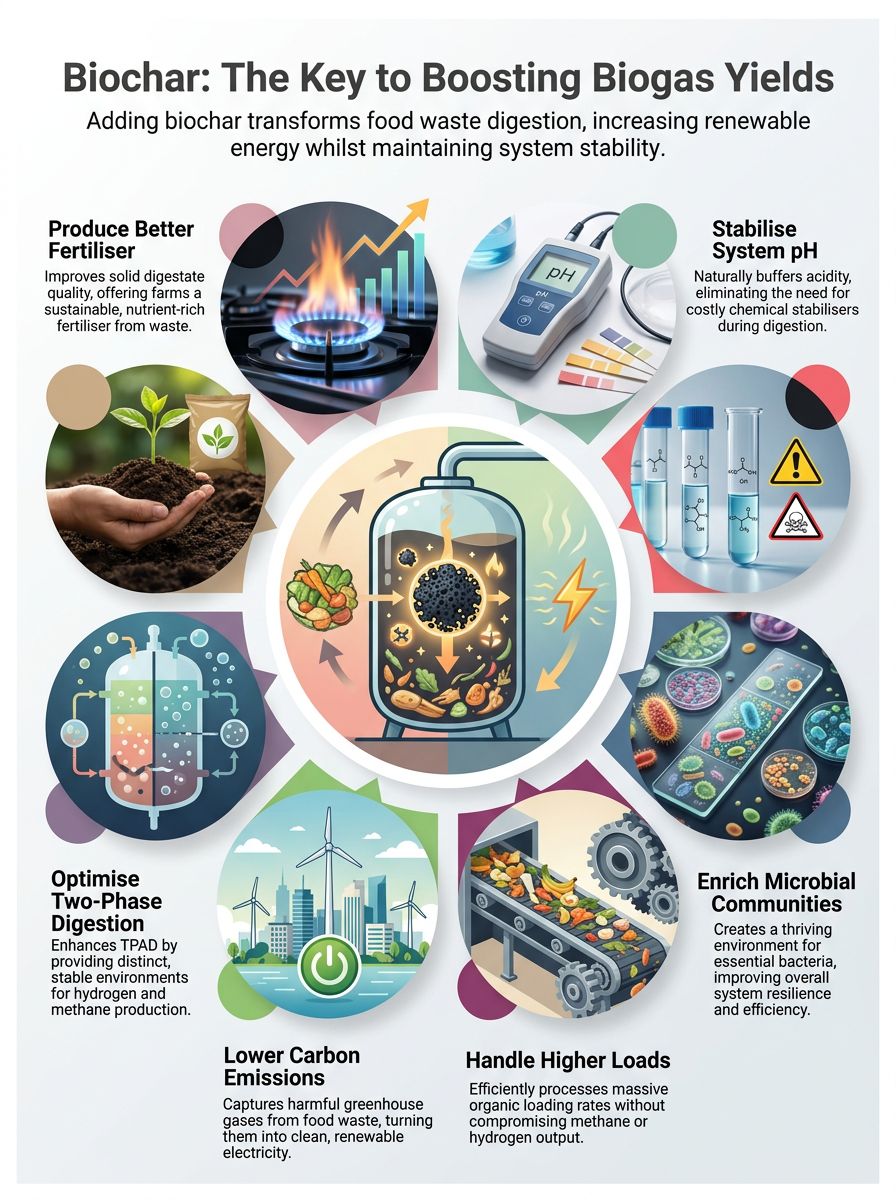
- Biochar boosts gas yields in anaerobic digesters. It raises hydrogen output by 45–88% and methane production by about 51.7% compared to systems without biochar (Sources: 1, 2, 5, 6).
- Adding biochar keeps the pH stable, close to ideal levels (around 5.5 for hydrogen stage and 7.2–7.3 for methane stage). This lowers the need for chemical buffers and cuts process upsets.
- With biochar, reactors handle higher organic loading rates—up to 6 g volatile solids per litre each day—without losing performance or stability (Sources: 6, 8).
- Biochar helps reduce harmful fatty acids like propionic acid at high loads and builds diverse, stable microbial communities such as Methanosarcinaceae and Clostridiaceae families.
- Australian research councils support these advances with strong funding of biochar studies, helping turn food waste into more renewable energy using improved biogas technologies (Source: 10).

How Biochar Enhances Gas Yields in Anaerobic Digestion
Biochar plays a big role in boosting gas yields during anaerobic digestion. It gets added to semi-continuous reactors, helping these systems produce more methane and hydrogen while keeping things stable.
How is biochar integrated into semi-continuous reactors?
Semi-continuous stirred-tank reactors are set up in pairs. One reactor serves as a control and contains no biochar, while the other holds biochar at around 15 grams per litre. Both run for 100 days to track long-term impacts on biogas production from food waste and organic matter breakdown.
Operators slowly raise the organic loading rate (OLR) across seven stages, starting at 0.5 up to 6 grams of volatile solids per litre each day. 1
In these test systems, technicians add biochar directly into both hydrogen-producing (R1) and methane-producing (R2) units. The system is then monitored for changes in gas yields, pH stability, and levels of volatile fatty acids.
This approach helps support syntrophic networks within the microbes; it also encourages direct electron transfer between microbial species which improves energy yield from waste management processes. 1
Adding just a small amount of biochar can change how microbes work together inside digesters—leading to higher renewable energy outputs.

What impact does biochar have on gas yield and system stability?
Biochar boosts gas yield in food waste anaerobic digestion systems. In hydrogen-producing digesters, reactors with biochar show a jump in hydrogen output by 45 to 88 percent compared to controls.
Methane-producing units keep a steady rate of about 1,900 millilitres per day with biochar present. Unlike control reactors, these do not suffer declines at higher organic loading rates; even at loads as high as 6 grams volatile solids per litre per day, methane production stays strong. 2
System stability is much better with biochar too. Reactors treated this way hold their pH steady near ideal levels: around 5.5 for hydrogen and between 7.2 and 7.3 for methane stages.
Volatile fatty acid build-up remains low, limiting the risk of process upset—especially propionic acid at high organic feed rates. With less reliance on chemical buffers to manage pH swings and quicker onset of methane production in the second phase reactor, plants achieve more reliable biogas generation from food waste streams using this renewable energy technology.
Why Is Food Waste a Global Concern?
Food waste is a big problem worldwide. It puts pressure on our waste management systems and increases greenhouse gas emissions, making climate change worse.

How does food waste strain waste-management systems?
Rising volumes of organic waste now overwhelm many municipal waste-management systems. High rates of food disposal complicate logistics and make processing less efficient. De-packaging, blending, and pre-treatment take up precious resources and increase operational costs for every tonne processed.
Central facilities face more frequent breakdowns and slower recovery of energy or by-products.
Traditional disposal, like landfill or incineration, risks both inefficiency and environmental harm; methane gas can escape into the atmosphere while energy from waste options often fall short due to system strain.
Many cities explore decentralised food-waste-to-energy solutions instead, seeking ways to ease pressure on overloaded sites.
Increasing levels of food waste highlight an urgent need for advanced digestion technologies that can boost renewable electricity output.
Plastics mixed with organics further slow down sorting lines, disrupt sustainable farming feedstock streams, and block resource recovery into natural fertiliser or biogas. Without better processes like anaerobic digestion using biochar in digesters, valuable materials often go lost alongside clean energy opportunities.
How does food waste contribute to greenhouse gas emissions?
Food waste in landfill sites breaks down without oxygen. This process, called anaerobic digestion, releases methane gas into the air. Methane is a powerful greenhouse gas, over 25 times more potent at trapping heat than carbon dioxide across a hundred years.
Poorly managed food waste increases methane emissions as well as levels of carbon monoxide and volatile fatty acids if digested improperly.
Incineration of organic materials can create flue gases rich in pollutants such as carbon monoxide. If biogas from anaerobic digestion plants is not captured or used for electricity generation, these gases escape and add to global climate problems instead of serving as renewable energy sources.
Capturing and using this biogas helps reduce reliance on fossil fuels and cuts net greenhouse gas emissions from municipal solid waste streams.
What Are the Challenges of Traditional Anaerobic Digestion?
Traditional anaerobic digestion faces several key challenges. Stability often suffers due to fluctuations in conditions, which can lead to lower gas yields and system inefficiency.
High carbon monoxide levels can also occur, caused by an unstable microbial community that may not break down organic matter properly. This instability can make it harder for the system to work effectively over time.

Why is stability poor in traditional anaerobic digestion?
Stability is poor in traditional anaerobic digestion for several reasons. The systems are very sensitive to changes in microbial communities. Even small shifts can disrupt the balance needed for efficient digestion.
Changes in pH levels happen, leading to instability. This affects how well organic matter breaks down.
High organic loading rates often overload the system. This results in inconsistencies in biogas production and lower yields of methane gas. Volatile fatty acids accumulate, which can cause acidification and process inhibition.
Without effective buffers, pH drops frequently, further harming stability. Systems also lack adequate microbial resilience to these operational changes; this compounds their issues with maintaining steady performance.
What causes high carbon monoxide content?
High carbon monoxide content often results from incomplete combustion in waste-to-energy systems. This can happen during inefficient gasification, which is common in traditional digestion technologies.
Poor control of the processing conditions can also lead to increased carbon monoxide emissions within biogas. 3
A lack of effective management, especially regarding pH and microbial populations, adds to this problem. Inadequate breakdown of organic matter contributes further to elevated levels of carbon monoxide.
This creates safety hazards and makes it harder to upgrade biogas for cleaner energy use.
How do microbial population shifts affect digestion?
Microbial population shifts can greatly impact digestion in anaerobic digesters. A balanced community of microbes is crucial for breaking down food waste. As these populations change, it disrupts the pathways for producing hydrogen and methane gas.
Loss of important species, like methanogenic archaea, leads to lower biogas yields.
Instability among microbes creates problems too. It causes higher levels of volatile fatty acids (VFAs), which is not ideal for a stable system. As VFAs build up, it affects overall system resilience.
Often, this instability means operators must add chemical buffers or take corrective actions to restore balance and efficiency in gas production.
How Does Two-Phase Anaerobic Digestion (TPAD) Improve Efficiency?
Two-Phase Anaerobic Digestion (TPAD) helps separate hydrogen and methane production. This makes the process better at handling acid build-up and improves how quickly it responds to changes in organic load.
Why separate hydrogen and methane production in TPAD?
Separating hydrogen and methane production in Two-Phase Anaerobic Digestion (TPAD) boosts efficiency. Each type of gas requires different conditions to thrive. Hydrogen-producing microbes prefer lower pH levels, while methane-makers work best at neutral pH.
This separation allows for precise adjustments to temperature and loading rates, enhancing the process.
By creating distinct environments for these microbes, competition is reduced. This leads to higher gas yields and better system stability. The approach also decreases acid build-up during methane production, improving overall gas quality.
In turn, this separation promotes specialised microbial communities that enhance the value of each gas product generated from food waste recycling.
How does TPAD address acid build-up and high OLR sensitivity?
TPAD uses anaerobic baffled reactors (ABR) with up-flow anaerobic sludge blanket (UASB) reactors. This setup helps to control acid build-up effectively. Staged lipid adsorption and hydrolysis-acidification occur in TPAD.
These processes keep the environment stable for bacteria, reducing acidity. 4
High organic loading rates (OLRs) can cause problems in digestion systems. The compartmentalised ABR supports microbial attachment and enhances operational stability. Stable inputs to the UASB reactor allow handling higher OLRs without causing big changes or fluctuations.
Laboratory tests showed TPAD could achieve COD removal rates of up to 99%. In full-scale operations in China, methane content reached 83.94% at high OLRs, showcasing its effectiveness in improving efficiency and managing waste better.
Biochar’s Role in Enhancing TPAD Systems
Biochar boosts gas production in Two-Phase Anaerobic Digestion (TPAD) systems. It helps make hydrogen and methane more effective while keeping conditions stable for the microbes that do the work.
How does biochar enhance gas yields in TPAD?
Biochar enhances gas yields in Two-Phase Anaerobic Digestion (TPAD). Adding biochar increases hydrogen production by 45–88% compared to control systems. Methane production also improves, with average rates reaching 1,908.4 mL/day, a gain of 51.7%.
This signifies more usable energy from food waste. 5
Biochar assists TPAD in handling organic loading rates up to 6.0 g VS/Ld without losing efficiency. Its buffering effect maintains stable pH levels for improved microbial activity and gas output.
The conductive properties of biochar facilitate smooth electron transfer between microbes; this boosts overall digestion performance as well. Biochar also increases microbial diversity in the system, leading to greater stability and reduced need for costly chemical buffers during the process.
What were the findings from semi-continuous stirred-tank reactor research?
The research used two 5 L continuous stirred-tank reactors. One reactor had biochar added at 15 g/L, while the other acted as a control. The reactors with biochar produced higher levels of hydrogen and methane.
Specifically, they reached 1,252.8 mL/d of hydrogen and 1,908.4 mL/d of methane. 6
These reactors handled organic loading rates up to 6.0 g VS/Ld with biochar, compared to just 4.0 g VS/Ld in the control group without it. Biochar also aided in starting methane production earlier in the second phase of digestion.
The pH levels remained stable in the biochar-treated reactors, around R1: ~5.5 and R2: between 7.2–7.3; controls showed more fluctuations during the process. Lower amounts of harmful volatile fatty acids were found too, especially propionic acid, which can hinder gas yield overall.
What Are the Key Research Findings on Biochar Use?
Biochar boosts gas production in anaerobic digestion. It helps make hydrogen and methane more efficiently. Studies show it keeps pH levels stable, which is crucial for healthy microbes.
Biochar also cuts down on harmful fatty acids that can build up during the process. This means better results with less waste… a win for energy production!
How does biochar affect hydrogen and methane production?
Biochar enhances hydrogen and methane production in anaerobic digestion. Hydrogen production rates in biochar reactors averaged 1,252.8 mL/d, which is 45% higher than traditional setups. 7 Methane reached an impressive rate of 1,908.4 mL/d, showing a remarkable increase of 51.7%. These improvements occur because biochar refines the microbial community structure. It encourages early methane formation during the second phase of digestion.
Production initiates swiftly with biochar; hydrogen begins on day two and increases with more organic load. At high loading rates, there’s no decline in gas yields from biochar reactors.
This stability supports efficient energy conversion from food waste into renewable energy; it enhances biogas output through direct interspecies electron transfer between microbes.
How does biochar help maintain stable pH levels?
Biochar helps maintain pH levels stable in anaerobic digestion systems. In the hydrogen-producing reactor, biochar-treated setups maintained an average pH of 5.5. This is significantly better than control reactors, which showed a range from 4.5 to 5.0, indicating poor stability. 8
In the methane-producing reactor, biochar kept the pH between 7.2 and 7.3. Stable pH creates favourable conditions for producing hydrogen and methane gas. It also prevents acidification and process inhibition that can hinder gas production efforts.
The buffering capacity of biochar reduces the need for chemical stabilisers too; this makes operations simpler and more sustainable while promoting environmental sustainability through effective waste management practices.
In what way does biochar reduce volatile fatty acid accumulation?
Biochar reduces volatile fatty acid (VFA) accumulation in several ways. It helps balance the processes of acid production and methane formation. This balance is crucial for maintaining a stable pH level in two-phase anaerobic digestion (TPAD) systems.
By adding biochar, the amount of harmful VFAs, especially propionic acid, decreases significantly at higher loading rates. Lower VFA levels minimise the risk of process inhibition and acidification.
Biochar reactors show more efficient conversion of these acids into biogas. As a result, digester performance improves without losing gas yield, leading to earlier onset and faster rates of methane production.
How does biochar enrich microbial communities?
Biochar helps create a thriving environment for microbes. In reactors that use biochar, researchers found larger populations of important methanogenic archaea, like Methanosarcinaceae and Methanobacteriaceae.
The presence of biochar leads to more stable and diverse microbial communities. This stability enhances the system’s resilience.
Better interactions among microbial species were observed in biochar-treated reactors. A family of bacteria known as Clostridiaceae also flourished in these systems. Greater diversity means higher biogas yields and improved operational stability.
These findings demonstrate how biochar can enrich microbial communities effectively, supporting renewable energy production from food waste recycling.
Where Can Biochar Be Applied Practically?
Biochar has many uses in biogas plants, both in cities and on farms. It can improve how well these plants work and may even do a better job than regular digesters.
How can municipal and agricultural biogas plants use biochar?
Municipal and agricultural biogas plants can greatly benefit from using biochar. Adding biochar boosts the pH-buffering capacity in anaerobic digestion systems. This helps manage acidity better, making conditions stable for microbial action.
Enhanced microbial activity leads to higher methane yields, which is essential for renewable energy generation. 9
Biochar also improves the quality of solid digestate, turning it into a more effective fertiliser. It supports microbial biofilm formation too, which aids in breaking down organic matter effectively.
By pairing biogas plants with pyrolysis, facilities can produce their own biochar sustainably while improving gas production and enhancing waste management practices.
Can biochar outperform traditional anaerobic digesters?
Biochar can indeed outperform traditional anaerobic digesters. It enhances gas yields, especially hydrogen and methane. Biochar-stabilised systems show better resilience than conventional ones.
They manage higher organic loading rates (OLRs) up to 6.0 g VS/Ld. This allows for increased throughput and improved biogas quality, with more methane and less CO2 or H2S.
The incorporation of biochar reduces the need for costly chemical buffers in the process. Research indicates that biochar-enhanced digestion produces more energy and also provides agricultural benefits through enriched digestate.
This makes it a promising solution for waste management professionals seeking efficient methods in renewable energy generation from food waste recycling while targeting carbon emissions reduction.
What Is the Future of Biochar-Enhanced Digestion Technologies?
Biochar could change the way we handle food waste. With better gas yields and stable systems, it offers exciting promise for future energy solutions.
How do microbial findings guide future technology development?
Microbial findings shape future technology by highlighting key areas for improvement in anaerobic digestion. The rise of certain microbes, like Clostridiaceae and Methanobacteriaceae, informs how engineers manage these systems.
It helps in selecting the right biochar types to enhance microbial growth. Researchers are discovering that stable microbial communities can lead to better gas yields.
These insights also guide reactor design, focusing on systems that handle high organic loading rates (OLRs) and varying feedstocks effectively. By encouraging direct electron transfer between species, new designs can boost efficiency too.
This integration of microbiology with engineering will drive advancements in renewable energy from food waste and other organic materials.The goal is a more resilient approach to waste management and energy generation.
Who Is Collaborating to Advance Biogas Technologies?
In Australia, research councils and project teams are working together to boost biogas technologies. They focus on improving methods for turning organic waste into renewable energy.
By sharing knowledge and resources, they help advance this vital field. Want to know more about their efforts?
What role do Australian research councils and project schemes play?
Australian research councils provided crucial funding for projects aimed at enhancing biogas technologies. This support allowed researchers to run long-term trials with reactors and conduct advanced studies on microbes.
Project schemes encouraged teamwork among different institutions, boosting innovation in renewable energy recovery and sustainable waste management. 10
With these investments, Australia has become a leader in developing biochar-enhanced digestion technologies. The collaboration improved knowledge sharing between Australia and China, helping both countries address food waste issues more effectively.
These efforts align perfectly with Australia’s goals for environmental sustainability and green energy solutions.
Conclusion
Biochar is a game changer for food-waste-to-energy systems. It boosts gas yields in anaerobic digestion and supports stability. Research shows biochar can improve hydrogen and methane production while keeping pH levels steady.
Municipal waste facilities and agricultural biogas plants can really benefit from using biochar. By adopting these advanced technologies, we can enhance renewable energy recovery while managing food waste better than ever before.
FAQs
1. What is food-waste-to-energy and how does it help the environment?
Food-waste-to-energy turns organic waste into renewable energy using anaerobic digestion or biomass gasification. This process cuts carbon emissions, reduces landfill use, and helps reach net zero goals.
2. How does biochar improve gas yields in energy production from food waste?
Biochar boosts methane gas output during anaerobic digestion by supporting microbial fermentation and aiding organic matter breakdown. This leads to more green energy for electricity generation or heat production.
3. Why is packaging separation important in food waste recycling?
Packaging separation removes plastic waste before processing organic material. Without this step, incinerators may release air pollutants; proper sorting ensures only biodegradable solids enter digesters or compost heaps.
4. Can biochar help with national gas grid supply?
Yes, using biochar raises the amount of synthesised gas produced from solid wastes like animal manure and leftover foods. The resulting compressed natural gas can feed directly into the national grid as a clean energy resource.
5. How does converting food waste support a circular economy?
Transforming wasted foods through anaerobic digestion recycles nutrients back as chemical fertilisers or synthetic fertilisers while generating renewable electricity and hot water for local use, closing loops in sustainable waste management.
6. Is this better than burning rubbish in incinerators?
Yes; plasma pyrolysis with biochar creates less air pollution than traditional incineration of waste because it traps harmful particles while making synthesis gas for fuel instead of just disposing of solid wastes without recovery benefits like solar power offers.
References
- ^ https://fuelcellsworks.com/2025/12/02/h2/biochar-boosts-hydrogen-and-methane-yield-in-next-generation-food-waste-to-energy-systems
- ^ https://www.sciencedirect.com/science/article/pii/S0960148124016379
- ^ https://www.sciencedirect.com/science/article/pii/S0301479723022466
- ^ https://pmc.ncbi.nlm.nih.gov/articles/PMC12820218/
- ^ https://www.researchgate.net/publication/398319235_Enhancing_H2_and_CH4_production_with_biochar_addition_in_two-phase_anaerobic_digestion_of_food_waste (2026-01-14)
- ^ https://www.maxapress.com/article/doi/10.48130/een-0025-0010?viewType=HTML
- ^ https://www.maxapress.com/data/article/een/preview/pdf/een-0025-0010.pdf (2025-10-21)
- ^ https://www.sciencedirect.com/science/article/pii/S2405844023020807
- ^ https://pmc.ncbi.nlm.nih.gov/articles/PMC12899135/
- ^ https://www.researchgate.net/publication/391487534_Food_waste_to_biochar_a_potential_sustainable_solution_for_Australia_a_comprehensive_review
Note: A horizontal line through a link URL above usually indicates that the website requires proof that you are human (captcha style).