Biogas permits are regulatory approvals required in England and Wales for anaerobic digestion (AD) plants to operate, ensuring environmental compliance. Similar instruments exist in the EU and US.
Have you ever felt like a solid anaerobic digestion project started falling apart the moment you needed to get a biogas plant permit, and the environmental permitting process began?
You have the vision. You want to turn organic waste into renewable energy and manage digestate responsibly. Then the paperwork arrives, and the momentum disappears.
Forms pile up. Agencies raise endless questions.
Months quietly turn into years.
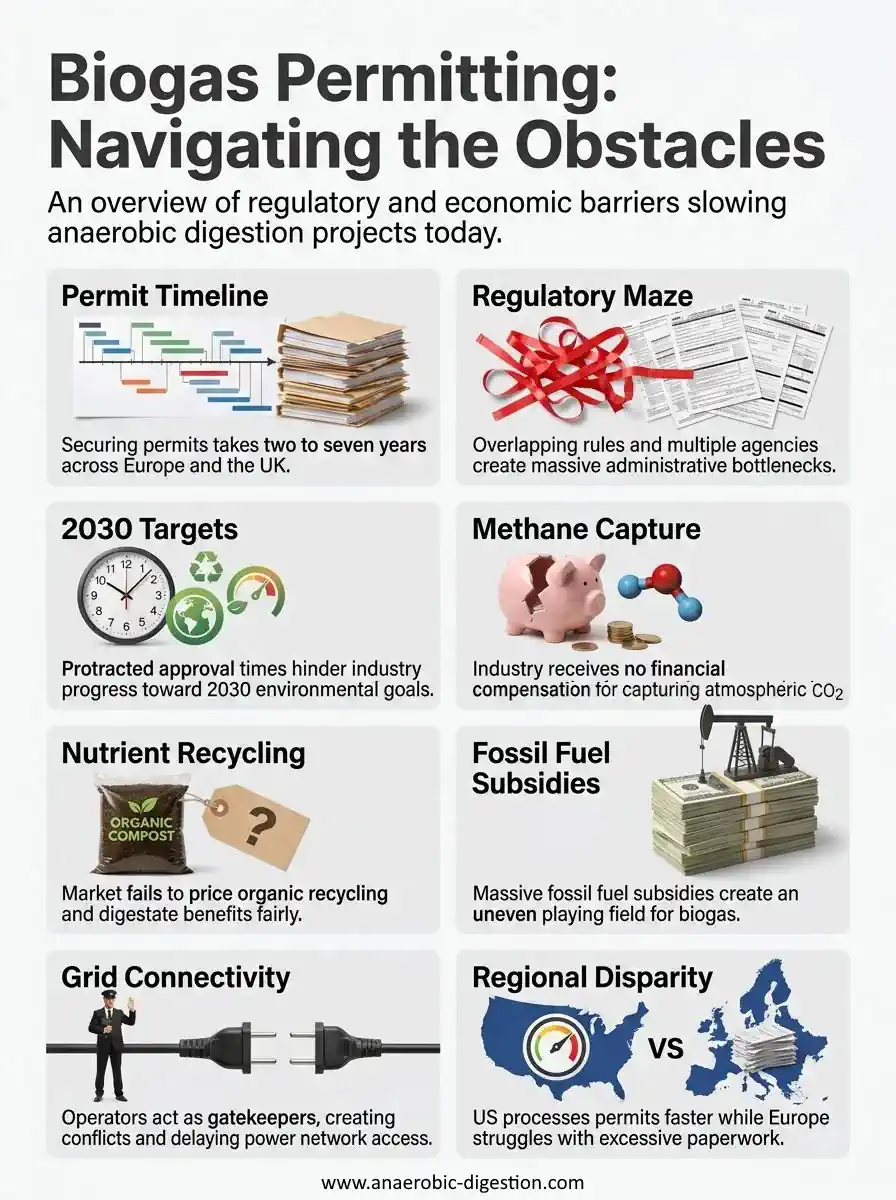
Here is the hard truth: biogas plants across Europe typically wait between two and seven years to secure all the permits they need. That is not a typo.
The Environment Agency, local authorities, and several other bodies all want their say. Each follows different rules and moves at its own pace. The Environmental Permitting (England and Wales) Regulations 2016 sets the legal framework, yet the process remains painfully slow.
Standard rules permits, bespoke permits, risk assessments, waste recovery operations, animal by-products regulations, and health and safety checks all demand your attention. It can feel never-ending.
This guide cuts through the confusion. We cover what the biogas permit process means for anaerobic digestion and digestate management, why the system takes so long, the economic barriers holding projects back, and what is being done to fix things. We also compare how Europe and the United States handle permits differently, and we look at the grid connection problems that frustrate developers.
By the end, you will understand the real obstacles, know what to expect, and see clearly what needs to change. I will walk you through it all, step by step.
Biogas Permit Key Takeaways
- Biogas plants across Europe typically wait two to seven years to secure all necessary permits due to overlapping regulations and administrative confusion between multiple agencies.
- Permitting delays directly threaten the biogas industry’s ability to meet 2030 renewable energy targets, as fewer anaerobic digesters come online when projects stall in bureaucratic queues.
- Current economic frameworks provide no financial reward for captured methane or nutrient recycling, whilst fossil fuel subsidies artificially lower energy prices and reduce biogas competitiveness.
- The United States processes biogas permits faster than Europe, with streamlined procedures and quicker capital access that support project development and grid connections more efficiently.
- European grid operators create conflicts of interest by controlling infrastructure access whilst competing in energy markets, causing delays and unfair treatment of biogas connection applications.
What makes securing biogas permits a major challenge?
Getting an environmental permit for a biogas project can feel like running through a maze with no map. The Environmental Permitting (England & Wales) Regulations 2016 and related rules like SR2021 No 7 create layers of paperwork that slow projects down for months, or even years.
Why does the permitting process take so long in the UK and Europe?
Securing environmental permits for anaerobic digestion facilities across the UK and Europe means managing a maze of overlapping regulations and unclear pathways. Biogas plants typically require two to seven years to obtain all necessary permits. This timeline reflects a fundamental problem: developers face real confusion about which authorities to approach, and when to approach them.
According to the Anaerobic Digestion and Bioresources Association’s (ADBA) 2024 and 2025 sector reports, bespoke environmental permits for anaerobic digestion in the UK can take five to seven years to secure. A major driver behind this is severe understaffing and underfunding at the Environment Agency, which slows the review process at every turn.
The Environmental Permitting (England & Wales) Regulations 2016 set the overall framework. Yet waste management professionals still encounter vague guidance on the correct administrative channels and application windows.
Understaffing at the Environment Agency is one of the biggest reasons biogas projects spend years waiting for bespoke permits to be approved.
Multiple agencies hold decision-making power. From local planning authorities to the Animal and Plant Health Agency, bottlenecks appear at every stage. Excessive paperwork demands responses about capture, treatment and storage methods, lagoons and tanks specifications, and compliance with SR2021 No 7 standards.
Nobody enjoys filling out forms for months, only to discover they submitted applications to the wrong department. The lack of clarity around duty of care obligations under the Waste Framework Directive compounds these delays further.
Administrative confusion sits at the heart of why so many projects stall across Europe. Developers must juggle requirements from conservation of habitats and species regulations 2017, natural environment and rural communities act 2006 provisions, and site of special scientific interest designations, all at the same time.
- Air quality management area assessments demand specialist attention at every stage.
- Pasteurisation and PAS 110 compliance documentation requires expert input.
- The Environmental Permitting framework requires location-specific assessments for each individual site.
- Guidance documents remain scattered across gov.uk resources and DEFRA communications.
Grid connection challenges from national operators add extra months or years to timelines. These same operators act as both stakeholders and obstacles, creating conflicts of interest that slow approvals.
Waste management professionals spend considerable time simply identifying which regulations apply to their specific digestate management plans. This fragmented system, lacking any clear permitting standard, leaves projects stuck in bureaucratic limbo whilst biomethane capture opportunities slip away.
How does permitting delay affect the biogas industry’s 2030 goals?
Permitting delays pose a serious threat to the biogas sector’s 2030 targets. The industry has a tight window to hit its objectives, yet long approval times keep slowing progress.
Projects stuck in the permitting system cannot move forward. Fewer anaerobic digesters come online, which means less renewable energy is produced and less waste is diverted from landfills.
Extended approval times make it impossible to scale and deploy the technology fast enough. Waste management professionals know this reality well. You see projects sitting in bureaucratic queues while the clock keeps ticking.
Each month a project waits for permits is a lost opportunity for methane capture and digestate management improvement.
The sector cannot deliver on its future targets if permitting delays remain this severe. Streamlined processes need to replace the current slow system, or the industry will fall short of its goals.
The business and the environment both suffer when projects stall due to regulatory gridlock. Calls to streamline permitting reflect the urgency needed to stay on track.
Faster permits mean more facilities operating, more renewable gas flowing into grids, and more genuine progress toward environmental targets. Your sector must push for reform now.
What economic barriers affect biogas projects?
Money problems stop many biogas projects before they even get started. Fossil fuel subsidies, missing rewards for captured methane, and undervalued nutrient recycling all combine to squeeze budgets and kill promising projects early.
Why is there no financial reward for captured methane?
Your biogas facility captures methane, reduces emissions, and prevents greenhouse gases from entering the atmosphere. Yet the industry receives no financial compensation for this critical environmental work.
Current economic frameworks ignore captured methane as a tradable or rewardable benefit. Incentive systems focus only on energy output, not on emissions abatement or resource recovery.
As highlighted in a 2025 sector briefing by the ADBA, the UK Emissions Trading Scheme (UK-ETS) currently penalises biomethane as if it were a fossil gas. It offers no carbon abatement allowances to biogas plants that successfully mitigate methane. So your facility tackles climate change, but the economic reward system fails to acknowledge it.
The industry captures methane and prevents environmental damage, yet receives no financial reward for either achievement.
Nutrient and organic matter recycling also suffers from undervaluation in current economic models. Your digestate management efforts produce real value, yet the market does not price these benefits fairly.
Energy generation receives incentives, but the emissions reduction you achieve stays invisible on balance sheets. This absence of financial rewards reduces the overall economic viability of biogas projects across the sector.
The SSAFO regulations and SR2023 No 1 frameworks guide your operations, but they do not create payment mechanisms for methane capture. Your work delivers genuine environmental benefit. The economic system simply has not caught up with the science yet.
How are nutrient and organic matter recycling undervalued economically?
Nutrient and organic matter recycling through anaerobic digestion creates real environmental value. Yet current economic systems fail to reward it properly.
Waste management professionals like you know that biogas facilities produce digestate rich in valuable nutrients. These processes recover useful materials from waste streams. The market, though, does not pay fairly for this recovery work.
Digestate contains phosphorus, nitrogen, and other nutrients that farms genuinely need. Yet operators receive little or no payment for delivering these materials. The undervaluation of organic matter recycling means companies cannot fund innovation in this space.
- Financial incentive structures do not recognise the true worth of nutrient recycling.
- Environmental benefits remain invisible to balance sheets and profit margins.
- Fossil fuel subsidies artificially lower energy prices, reducing demand for biogas alternatives.
- ESA/EU sector skills development programmes push for better practices, but financial mechanisms do not back them up.
This gap between actual value and economic reward limits investment in critical processes. Until policymakers value nutrient recovery as much as they value energy production, recycling will remain economically marginal rather than genuinely profitable.
How do fossil fuel subsidies impact biogas development?
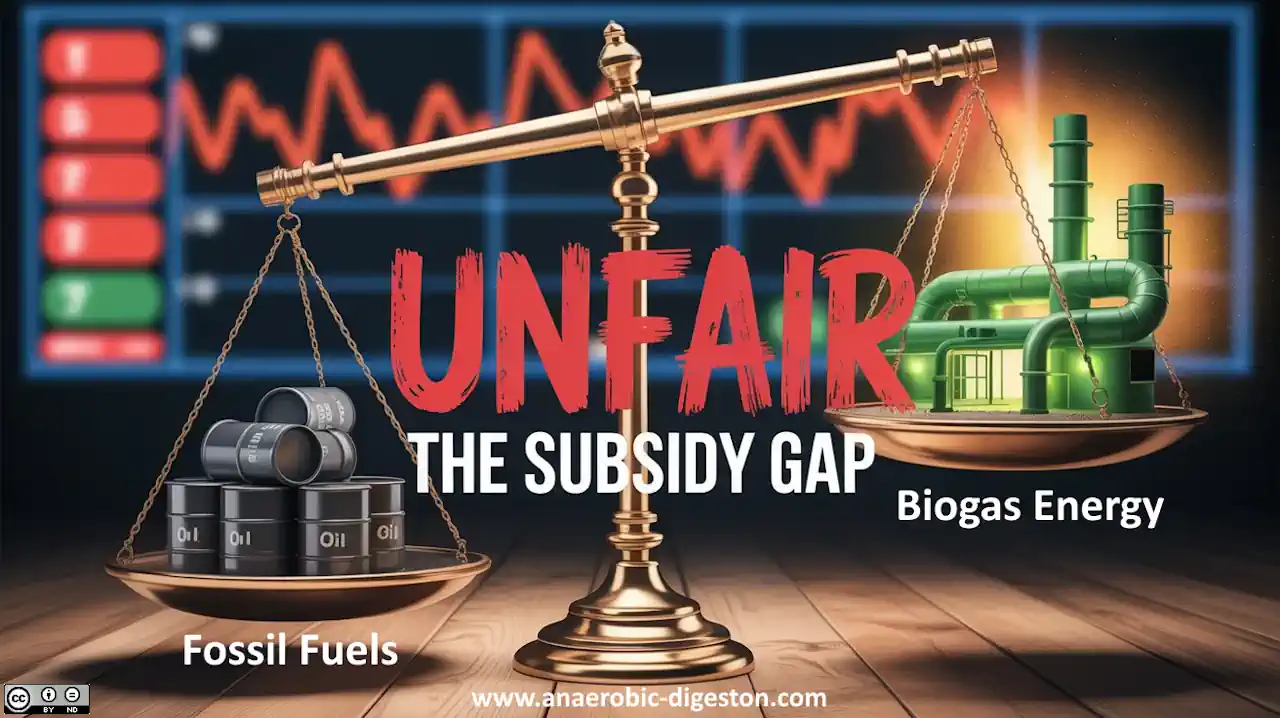
Fossil fuels receive enormous subsidies every year, and these payments distort the entire energy market. According to a 2024 report by Global Justice Now, combined with the UK Government’s 2025/2026 Green Gas Support Scheme expenditure forecasts, the UK government provided roughly £3.6 billion in subsidies to fossil fuel producers in 2023. That compares starkly with the £96.5 million annual budget forecasted for the Green Gas Support Scheme (GGSS) in 2025 to 2026.
This creates a deeply unfair playing field for biogas projects. Your biogas facility must compete against energy sources that enjoy massive government support, whilst biogas gets no financial reward for captured methane.
When fossil fuels receive 37 times more in government subsidies than biogas, the playing field is not just uneven. It is stacked against clean energy development.
These subsidies undermine sustainability goals by favouring less environmentally friendly energy sources. Your sector faces real economic pressure because of this imbalance, and that pressure shows up at every stage of a project.
- Biogas operators cannot match the low prices that subsidised fossil fuels offer to energy buyers.
- This disadvantage affects every part of your business, from securing permits to attracting investment capital.
- Waste management professionals must work harder to prove that biogas makes economic sense.
- Your projects need strong business cases to succeed in this uneven market.
The subsidy system essentially punishes clean energy development. Until governments level the playing field, biogas will struggle to reach its full potential in the waste management sector.
Current efforts to reform the permitting system
Governments and industry groups are pushing hard to create standard permit rules across different regions. These efforts aim to speed up approvals and help biogas projects move forward faster, with clear and consistent requirements that waste management professionals can follow with confidence.

What progress is being made on a global permitting standard?
Industry leaders and regulatory bodies are working hard to create a globally accepted permitting system that will transform outcomes for biogas projects. This unified approach aims to cut approval times from as long as seven years down to just a few weeks, which would be a genuine game-changer for waste management professionals.
A consistent permit framework, built on common standards across regions, will give project developers real predictability. Right now, the variation between countries creates substantial challenges. A global standard removes that inconsistency and lets you focus on what matters: actual project delivery.
The push for a standardised system reflects a growing recognition that fragmented rules slow down the entire sector. By establishing common criteria and timelines, regulators and industry bodies can remove the unnecessary barriers that currently block progress.
- Developers gain a clear, predictable path from application to approval.
- Investors gain the confidence to commit capital without fear of regulatory surprises.
- Smaller operators compete on a level footing with larger firms.
- The biogas industry gains the speed it needs to scale up operations across Europe and beyond.
This consistency means your team will not waste months figuring out different requirements in each location. The reforms recognise that faster permitting directly supports the 2030 climate goals, and there is genuine momentum building behind these efforts right now.
Why is a streamlined permitting system crucial for growth?
A streamlined permitting system acts as the engine that drives the biogas sector forward. Right now, waste management professionals face long delays that slow projects and drain budgets.
Simplified administrative procedures remove major barriers to market entry and expansion. Accelerated approval times let projects move from planning to reality much faster.
This speed matters because the 2030 targets demand action now, not years from now. Operators can invest capital with confidence when they know approvals will arrive on schedule.
- Faster permits mean teams can hire workers sooner and order equipment earlier.
- Standardised processes make it easier to plan projects across multiple locations.
- Simplified systems level the playing field so smaller firms can compete alongside larger ones.
- Investment flows into sectors that move fast and deliver results, so faster permitting directly attracts funding.
The sector needs this momentum to compete with fossil fuels and attract serious investment. The biogas industry cannot reach its full scale without removing the administrative obstacles that hold progress back today. Regulatory reform is not a nice-to-have. It is the engine of sector growth.
How do Europe and the U.S. differ in biogas permitting and funding?
Europe and the U.S. take very different approaches to biogas permits and the funding behind these projects. The U.S. tends to move faster through its approval process, whilst Europe requires bespoke permit applications that can stretch on for years.
What are the key differences in permitting approaches between Europe and the U.S.?
When you compare biogas permitting across the Atlantic, you will spot some striking differences that shape how projects move forward or stall altogether.
| Permitting Aspect | United States Approach | European Approach |
|---|---|---|
| Processing Speed | Moves more smoothly, particularly in California. Permits process faster and reach approval stages quicker. | Bogged down by excessive paperwork and bureaucratic delays. The permitting process takes considerably longer, stretching timelines significantly. |
| Financial Access | Funds become accessible more quickly and efficiently. Project developers tap resources without prolonged waiting periods. | Financial systems move slower. Access to capital faces administrative obstacles that frustrate project development efforts. |
| Funding Targeting | The approach effectively targets funding to those who need it. Money reaches suitable projects faster, facilitating development. | Funding allocation lacks the same efficiency. Resources do not always reach projects that need them most urgently. |
| Administrative Burden | Streamlined procedures reduce unnecessary documentation. Officials work with digestate management standards that permit faster decisions. | Excessive documentation requirements slow everything down. Anaerobic digestion projects face multiple layers of regulatory review. |
| Grid Connection Process | Connection to energy networks proceeds with relative efficiency. Biogas integration into power systems encounters fewer bureaucratic hurdles. | Grid operators create substantial barriers. Conflicts of interest hinder biogas connections to existing infrastructure. |
| Project Timeline Impact | Faster permitting directly supports 2030 energy goals. Development timescales align with renewable energy targets. | Permitting delays undermine climate commitments. Slow processes prevent the sector from meeting ambitious renewable targets. |
California’s model shows what happens when administrations prioritise biogas development. Projects there experience smoother transitions from conception to operation. The U.S. system allows waste management professionals to access funding more readily, which means capital deployment accelerates. Based on 2025 industry guidance surrounding the US Inflation Reduction Act, anaerobic digestion projects in the United States can claim up to a 30% Investment Tax Credit (ITC), with extensions running through 2031. This immediately speeds up capital deployment compared to Europe’s slower grant application processes.
Across the Atlantic, things move differently. Excessive paperwork creates bottlenecks that waste months. Your projects sit in queues whilst officials shuffle documents between departments. Grid operators in the region also throw up additional obstacles, protecting conventional energy suppliers from competition.
The fundamental difference comes down to administrative culture. American systems prioritise speed and resource allocation. European frameworks emphasise procedure and documentation, sometimes at the expense of progress. Your organisation will find faster capital access, quicker approvals, and smoother grid connections if you operate in the U.S. European operations demand patience and careful planning through bureaucratic structures.
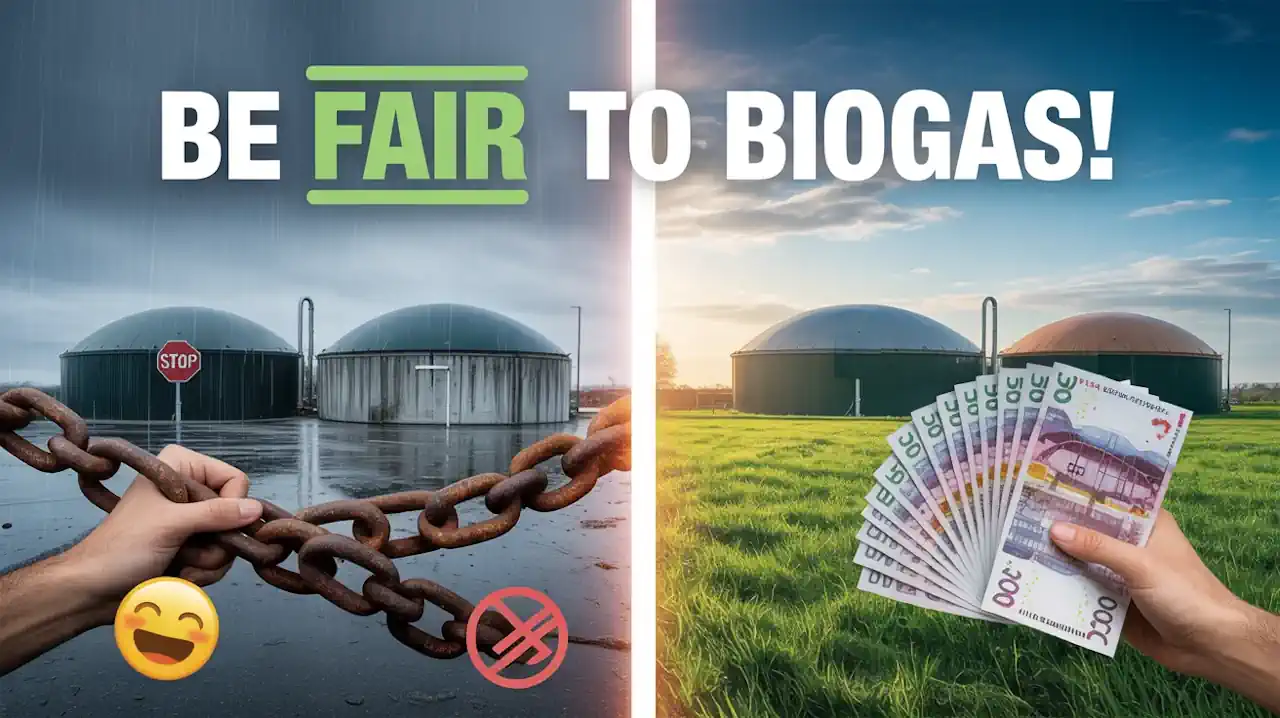
What administrative obstacles hinder biogas projects in Europe?
European waste management professionals face a maze of paperwork and unclear rules that slow down biogas projects. Developers struggle to find the right authorities and application windows across different regions. These obstacles fall into two broad categories.
Documentation and process barriers:
- Excessive paperwork fills every stage of the permitting and funding process, consuming months of your team’s time on forms alone.
- Authorities remain unclear about which administrative channels you should use for your specific project type.
- Application windows shift between regions, leaving developers confused about submission deadlines.
- Multiple government departments demand separate permits, yet nobody explains which office handles which responsibility.
- Funding applications demand different documentation than permitting applications, forcing separate submissions for each stage.
Structural and coordination barriers:
- Complex procedures create significant barriers to timely project development, pushing timelines back by years.
- Administrative confusion spreads across waste management, energy, and environmental sectors, each with separate rules and standards.
- Permit requirements vary so much between countries that a system working in Germany fails in France or Poland.
- Lack of clarity about which authorities to approach forces you to contact several agencies repeatedly.
- Grid connection authorities operate independently from planning departments, creating conflicting demands on your project specifications and timelines.
What infrastructure and grid connection issues affect biogas projects?
Grid operators in Europe often block biogas projects from connecting to power networks, which stops energy from reaching homes and businesses. Conflicts of interest mean some operators favour fossil fuels over renewable energy sources, making it harder for anaerobic digestion facilities to get fair access to the electrical infrastructure they need.

What challenges do European grid operators pose for biogas connections?
National grid operators in Europe hold the keys to infrastructure access, yet they often create real obstacles for biogas projects. These operators control the power lines and connection points that projects need to feed energy into the system.
They act as both facilitators and gatekeepers, which puts developers in a very difficult position. Project developers must satisfy many requirements to secure grid access.
According to the ADBA’s 10-point biogas road map updated for 2024 and 2025, gas and electricity grid connections now rank among the greatest developmental challenges for the UK biogas sector. Industry leaders are now demanding that local authorities legally classify AD plants as “critical infrastructure” to force grid compliance and bypass the conflicts of interest that slow connections down.
- Operators set technical standards and demand expensive upgrades before approving connections.
- Developers need a bespoke permit from each operator, and each one follows different rules.
- Review processes take months, adding significant cost and delay to every project.
- The process feels like dealing with multiple gatekeepers rather than one clear pathway.
Infrastructure conflicts run deep in the European energy system. Operators sometimes delay their work on biogas projects because they favour other energy sources. Connection timelines stretch from months into years, which damages project momentum and drains developer budgets.
Some operators require biogas projects to cover the full cost of grid upgrades, even when those upgrades benefit the entire system. This financial burden makes many projects uneconomical before they even get off the ground.
These barriers mean that many viable biogas projects never get built. Waste management professionals see promising projects fail because grid access becomes too expensive or too slow to achieve.
How do conflicts of interest create barriers to grid access?
Grid operators in Europe hold a tricky position. They own the infrastructure and also run energy businesses. This dual role creates real problems for biogas projects trying to connect to the grid.
These operators can slow down connections or give unfair treatment to biogas companies. They might prioritise their own energy sources over new biogas producers. This puts waste management professionals like you in a genuinely difficult spot.
You face delays that push back your project timelines and drain your budgets. European governments must tackle this conflict of interest to help the sector grow. A fair system requires operators to separate their infrastructure role from their commercial role.
- Operators who profit from fossil fuels have little reason to rush biogas connections.
- Permit applications sit in queues whilst competing energy sources get faster approvals.
- Independent regulators need to step in and set clear rules ensuring equal treatment for all energy sources.
- Strong oversight transforms grid access from a barrier into a genuine opportunity for growth.
Your projects deserve fair access based on merit, not on whether the operator profits from delays. Grid access reform is not optional. It is essential for the future of the sector.
Conclusion
Biogas projects face real hurdles, and environmental permitting sits right at the top of the list. Getting approval takes years, not weeks, and the system needs to change fast.
Money matters too. Fossil fuels grab the biggest subsidies while methane capture and nutrient recycling get very little in return. The Europe and U.S. comparison shows us different paths forward, yet both regions must act now to hit 2030 targets.
Your role as a waste management professional matters more than ever. Push for streamlined approvals, fair economic support, and grid access that actually works for renewable energy projects. The case for reform is clear, and the time to make that case is now.
Biogas Permit FAQs
1. What is a bespoke permit for anaerobic digestion?
A bespoke permit is a custom environmental permit from the Environment Agency built for your specific anaerobic digestion site. It covers operations that fall outside standard rules permits, particularly facilities processing more than 100,000 tonnes of waste per year or handling unique waste streams.
2. When do you need a bespoke permit for biogas operations?
You need one when your site exceeds the capacity limits of a standard rules permit or handles waste types not covered by those permits. The Environment Agency requires bespoke permits for sites processing over 100,000 tonnes annually or those with complex operational requirements.
3. Does digestate management affect your permit requirements?
Yes, it does. If you’re producing digestate for land spreading, your permit must address storage capacity, treatment processes, and whether you’re meeting the Quality Protocol for anaerobic digestate or managing it as waste.
4. How long does it take to get a bespoke permit approved?
The Environment Agency says it typically takes 4 to 6 months to determine a bespoke permit application, though complex sites can take longer. The regulator reviews your application in detail, including site visits and consultations with relevant bodies. Getting your paperwork complete and accurate from the start genuinely speeds things up and helps you avoid costly delays.