The potential for a massive increase in anaerobic digestion in Africa is no longer just a theoretical opportunity. It is becoming a practical energy, health and waste-management proposition — especially where new biogas cylinder compression technologies make it possible to distribute clean cooking fuel beyond the immediate site of a biogas plant.
Recent meetings between Gary Fanger, CEO of Cenergy Solutions, and government and business leaders in Zimbabwe, South Africa, Eswatini and Namibia point toward an important emerging trend. Anaerobic digestion is not being presented merely as a waste-treatment technology. It is being positioned as a route to cleaner cooking, reduced deforestation, rural enterprise, energy independence and public-health improvement.
This matters because household air pollution from polluting cooking fuels remains one of the world’s major preventable health burdens. The World Health Organization estimates that household air pollution was responsible for about 2.9 million deaths in 2021, with women and children especially exposed because of time spent near cooking areas. Earlier WHO-linked clean-cooking estimates have commonly cited around 3.2 million premature deaths annually from household air pollution associated with dirty cooking fuels.
For African nations with large quantities of organic waste, agricultural residues, food waste, manure and sewage sludge, the argument is compelling: convert waste into biogas, clean it, compress or adsorb it into cylinders, and distribute it as a cleaner fuel for households and businesses.

Compressed Biogas in Africa – Key Takeaways
✅ Anaerobic digestion could grow rapidly in Africa if biogas can be stored and distributed conveniently.
✅ Compressed or adsorbed biogas cylinders may help overcome one of the biggest barriers to biogas adoption: getting the gas from the digester to the user.
✅ Clean cooking is a public-health priority, particularly where households still depend on wood, charcoal, dung, crop residues or kerosene.
✅ Organic waste becomes a national resource when it is treated as feedstock for clean fuel rather than a disposal problem.
✅ Governments may be attracted by the combined benefits: lower healthcare costs, reduced deforestation, new jobs, tax revenues, carbon benefits and energy security.
✅ The concept needs careful technical implementation, including gas cleaning, safe cylinder design, quality control, training and regulation.
Why Biogas Has So Much Untapped Potential in Southern Africa
Africa has an enormous but underused organic resource base. Food waste, crop residues, animal manures, abattoir wastes, sewage sludge, market wastes and agro-industrial residues are often treated as low-value materials or environmental liabilities. In reality, they are potential feedstocks for anaerobic digestion.
Anaerobic digestion uses naturally occurring microorganisms to break down organic matter in the absence of oxygen. The result is biogas, a methane-rich renewable gas, and digestate, a nutrient-rich biofertiliser that can return organic matter and plant nutrients to soils.
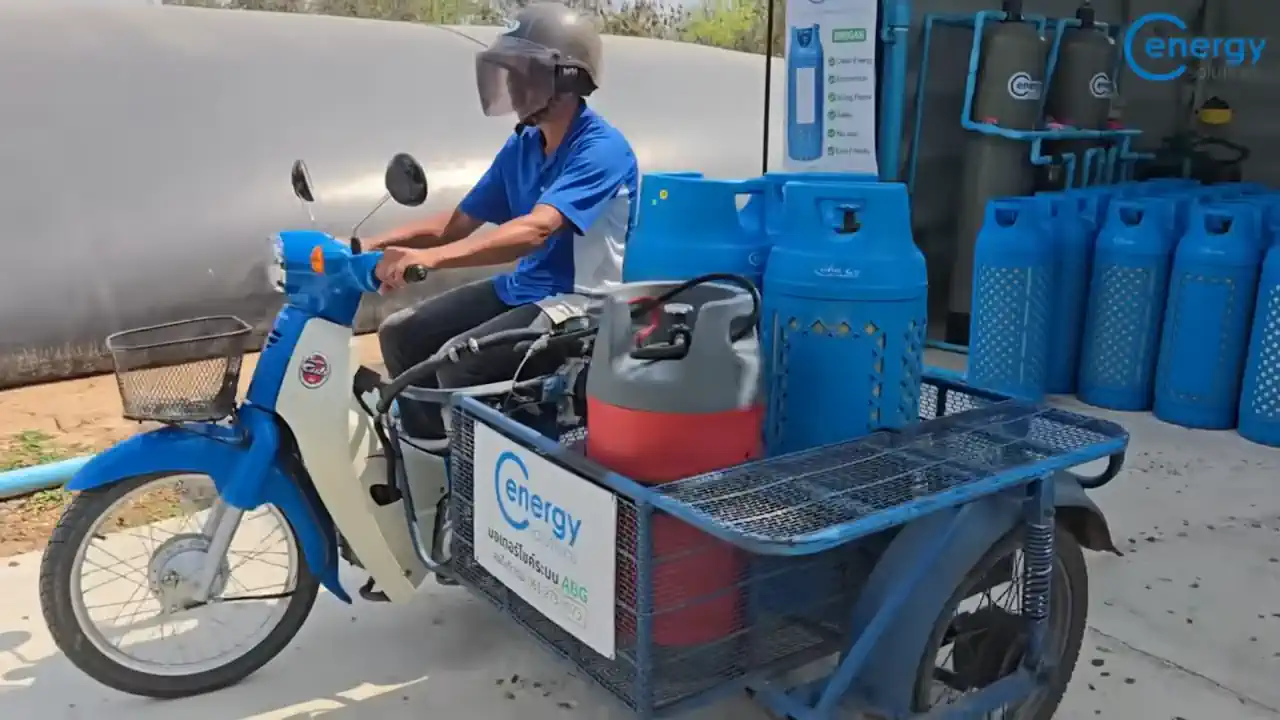
Traditionally, many smaller biogas projects have been limited by location. The gas is produced where the digester is built. That works well for a farm, school, hospital, prison, market, wastewater treatment works or food-processing plant if the gas can be used on site. But it becomes much more powerful if the gas can be stored, bottled and transported.
That is where compressed biogas and adsorbed biogas cylinders may change the economics.
The Missing Link: Biogas Distribution
For decades, biogas has often been described as a local energy solution. That is both its strength and its weakness.
It is a strength because waste can be converted into energy close to where it is produced. It is a weakness because households and small businesses needing clean cooking fuel may be scattered across towns, villages and peri-urban communities.
If biogas cannot be stored and moved conveniently, its usefulness is restricted. If it can be compressed, adsorbed and distributed safely in cylinders, the market becomes much larger.
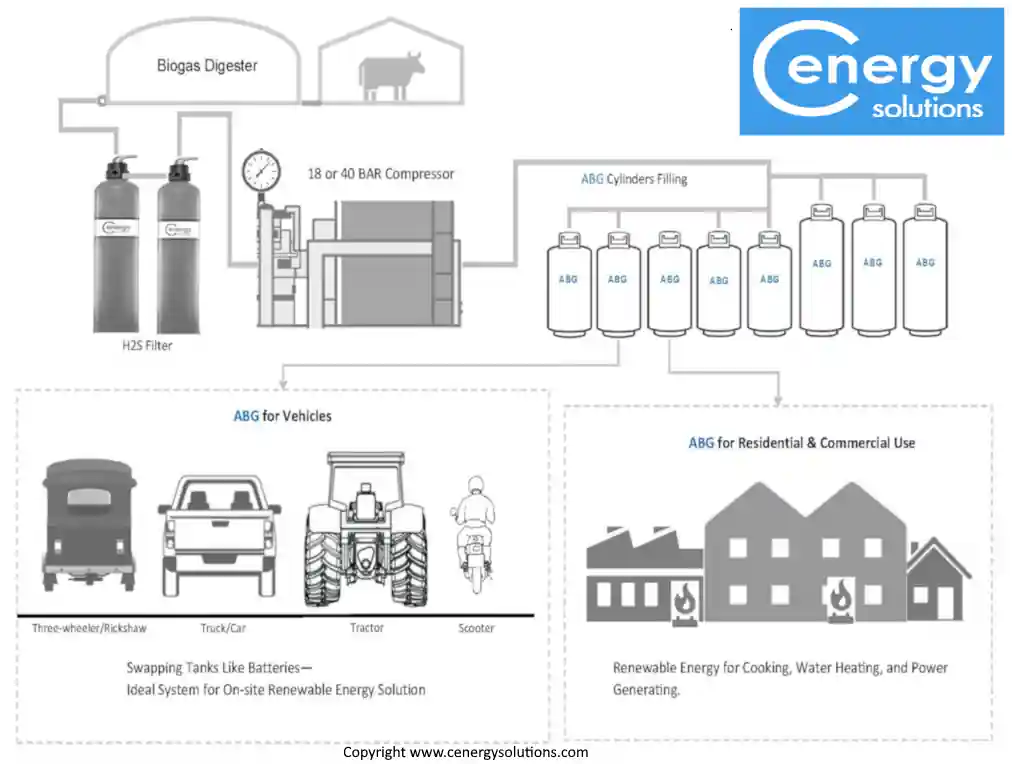
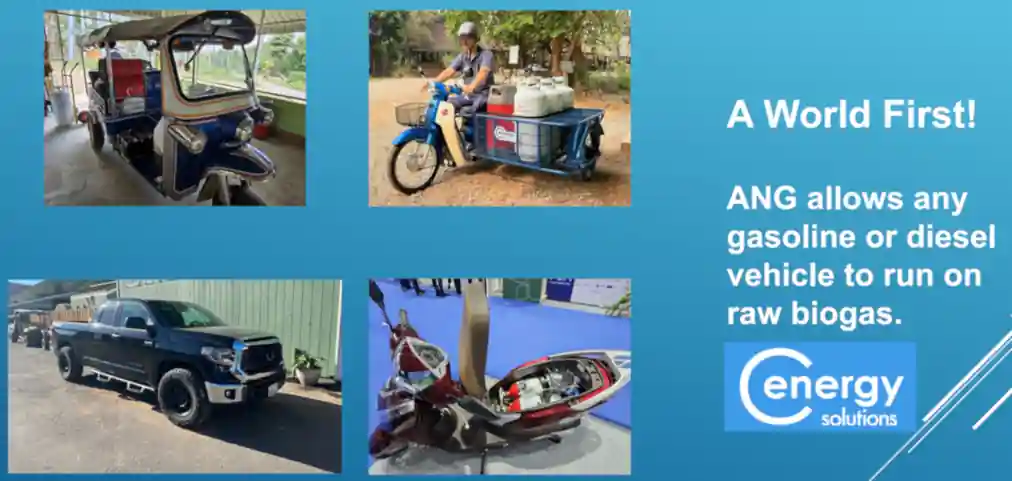
Cenergy Solutions says its patented adsorbent biogas cylinder technology allows biogas to be stored at lower pressures than conventional high-pressure gas systems. Public descriptions of the company’s technology refer to adsorbed biogas using activated carbon, which can hold methane molecules within a porous adsorbent structure. This is intended to make methane-rich gas storage more practical and cost-effective at lower pressure than conventional compressed natural gas systems.
In simple terms, this technology could make biogas behave more like a distributable cooking fuel. Instead of every household needing its own digester, centralised or semi-centralised biogas production sites could supply cylinders to many users.
Cenergy Solutions’ Recent African Meetings
According to the company’s recent communication, Gary Fanger, CEO of Cenergy Solutions, travelled to Zimbabwe, South Africa, Eswatini and Namibia to meet government officials, U.S. Embassy representatives, distributors and business leaders.
The purpose of the meetings was to demonstrate how organic waste could be converted into biogas and distributed through Cenergy’s patented adsorbent biogas cylinders as a replacement for dirty cooking fuels.
The company says the discussions covered not only clean cooking, but also waste management, deforestation, public health, mortality reduction, energy independence, commercial fuel use, transport, food processing, heating and electricity generation.
This is a broader vision than a simple household stove programme. It is a waste-to-energy development model, with biogas as the central fuel.
Why Clean Cooking Is Such a Powerful Driver
Clean cooking is one of the most important but often under-recognised energy challenges in the world. Where households cook with wood, charcoal, crop residues, dung, coal or kerosene, the smoke and emissions can create severe indoor and local air pollution.
The health burden falls most heavily on women, children and elderly people. Smoke exposure is associated with respiratory disease, cardiovascular disease, childhood pneumonia, chronic obstructive pulmonary disease and other serious conditions. Clean Cooking Fund materials and WHO information both identify household air pollution as a major cause of premature death, with women and children disproportionately affected. :contentReference[oaicite:2]{index=2}
Replacing smoky fuels with clean-burning gas can therefore produce benefits well beyond convenience. It can reduce smoke exposure, free time spent gathering firewood, reduce pressure on forests and improve quality of life.
Biogas is especially attractive because it can be produced from local waste rather than imported fossil fuel.
The Revenue Opportunity Claimed for Four African Countries
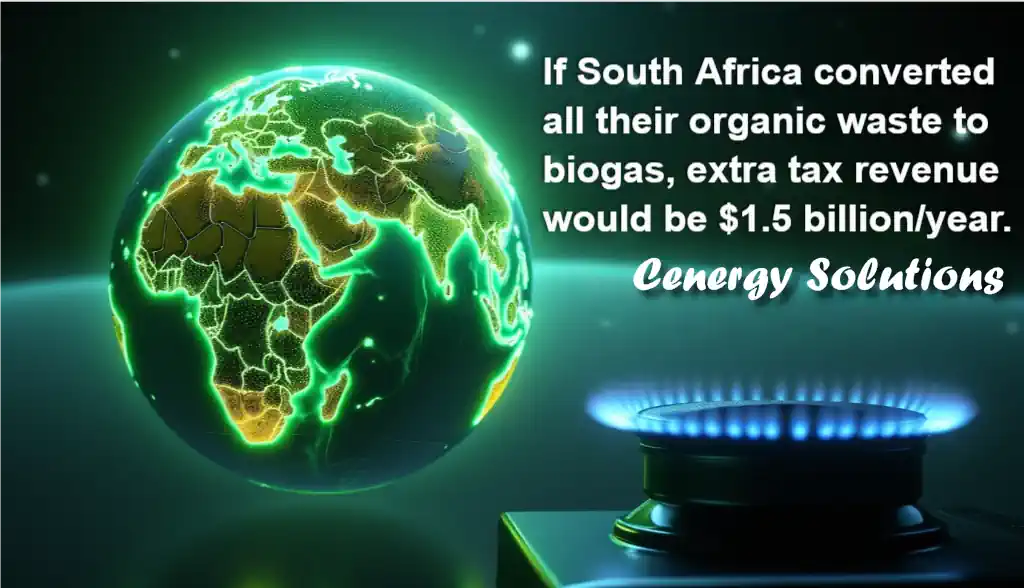
Cenergy Solutions has provided estimated figures for the opportunity in Zimbabwe, Eswatini, South Africa and Namibia. These figures should be treated as company estimates and would need country-level feasibility studies before investment decisions were made.
However, they show the scale of the opportunity being discussed with policy makers and business leaders.
| Country | Population Estimate | Company Estimate: Deaths Per Year Linked to Biomass Cooking | Company Estimate: Healthcare Costs Linked to Dirty Cooking | Company Estimate: Potential Annual Biogas Revenues | Company Estimate: Potential Government Tax at 10% |
|---|---|---|---|---|---|
| Zimbabwe | 16.3 million | 3,000 | $1.6 billion | $1.5 billion | $153 million |
| Eswatini | 1.23 million | 300 | $85 million | $131 million | $13 million |
| South Africa | 63.2 million | 2,500 | $1.1 billion | Company figures require clarification* | $150 million |
| Namibia | 2.96 million | 200 | $140 million | $355 million | $35 million |
*Note: The South Africa figures supplied in the email appear to contain a possible inconsistency. The clean-cooking revenue estimate is given as $3.8 billion and commercial-use revenue as $375 million, but the total revenue is stated as $1.5 billion. Readers should be aware that we are checking this with Cenergy Solutions.
Why the AD and Cylinder Model Is So Synergistic
The synergy between anaerobic digestion and compressed or adsorbed biogas cylinders is unusually strong because each part of the system solves a problem for the other.
🔹 Anaerobic digestion needs reliable gas markets. Cylinder distribution can create demand from households, restaurants, schools, clinics, farms and small industries.
🔹 Clean cooking needs affordable fuel supply. Local biogas can reduce dependence on imported LPG, charcoal or kerosene.
🔹 Waste authorities need better organic waste solutions. AD diverts organics from dumpsites and uncontrolled decomposition.
🔹 Farmers need better nutrient recycling. Digestate can return fertiliser value to soils.
🔹 Governments need visible development wins. Biogas projects can connect health, energy, waste, climate and employment policies.
In many developing markets, the biggest clean-energy opportunities are not simply about generating electricity. They are about replacing inefficient daily fuel use. Cooking fuel is one of the most important examples.

From Waste Burden to Energy Asset
One of the strongest arguments for anaerobic digestion in Africa is that organic waste already exists. It is produced every day in markets, farms, food factories, abattoirs, hotels, households and wastewater systems.
Without proper management, this waste can cause odour, vermin, water pollution, methane emissions and public-health problems. With anaerobic digestion, the same material can become a source of renewable gas and biofertiliser.
This creates a circular economy model:
- Organic waste is collected.
- Waste is processed in anaerobic digesters.
- Biogas is cleaned and compressed or adsorbed into cylinders.
- Cylinders are distributed for clean cooking and commercial energy use.
- Digestate is used as fertiliser or soil improver where suitable.
- Money that would have left the economy for imported fuel circulates locally.
That circularity is why politicians and government agencies may find the proposition attractive. It is not just an energy project. It is a waste, health, jobs, agriculture and climate project combined.
Could This Reduce Deforestation?
In countries and regions where wood fuel and charcoal remain major cooking fuels, clean biogas could help reduce pressure on forests and woodland. The effect would depend on cost, availability, consumer acceptance and reliable cylinder supply.
The clean-cooking sector has long recognised that traditional biomass cooking can contribute to deforestation and environmental degradation where fuelwood harvesting is unsustainable. World Bank clean-cooking work has highlighted the need for improved and cleaner cooking solutions across Sub-Saharan Africa. :contentReference[oaicite:3]{index=3}
Biogas is not the only solution. LPG, electricity, ethanol, pellets, improved cookstoves and solar-electric cooking may all have roles. But biogas has the special advantage of being locally produced from waste.
The Safety and Quality Issues Must Not Be Overlooked
There is a crucial technical point that must be made clearly. Raw biogas is not the same as clean, dry, compressed biomethane.
Biogas can contain carbon dioxide, water vapour, hydrogen sulphide and trace contaminants. If it is to be compressed, stored or distributed in cylinders, it must be cleaned and dried to the specification required by the cylinder system, valves, regulators, burners and all wetted parts.
Hydrogen sulphide is corrosive and toxic. Moisture can accelerate corrosion. Poorly cleaned gas can damage equipment and create safety risks. Any cylinder-based biogas system therefore needs proper gas treatment, quality monitoring, trained operators, safe filling procedures and robust regulation.
This is not a reason to reject the technology. It is a reason to implement it professionally.
Why Governments May Take This Seriously
The political attraction of a cylinder-based biogas model is easy to understand. It can be presented as a direct response to several national priorities:
- ✅ Reducing deaths and illness linked to dirty cooking.
- ✅ Cutting household exposure to smoke.
- ✅ Reducing dependence on imported fuel.
- ✅ Creating local jobs in waste collection, plant operation, gas distribution and maintenance.
- ✅ Improving urban sanitation and organic waste management.
- ✅ Reducing methane emissions from uncontrolled organic waste decay.
- ✅ Supporting farmers through digestate nutrient recycling.
- ✅ Generating taxable business activity.
That combination is powerful. A government does not need to justify the policy on climate grounds alone. The same investment can be defended on health, economic, waste-management and energy-security grounds.
A Realistic View: Great Potential, But Not Automatic Success
The opportunity is large, but success is not guaranteed. Many biogas programmes have struggled in the past because they underestimated maintenance, feedstock logistics, user behaviour, affordability, gas quality, spare parts, training and after-sales support.
For compressed or adsorbed biogas cylinders to scale successfully in Africa, the following issues will matter:
- Reliable organic waste supply contracts.
- Well-designed digesters matched to local feedstocks.
- Gas cleaning systems suitable for cylinder storage.
- Safe and certified cylinders, valves and regulators.
- Affordable household stoves and refill pricing.
- Local technicians trained in maintenance and safety.
- Clear government standards for bottled biogas.
- Consumer trust in the fuel supply chain.
- Practical distribution networks.
- Carbon-credit or climate-finance support where appropriate.
The greatest opportunity may be in hybrid models: municipal organic waste plants, farm clusters, food-processing sites, wastewater treatment works and regional filling hubs supplying households and small businesses.
A New Phase for Anaerobic Digestion in Africa?
The Cenergy Solutions meetings in Zimbabwe, South Africa, Eswatini and Namibia may prove significant because they frame anaerobic digestion as a practical clean-cooking and energy-security technology rather than only a waste-treatment system.
If governments, investors and local businesses can align around the right delivery model, compressed and adsorbed biogas cylinders could unlock demand that conventional fixed-pipe biogas systems cannot reach.
This could support a major expansion of anaerobic digestion across Africa, especially where the same project can solve several problems at once: organic waste, dirty cooking, deforestation, imported fuel dependence and rural unemployment.
The phrase “waste-to-energy” is often used too loosely. But in this case, it is highly appropriate. Organic waste really can become clean cooking fuel. With the right technology, it can also become a distributable product.
That is why the latest generation of biogas cylinder compression and adsorbent storage technology deserves close attention. It may provide the missing link between Africa’s abundant organic resources and the urgent need for cleaner, safer, locally produced household energy.
FAQs
What is compressed biogas?
Compressed biogas is biogas that has been cleaned, dried and compressed so that it can be stored in cylinders or tanks. Depending on the system, the gas may be upgraded toward biomethane quality or used in a cleaned biogas form suitable for the intended equipment.
What is adsorbed biogas?
Adsorbed biogas is methane-rich gas stored in a cylinder containing a porous adsorbent material, commonly activated carbon. The adsorbent helps hold more methane at lower pressure than an empty cylinder at the same pressure.
Why is bottled biogas important?
Bottled biogas can be transported to users who are not located next to a digester. This makes it more useful for households, restaurants, schools, clinics and small businesses.
Can biogas replace charcoal and wood for cooking?
Yes, in principle. Clean biogas can be used as a cooking fuel where the gas is properly treated, safely stored and supplied at an affordable price. The challenge is building a reliable production and distribution system.
Is raw biogas safe to compress?
Raw biogas should not be compressed into cylinders without proper cleaning, drying and safety controls. Contaminants such as hydrogen sulphide and moisture can create corrosion, toxicity and equipment problems.
Why is anaerobic digestion suitable for Africa?
Anaerobic digestion is suitable where there are reliable organic feedstocks such as manure, food waste, market waste, sewage sludge, crop residues and agro-industrial wastes. Many African countries have significant organic waste resources that could be converted into useful fuel and biofertiliser.
Could this create jobs?
Yes. A cylinder-based biogas sector could create jobs in waste collection, digester operation, gas cleaning, cylinder filling, distribution, stove supply, maintenance, safety inspection and digestate management.
Is this better than LPG?
It depends on local conditions. LPG is often convenient and already established, but it is usually fossil-derived and often imported. Biogas can be locally produced from waste, which gives it advantages for circular economy development, energy security and methane-emission reduction.
Compressed Biogas Conclusion
Africa’s clean-cooking challenge is immense, but so is its organic waste-to-energy opportunity. The recent engagement between Cenergy Solutions and leaders in Zimbabwe, South Africa, Eswatini and Namibia highlights a practical route that deserves serious attention.
By combining anaerobic digestion with compressed or adsorbed biogas cylinder technology, countries may be able to turn local waste into clean cooking fuel, reduce household smoke exposure, protect forests, create jobs and strengthen energy independence.
The technology will need rigorous safety standards, reliable gas cleaning and realistic business planning. But the direction of travel is promising. If biogas can be produced locally and distributed conveniently, anaerobic digestion in Africa could move from a niche environmental technology to a major clean-energy industry.
Clean cooking, waste management and energy security do not need to be separate goals. With the right anaerobic digestion and biogas cylinder systems, they can become one integrated solution.
You may find the following article on this subject at “Compressed Biogas in Africa: Could Cylinder-Based Anaerobic Digestion Unlock a Clean Cooking Revolution? of interest.
Sources
- World Health Organization: Household air pollution and health — source for current WHO estimates on deaths linked to household air pollution and the health burden from polluting cooking fuels.
- Climate and Clean Air Coalition: Household Air Pollution Fact Sheet — useful supporting source for the widely cited estimate of 3.2 million deaths per year from household air pollution and the impact on women and children.
- World Bank: Clean and Improved Cooking in Sub-Saharan Africa — background on clean and improved cooking solutions across Sub-Saharan Africa and the need to move beyond traditional cooking technologies.
- World Bank: How clean cooking solutions can help protect human capital in Sub-Saharan Africa — explains why traditional fuels and cooking methods remain a serious public-health and development issue in the region.
- Cenergy Solutions: Biogas Cylinders — company source describing Cenergy’s adsorbed biogas cylinders and their use for transporting and storing biogas.
- Cenergy Solutions: Adsorbed Biogas Storage Technology — company source describing its patented adsorbed biogas storage cylinders, clean cooking focus and claimed benefits.
- World Biogas Association: Cenergy Solutions member press release — background on Cenergy Solutions’ patented adsorbent technology and its claimed role in capturing methane and replacing polluting fuels.
- Modern Energy Cooking Services: Scaling biogas and natural gas cooking solutions in Nigeria and beyond — independent discussion of adsorbed biogas and natural gas cylinder technology for clean cooking markets.
Note: The country-level revenue, healthcare-cost and tax estimates used in this article are based on figures supplied by Cenergy Solutions in a recent Newsletter email text. They should be treated as company estimates unless independently verified through national feasibility studies or official government data.