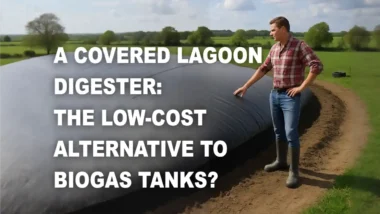
Could medium-sized farms and existing anaerobic digestion plants soon turn raw biogas into useful, fuel-grade biomethane without needing a full gas-to-grid project? That is the inspiring prospect raised by Bennamann’s biomethane upgrading and Bio-CNG refuelling technology.
For many years, the UK farm biogas sector has been shaped by subsidy regimes, electricity generation, CHP engines, heat use, and — for larger projects — expensive gas-to-grid connections. But as Feed-in Tariff, Renewables Obligation and other support mechanisms decline or close to new entrants, the industry urgently needs practical new commercial models.
Bennamann, a UK biomethane technology company, is promoting a different route: upgrading biogas locally into fuel-grade biomethane, compressing it, storing it in cylinders, and using it as Bio-CNG for tractors, HGVs, generators, off-grid power and other local energy applications. Its CAPCH4® Biogas Upgrader is described as a retrofittable solution for existing AD plants, designed to upgrade biogas into fuel-grade biomethane [1].
This matters because it could open a new pathway for farm AD plants that are too small, too remote, or too commercially constrained to justify full biomethane grid injection. It also raises a bigger question: are we approaching a new era of unsubsidised UK farm biogas growth?
Key Takeaways
- ✅ Bennamann’s concept is not just gas upgrading. It is a decentralised farm energy model based around biomethane, Bio-CNG storage and local fuel use.
- ✅ Existing AD plants may gain a new post-subsidy income route. Instead of relying only on electricity export, heat use or grid injection, operators could produce compressed biomethane fuel.
- ✅ Gas-to-grid may no longer be the only serious biomethane route. Bio-CNG cylinders and local refuelling could suit farms, hauliers, councils, contractors and rural fleets.
- ✅ The model appears particularly relevant as FIT and ROC support declines. The FIT scheme closed to new applicants in 2019, while the Renewables Obligation closed to new generating capacity in 2017 [5] [6].
- ✅ The gas may not need to meet full natural gas grid injection requirements. For vehicle fuel and local Bio-CNG use, the commercial target is different from pipeline-quality grid gas, although gas cleaning, drying, compression and safety remain critical.

A Fresh Way to Think About Farm Biogas
Traditional UK farm AD has often followed a familiar pattern. A farm or rural business installs an AD plant, produces biogas, burns that gas in a CHP engine, exports electricity, uses some heat if possible, and relies on subsidy income to make the economics work.
That model helped build much of the UK’s existing agricultural AD plant stock. It also created a problem. Many plants were designed around incentives that are now closed, declining, or no longer available to new projects. Once the original tariff assumptions weaken, the question becomes unavoidable:
What is the next commercial life for these assets?
Bennamann’s answer is compelling because it treats raw biogas as a transport and local energy fuel opportunity, rather than only as a feedstock for electricity generation or gas-grid injection. Its public materials describe technology that allows AD operators, fleets and the construction industry to upgrade biogas to fuel-grade biomethane, also known as Bio-CNG, to replace fossil fuels in multiple sectors [2].
What Bennamann Is Offering
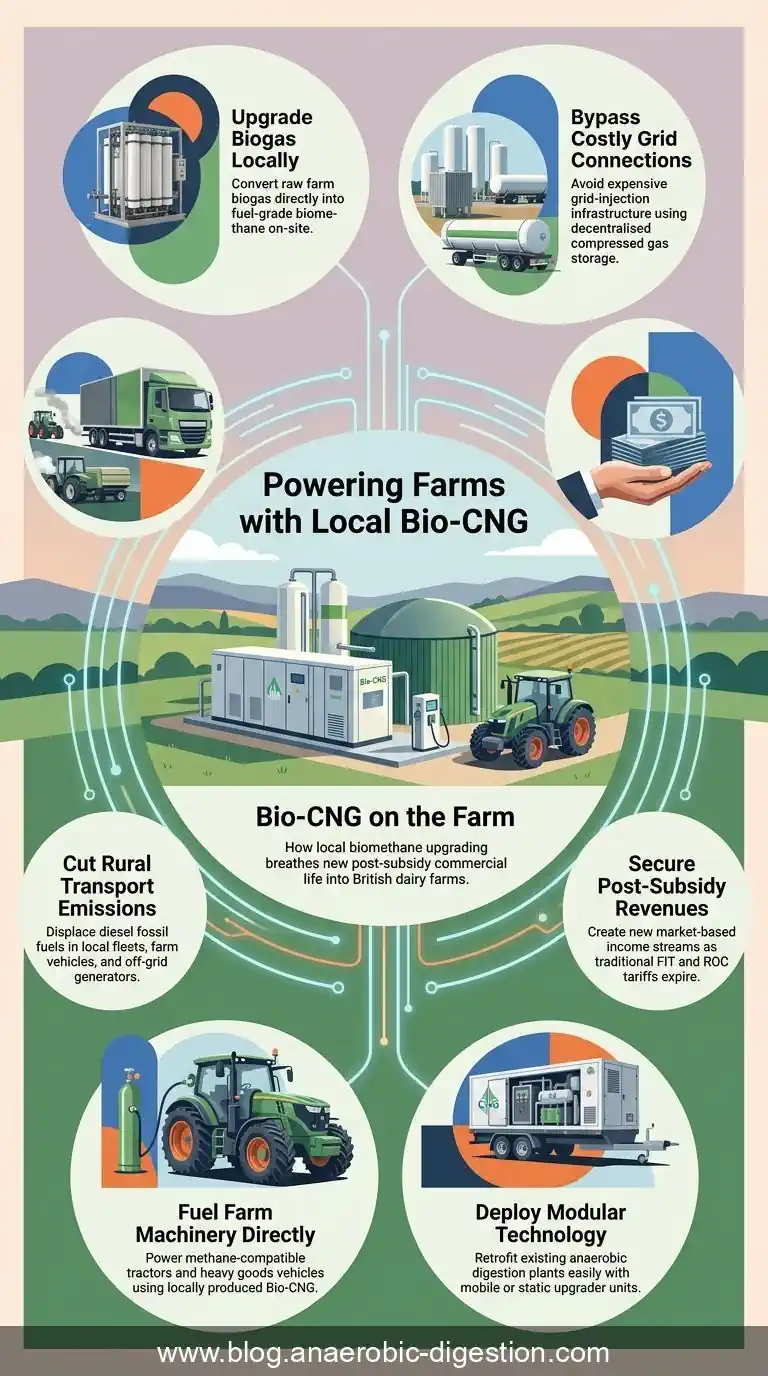
Bennamann’s CAPCH4® Biogas Upgrader is described as a modular, retrofittable unit for AD plants. The company says it upgrades biogas into fuel-grade biomethane and integrates gas drying, compression and refuelling capability [1].
In simple terms, the system is aimed at helping farms and AD operators move from this:
raw biogas → CHP electricity and heat
towards this:
raw biogas → cleaned biomethane → compressed Bio-CNG → useful farm, fleet or off-grid fuel
That is a significant shift. It means an AD plant can potentially become a local fuel production asset, not merely a renewable electricity generator.
The Mobile and Modular Biomethane Idea
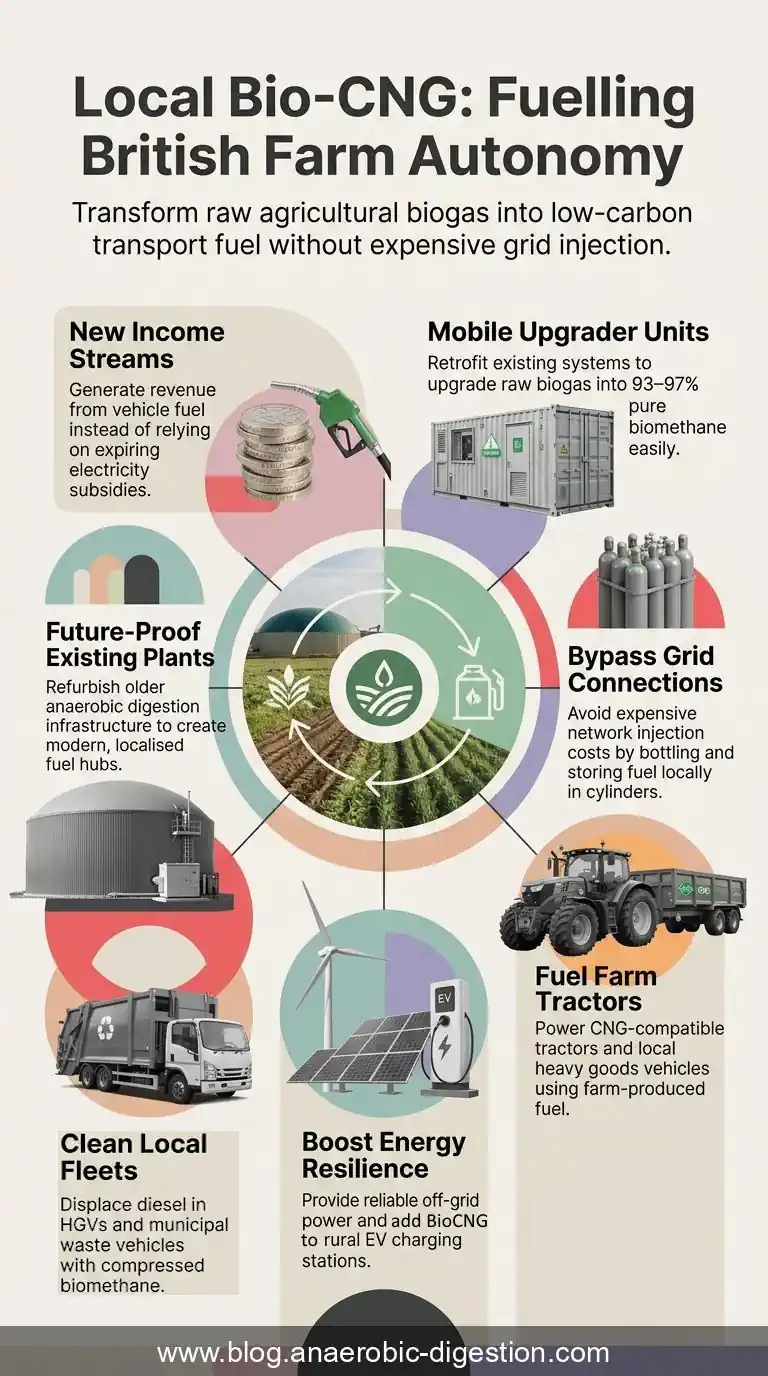
One of the most interesting aspects of Bennamann’s approach is the mobile or modular character of its upgrading model. Farmers Weekly reported in April 2026 that the Bennamann BioCycle unit can be supplied as either a static or mobile unit, upgrading methane to a purity of 93–97%, with one unit capable of producing 140,000 kg of bottled biomethane per year [3].
This is a crucial point. Not every farm AD plant can justify a full gas-to-grid connection. Grid injection usually brings major requirements: high gas quality, propane enrichment in some cases, metering, odorisation, grid connection costs, compliance obligations and long development times.
By contrast, a mobile or modular Bio-CNG model may allow a farm or AD operator to produce usable compressed biomethane without having to become a full gas-grid exporter.
Why This Could Matter as FIT and ROC Income Declines
The UK AD sector has relied heavily on support mechanisms. The Feed-in Tariff scheme closed to new applicants from 1 April 2019 [5]. The Renewables Obligation closed to all new generating capacity on 1 April 2017 [6]. Government statements have also confirmed that it does not plan to extend the Renewables Obligation when it comes to an end from 2027 onwards [7].
For existing farm AD plants, this creates a strategic problem. Many assets still have operational value. Digesters, tanks, feedstock systems, reception areas and gas handling equipment already exist. In many cases, the plant site, planning history, operator knowledge and feedstock relationships are also already in place.
The opportunity is not necessarily to build every project from scratch. It may be to refurbish, improve and repurpose existing AD capacity for new value streams.
That is why Bennamann’s Bio-CNG concept is so interesting. It suggests a future in which ageing or under-optimised AD plants can be upgraded into local renewable fuel hubs.
From Subsidised Electricity to Local Renewable Fuel
| Old Farm AD Model | Emerging Bio-CNG Model |
|---|---|
| Biogas mainly burned in CHP engines | Biogas upgraded to biomethane |
| Revenue often linked to FIT, ROC or electricity export | Revenue linked to fuel value, local fleet use and fossil fuel replacement |
| Heat use may be limited or seasonal | Compressed biomethane can be stored and used when needed |
| Gas-to-grid may be too costly for smaller sites | Bio-CNG cylinders and local refuelling may avoid full grid injection |
| Plant economics vulnerable as subsidies decline | Potential for more market-based, unsubsidised operation |
What Can Bio-CNG Be Used For?
Compressed biomethane is valuable because it is flexible. Once the gas has been cleaned, upgraded and compressed, it can potentially be used in several practical ways.
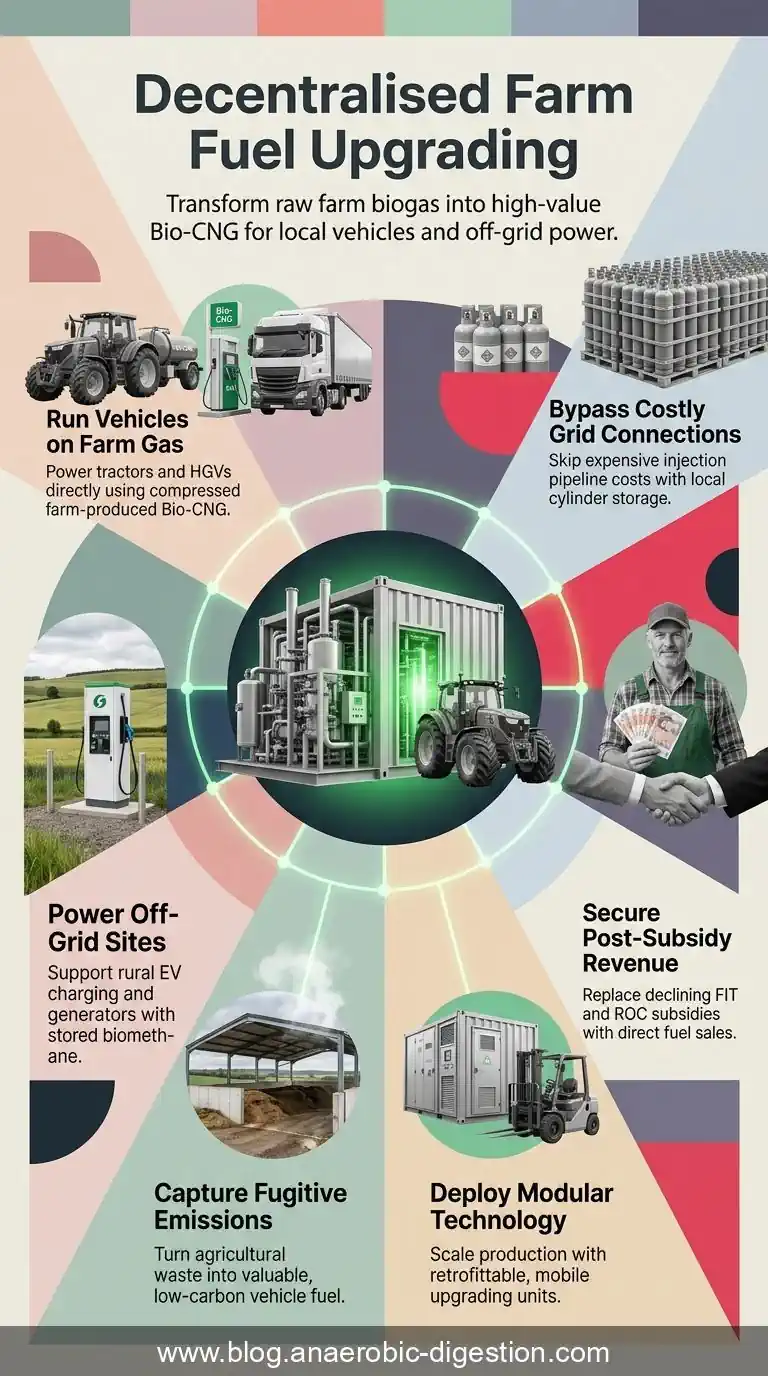
- 🚜 Fuel for methane-powered tractors, including farm machinery using CNG-compatible engines.
- 🚛 Fuel for HGVs and local fleets, particularly where vehicles return to base.
- ⚡ Off-grid electricity generation where renewable gas is more practical than grid reinforcement.
- 🔋 Support for EV charging in rural or construction locations where grid capacity is limited.
- 🏭 Industrial or process heat where fossil gas or LPG can be displaced.
- 🏡 Farm and estate energy resilience, especially where energy security is increasingly important.
ADBA reported that Bennamann’s CAPCH4 upgrader gives AD operators an opportunity to transition to Bio-CNG road fuel for both self-consumption and retail sales. The report stated that each device can produce 140,000 kg of biomethane road fuel per year, enough for 4–6 HGVs covering 100,000 km or 4–6 New Holland T6.180 CNG tractors operating 1,500 hours per year [4].
A New Role for Existing AD Plants
The most exciting possibility is that this approach could give existing AD plants a second commercial life.
Instead of seeing older farm biogas plants as subsidy-dependent assets approaching commercial decline, they can be seen as renewable gas platforms waiting to be upgraded. Many already have feedstock supply chains, gas production capacity and an operational base. What they may need is improved gas utilisation.
In that sense, Bennamann’s model could help reframe the UK AD debate. The question is no longer simply:
Can this plant export electricity or inject biomethane into the gas grid?
The better question may be:
What local fossil fuel use can this plant replace?
That could include diesel tractors, diesel trucks, diesel generators, LPG heating, fossil natural gas, and grid-constrained rural energy uses.
Why the Gas Does Not Always Need to Be Grid-Quality Natural Gas
One of the practical insights behind the Bio-CNG route is that not every biomethane project needs to satisfy the full requirements of natural gas grid injection.
Gas-grid injection is a demanding application. The gas must satisfy network specifications, including requirements for composition, calorific value, metering, odorisation and safety. In some UK biomethane projects, propane enrichment has historically been used to raise calorific value to grid requirements.
For compressed biomethane used as a local vehicle or off-grid fuel, the requirement is different. The gas still needs proper cleaning, moisture removal, upgrading, compression and safety controls. Hydrogen sulphide, water vapour and other contaminants must be managed correctly. But the commercial purpose is fuel use, not blending into the natural gas grid.
This distinction matters. It may allow useful biomethane production at sites where grid injection would be too expensive or technically unattractive.
Could This Lead to Unsubsidised UK Farm Biogas Growth?
There is a credible reason for optimism.
If biomethane can be produced, compressed and used locally at a competitive cost, farm AD may become less dependent on government subsidy and more connected to real energy markets. Diesel replacement, fleet decarbonisation, energy security and local fuel resilience are powerful drivers.
The UK agricultural sector also has a practical need for alternatives to fossil diesel. Electrification will suit some applications, but heavy farm machinery, HGVs, remote sites and high-duty-cycle vehicles are not always easy to electrify quickly. Bio-CNG could therefore occupy an important middle ground.
Farmers Weekly has described biomethane as potentially important for UK farms, including the use of slurry-fed AD systems, gas filtration, upgrading and bottled biomethane production [3]. Bennamann also highlights scalable, farm-based solutions that capture, upgrade and utilise latent and fugitive biogas [8].
However, it would be unwise to pretend that every farm AD plant can immediately become a profitable Bio-CNG site. The economics will depend on gas yield, plant uptime, local fuel demand, equipment cost, maintenance, permitting, insurance, gas quality, storage arrangements and the availability of compatible vehicles.
Even so, the direction of travel is important. Bennamann’s concept points toward a future in which AD plants are not built merely to chase tariffs, but to provide useful, locally consumed renewable fuel.
The Most Likely Early Adopters
The strongest early markets are likely to be sites where gas production and gas demand sit close together.
- Farm AD plants with CNG tractor demand and a desire to reduce diesel use.
- Food waste AD plants with local vehicle fleets, especially collection vehicles or HGVs returning to base.
- Rural estates and large farms with heat, power and transport fuel needs.
- Contractors and construction operators needing low-carbon off-grid power or mobile energy.
- Local authorities and waste companies seeking low-carbon fleet fuel from organic waste.
- Existing AD operators facing declining subsidy income and looking for retrofit options.
Why This Is an Inspiring Development
The UK AD industry has sometimes been criticised for being too subsidy-dependent. That criticism is not entirely fair, because early renewable energy markets usually require policy support. But the next phase of AD growth must be more commercially resilient.
Bennamann’s approach is inspiring because it suggests a more mature model: produce renewable gas where organic waste and manures arise, upgrade it locally, compress it, and use it where fossil fuel is still hard to replace.
This is not just an engineering innovation. It is a business model innovation.
It could help turn farm AD plants into decentralised renewable fuel hubs. It could help keep older plants productive after subsidy support weakens. It could give farms more control over energy costs. It could provide a practical low-carbon route for rural transport, off-grid power and local fleets.
Most importantly, it could make biogas feel commercially relevant again to medium-sized farms that cannot justify a conventional gas-to-grid project.
Conclusion: A New Chapter for UK Farm AD?
Bennamann’s biomethane upgrading concept deserves attention because it addresses one of the biggest questions facing UK farm biogas: what comes after subsidy-led electricity generation?
If medium-sized farms and existing AD plants can turn raw biogas into compressed Bio-CNG, then the UK may have a practical new route for refurbishing and upgrading its existing AD plant stock. Not every site will be suitable. Not every project will work without careful technical and commercial assessment. But the principle is powerful.
For the first time, many operators may be able to imagine a future in which their AD plant does not need to depend entirely on FIT, ROCs or a costly gas-grid connection.
Instead, the plant becomes a local renewable fuel producer.
That could mark the beginning of a new era for UK farm biogas: more decentralised, more flexible, more practical, and potentially far less dependent on subsidy than the first generation of AD development.

FAQs
What is Bennamann’s biomethane upgrading concept?
Bennamann’s concept is based on upgrading raw biogas into fuel-grade biomethane, compressing it, storing it, and using it as Bio-CNG. The company promotes its CAPCH4® Biogas Upgrader as a retrofittable solution for AD plants [1].
Does this mean a farm AD plant no longer needs gas-to-grid?
Potentially, yes. Gas-to-grid may still be the best route for some larger biomethane projects, but Bio-CNG production offers another pathway. A farm or AD plant may be able to produce compressed biomethane for local vehicle fuel, off-grid energy or fleet use without needing full grid injection.
Is Bio-CNG the same as biomethane?
Bio-CNG is compressed biomethane. Biomethane is upgraded biogas with carbon dioxide and contaminants removed. When compressed to high pressure and used as a fuel, it is commonly referred to as Bio-CNG.
Can compressed biomethane be used in tractors?
Yes, provided compatible methane or CNG-powered tractors are used. ADBA reported that Bennamann’s system unit could produce enough biomethane road fuel for 4–6 New Holland T6.180 CNG tractors at 1,500 hours per year [4].
Is the gas suitable for natural gas grid injection?
Not necessarily. Grid injection has specific gas quality and calorific value requirements. A Bio-CNG system can be aimed at vehicle fuel or local energy use rather than gas-grid blending. That does not remove the need for gas cleaning, drying, compression and safety controls, but it can change the commercial and technical target.
Why is this important for existing AD plants?
Many existing AD plants were built around subsidy-supported electricity generation. As FIT, ROC and other support arrangements decline or close to new entrants, operators need new income routes. Bio-CNG production could allow existing plants to be refurbished and upgraded for transport fuel and local energy markets.
Is this a route to unsubsidised AD growth?
It could be. The strongest opportunity is where a site can match biogas production with local fuel demand, such as farm machinery, HGVs, contractors, waste collection vehicles or off-grid power. The more the gas can replace expensive fossil fuel directly, the less dependent the project may be on subsidies.
Will every farm AD plant be suitable?
No. Suitability will depend on biogas volume, methane concentration, contaminant levels, site layout, vehicle demand, storage requirements, permitting, insurance and economics. The concept is promising, but each site still needs a proper technical and commercial assessment.
Sources
- Bennamann CAPCH4® Biogas Upgrader
- Bennamann: Biomethane Solutions Partner
- Farmers Weekly: What the Biomethane Revolution Could Mean for UK Farms
- ADBA: Bennamann Unveils Modular Bio-CNG Refuelling Station at World Biogas Expo 2025
- Ofgem: Feed-in Tariffs Scheme
- Ofgem: Renewables Obligation Scheme
- UK Parliament: Renewables Obligation and Anaerobic Digestion
- Bennamann Products 2025