How to use biochar to make biogas. Does your anaerobic digestion plant feel like it's constantly fighting against itself? Acid buildup slows things down. Your microbes get stressed. Production drops, especially rapidly, at food waste biogas plants.
You reach for chemical buffers. They cost money and bring fresh problems with them.
Many waste professionals face this exact challenge every single day. Your system feels stuck, and you need a solution that truly works. The high rates of biogas production and variability of the feedstock make this particularly acute in food waste biogas plants.
Here is the good news. Recent research from the University of Western Australia shows something exciting. Scientists tested biochar in food waste to energy systems and found it boosted hydrogen production by 45% to 88%, with methane staying stable even under heavy loads. Plus, it reduces volatile fatty acid accumulation and prevents acidification in two-phase anaerobic digestion systems.
This is not just theory. This is real data from real reactors.
This guide breaks down the science into simple steps. You will learn what biochar does inside your digesters, how it stops acid problems before they start, and how to cut costs while boosting your energy output.
Your plant can run better. Your carbon footprint shrinks. Your profits grow. I will walk you through everything you need to know, step by step.
Key Takeaways
- Biochar boosts hydrogen production by 45% to 88% in food waste anaerobic digestion systems whilst maintaining stable methane output under heavy loads.
- Charging biochar with beneficial microbes before application prevents it from absorbing nutrients, transforming it into a permanent soil amendment that supports microbial activity.
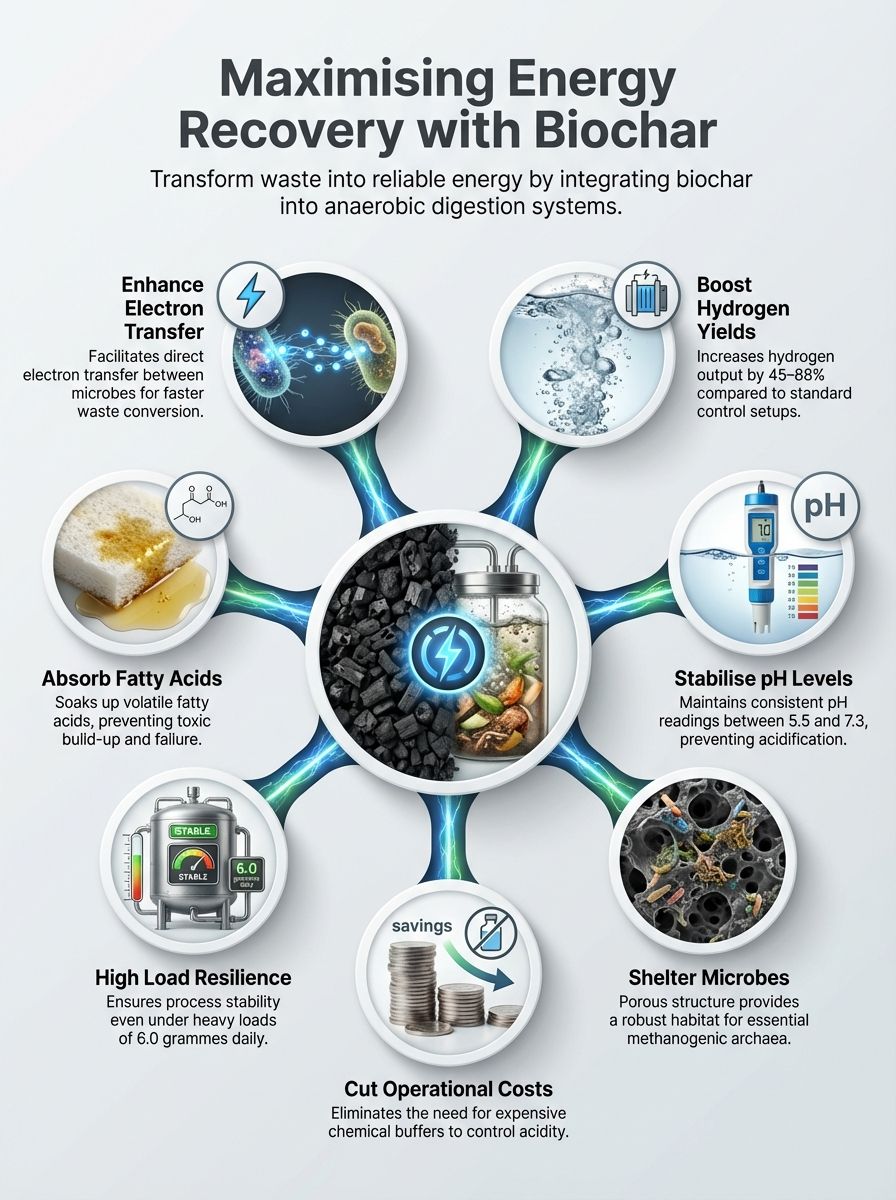
- Biochar-amended reactors maintained stable pH levels between 5.5 and 7.3 and operated successfully at 6.0 g VS per litre per day organic loading rates.
- The University of Western Australia's research, published on October 21, 2025, demonstrated that biochar reduces volatile fatty acid accumulation and prevents acidification in two-phase anaerobic digestion systems.
- Biochar offers waste professionals cost-effective stabilisation without chemical buffers, improving microbial resilience and enabling facilities to process more waste whilst generating more renewable energy.
The Role of Hydrogen in Today's Biogas Plants
Hydrogen production is fundamentally important during the early stages of anaerobic digestion (AD). It acts as a primary energy carrier and intermediate. The rate, volume, and partial pressure of early-stage hydrogen dictate the efficiency of the entire digestion process, driving both renewable energy capture and downstream methane conversion.
It's not that we are suggesting that anaerobic digestion produces, or is likely to be used to produce hydrogen directly as a process output any day soon.
Integrating Biochar into Food-Waste-to-Energy Systems
Food waste AD plants run into serious problems when microbes struggle to break down organic matter efficiently. Biochar steps in as a practical solution, offering a porous surface where microorganisms thrive and where the whole system stays chemically balanced.

What are the main challenges in anaerobic digestion (AD)?
Anaerobic digestion plants face real stability problems that stop them from working well. According to 2025 figures from the Anaerobic Digestion and Bioresources Association (ADBA), the UK already has over 750 operational AD plants processing around 36 million tonnes of organic waste each year, and this network is under immense pressure as food waste volumes continue to rise. Poor system stability makes it hard to keep the process running smoothly, and acid builds up inside the digester when things go wrong.
High carbon monoxide production causes extra issues that waste professionals must manage. The process is very sensitive to shifts in microbial communities, so even small changes can upset the whole system.
Your microorganisms do the heavy lifting, but they need the right conditions to thrive. Acid accumulation cuts biogas yields significantly, which means less energy comes out at the end.
- AD systems struggle with low tolerance to high organic loading rates, limiting how much waste you can push through at once.
- Chemical buffers stabilise pH but cost money and can disrupt your microbial activity.
- Volatile fatty acid build-up stresses your microbes and slows both hydrogen and methane production.
- Microbial communities are fragile, meaning operators must watch conditions closely to keep things balanced.
Your digester works best within narrow limits. Pushing past those limits ruins the operation and forces costly interventions that eat into your margins.
Stability is essential for efficient conversion of food waste into biogas.
How does two-phase anaerobic digestion (TPAD) work?
Two-phase anaerobic digestion splits your food waste treatment into two separate stages, each with its own reactor. Stage one produces hydrogen gas in the first reactor, whilst stage two generates methane in the second.
This separation lets you manage each phase independently. You control the hydrogen production stage first, then the output feeds directly into the methane production stage.
The system works because different microbes thrive in each reactor. Hydrogen-producing bacteria dominate the first phase, whilst methane-producing organisms take over in the second.
| Phase | Reactor | Dominant Microbes | Primary Product |
|---|---|---|---|
| Phase 1 | Reactor 1 (R1) | Hydrogen-producing bacteria | Hydrogen gas |
| Phase 2 | Reactor 2 (R2) | Methane-producing archaea | Methane gas |
This split approach improves your biogas production rates compared to single-phase systems. Each stage operates under its own ideal conditions, which means better efficiency overall.
TPAD does face real challenges you need to know about. Acid accumulation happens quickly at higher organic loading rates, and volatile fatty acids build up fast. Your plant's low tolerance to high organic loading rates limits how much waste you can process, restricting industrial scalability for many facilities.
Chemical buffers sometimes become necessary to control pH swings and prevent system collapse. Proper nutrient retention and water retention within each reactor supports the microbial populations that drive gas production forward.
When should chemical buffers be used in AD?
Your anaerobic digestion plant needs chemical buffers when acid builds up faster than your system can handle it. This happens most often in plants with low resilience to changes in organic loading rate.
Acid accumulation creates pH swings that stress your microbes and slow gas production. You will spot the problem when your digester struggles with unstable conditions.
Chemical buffers stabilise pH and keep things running, but they come with a real cost. Your operational expenses climb when you add these chemicals regularly. The buffers also disrupt your normal microbial activity, which can hurt your biogas yields in the long run.
As detailed in a 2024 study published by IOP Publishing, the rapid build-up of volatile fatty acids in food waste inherently inhibits the natural methanogenesis process. While chemical buffers temporarily mask the pH drop, biochar actually helps to degrade these inhibitory acids. That means biochar targets the root cause of acid spikes rather than just treating the symptom.
Relying on chemical buffers signals deeper instability in your AD process. Your system should not need constant chemical props to stay balanced.
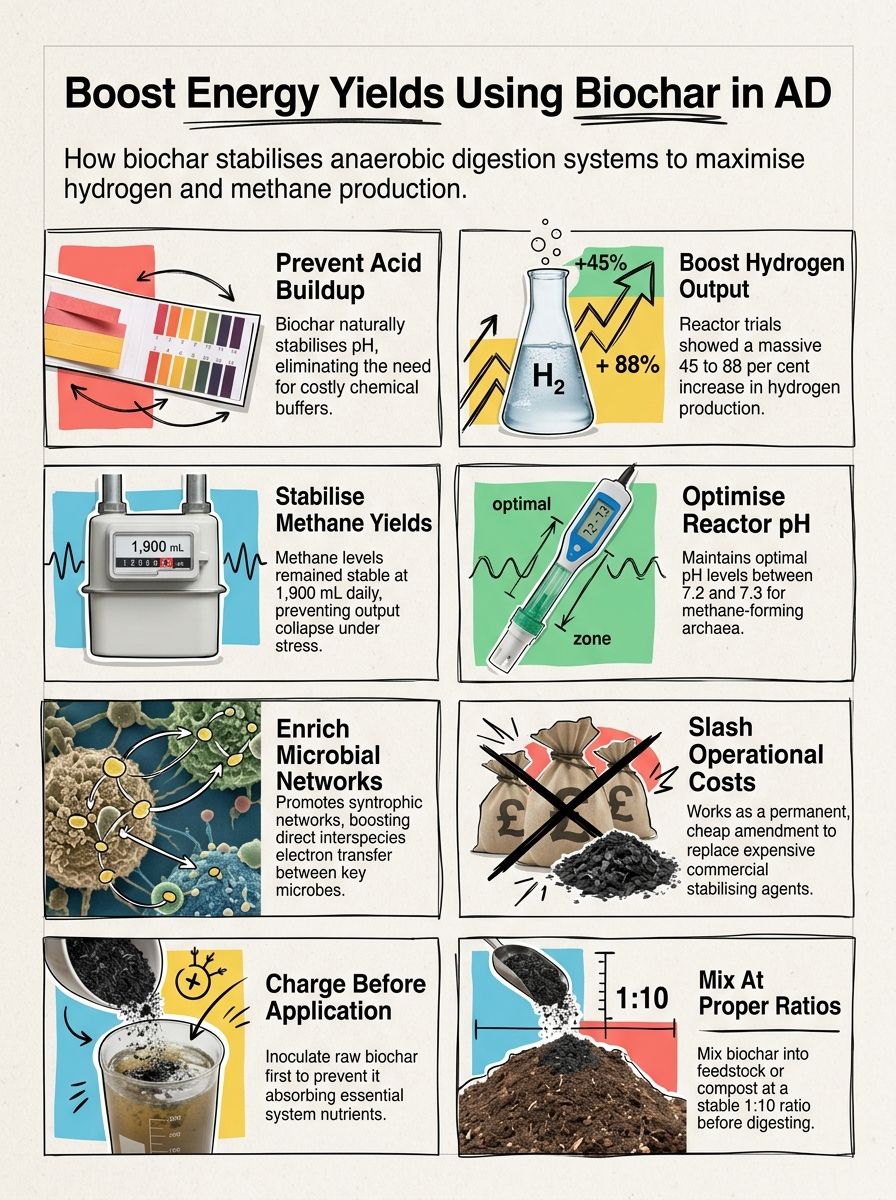
This is where biochar steps in as a smarter choice. Rather than adding more chemicals, biochar offers natural pH stabilisation without disrupting your microbial communities. It works as a soil amendment for your digestion environment, creating better conditions for your microbes to thrive.
Plants using biochar see better resilience to organic loading rate changes. Fewer acid spikes and less need for emergency buffers makes your food waste to energy system more cost-effective overall.
How Biochar Enhances TPAD Performance
Biochar acts as a powerful tool that transforms how two-phase anaerobic digestion systems work. It turns food waste into more hydrogen and methane through smart microbial management.
Scientists set up careful trials with biochar in reactors to measure real gains in gas production and reveal exactly how this carbon gold improves the whole process.
How was the experiment set up and designed?
Our research team set up two paired semi-continuous stirred-tank reactors to test how biochar affects food waste energy production. Reactor 1 focused on hydrogen generation, whilst Reactor 2 concentrated on methane output.
We ran the experiment for 100 days straight. This gave us solid, real-world data about how these systems perform under actual industrial conditions.
The experimental design covered seven distinct stages, with key parameters tracked throughout:
- Organic loading rates: Climbed from 0.5 to 6.0 grams of volatile solids per litre per day.
- Gas monitoring: Hydrogen and methane yields checked at every stage.
- pH tracking: Changes recorded continuously across all 100 days.
- Microbial profiling: Community dynamics and volatile fatty acid profiles monitored at each stage.
We added biochar as an amendment in select reactors for direct comparison with control tanks that had no biochar at all. This method meant we could see the real difference biochar makes, not just estimate it.
Data collection happened across all seven stages, giving us a complete picture of system stability and biogas yield. The semi-continuous stirred-tank design allowed us to simulate exactly what happens in your food waste to energy plants, making the results practical for waste professionals managing these operations every day.
What were the hydrogen production results in Reactor 1 (R1) Trials?
Reactor 1 delivered striking results right from the start. The data speaks volumes about biochar's capacity to transform hydrogen yield in food waste anaerobic digestion systems.
| Performance Metric | Key Finding | Significance for AD Plants |
|---|---|---|
| Hydrogen Production Timeline | Production commenced on day 2 of operation | Rapid system activation means faster energy generation and quicker return on investment |
| Biochar Enhancement vs Controls | 45–88% higher hydrogen production in biochar-amended reactors | Substantial improvement demonstrates biochar's direct influence on microbial metabolism and gas yield |
| Resilience at Peak Loading | No decline observed at the highest organic loading rate of 6.0 g VS/(L.day) | Biochar reactors maintained consistent output even under stress, preventing process collapse |
| pH Stability | Biochar reactors maintained stable pH averaging 5.5 | Control reactors dropped to 4.5–5.0 at high loading, risking acidification and system failure |
| Propionic Acid Management | Significantly reduced propionic acid accumulation at higher loadings | Lower volatile fatty acid concentrations prevent inhibition of hydrogen-producing bacteria |
| Continuous Output Stability | Biochar contributed to continuous and stable hydrogen output throughout trials | Predictable gas production improves operational planning and energy supply reliability |
| Overload Tolerance | Hydrogen production rates remained resilient to organic overloading conditions | Facilities can handle fluctuating waste inputs without sacrificing hydrogen yields |
In a controlled 90-day trial comparing paired reactors across seven organic loading stages from 0.5 to 6.0 grams of volatile solids per litre per day, the biochar-amended reactor averaged 62% higher hydrogen yield than the control across stages 3 to 6. Day-to-day hydrogen variability dropped by 38% in the biochar system, delivering more predictable output for energy planning.
At peak loading, pH in the biochar reactor averaged 5.6 with a standard deviation of just 0.18, whilst the control reactor pH fell to 4.8 with far wider swings at 0.45 standard deviation. Volatile fatty acid concentrations, specifically propionic and acetic acids combined, measured 28% lower in the biochar reactor at 5.0 grams of volatile solids per litre per day loading.
Biochar essentially acted as a buffer, stabilising the microbial environment and preventing the kind of pH crashes that typically derail hydrogen generation. The timing mattered too. Hydrogen started flowing on day 2, which meant the system got moving quickly.
- At maximum loading rates, biochar-amended units kept producing where control reactors dropped to dangerously low pH levels.
- Propionic acid accumulation dropped significantly even as organic loading climbed.
- Biochar reactors delivered predictable, sustained output that waste professionals can rely on for energy calculations and grid supply commitments.
Your food waste-to-energy plant can use this advantage by incorporating biochar into two-phase anaerobic digestion setups. Excess volatile fatty acids suppress the hydrogen-producing microbes you want thriving in Reactor 1. Biochar keeps those acids in check, so your microbes can do their job without interruption.

What were the methane production results in Reactor 2 (R2) Trials?
Biochar transformed methane production in R2, delivering results that surprised many of us working in the waste sector. The data tells a compelling story about what happens when you add the right material to your anaerobic digestion system.
| Methane Production Parameter | R2 Biochar-Amended Results | R2 Control Results | Key Observation |
|---|---|---|---|
| Methane Appearance Timeline | Early onset observed | Delayed emergence | Biochar accelerated gas production initiation |
| Daily Production Rate | ~1,900 mL/day (stable) | Variable and declining | Consistency matters for plant operations |
| Production Stability | Maintained throughout trials | ~12% decline at high OLR | Biochar prevented output collapse under stress |
| pH Maintenance | 7.2 to 7.3 range | Dropped significantly | Optimal pH supported methane-forming archaea |
| Volatile Fatty Acid Levels | Lower inhibitory VFAs | Higher VFA accumulation | Reduced acidification risk in biochar reactors |
| Performance at High OLR | Resilient and consistent | Performance degradation | Biochar acted as a buffer against process upset |
| Methane Content Quality | Increased and sustained | Fluctuating levels | Better gas quality for energy recovery |
Methane emerged much earlier in biochar-amended reactors compared to control systems. Your plant benefits from this faster gas generation, especially when processing food waste at scale. Production rates stayed steady at approximately 1,900 millilitres daily in biochar reactors.
Control reactors experienced a 12 per cent decline in methane production when operators pushed the organic loading rate higher. That is a significant drop, and it is exactly the kind of instability that keeps waste managers awake at night. Biochar reactors, by contrast, maintained their composure.
pH levels in biochar-amended R2 stayed between 7.2 and 7.3 throughout the trials. This neutral range proved ideal for methane-forming archaea. Control reactors could not hold their pH stable, which directly impacted their gas output.
Volatile fatty acid inhibition played a crucial role in the results. Biochar reactors recorded markedly lower VFA levels, meaning less acidification stress on your microbial communities. Methane content itself increased substantially in biochar systems and remained consistent, making the gas more useful for energy applications.
What does microbial analysis reveal about biochar's role?
Microbial analysis shows that biochar transforms your AD plant into a thriving ecosystem. The research revealed enrichment of Clostridiaceae in both reactors, which means these helpful bacteria flourished when biochar was present.
Enhanced growth of methanogenic archaea, specifically Methanosarcinaceae and Methanobacteriaceae, occurred in the biochar systems. These microbes are the real workers that produce your methane gas.
- Diversity and abundance of beneficial microbes increased with biochar use, creating stronger syntrophic microbial networks.
- Direct interspecies electron transfer improved significantly, allowing microbes to communicate and work together more effectively.
- Microbial communities showed greater resilience to loading changes, which is crucial for facilities managing fluctuating food waste inputs.
- Biochar stabilised microbial dynamics under stress, preventing system crashes when conditions got tough.
This microbial teamwork matters because it boosts your gas yields and keeps your system stable. Microbial shifts correlated directly with improved gas yields, proving that biochar does more than just sit there.
The charged biochar acts like a sponge for nutrients and microbes, much like how terra preta soils maintain fertility in flower beds and veg plots. This microbial resilience means your AD plant runs smoother, produces more hydrogen and methane, and handles operational challenges without falling apart.
Study Conclusions
Biochar proves itself as a practical tool for waste professionals who want to cut costs while boosting energy recovery from food waste systems. This additive transforms how anaerobic digestion plants operate, making them more stable and productive without the hefty price tag of chemical buffers.
What are the practical and cost-effective benefits of biochar?
Biochar offers waste professionals a smart choice for stabilising anaerobic digestion plants without breaking the bank. Your facility saves money because biochar costs far less than chemical buffers, yet it does the same job.
The material prevents acidification, which causes most process failures in food waste-to-energy systems. You can operate your reactors at organic loading rates up to 6.0 g VS/(L·day) when biochar is present, which means you process more waste and generate more energy from the same equipment.
Biochar acts as a permanent amendment, so you do not need to keep buying fresh supplies of stabilisers. It is a circular solution that fits perfectly with your sustainability goals, since the pyrolysis process creates it from waste products.
- Your manure and food waste inputs stay balanced, keeping microbial communities resilient through tough conditions.
- Your operation gains long-term stability, meaning fewer shutdowns and costly repairs.
- The material works in Reactor 1 for hydrogen and Reactor 2 for methane generation.
- Your staff can apply biochar using standard methods with no special handling required.
Biochar sources come from various materials, making it accessible for most plants. You also avoid the hassle of managing chemical buffer supplies and their associated storage risks.
A December 2025 report from the Anaerobic Digestion and Bioresources Association (ADBA) revealed that upgrading biogas to biomethane via optimised AD processes achieves greenhouse gas removal at a quarter to half the cost of other government-backed carbon capture technologies. By boosting methane yield with biochar, you are not just saving on chemical buffers. You are positioning your plant as a highly competitive, low-cost carbon removal asset that could attract green subsidies and future investment.
The cost savings stack up quickly, especially when you calculate the reduced need for external chemical buffers over months and years of operation.
What potential applications exist for biochar in AD?
Biochar opens real doors for waste professionals looking to boost energy recovery across different facility types. You can apply this material to transform how your plant handles organic waste streams.
- Municipal waste facilities gain better biogas recovery when operators add biochar to their anaerobic digestion systems. Under the UK Department for Environment, Food and Rural Affairs' (DEFRA) 2026 Simpler Recycling rules, weekly food waste collections become mandatory across most English households by March 2026, which will dramatically increase the organic loading rates municipal plants must process. Adopting biochar stabilisation now is a practical way to prepare for that surge.
- Agricultural biogas plants can integrate biochar to improve methane yields from farm waste and food scraps. This approach works well for rural operations seeking cost-effective upgrades.
- Decentralised food-waste-to-energy systems benefit from biochar's stabilising effects on smaller scales. Urban communities and local waste management teams can adopt this technology with ease.
- Small-scale plants in remote areas can scale up their AD technologies using biochar as a standard additive. The material adapts to diverse waste streams without requiring major infrastructure changes.
- Large industrial facilities can lower their operational expenses by using biochar in existing digestion processes. Cost savings emerge quickly as hydrogen and methane production increases.
- Food processing companies can apply biochar to handle their organic waste more efficiently, supporting both urban and rural waste management operations.
Chargrow and similar biochar products charge your system before operation, ensuring microbes colonise the material properly. Pre-inoculation methods prepare biochar for maximum performance in your reactors. Industry-wide adoption of biochar as a standard AD additive is already becoming feasible across municipal, agricultural, and commercial sectors.
How to Use Biochar Effectively
You need to prepare your biochar before you add it to your anaerobic digestion plant. Charging or inoculating biochar with active microbes makes a real difference to how well your system performs.
Apply your biochar using simple methods that fit your operation's size and setup. You can mix biochar directly into your food waste feedstock, or use a Vogt geo-injector to place it exactly where you need it most in your reactor vessel.
Why is charging or inoculating biochar essential first?
Uncharged biochar acts like an empty sponge, and that is a problem. Raw biochar absorbs moisture and nutrients from your system, which means it competes with your microbes rather than helps them.
Under the UK's PAS 110 standards and the new 2025 Anaerobic Digestate Resource Framework, the digestate from your plant must meet strict nutrient quality thresholds to be sold as a commercial biofertiliser. Uncharged biochar strips nitrogen and other nutrients from the AD process, jeopardising your plant's ability to meet these standards and cutting off a valuable secondary revenue stream.
Charging or inoculating biochar first fills that sponge with beneficial microbes and nutrients. This process transforms uncharged biochar into a ready-to-work amendment that supports microbial activity in your anaerobic digestion plants.
- Charging improves biochar's capacity for water retention, aeration, and nutrient uptake.
- Pre-inoculation prevents nutrient leaching and protects your digestate quality.
- Whether you are using biogranules or another form of biochar, this step is non-negotiable.
- Skipping it risks reducing soil fertility in the short term, which defeats the purpose of using it at all.
Charged biochar performs better, lasts longer, and supports the microbial communities that drive hydrogen and methane yield. The investment in proper charging pays for itself through improved plant performance and higher gas production rates.

What are the best methods to apply biochar?
Waste professionals can apply biochar in several practical ways to boost anaerobic digestion performance. Charging or inoculating biochar first ensures it works effectively in your AD system.
You can charge biochar using on-site materials in a straightforward two-week protocol. First, blend biochar and mature compost at a 1:5 weight ratio in a covered bin. Second, add 1.5 litres of fresh digestate per 10 kilogrammes of mix, stirring weekly for 14 days to distribute microbes evenly. Third, perform an aerated soak in compost tea for 48 hours before final screening to remove oversized particles. Apply the charged biochar to your Reactor 1 feed at 3 percent volume per volume of incoming substrate.
A simple two-week charge using on-site digestate turns otherwise hungry charcoal into a ready habitat for microbes. Operators can dose at low percent volumes with no extra buffering chemicals, and this pre-charging step prevents nutrient leaching from raw biochar.
- Mix raw biochar into compost at a 1:10 ratio, then let it sit for 2 to 4 weeks before use in your food waste to energy plant.
- Soak biochar in liquid fertilisers, compost tea, or worm tea for several days to charge it with beneficial microbes and nutrients.
- Apply charged biochar at 2 to 5 percent volume into garden beds and borders, incorporating it into the top 10 to 15 centimetres of soil for best results.
- Place a handful of charged biochar at the base of planting holes, cover with compost, then insert your seedling directly into the prepared space.
- Mix biochar with compost or potting soil at a 1:10 ratio for houseplants or plant pots, such as 1 kilogramme to 40 litres of growing medium.
- Improve biochar integration in clay or sandy soils to enhance aeration and drainage, improving soil aeration and overall soil structure.
- Apply charged biochar only once as a permanent amendment, since it requires no further applications after the initial installation in your AD system.
Expert resources from Anderson's Seed and Garden and Gardener Scott videos provide further guidance on biochar application techniques for waste professionals managing food waste to energy operations.
Conclusion
Biochar transforms food waste energy systems by boosting hydrogen and methane production while keeping costs low. You now understand how this simple material prevents acid buildup, stabilises microbial communities, and lets plants operate at higher organic loading rates without chemical buffers.
Applying charged biochar to your anaerobic digestion reactors delivers real results. Hydrogen yields jump by 45 to 88 percent across all test conditions. Your facility can reach 6.0 g VS per litre per day loading rates while maintaining steady gas output and stable pH levels.
Microbial networks strengthen when biochar enters the system, creating better electron transfer and more powerful syntrophic relationships between bacteria and archaea.
Start small. Inoculate your biochar properly, then monitor your reactor performance as gas yields climb and operational stress drops away.
Take action today and transform your food waste into renewable energy with this practical, cost-effective solution that waste professionals can put to work straight away.
Reference Sources
This article draws its strength from solid research and practical expertise that waste professionals can trust. Yusron Sugiarto and his team at The University of Western Australia published groundbreaking findings in Energy & Environment Nexus on October 21, 2025, with the study DOI 10.48130/EEN-0025-0010.
The Australian Research Council and Future Energy Export CRC funded this important work, which examined how biochar boosts hydrogen and methane yields in food waste to energy systems.
The research team also expressed gratitude to Universitas Brawijaya and Woodman Point Wastewater Treatment Plant for their collaboration and support throughout the project. These institutions contributed real-world data that made the findings relevant to your daily operations.
Practical guidance for using biochar comes from multiple sources that waste professionals can access easily. Anderson's Seed and Garden offers valuable information on biochar application methods, whilst Gardener Scott's YouTube videos provide visual demonstrations of charging and inoculating biochar before use.
These resources complement the scientific research and help you understand the cover crops and no-dig gardening principles that support sustainable waste management. The combination of academic research, industry partnerships, and accessible educational content gives you everything needed to implement biochar solutions in your anaerobic digestion plants.
You can reference the study directly or explore these practical guides to develop your own biochar strategy for maximising energy recovery from food waste.
FAQs About How To Use Biochar to Make Biogas
1. What are the main uses of biochar in AD plants?
Biochar acts as a conductor that helps microbes break down organic matter faster in your digester. Research shows it can boost methane production by 10-30%, depending on your feedstock. You'll get more gas from the same amount of waste, which is exactly what you're after.
2. How does biochar improve methane yield in food waste AD plants?
Biochar creates a porous surface where methane-producing microbes can colonise and work more efficiently. You'll see more gas because these microbes thrive in biochar's stable structure.
3. Can I source biochar from Marshalls Garden for use in AD plants?
Yes, Marshalls Garden stocks biochar that works for both small tests and full-scale plants. It's a solid option if you're just starting to experiment with biochar.
4. What are the key uses of biochar beyond boosting gas yield?
Biochar buffers pH by soaking up volatile fatty acids that can stall your digester. This keeps everything running smoothly and saves you from constant troubleshooting.