
Our sponsor Landia sent us a press release this week headlined “Slurry Grant a Fossil Fuel Failure?” – and it grabbed our attention immediately, just as it's likely to grab yours. On first read, though, it's written for the mainstream farming press, and it assumes a working knowledge of slurry stores and mixing equipment that not everyone in the AD and biogas community will have.
So we sat with it for a bit, and it turns out there's a lot more to it than meets the eye at first glance. What Landia has flagged is a detail in a new government grant that, on the face of it, is about mixing equipment specifications – but which actually touches on a genuine tension in how the UK is going about decarbonising farming:
- a well-meaning grant that, in its detail,
- ends up nudging larger farms towards tractor diesel rather than the electric power many of them could draw from their own solar panels, wind turbines or biogas plant.
This article gives you the background you need if slurry management isn't your usual territory, reproduces Landia's press release in full, and then looks at why the point they're raising is worth taking seriously rather than treating as a one-off equipment spec query.
Key takeaways
- The UK's Slurry Infrastructure Grant (round 2, Rural Payments Agency) funds mixing equipment (“agitators”) for slurry stores, at two tiers: up to 1,200m³ (electric only, £3,847) and up to 8,000m³ (electric or PTO/tractor-driven, £8,668).
- Mixing is not optional housekeeping. Slurry stratifies in storage, and it has to be re-homogenised before it can be pumped out reliably – whether that's for field spreading or for feeding a digester.
- Slurry stores are increasingly being used for longer-term storage because of Environment Agency spreading restrictions during the closed period, which extends the time slurry sits and emits methane and other greenhouse gases before it's used.
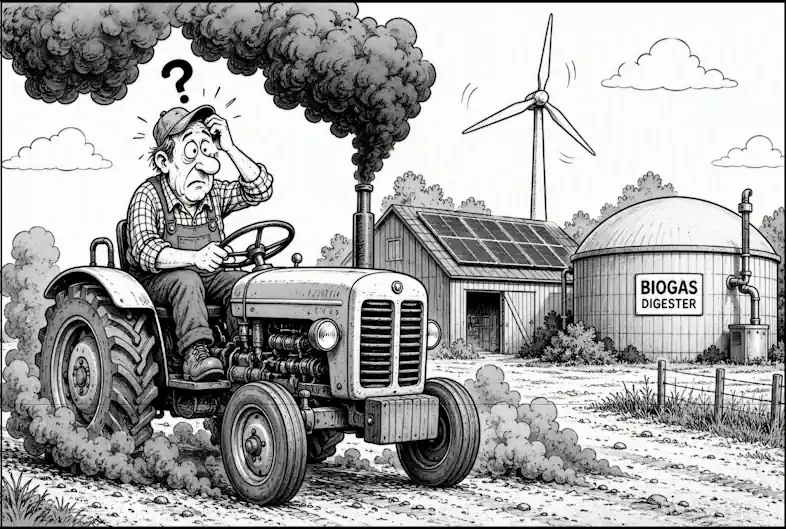
- Landia's point is that the higher-capacity grant tier's technical spec (twin jetters, upper and lower) is, in practice, only met by PTO-driven equipment – meaning the grant nudges larger farms towards tractor diesel rather than electric mixing, even though electric mixing could run on a farm's own solar, wind or biogas-generated power.
- For AD operators, reliable re-mixing of stored slurry is directly relevant to feedstock consistency and digester loading – this isn't just a farming issue at arm's length from biogas.
What is PTO?
PTO stands for Power Take-Off – the rotating shaft on a tractor that transfers mechanical power from the tractor's engine to an attached implement. Instead of an implement (a mower, a baler, a slurry mixer) having its own motor, it's driven directly off the tractor's engine via this shaft. A PTO-driven slurry mixer therefore needs a tractor physically coupled to it, engine running, for as long as the mixing takes – as opposed to an electric mixer, which is wired into the farm's own electricity supply and can run unattended.
The press release:
Press Release
Slurry Grant a Fossil Fuel Failure?
At a time when farms are encouraged to invest in solar panels, wind turbines and biogas plants, where is the logic in a slurry grant that instead encourages farmers to use fossil-fuelled tractors to perform tasks that could be carried out using renewable energy?
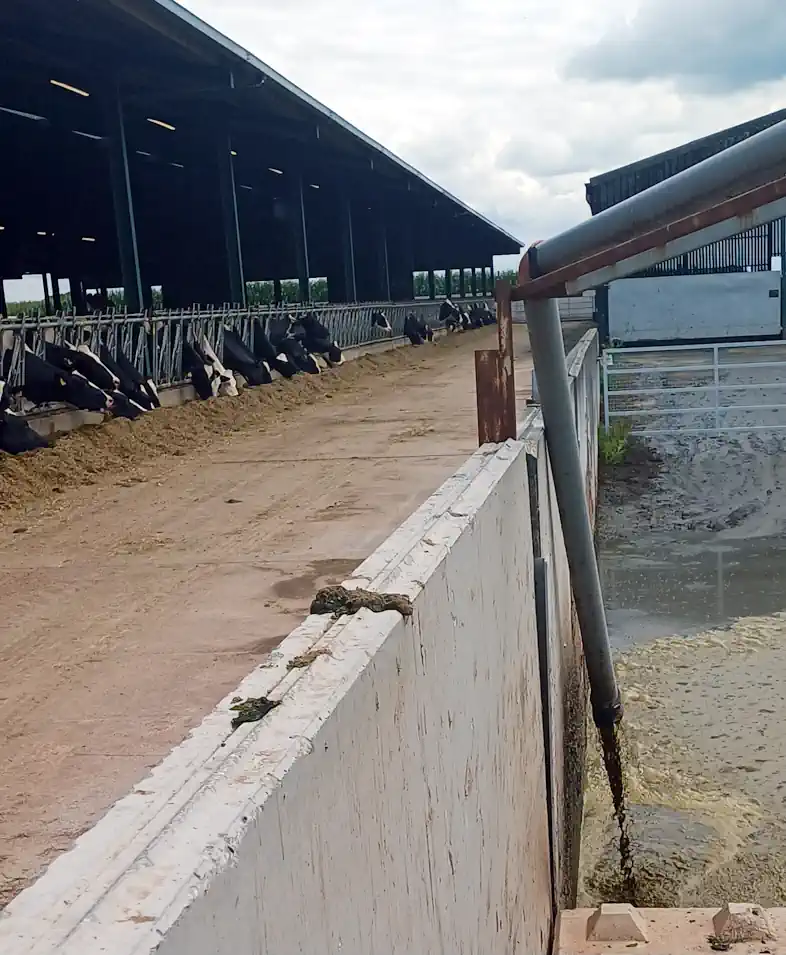
So says pump and mixer manufacturer Landia, who strongly question the grant eligibility criteria for mixing equipment for slurry stores over 1,200 m³, which they claim excludes all but one maker.
‘A pretty spectacular snub to all things environmental'
“Despite all the proven efficiencies that we and other manufacturers can provide,” said Landia’s Howard Burton, “the specification demands, for example, that an impeller’s diameter must be 600mm, and have upper and lower jetting nozzles. This doesn’t give farmers a fair choice. It is a total nonsense to discourage farms from selecting equipment that best suits their needs and their budgets – and ties up their manpower and expensive tractors too.”
He added: “Several farmers have told us that they do not want their tractor lumbered with these duties anyway. Tractor-driven mixing equipment might be cheaper to buy than electrically-driven alternatives, but a grant that very specifically demands a two-jetter machine (only available with a Power Take Off/PTO drive), run by a tractor is, in 2026, a pretty spectacular snub to all things environmental.
‘Being pushed to burn up fossil fuel'
“Unless that tractor uses Biodiesel (sadly, only in a very small number of cases), it will be burning fossil fuels. Even if it is running on renewable biodiesel, it still ties up the tractor and farm manpower. Compare that to a farm with wind turbines, biogas plant and/or solar panels that could use its renewable energy at source. We don’t understand why farms, rather than being helped to reduce their carbon footprint, are being pushed to burn up fossil fuel from a tractor that has far better uses!”
He continued: “Farmers also want equipment longevity and value for money. In covered tanks containing pig slurry, the tractor-powered equipment’s galvanised steel will be attacked by H2S (hydrogen sulphide), leading to premature failure. This cannot happen with our mounting equipment, because it is made from stainless steel. Even in this aggressive environment, we would expect 20-plus years of service.”
Burton also says that whilst the lower level of funding (£3800) will be available to farmers purchasing electric submersible propeller mixers, the higher-level grant (£8000) for tanks over 1,200m³ – needs – for the sake of all farmers – an urgent review.
www.landia.co.uk
01948 661 200
Why this matters beyond the farm gate
Mixing isn't cosmetic – it's what makes stored slurry usable
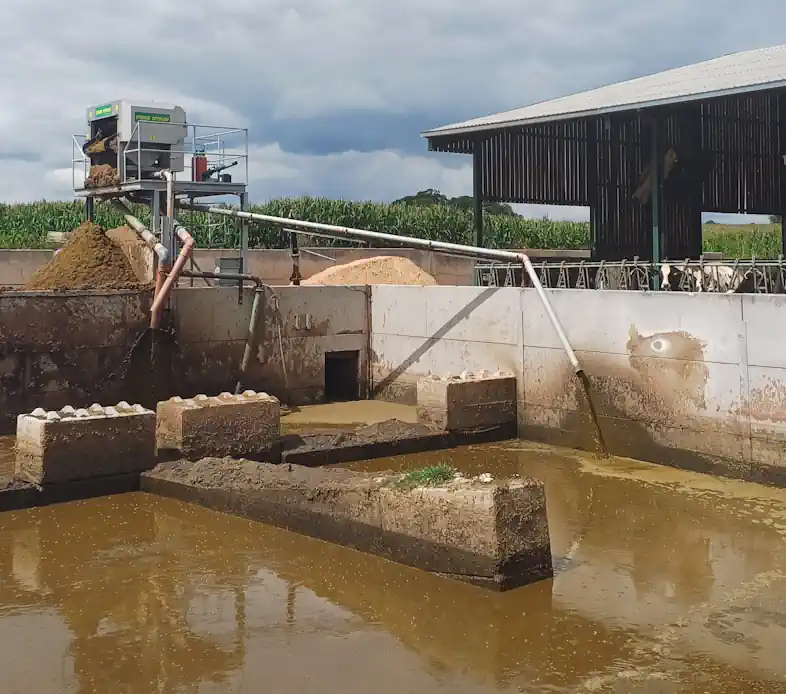
Slurry stratifies in storage: heavier solids settle to the bottom, a fibrous crust can form on top, and the liquid in between is left relatively uniform, but the tank as a whole is layered. Before that slurry can be pumped out – whether onto land or into a digester – it needs to be agitated back into a consistent, pumpable mixture.
Skip the mixing, and you get a weak, nutrient-poor liquid at the start of emptying and a thick, hard-to-handle sludge at the end. For AD operators drawing feedstock from a lagoon or store, that inconsistency is exactly the kind of variability that makes stable digester loading difficult.
The storage duration problem: why this grant lands at a bad moment
Here's the part of the story the press release doesn't spell out, but which matters most to a biogas audience. Environment Agency rules restrict when slurry can be spread on land – broadly, spreading is curtailed outside the growing season, when crops aren't actively taking up nutrients, and the risk of run-off into watercourses is highest.
That's a sound principle for water quality, but the practical effect is that many farms now have to hold slurry in store for considerably longer stretches than they once did, simply waiting for a spreading window to open.
Stored slurry doesn't sit inertly during that wait. Anaerobic conditions in a slurry store generate methane, along with smaller quantities of nitrous oxide and carbon dioxide – all released to the atmosphere unless the store is covered and that gas is captured. The longer the slurry sits, the more it emits.
So the closed-period rules that protect water quality are, as an unintended side effect, extending the emissions window from stored slurry. That's a genuine tension in farm decarbonisation policy, and one that needs addressing on its own terms rather than being treated as a footnote.
Against that backdrop, a grant that nudges farmers with larger stores towards diesel-burning tractor power to do the mixing looks like a second, avoidable emissions hit stacked on top of the first. It's not the same gas, and it's not the same mechanism, but it's still carbon the sector is being encouraged – via public money – to keep emitting, at a time when the policy direction everywhere else is to squeeze it out.
What the grant actually specifies, and where Landia's argument needs a slight correction
Having checked the Rural Payments Agency's published specification for round 2 of the Slurry Infrastructure Grant, the figures in the press release stand up: a 600mm-impeller electric mixer for stores up to 1,200m³ attracts £3,847, and a twin-jetter mixer for stores up to 8,000m³ attracts £8,668. Worth clarifying one nuance for readers who go on to check the official wording themselves: the rules for that larger tier technically permit electric or PTO motor drive.
The real-world effect Landia are pointing to is that no manufacturer currently offers an electric twin-jetter unit meeting the twin upper-and-lower jetting spec, so PTO ends up being the only equipment on the market that actually qualifies, regardless of what the wording allows. That's the more precise version of the point – the technical spec, as written, has inadvertently frozen out electric options from the market, even though it doesn't exclude them on paper.
What Landia actually sells, and where it fits against the grant
It's worth setting out what Landia's own range looks like against the two grant tiers, since that's really what the press release is arguing from.
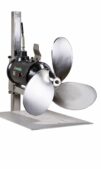
Landia's slurry mixer is the POP, an electrically driven submersible propeller mixer built around a three-blade, low-speed propeller design, specifically engineered to handle thick slurry without clogging. It's supplied with motors from 3.0kW up to 30.0kW, in a range of sizes suited to stores of varying capacity, and is available in acidproof or stainless steel for aggressive environments such as covered pig slurry stores – directly addressing the H2S corrosion point Landia raise in their release. It's also designed to be installed into an existing tank without draining it down first, and can be relocated between tanks if needed.
Against the lower grant tier – the up-to-1,200m³ store, electric drive, 600mm impeller, £3,847 contribution – the POP is a natural fit: it's electric, submersible, and supplied across a range of sizes that can be specified to match that impeller requirement.
Against the higher tier – the up-to-8,000m³ store requiring twin jetters, upper and lower, at £8,668 – the POP doesn't qualify, and this is really the nub of Landia's argument. The POP is a propeller mixer, not a twin-jetter design, so it sits outside that specification regardless of whether it's offered in electric or any other drive format. That's consistent with what Landia are saying: it isn't that the rules exclude electric drive from the larger tier on paper, it's that the twin-jetter format itself – which the larger tier requires – isn't one that electric submersible propeller mixers like the POP are built around, leaving PTO-driven units as the equipment currently available on the market that fits the spec.
The renewable-energy irony
Many of the farms affected by this are exactly the ones this website's readers will recognise: sites with an AD plant, solar array or wind turbine already on the yard, generating power that could run an electric mixer directly, at source, without a tractor engine idling for the duration of the job. Using tractor diesel (or, in the rare cases it's available, biodiesel) to mix slurry on a farm that's simultaneously generating renewable electricity a few hundred metres away is the specific irony Landia is pointing at, and it's a fair one.
FAQ
Is this the same as the grant that pays for AD plants or biogas equipment?
No. This is the Slurry Infrastructure Grant, which funds stores, covers, separators, pumps, pipework and agitators (mixers) for slurry management generally. It sits alongside, rather than inside, the various schemes that support AD plant construction, though the two overlap wherever a farm's slurry is a digester feedstock.
Does the grant only cover mixers, or the whole slurry storage system?
The wider scheme covers a full list of items – stores, covers, separators, reception pits, pumps, pipework, transfer channels, agitators and safety equipment – each with its own reference cost and specification. Mixers (agitators) are just one line item within that.
Why does mixing matter specifically for anaerobic digestion, rather than just spreading?
Digesters perform best with a consistent feedstock. Slurry drawn from an unmixed, stratified store will vary in solids content and nutrient load depending on when in the tank it's drawn from, which makes loading rates and digester performance harder to manage. Reliable mixing upstream of the digester, or in the store the digester draws from, supports more stable operation.
Could an electric mixer realistically be powered by a farm's own biogas plant?
Where a farm already runs a CHP unit or has a grid connection tied to its own generation, yes – that's precisely the point Landia is making. An electric mixer's demand could, in principle, be met from on-site renewable or biogas-derived generation rather than imported diesel.
Is Landia's criticism about the grant rules, or about what's currently on the market?
Both get blurred together in the release, but based on the actual published specification, it's more accurate to describe this as a market-availability problem: the technical requirement (twin jetters, upper and lower) currently narrows the field to PTO-driven products, even though the rules themselves don't exclude electric drive for that tier.
Conclusion
Once you put it in plain terms, this is a story our readers are well placed to appreciate: a well-intentioned slurry infrastructure grant, sitting downstream of sound water-quality rules that are themselves extending how long slurry sits in store and emits greenhouse gases, has ended up specifying mixing equipment for larger stores in a way that – in practice, if not by explicit rule – favours diesel tractor power over on-site renewable electricity.
It's a small line item in a much bigger scheme, but Landia deserve credit for spotting it and raising it publicly. It's exactly the kind of detail that's easy to miss in a large grant scheme, and worth the government revisiting so that the mixing equipment on offer keeps pace with the renewable generation many farms already have on site.