Biogas plant construction involves building an anaerobic digestion system to convert organic waste into methane gas and fertiliser. All types consist of an inlet, a digester tank or tanks, gas storage (usually above the reactor), and an outlet.
Key steps include site selection, pit excavation, tank containment (110% by volume of tank rupture volume), fabrication or civil engineering construction work with waterproofing, and a curing time allowance for all concrete works.
Key Takeaways for All Types of Biogas Plant Construction
- There are a variety of digester types — fixed-dome, floating-drum, and plug-flow, for example — but in this article, we limit the discussion to the construction requirements common to all digester types.
- Site selection and feedstock availability are the two most critical factors that determine whether a biogas plant succeeds or fails before construction even begins.
- Most biogas plant failures trace back to poor planning, not poor construction — specifically neglecting feedstock analysis, digestate management, and energy utilisation strategies.
- A properly built biogas plant can achieve full return on investment — but the timeline depends heavily on feedstock volume, any gate fees, energy pricing, and avoided waste disposal costs.
Getting a biogas plant built right the first time often comes down to understanding what goes wrong before the first shovel hits the ground.

Many developers who find difficulty with biogas projects are not failing due to bad equipment or poor contractors – they are failing because they missed the basics. The feedstock was not properly characterised. The digester was undersized. Gas utilisation was not planned before construction started.
These are not minor overlooks; they are project destroyers. If you are serious about building a plant that actually performs, this guide will walk you through every stage, from site selection to commissioning, with the technical specificity that actually matters.
BiogasWorld has gathered insights from real-world biogas projects across multiple continents to help developers like you avoid the most costly mistakes in the industry.
Choosing the Right Site Is the Most Important Decision You’ll Make
Before any design work begins, the site has to be right. A poorly chosen site creates cascading problems — longer feedstock transport distances, higher infrastructure costs, regulatory conflicts, and structural issues that no amount of engineering can fully fix later.
- How close the plant is to the sources of feedstock (like farms, food processors, and wastewater facilities)
- How close the plant is to the end user of the energy or the point where it will connect to the grid
- The capacity of the soil to bear load and the depth of the groundwater
- The direction of the prevailing wind relative to the properties around the plant
- Whether the access roads are wide enough for delivery trucks
- How close the plant is to sensitive receptors (like homes, schools, and bodies of water)
- The local zoning classification and what land uses are permitted
Each of these factors will directly affect how much it costs to build and operate the plant, and whether you can get a permit. If you ignore even one of these factors when you’re choosing a site, it could add months and a significant amount of money to your project. Additionally, considering biogas energy security is crucial in the planning phase to ensure long-term sustainability and efficiency.
Close to Feedstock Sources and Energy Users
The distance between your feedstock source and your plant can increase transport costs and make logistics more complicated. It’s best if the plant is located at or very close to the main waste generator, like a large livestock farm, a food processing facility, or a municipal wastewater treatment plant. The same idea applies to your energy user.
If you’re generating electricity through a Combined Heat and Power (CHP) unit, being close to the grid connection or an on-site energy user can significantly improve project economics. Biogas that’s been upgraded to biomethane for injection into a gas grid is more flexible, but you’ll need to factor in pipeline connection costs early on.
Ground Conditions and Load-Bearing Needs
Digester tanks, particularly large concrete ones that hold hundreds or thousands of cubic meters of slurry, place enormous static loads on the ground. A geotechnical survey is a must. You need to know the soil’s bearing capacity, the depth to bedrock, and whether the site is in a flood zone or has a high seasonal water table.
Soft or expansive soils may require deep pile foundations, which can significantly add to the cost of construction. Sites with a water table less than 1.5 meters below the digester base necessitate special waterproofing measures and may not be feasible at all without significant civil engineering intervention. For more information on the importance of biogas production from sewage sludge, consider exploring related resources.

US Rules and Regulations for Biogas Plant Construction
In the United States, the rules and regulations for constructing a biogas plant can vary by state and county. However, a common rule is that biogas facilities must be located a minimum of 300 to 1,000 feet away from residential properties. This distance can depend on the size of the plant and the jurisdiction.
Some states also require additional distances from water bodies, wells, and public roads. The zoning classification of the land is also important. Many agricultural zones allow on-farm digesters as accessory structures. However, commercial-scale facilities that process off-site waste may require a conditional use permit or rezoning.
It is highly recommended to consult with a local land use attorney or permitting consultant early in the site selection process. This can be one of the best investments you can make for a biogas project.
The 6 Essential Elements of a Biogas Plant
No matter the size of the project — from a 50 m³ farm digester to a 10,000 m³ commercial facility — every operational biogas plant is constructed with the same six essential elements. Knowing the function of each one and how they work together is critical before you finalize any design.
1. Feedstock Reception and Pre-Treatment Unit
This is the point at which organic material is introduced into the system. Solid wastes such as food waste or crop residues usually require pre-treatment, which typically involves shredding or macerating the material to reduce the size of the particles, which speeds up digestion.
Liquid wastes such as manure slurries or food processing effluents may need to be screened to remove grit, stones, or plastic contaminants that could damage downstream pumps and mixers.
Some feedstocks also need to be diluted with water to achieve the correct total solids content — usually 8 to 12% for a wet digestion system. Pre-treatment is crucial as it not only protects every other component in the plant but also directly affects gas yield.
2. Anaerobic Digester Tank
The digester is the most critical part of the biogas plant. It’s a sealed container where anaerobic microorganisms decompose organic matter without oxygen, producing biogas (mostly methane and CO₂) and digestate.
The volume of the digester is determined based on the hydraulic retention time (HRT), which is typically 20 to 40 days for mesophilic digestion at 35–40°C, multiplied by the daily volume of feedstock. One of the most frequent and expensive construction errors is making the digester too small, which can lead to process instability and reduced gas production.
3. Gas Storage System
Biogas is produced around the clock, but the demand for energy is not constant. A gas storage system — usually a flexible membrane gas holder that is either mounted on the digester or located in a separate tank — balances out this discrepancy.
The storage capacity is typically designed to hold between 20 and 50% of the daily gas production. For plants that supply a CHP engine, this buffer allows the engine to run at a steady load rather than switching on and off, which prolongs the life of the engine and increases electrical efficiency.
4. Gas Purification and Optional (but Preferred) Upgrading Equipment
Raw biogas contains 50–70% methane, 30–45% CO₂, and trace amounts of hydrogen sulfide (H₂S), water vapor, and siloxanes. Before the gas can be used in a CHP engine or injected into a gas grid, it must be treated.
The necessary steps for gas treatment, in sequence, are:
- Elimination of H₂S — this can be accomplished through iron dosing in the digester, biological desulfurization, or the use of activated carbon filters. If H₂S levels exceed 200 ppm, CHP engines can corrode rapidly.
- Elimination of Moisture — water damage to downstream equipment can be prevented by using condensate traps and desiccant dryers.
- Elimination of CO₂ (upgrading) — this is only necessary for the production of biomethane. Technologies such as pressure swing adsorption (PSA), water scrubbing, and membrane separation can be used to achieve methane concentrations of more than 97%.
- Elimination of Siloxane — this is crucial for plants that process municipal solid waste or sewage sludge, as siloxane concentrations can cause abrasive deposits to form inside CHP engines.
Expensive engine repairs and unplanned downtime can result from skipping or undersizing gas treatment equipment.
5. Digestate Separation and Storage
After digestion, the remaining nutrient-rich slurry, known as digestate, is a valuable biofertilizer. However, it must be handled with care. A screw press or centrifuge separator can be used to divide it into a solid fraction (a stackable, compost-like material) and a liquid fraction (a pumpable substance suitable for field application).
Both fractions need to be stored in a covered area to prevent ammonia emissions and nutrient runoff. In the European Union, the Nitrates Directive governs the requirements for digestate storage, which typically require a minimum storage capacity of 6 months. In the US, state nutrient management plans have similar requirements.
6. Combined Heat and Power (CHP) Unit
CHP Efficiency Snapshot: A modern biogas CHP unit operating on 60% methane content biogas typically converts 35–42% of energy content to electricity and 40–50% to recoverable heat, giving a combined efficiency of 80–90% — far higher than electricity-only generation at 35–42%.
The CHP unit is where biogas becomes usable energy. It consists of a gas engine (or gas turbine for larger plants) connected to a generator for electricity production, with heat recovery systems capturing thermal energy from the engine’s exhaust and cooling circuits. This recovered heat is typically used to maintain digester temperature, reducing parasitic energy consumption and improving net energy output.
The size of the CHP unit must be determined by the gas production rate, not the peak demand. A CHP unit that is too large and running at partial load is much less efficient than a unit that is the correct size and running at full capacity. For plants that produce gas seasonally, two smaller CHP units that operate in rotation often perform better than one large unit.
It’s the correct blending of all six systems — from feedstock intake to energy output — that distinguishes a plant that performs to design specifications from one that falls short for its entire operational life.
Choosing Between Fixed-Dome, Floating-Drum, and Plug-Flow Digesters
Deciding on a digester design isn’t just about technicalities—it impacts your construction expenses, how complicated maintenance will be, how flexible your operation is, and how well the system can manage your particular feedstock.
Fixed-Dome Digesters: Ideal for Those on a Tight Budget
The most common design in developing regions is the fixed-dome digester. This popularity is due to its lack of moving parts, no need for imported steel components, and it can be entirely constructed with local materials by trained masons.
The dome-shaped roof is constructed directly above the digester pit using brick and cement, which creates a sturdy gas storage chamber above the slurry. When gas pressure builds, the slurry is displaced into an external expansion chamber.
This design is simple and durable due to its pressure-driven nature, but it does mean that gas pressure fluctuates throughout the day as the gas holder fills and empties. This is something that needs to be taken into account when selecting downstream equipment.
Floating-Drum Digesters: Even Pressure, Steeper Price
Floating-drum digesters, first created in India and known as the KVIC (Khadi and Village Industries Commission) model, use a drum made of steel or fiberglass that floats on the slurry in the digester. As gas is made, the drum rises.
When the gas is used, the drum lowers. This simple design provides something the fixed-dome design can’t — steady, even gas pressure no matter how full the gas holder is. Because of this, floating-drum digesters are especially good for direct connections to gas stoves and small engines where pressure stability is important.
While the floating drum may seem like the best option, it does come with a price. The drum is exposed to moisture, hydrogen sulfide, and temperature fluctuations. As a result, steel drums need to be repainted every 2 to 5 years to avoid corrosion.
On the other hand, fibreglass drums don’t have this problem, but they are more expensive upfront. For projects where long-term maintenance is a concern, the fixed-dome design is often the best choice. It has no moving parts, which eliminates the pressure variability problem.
Plug-Flow Digesters: Perfect for Fibrous Agricultural Waste
Plug-flow digesters work on an entirely different principle. Instead of a mixed tank, the feedstock enters one end of a long, horizontal, trench-like reactor and slowly moves through to the outlet over the hydraulic retention time, which is typically 20 to 30 days.
There is no mixing. The material literally “plugs” through the digester in sequential batches, which is why this design is perfect for high-solids, fibrous feedstocks like dairy manure with bedding, straw, or crop residues that would clog pumps and mixers in a conventional stirred tank reactor.
Building a plug-flow digester is simple. They are usually constructed as in-ground channels made of reinforced concrete. These channels are covered with insulation and a flexible membrane gas holder.
The absence of mechanical mixing cuts down on both the initial cost and the ongoing maintenance costs. However, plug-flow systems are more sensitive to changes in temperature. In colder climates, it is crucial to insulate the in-ground channel and design the heating pipe carefully to ensure uniform heating.
Plug-flow digesters are often more reliable and cost-effective than stirred tank reactors when it comes to processing manure with a total solids content of 11 to 14% for larger dairy operations. However, the most suitable digester design will always depend on the characteristics of your waste stream.
How to Build a Biogas Plant: A Step-by-Step Guide
Building a biogas plant isn’t as simple as following a straight line. Instead, it’s a series of closely connected steps, where a mistake in one step can cause problems in all the steps that follow. Here’s how a successful construction project typically progresses.
Step 1: Conduct a Feasibility Study and Waste Audit
Before a single design drawing is produced, you need a complete picture of your feedstock. A proper waste audit quantifies not just the volume of organic material available, but its composition — total solids (TS), volatile solids (VS), biochemical methane potential (BMP), and seasonal variability.
These numbers directly determine digester size, expected gas yield, and ultimately whether the project is financially viable. Commissioning a BMP test on representative feedstock samples from an accredited lab is a standard industry practice that costs relatively little but prevents multi-million dollar sizing errors.
A feasibility study takes the feedstock data and uses it to create a preliminary plant design, an energy balance, and a financial model. Banks and investors require this document before they will commit to financing. The most common reason for the failure of biogas projects around the world is skipping or shortcutting the feasibility study, and this is completely avoidable.
Step 2: Obtain Necessary Permits and Environmental Approvals
The time it takes to get a permit can vary greatly depending on the jurisdiction, but in the US, a commercial biogas facility typically needs an air quality permit, a stormwater pollution prevention plan (SWPPP), a solid waste or composting permit if it is processing off-site organic waste, and in some states, a Title V operating permit if emissions thresholds are exceeded. In the European
Union, facilities that process animal by-products must comply with EU Regulation 1069/2009, which classifies feedstocks into three categories with different processing and hygienization requirements. You should plan for 6 to 18 months for permitting on a commercial-scale project and hire specialised environmental consultants who are familiar with your specific regulatory environment.
Step 3: Digging and Building the Foundation
How deep you need to dig depends on the type of digester — fixed-dome and plug-flow digesters are usually built below ground level, while steel or concrete tank digesters that are above ground need a reinforced concrete slab foundation. Regardless of the type, you need a geotechnical report to inform the foundation design. Important things to consider when digging include:
Typical Requirements for Commercial Biogas Plant Foundation Design:
Requirement Typical Parameter Soil bearing capacity At least 100 kN/m² (10 tonnes/m²) Water table depth from base At least 1.5 meters Thickness of concrete slab (above-ground tank) 300–400 mm reinforced Allowance for excavation over-dig 500 mm beyond tank footprint Depth of compacted sub-base 150–200 mm granular fill
Concrete work should adhere to the appropriate structural codes. In the US, the standard for liquid-containing structures like digesters is ACI 350 (Code Requirements for Environmental Engineering Concrete Structures). This code outlines the concrete mix design, limits for crack width, and requirements for reinforcement cover specifically for structures that contain aggressive liquids like digestate slurry.
If you try to save money on the foundation, you’re putting the whole structure at risk. If digester tanks don’t have an even surface to rest on, they’ll start to crack and leak. This could cause the whole tank to fail. It’s very expensive to repair a digester that’s underground or partially underground, so it’s not worth the risk. For more information on essential requirements, consider checking out the biogas permit guidelines.
Step 4: Building the Digester and Waterproofing
When building a digester using cast-in-place concrete, you should follow the standard practice for reinforced concrete. However, there is one key difference: the inside surface must be waterproofed and protected from the chemical attack of the digestate. The digestate environment is mildly acidic to neutral (pH 7.0–8.5), but it contains ammonia, organic acids, and hydrogen sulfide.
These substances can aggressively attack unprotected concrete over time. The most common solution is a two-component epoxy coating system. This system is applied to the inside walls and floor after the concrete has cured for at least 28 days. The most commonly used systems are Sika’s SikaGard range and Xypex crystalline waterproofing.
These systems penetrate into the concrete matrix rather than sitting on the surface. The gas headspace above the slurry is particularly aggressive because of condensed H₂S and CO₂. This zone requires special attention during the coating application. All construction joints and wall-to-floor junctions must be treated with hydrophilic waterstop strips before pouring to prevent seepage pathways.
Step 5: Installing the Pipeline, Valve, and Gas Storage
Within a biogas plant, there are two distinct types of pipework systems, the slurry lines and the gas lines, each of which requires different materials. Slurry pipework that carries feedstock and digestate usually uses HDPE (high-density polyethylene) pipe in DN80 to DN200 diameters, which is dependent on flow rates.
HDPE is resistant to chemicals, flexible enough to handle ground movement, and much less expensive than stainless steel for slurry service. All slurry pumps, which are typically progressive cavity or centrifugal designs, must be sized for the specific viscosity and solids content of the feedstock to prevent continuous pump failures. For more detailed information, you can refer to an overview of biogas plant construction.
Gas pipework is a completely different field. For above-ground runs, internal gas lines from the digester to the CHP or upgrading unit use Schedule 40 black steel pipe with welded joints, or medium-density polyethylene (MDPE) yellow gas pipe for any buried sections. All gas pipework must be pressure-tested to 1.5 times operating pressure using compressed air or nitrogen before the system is charged with biogas.
Gas pressure safety relief valves, flame arrestors, and isolation valves must be installed at specified points per NFPA 820 (Standard for Fire Protection in Wastewater Treatment and Collection Facilities) in the US, or AD 2000 Merkblatt standards in Germany.
The gas storage membrane — typically a double-membrane HDPE or EPDM geodesic dome or pillow-style holder — is installed last and pressure-tested before any biogas is introduced. For more detailed information on biogas plant construction, you can refer to this overview of biogas plant construction.
Step 6: Testing the System, Commissioning the Process to Cultivate Microorganisms, and Inoculating with a Starter Culture
When you commission a biogas plant, it’s not as simple as flipping a switch. The anaerobic microbial community that produces methane — specifically, the methanogenic archaea that carry out the final conversion step — takes 4 to 8 weeks to establish under stable operating conditions.
One of the most common reasons for process failure in new plants is rushing this phase by overloading the digester with feedstock before the microbial population has been established. The correct approach is to inoculate the digester with a starter culture — ideally, active digestate from a plant that processes similar feedstock and is performing well — at a volume of 20 to 30% of the digester’s working volume.
If no suitable inoculum is available, anaerobically stabilised sewage sludge from a local wastewater treatment plant is a widely accepted alternative.
After the inoculation process, the feedstock should be introduced at 25% of the design loading rate for the first two weeks. Then, it should be increased gradually in 25% increments every 7 to 10 days. During this time, the volatile fatty acid (VFA) concentration and VFA-to-alkalinity ratio should be monitored. A VFA/alkalinity ratio below 0.3 indicates a stable, healthy process.
If the ratio is above 0.4, it means that the system is overloaded — the organic acid concentration is too high for the methanogens to convert it to methane. If this happens, the loading must be reduced immediately. The biogas composition (methane percentage) should be monitored daily during commissioning using a portable gas analyser.
A stable methane content of 55–65% confirms that the microbial community is mature and functioning properly.
How the Right Construction Materials Can Make or Break Your Biogas Plant
Think of a biogas plant as a long-term investment that should last 20 to 30 years. The materials used to build it can either support this lifespan or cause it to fall apart within the first few years. The most common material failures in biogas plants are not dramatic structural collapses.
Instead, they’re slow, gradual deterioration from chemical attack, UV exposure, and mechanical fatigue that quietly reduce performance and eventually force expensive emergency repairs. To learn more about how biogas production can be optimized, explore our detailed guides.
There are three areas where the materials used are most at risk. These are the inside of the digester (due to chemical attacks from digestate and gas), the gas storage membrane (because of UV degradation and mechanical fatigue), and the slurry pipework (as a result of abrasion and chemical attacks from H₂S).
Choosing the correct materials for each area from the start may cost a little more, but it’s a fraction of the cost of fixing problems five years down the line.
Concrete Tanks vs. Bolted Segmental Steel Tanks
For many years, cast-in-place reinforced concrete has been the most popular method of digester construction for commercial-scale plants, and it is still the most robust choice for permanent installations. Concrete digesters that are correctly designed and waterproofed can often last for over 30 years.
The other option, bolted segmental steel tanks, like those produced by CST Industries (Permastore) or BALMORAL Tanks, offer quicker construction times (usually 30 to 50% quicker than cast-in-place concrete) and are less affected by site conditions because the tank is delivered pre-assembled.
Bolted steel tanks use glass-fused-to-steel (GFS) or epoxy-coated panels, which offer excellent resistance to chemicals. However, the trade-off is that bolted joints need to be inspected and retorqued regularly, and if panels are not handled carefully on site, the panel coating can be damaged during installation.
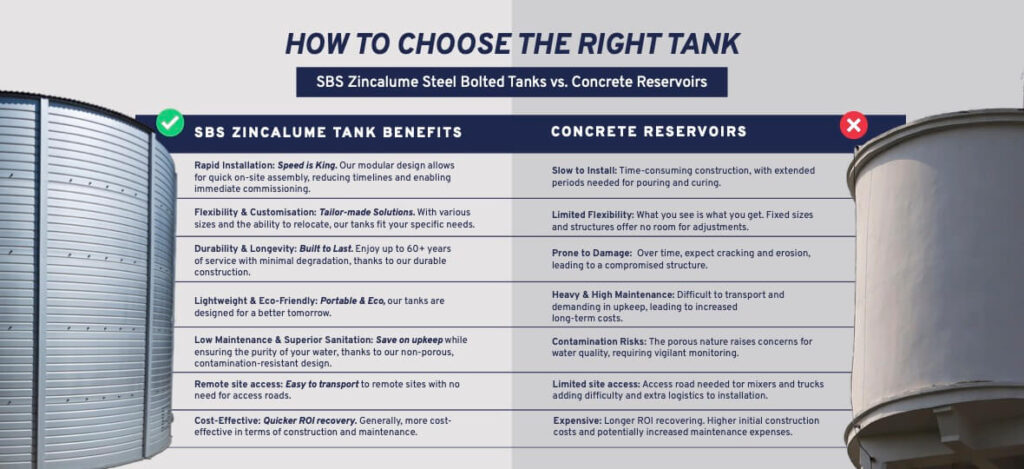
“Water storage tanks: steel vs concrete …” from www.sbstanks.co.ke and used with no modifications.
Choosing the Right Materials for Gas and Slurry Lines
When it comes to building a biogas plant, you can’t afford to skimp on the materials you use for your pipes. If you choose the wrong material, it won’t just fail. It will fail in a way that you may not notice until it’s too late and significant damage has been done.
- Slurry lines (feedstock and digestate): HDPE SDR 11 pipe, fused joints, minimum DN80 for transfer lines
- Internal gas lines (above-ground): Schedule 40 black steel, welded joints, minimum DN25 for branch lines
- Underground gas lines: MDPE yellow gas pipe, electrofusion fittings, minimum 600 mm burial depth
- Heating circuit pipes (digester heating): Cross-linked polyethylene (PEX) or polypropylene random copolymer (PP-R) rated for continuous service at 60°C
- Condensate drain lines: HDPE or PVC, installed at continuous fall of minimum 1:100 to prevent water trap accumulation
- H₂S scrubber connections: Fiberglass reinforced plastic (FRP) or PVDF for sections where H₂S concentration exceeds 1,000 ppm
Every joint, fitting, and valve in the gas circuit must be leak-tested with soapy water solution or an electronic gas detector after installation and before system startup. (See earlier section for more details.) A single undetected gas leak in an enclosed building creates both a safety hazard and a greenhouse gas emission liability that no project can afford.
Common Installation Errors That Destroy Plant Productivity
It doesn’t matter how much money you’ve invested in your biogas project or how experienced your contractors are — you’re still likely to make the same mistakes that everyone else does. These aren’t rare technical glitches. They’re common errors that occur in project after project, and they’re all avoidable with the right planning and specification.
Underestimating the Size of the Digester for Available Feedstock
The most common mistake made when sizing a digester isn’t due to a miscalculation — it’s due to overconfidence. Developers often design the digester based on the average feedstock availability rather than the peak availability, and then add more feedstock as the operation expands, overloading a system that was never designed to handle the increased load. The proper way to do this is to size the digester based on the maximum projected feedstock volume over the first five years of operation, not the volume available at the time of startup. This usually means building a digester that is 20 to 30% larger than you think you need on the first day.
When you make the mistake of undersizing, you run the risk of volatile fatty acid (VFA) accumulation. This is when organic acids amass faster than methanogens can convert them. As a result, the pH decreases, methane production falls, and the plant essentially ceases to function until the organic loading is significantly lowered. It takes weeks to recover a VFA-inhibited digester, which represents both a loss of income and a significant operational expense. The cost of oversizing a digester by 25% is far less than the cost of a single VFA crash event.
Gas Leakage Due to Inadequate Sealing
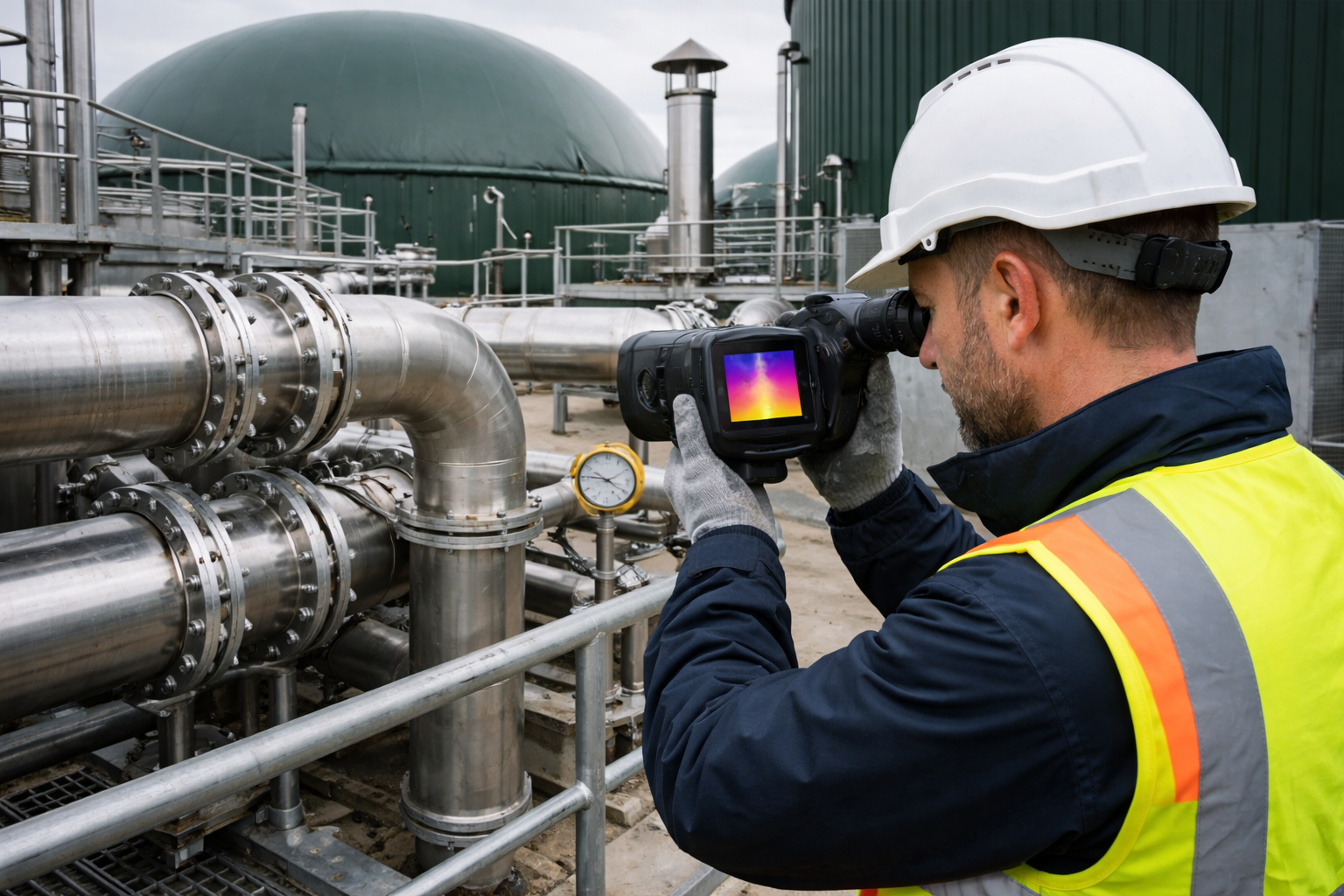
“Biogas Leak Detection in AD Plants: How …” from www.biocongroup.co.uk and used with no modifications.
Biogas is mainly composed of methane, a greenhouse gas that is 84 times more potent than CO₂ over a 20-year period. A biogas plant that leaks doesn’t just lose money; it also contributes to the very climate issue it was designed to address, and it poses a serious safety risk.
The most common leak points are construction joints in concrete digesters, roof membrane penetrations, valve flange connections, and the junction between the gas membrane and its supporting structure. Each of these points requires a specific sealing solution — hydrophilic waterstops at concrete joints, specially designed pipe penetration seals for roof entries, and PTFE tape or anaerobic thread sealant on threaded gas fittings. For more insights on this topic, you can explore the importance of reducing methane emissions.
Each component of the gas system needs to be tested for pressure independently before the entire system is tested. If you test the whole system at once, a tiny leak anywhere will cause the entire test to fail, and you won’t know where the problem is. Test each section, record the results, and approve each section before moving on to the next. During the final system walk-through, use an electronic combustible gas detector (CGD) that can detect methane at concentrations below 100 ppm — soapy water alone won’t catch slow leaks at flanged joints under normal operating pressure.

“Combustible Gas Detector from Sirchie” from www.sirchie.com and used with no modifications.
Overlooking Temperature Control in Cold Climates
Mesophilic anaerobic digestion works best between 35°C and 40°C. When the digester temperature falls below this range, microbial activity and gas production decrease. In cold climates — places with average winter temperatures below 5°C — a digester that is not insulated or heated enough can lose 30 to 50% of its designed gas output during winter months, which can ruin the project’s financial model. The answer is simple: at least 100 mm of rigid polyisocyanurate (PIR) or expanded polystyrene (EPS) insulation on all digester surfaces, along with a properly sized hot water heating system that uses recovered heat from the CHP unit. In extremely cold climates (below -20°C), the feedstock reception area and pipework also need heat tracing to prevent freezing.
Insufficient Mixer Selection or Absence of Gas Sparging Equipment
Mixing maintains the consistency of the digester contents, inhibits the development of floating scum layers and settled sand beds, and ensures that fresh feedstock comes into contact with active microbial populations. The three main mixing technologies — submersible motor-driven impellers, external pump recirculation, and gas sparging (injecting biogas bubbles through the slurry) — each have their own advantages and disadvantages.
Submersible mixers are efficient but prone to mechanical failure in abrasive slurries. Pump recirculation is effective for low-solids feedstocks but has difficulty with fibrous materials. Gas sparging provides excellent bulk mixing with no submerged moving parts, making it particularly dependable for high-solids digesters. The most common error is specifying a single mixing technology without considering the rheological properties of the specific feedstock — a mixer designed for liquid manure will fail within months when processing food waste with a total solids content of 12%.
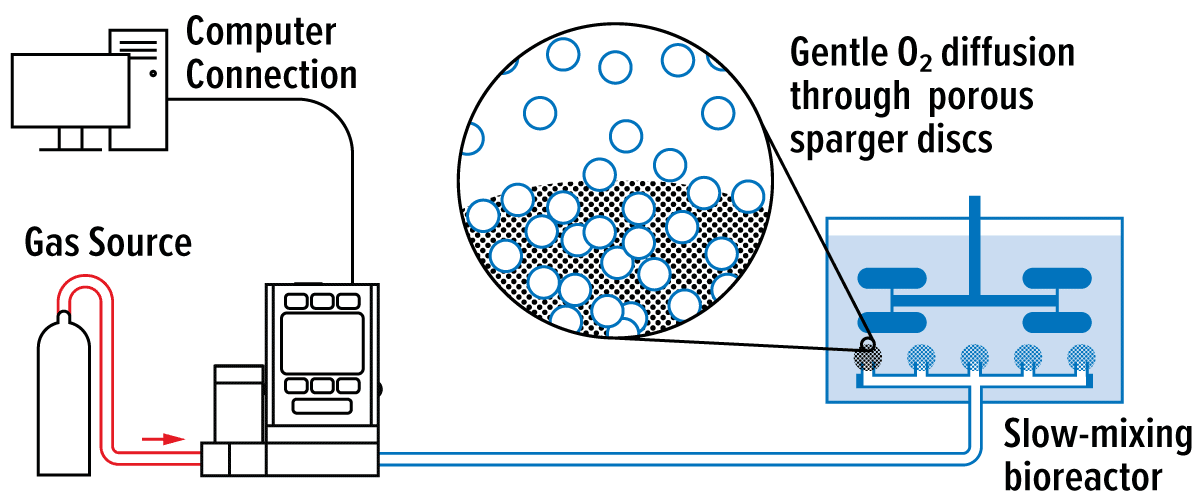
“Bioreactors Using Spargers …” from www.pctflow.com and used with no modifications.
Biogas Plants Are a Worthwhile Long-Term Investment
With the right specifications, the right location, and the right feedstock strategy, a biogas plant is one of the most robust and economically viable renewable energy investments available. Unlike solar or wind energy, biogas generation is dispatchable, meaning it produces energy on demand, not just when the sun is shining or the wind is blowing.
Plants that are designed and built with the right attention to detail at every stage, as covered in this guide, can operate for 25 to 30 years. They generate revenue from energy sales, gate fees for waste reception, and the sale or use of digestate as a biofertilizer. The construction phase is the stage at which all future performance outcomes are determined, so it’s worth investing the time, expertise, and budget to get it right the first time. For more insights, you can refer to this overview of biogas plant construction.
Common Questions About Building a Biogas Plant
Here are the most common questions we get from developers, farmers, and project managers who are new to biogas construction — and the detailed answers they require.
What is the Timeline for Building a Biogas Plant?
The length of time it takes to build a biogas plant can vary greatly depending on the size and design of the plant. A traditional Indian small farm-scale fixed-dome digester of 20 to 50 m³ could be built in as little as 4 to 8 weeks by a trained team of masons. On the other hand, a mid-scale agricultural biogas plant with a digester volume of 500 to 2,000 m³ typically takes 6 to 12 months to build from the time the first shovel hits the ground to the time the first gas is produced, including equipment commissioning.
A large commercial facility that processes 50,000 to 200,000 tonnes of organic waste per year — complete with full pre-treatment, multiple digesters, gas upgrading, and CHP infrastructure — usually takes 18 to 30 months to build. These timelines assume that all permits have already been obtained; if the permitting phase is included, the total project duration could be extended by at least 6 to 18 months, depending on the jurisdiction.
What is the least amount of waste required to operate a commercial biogas plant?
The smallest amount of feedstock that can make a commercial biogas plant economically sustainable is heavily dependent on the type of feedstock, local energy prices, and any incentives that may be available. Generally speaking, a commercially sustainable biogas plant that processes food waste or agricultural slurry will need at least 5,000 to 10,000 tonnes of feedstock per year to justify the capital investment not only in the digester plant but also in pre-treatment, CHP, upgrading and grid connection infrastructure. If the amount of feedstock is less than this, farm-scale systems that don’t require commercial pre-treatment or gas upgrading can still be economically justified if the main benefit is the use of on-site energy and the avoidance of waste disposal costs, rather than just revenue from the sale of energy.
Is it possible for a Biogas Plant to function all year in colder climates?
Yes, indeed — with the right insulation, heating system, and cold-weather operating procedures. Commercial biogas plants are successfully operating all year round in Scandinavia, Canada, and northern Germany, where winter temperatures regularly drop below -15°C.
The crucial elements are sufficient digester insulation (at least 100 mm PIR on walls and roof), a correctly sized heating circuit that maintains the digester temperature at 37 to 38°C, heat-traced feedstock pipework, and enclosed or heated feedstock reception areas.
The additional capital cost for a cold-climate specification is typically 8 to 15% more than a standard plant design — a justifiable expense compared to a 40% reduction in winter gas production from a system that is not adequately insulated. For more information on optimising energy use, you might explore the advantages and disadvantages of combined heat and power systems.
What Certifications or Permits Are Required for Biogas Plant Construction?
In the United States, you will need to obtain a building permit from your local authority, an air quality construction permit from your state environmental agency, a stormwater permit (NPDES), and, depending on the type of feedstock, a solid waste facility permit or agricultural waste permit.
If your facility is generating electricity for grid export, you will also need to have interconnection agreements with your local utility. In the European Union, the regulatory framework is a bit more complex. Facilities that process animal by-products require approval under EU Regulation 1069/2009, and plants that operate under the EU Renewable Energy Directive to claim Guarantees of Origin for their biomethane must meet feedstock sustainability criteria and mass balance accounting requirements.
In addition to obtaining the necessary permits, the construction contractor should have the appropriate certifications for confined space work, welding certification for gas pipework (in the US, AWS D1.1, and in Europe, EN ISO 9692), and electrical work on equipment classified as hazardous areas (ATEX Zone 1 and Zone 2 classifications apply to areas around the digester, gas storage, and CHP enclosure).
Do not accept a bid from a contractor who cannot prove specific experience in constructing a biogas plant – general civil engineering skills are not enough for the gas handling and process engineering parts of a biogas project.
When Can I Expect a Return on My Investment in a Biogas Plant?
Depending on various factors, it can take anywhere from 3 to 4 years to 8 to 12 years for a biogas plant to become profitable. Smaller plants that are conveniently located on farms, receive gate fees for food waste, and benefit from robust renewable energy incentives usually start making money in 3 to 4 years. Larger commercial facilities with higher startup costs and more complicated operating needs take longer, usually 8 to 12 years.
The most important factor in how quickly a plant becomes profitable is feedstock gate fee income. Plants that charge a tipping fee for processing organic waste from third parties become profitable much more quickly than plants that only make money from selling energy.
There are several sources of income that can enhance the financial performance of your biogas plant. These include the sale of electricity or the cost savings from not having to buy electricity, selling heat to nearby industrial or commercial users, tariffs for injecting biomethane or premiums for Renewable Natural Gas (RNG) in North American markets, selling digestate as certified organic fertiliser, and income from carbon credits in voluntary or compliance carbon markets.
If a plant can capture all five of these income sources and is operating in a favourable regulatory environment, it may be able to pay for itself in under five years, even if it is relatively small in scale. For more detailed information on optimising biogas plant operations, consider reading this overview of biogas plant construction.
The conclusion is simple: well-planned, correctly built biogas plants that are operated with a disciplined process management system are financially strong assets with the potential to generate revenue for many decades. The investment in construction is substantial, but the return — in terms of energy, waste diversion, and carbon impact — builds up over decades. If you’re ready to go from planning to construction, BiogasWorld can connect developers with the engineers, equipment suppliers, and industry expertise they need to take biogas projects from idea to commercial operation.